Get in Touch with Engelhardt


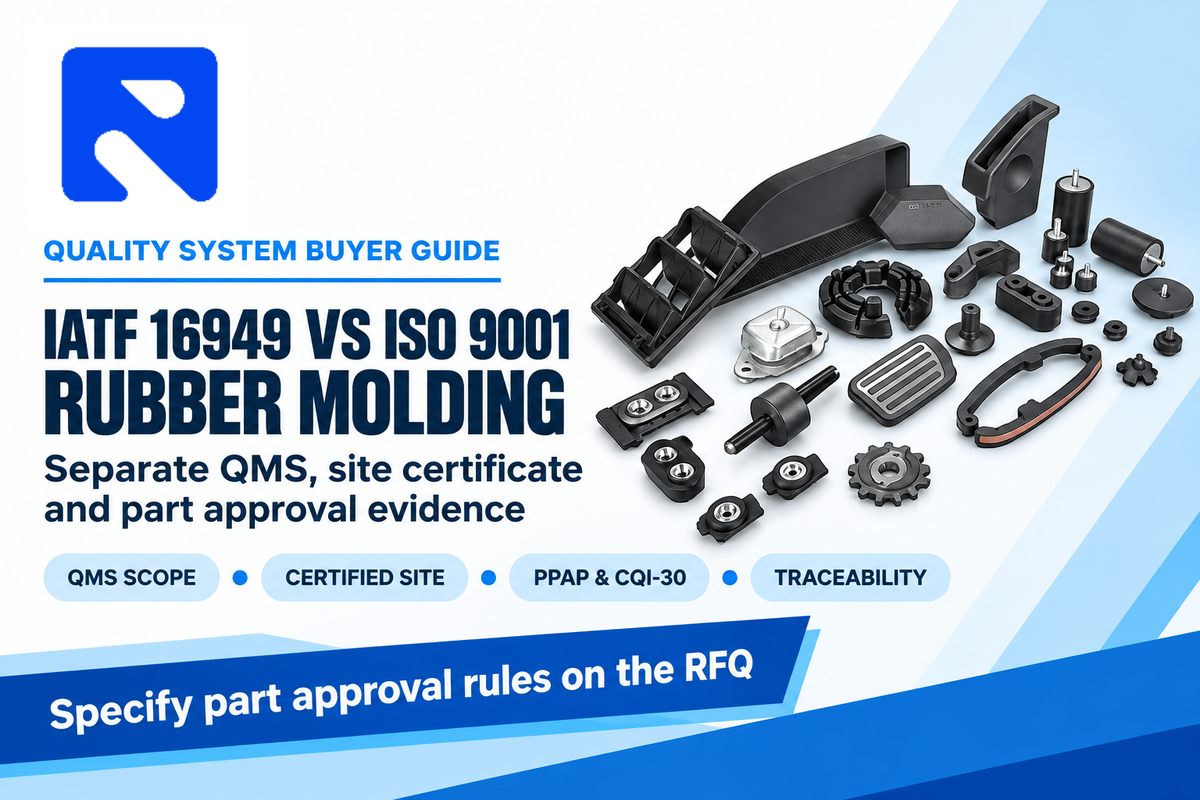
IATF 16949 vs ISO 9001 rubber molding refers to the comparison between a general quality management system and an automotive-specific quality system for elastomer manufacturing. Buyers should separate three distinct approvals: the quality management system, the certified production site, and the customer-approved rubber part. ISO 9001 sets the baseline management system across industries, while IATF 16949 adds automotive-specific defect prevention, supplier development, and process controls.
Neither certificate automatically approves your molded seal, grommet, or bonded mount for serial shipment. Purchasing and engineering teams still need to specify the production part approval package, compound traceability rules, and measurement methods on the request for quotation before releasing production tooling.
By Aurora · Updated November 2026
At a glance
- System scope: IATF 16949:2016 is implemented as a supplement to and in conjunction with ISO 9001:2015, not as a standalone replacement or a product warranty.
- Approval layers: A valid factory QMS certificate doesn’t replace Production Part Approval Process (PPAP) evidence or AIAG CQI-30 rubber mixing and molding assessments.
- Supplier progression: Under IATF 16949 Sanctioned Interpretation 8 (Clause 8.4.2.3), customer-authorized sub-tier progression can start from ISO 9001 compliance with second-party audits.
- Edition status: ISO published ISO 9001:2026 on 16 September 2026, whereas the IATF 16949 second edition is planned for mid-2027 per the July 2026 IATF communiqué.
ISO 9001 vs IATF 16949: the practical difference
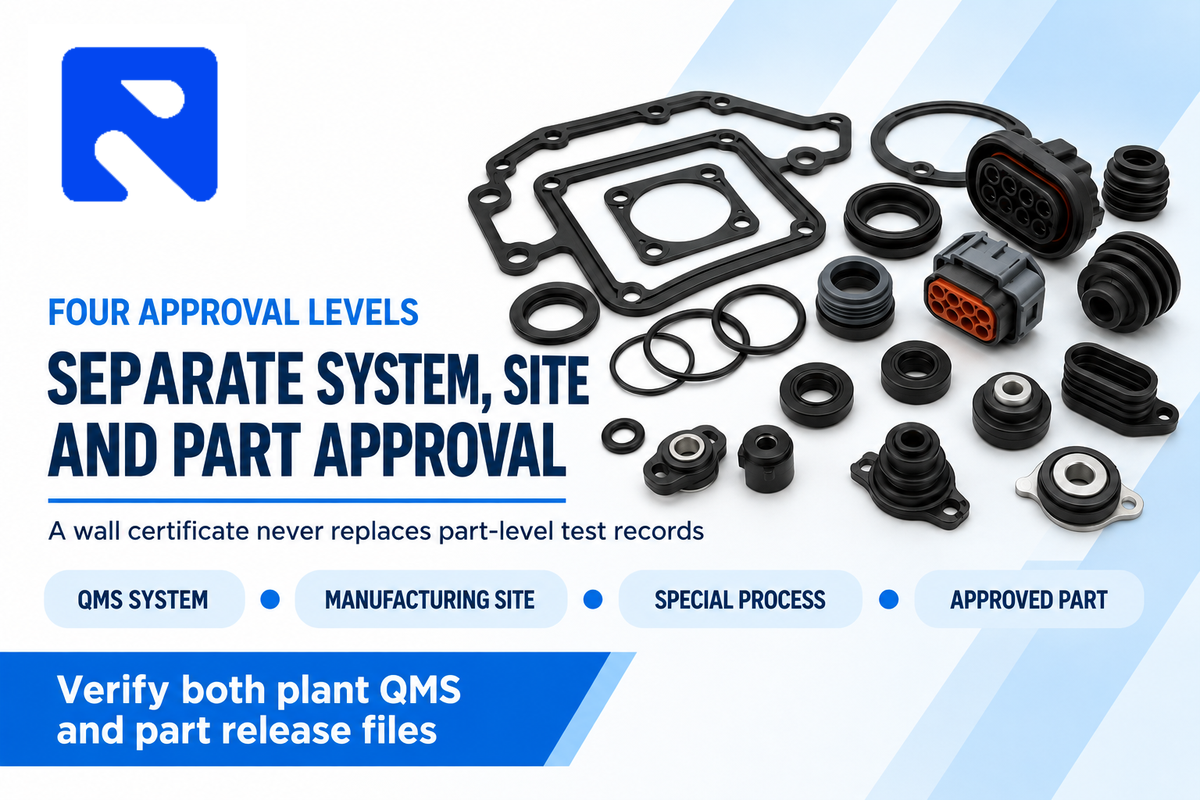
The practical difference is that ISO 9001 defines a general quality management system across industries, whereas IATF 16949 adds automotive-specific rules for defect prevention, variation reduction, and supply chain control. In custom rubber molding, no certificate item or elastomer compound is approved independently.
According to the Automotive Industry Action Group (AIAG) IATF 16949:2016 overview, IATF 16949 is not a standalone document. Factories implement it as a supplement to, and in conjunction with, ISO 9001:2015. They also pair it with applicable customer-specific requirements for automotive production and service parts.
Many procurement delays start when a buyer treats a wall certificate as a blanket part release. As Moldtech Rubber’s quality certificate guide notes, buyers who skim past certificate acronyms miss what each standard actually governs on the shop floor. They also miss what inspection records should accompany each shipment.
What’s the difference between ISO and IATF?
ISO is the International Organization for Standardization, which publishes baseline management systems such as ISO 9001 for organizations of any size or sector. IATF is the International Automotive Task Force, which publishes supplemental automotive quality requirements and oversees recognized certification bodies for eligible automotive manufacturing sites.
When sourcing molded elastomers, there’s no better way to eliminate confusion than breaking out four approval tiers. Each level has its own approval document, verification file, and release owner within your company.
| Approval object | ISO 9001 baseline scope | IATF 16949 automotive scope | Buyer verification record | Decision owner |
|---|---|---|---|---|
| Quality management system (QMS) | General management system structure, leadership, risk and opportunities, and corrective action across industries | Supplements ISO 9001 with automotive defect prevention, product safety, contingency plans, and customer-specific requirements | Quality manual, process interaction map, and internal audit schedule | Supplier quality engineer |
| Certified manufacturing site | Third-party certificate issued by an accredited registrar for the stated business scope and address | Third-party certificate issued by an IATF-recognized body for an eligible automotive manufacturing site | Certificate number, exact street address, scope statement, and active portal status | Supplier quality and purchasing |
| Special process control (mixing and molding) | General production and service provision controls defined by the supplier | Structured process audits such as AIAG CQI-30 across 8 sections for rubber mixing and molding | Completed CQI-30 self-assessment or customer second-party process audit report | Process and quality engineering |
| Approved rubber part and tool | First-article inspection report, material certificate, and buyer-defined sample checks | AIAG Core Tools package (PFMEA, control plan, MSA, SPC, and PPAP Part Submission Warrant) | Signed warrant or written sample approval tied to drawing revision and compound code | Customer product and quality engineering |
When you review custom rubber molding capabilities at the start of a program, use this four-row distinction to frame your technical inquiry. Ask which quality management system governs the plant, and separately define what part-level test records your team requires before serial production.
When does a rubber molding project need IATF 16949?
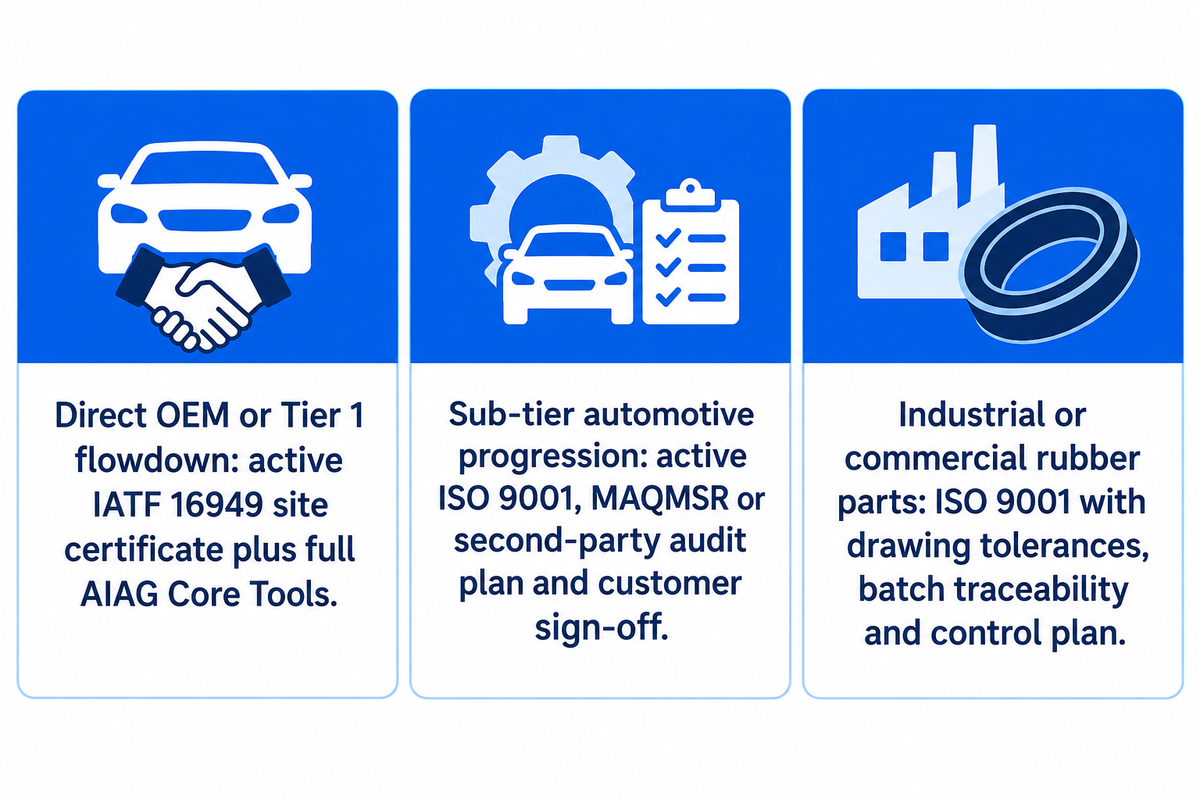
A rubber molding project requires third-party IATF 16949 certification when the part is an eligible automotive production, service, or accessory component and the customer contract mandates a certified site. For non-automotive applications or customer-authorized sub-tier development under Clause 8.4.2.3, an ISO 9001 system with defined process controls can qualify.
Published IATF 16949 Sanctioned Interpretations (November 2025, SI 8 on Clause 8.4.2.3) clarify that supplier quality management system development follows a risk-based progression. While third-party IATF 16949 certification is the ultimate objective for eligible automotive suppliers, the rule explicitly records an authorized baseline:
“NOTE: The minimum acceptable level of QMS development may be compliance to ISO 9001 through second-party audits, if authorized by the customer.”
That single sentence resolves a frequent argument between purchasing and quality teams. An ISO 9001 rubber molder is not automatically barred from every tier of an automotive supply chain. The customer can grant written authorization and verify progression through second-party audits or the Minimum Automotive Quality Management System Requirements for Sub-Tier Suppliers (MAQMSR).
What areas does IATF 16949 cover?
IATF 16949 covers manufacturing sites that produce automotive production parts, service parts, or original-equipment accessories destined for automotive customers. Under Sanctioned Interpretation 8, organizations that don’t manufacture eligible automotive parts, such as transport and logistics providers or scrap metal suppliers, aren’t eligible for certification.
A raw elastomer polymer producer, a custom compounder, and a finished-part rubber molder occupy different positions in the automotive sector. Don’t buy a waiver of a raw-material program for the finished-automotive seal without consulting your customer’s supplier quality manual.
- Direct OEM or Tier 1 suppliers programs with mandatory flowdown require an active IATF 16949 certificate for the exact molding plant plus full AIAG Core Tools deliverables.
- Sub-tier automotive supply with customer-authorized progression requires an active ISO 9001 certificate, a documented MAQMSR or second-party audit plan, and written customer authorization before awarding tooling.
- Industrial, off-highway, or general commercial rubber parts require ISO 9001 certification paired with part-specific drawing tolerances, compound batch traceability, and a right-sized control plan.
For a broader look at evaluating factory fit and PPAP control plan readiness beyond certificate badges, review our guide on how to choose a rubber molding supplier.
What changes in PPAP, FMEA and the control plan?
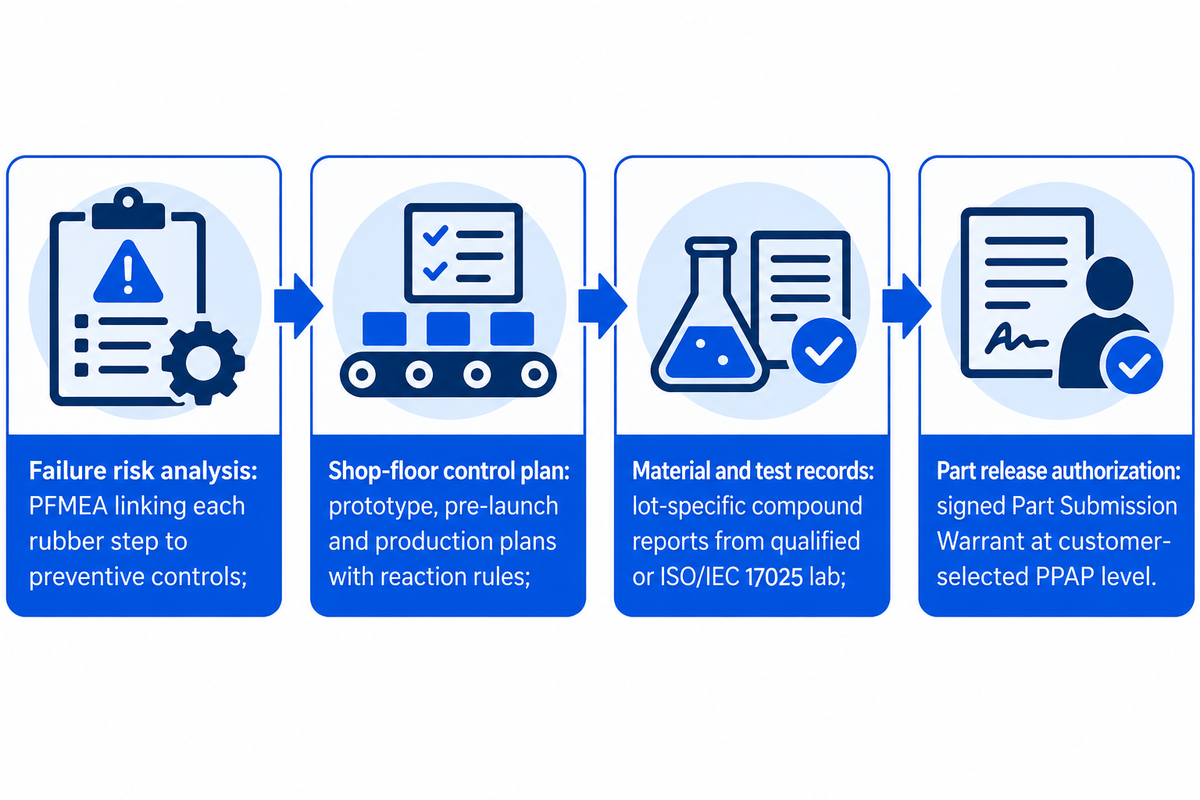
Moving from ISO 9001 to an IATF 16949 program replaces supplier-defined sample inspection with linked AIAG Core Tools: Process Failure Mode and Effects Analysis (PFMEA), a phase-linked control plan, Measurement System Analysis (MSA), Statistical Process Control (SPC), and a customer-specified Production Part Approval Process (PPAP) submission.
In a general ISO 9001 workflow, a molder often validates a new tool by submitting a five-piece dimensional layout and a standard material data sheet. Under the AIAG Automotive Quality Core Tools framework, structured risk management and continuous improvement require preventive controls proven during an actual production run at quoted production rates.
Crucially, PPAP submission levels are selected by the customer for the specific part and program rather than fixed by a universal Level 3 rule for every rubber item. For example, AVA’s supplier PPAP requirement form (AVA-FO-017) requires the supplier to populate the customer/program, submission reason, and designated PPAP level from program instructions.
| Approval deliverable | Typical ISO 9001 commercial practice | IATF 16949 / AIAG Core Tools practice |
|---|---|---|
| Process flow diagram | High-level routing sheet from receiving to shipping | Step-by-step flow covering compound weighment, mixing, molding, post-cure, deflashing, and rework loops |
| Failure risk analysis | General operational risk register or engineering review notes | PFMEA linking each rubber processing step and failure mode to severity, occurrence, and preventive controls |
| Shop-floor control plan | Standard incoming, in-process, and final inspection traveler | Prototype, pre-launch, and production control plans tied directly to special characteristics and reaction plans |
| Dimensional results | First-article layout on a small sample of molded parts | Ballooned drawing layout recorded per cavity across a production run at quoted press cycle rates |
| Material and performance test records | Supplier batch certificate or standard compound data sheet | Lot-specific compound and functional test reports from a qualified internal or ISO/IEC 17025 accredited lab |
| Initial process studies (SPC) | Pass/fail tolerance check without capability indices | Initial capability study on customer-designated special characteristics once process stability is demonstrated |
| Measurement system proof (MSA) | Valid calibration stickers on calipers, durometers, and optical comparators | Calibration plus gage R&R and bias studies on the exact gages and fixtures named in the control plan |
| Part release authorization | Buyer email sign-off on first-article samples | Signed Part Submission Warrant (PSW) and appearance approval (if applicable) at the customer-selected PPAP level |
Pay close attention to laboratory competence when reviewing elastomer conformity reports. Under IATF 16949 Sanctioned Interpretation 10 (Clause 7.1.5.3.2), any external or independent laboratory used for inspection, test, or calibration services must have a defined laboratory scope covering the required test. It must also hold accreditation to ISO/IEC 17025 or its national equivalent, unless another customer-approved route applies.
How the requirements change rubber molding controls
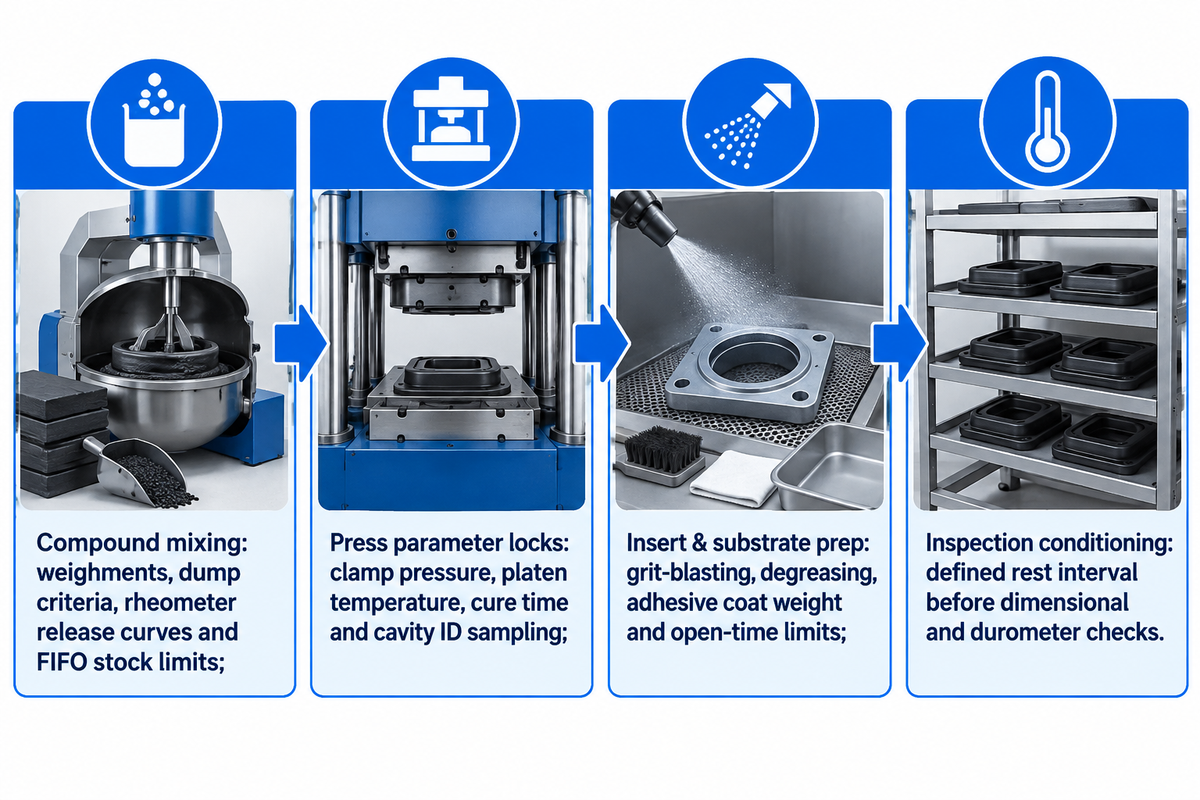
In rubber molding, automotive quality control moves upstream from final part sorting to compound batch mixing, uncured stock storage, cure time-temperature-pressure windows, cavity-level tracking, and conditioned dimensional inspection. The controls are assessed using the eight dedicated rubber processing sections in AIAG CQI-30.
Elastomer performance can be unpredictable unlike machined metals because the final durability and reliability are created within the hot cavity of the steel mold during vulcanization. Two parts from the same steel tool can show different compression set or durometer values if compound scorch safety, platen temperature uniformity, or post-cure conditioning drifts.
To support repeatable molding and reduce process variability, the AIAG CQI-30 Special Process: Rubber Processing System Assessment (Mixing & Molding) defines a common process-assessment approach for automotive production and service part organizations. Its eight sections cover the pre-audit survey, management responsibility and quality planning, job audit, rubber mixing, inspection and testing, facilities and equipment, molding, and substrate preparation.
- Track raw polymer, curative, and filler weighments, mixing energy or temperature dump criteria, rheometer release curves, and first-in, first-out storage limits for uncured compound stock.
- Lock press clamp pressure, platen or barrel temperatures, and cure time against unauthorized operator overrides, and keep cavity identification tied to inspection sampling.
- Control grit-blasting media, degreasing baths, adhesive coat weight, drying humidity, and open-time limits before loading metal or plastic inserts into the mold.
- Define how long molded silicone or organic rubber parts rest before dimensional and hardness checks, because thermal shrinkage and post-cure relaxation alter readings measured immediately at the press.
Engineers developed this approach over a decade ago as a technique for monitoring machine performance in molding dynamics. This patented method has been used by engineers for many years for several reasons, such as identifying parametric fluctuations in compounds. In the historical patent US7433755B2, cure time can be predicted from dielectric and rheometer regression data as a function of compound temperature and mold temperature.
It may be cited alone to identify that need in your control plan, even if the clause isn’t required.
For part-specific engineering inputs that sit outside a quality-system comparison, see our dedicated guides on selecting a rubber compound for temperature extremes and fluid compatibility, rubber molding tolerances under ISO 3302-1, and rubber-to-metal bonding substrate controls.
Traceability and changes: follow the compound to the shipment
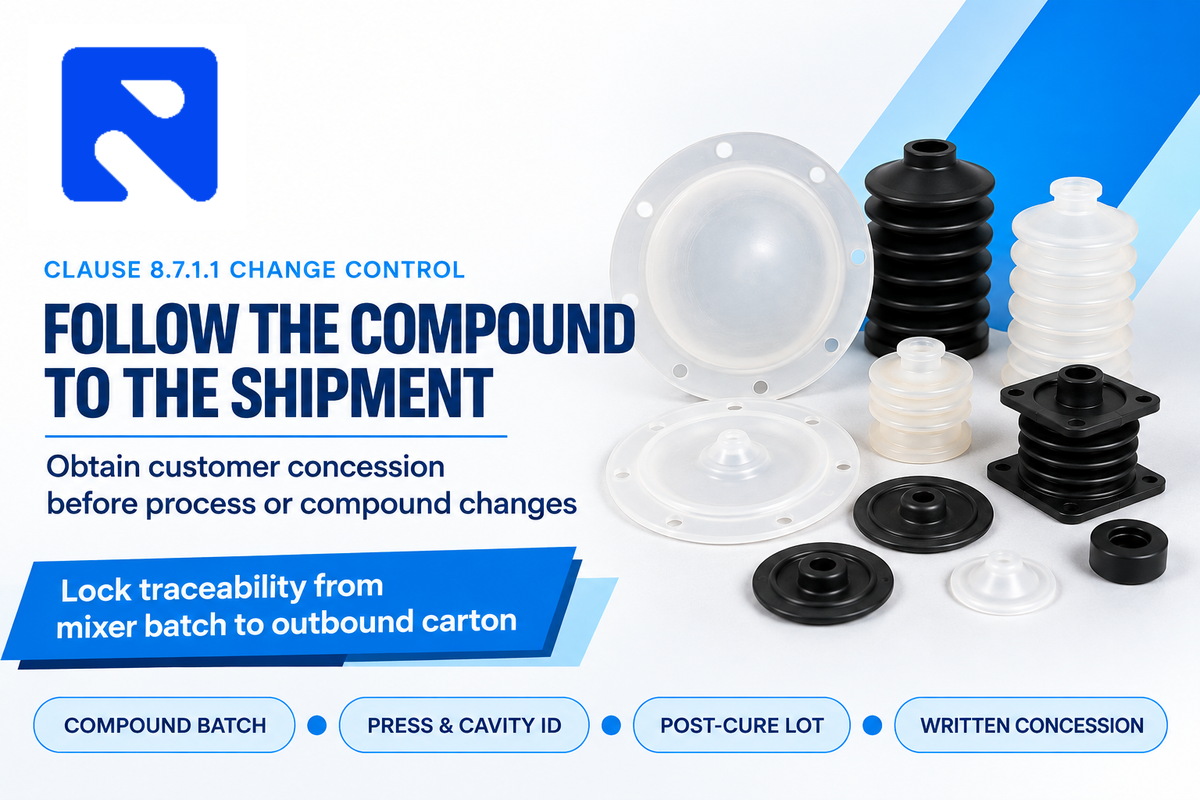
Intermediates used in rubber molding should have traceability from the shipping carton outward to molding press, tool cavity, operator shift, post cure batch, adhesive batch lot, and master compound batch number. Under IATF 16949 Clause 8.7.1.1 (SI 9), any unapproved product or business process deviation, rework for repair, or sub-component reuse requires prior customer concession.
Typical commercial molding-supplier with raw-material delay will change to an equal-durometer carbon black or move a mold to a sister press without formal warning. In an automotive supply chain, an unannounced change can invalidate thermal aging or fluid resistance qualifications. That loophole can cause a containment hold spanning internal and external warehouses.
Sanctioned Interpretation 9 on Clause 8.7.1.1 states that the organization must obtain a customer concession or deviation permit prior to further processing whenever the product or manufacturing process differs from what is currently approved. It also requires customer authorization before “use as is” or rework for repair dispositions, and requires clear communication if sub-components such as metal inserts are reused.
| Change type and plant trigger | Hidden material or process risk | Traceability link required | Evidence before shipment | Approval owner |
|---|---|---|---|---|
| Alternate polymer or elastomer grade | Shifts glass transition, compression set, or fluid swell despite matching hardness | Polymer lot certificate → mixer batch ticket → rheometer release log | Written customer change request, full compound qualification, and updated PPAP warrant | Customer materials and quality engineering |
| Curative, accelerator, or plasticizer source change | Alters scorch safety, crosslink density, or high-temperature aging stability | Chemical ingredient lot → masterbatch lot code → press cure chart | Comparative rheometer and physical property report plus customer engineering sign-off | Customer materials engineering |
| Compound mixing site or Banbury/mill line transfer | Changes carbon black dispersion, batch dump temperature, and viscosity window | Mixer ID and site code → batch release test → molded lot traveler | CQI-30 mixing section audit, batch-to-batch capability check, and customer notice | Supplier quality engineer |
| Transfer of mold between compression, transfer, or injection press types | Alters shear heating, cavity fill balance, flash thickness, and shrinkage | Press ID → process parameter sheet → inspection lot label | Updated PFMEA/control plan, full dimensional layout, and PPAP resubmission | Customer supplier quality engineer |
| Manufacturing plant relocation or subcontracted molding site | Different site QMS scope, water/air utilities, and operator training baseline | Plant address code → site certificate number → outbound carton barcode | Site certificate verification, on-site readiness audit, and new PSW release | Purchasing and supplier quality |
| Cavity repair, weld rework, or replacement core pin | Changes critical sealing lip geometry or parting-line flash witness | Tool maintenance log → cavity number mark → post-repair sample report | Cavity-specific dimensional and visual report before returning cavity to production | Supplier quality and product engineering |
| Post-cure oven cycle or cryogenic deflashing media change | Alters volatile removal, final durometer, or thin-lip tear resistance | Oven chart and batch load ID → final inspection lot → packing list | Updated control plan parameters and comparative hardness/compression-set check | Supplier quality engineer |
| Part rework for repair or metal/plastic insert reuse | Surface contamination, residual adhesive film, or weakened rubber-to-substrate bond | Nonconformance tag → segregated rework lot code → concession number | Written customer concession or deviation permit under Clause 8.7.1.1 prior to processing | Customer quality and product engineering |
Illustrative compound-change scenario: An industrial housing seal is priced with medium-hard nitrile. After a few months, the compounder recommends another plasticizer to address a regional raw materials pinchpoint without changing the declared hardness. Based on the matrix above, the end user must be advised in advance, attach the test lot to a isolatable lot code, compare fluid immersion and compression set to the original specification, and provide a written disposition before parts go out.
How to verify a rubber molding supplier certificate
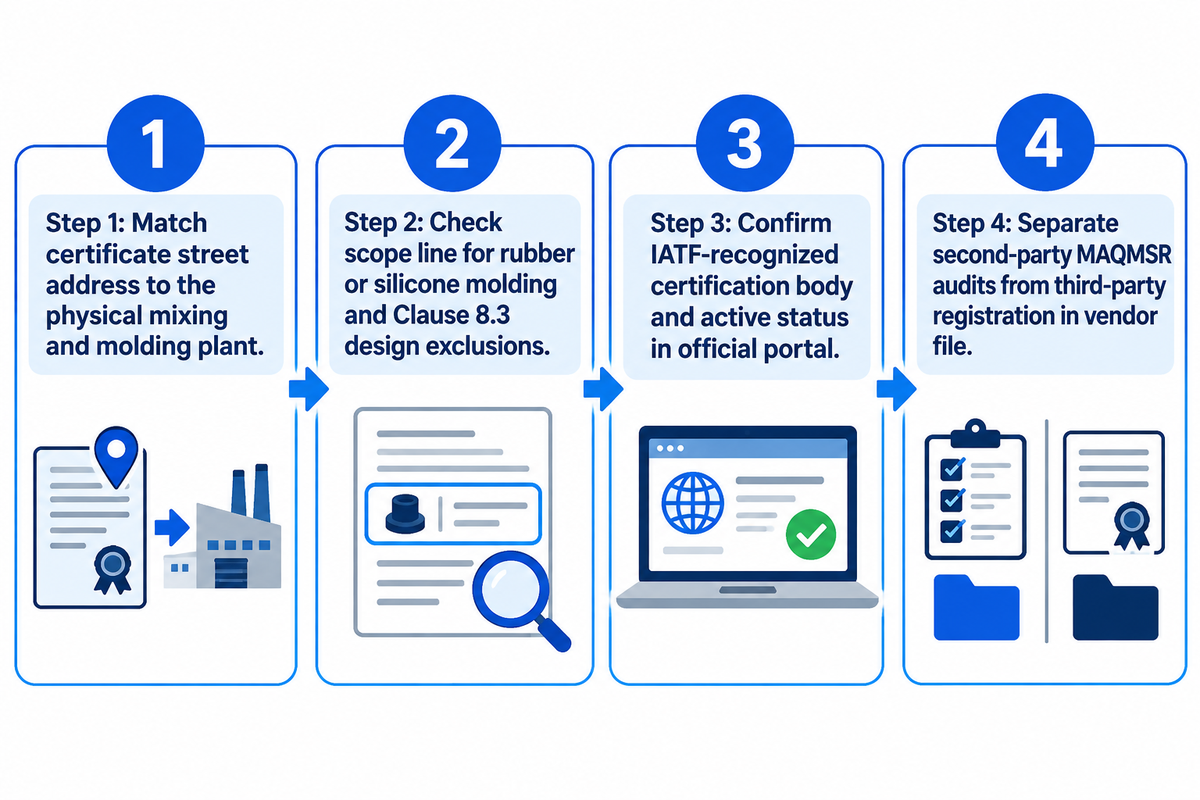
To validate a rubber molding supplier certificate, compare the specification legal entity name, factory street address, process scope, standard edition, and certification body issuing with an authorized registry before awarding business. Don’t depend on website badge or a distributor office cert to be able to cover a subcontracted molding factory.
As the ISO official certification guidance explains, ISO develops international standards globally but does not issue certificates itself. Independent third-party certification bodies perform the audits. Buyers should verify that the registrar is accredited and that the cert explicitly names the manufacturing scope.
For automotive certificates, the IATF Certification Bodies and Certificate Validity Check page lists the certification bodies contracted by IATF national oversight offices. It also provides an official portal to confirm whether a supplier’s IATF 16949 certification is verifiable and currently valid.
- The street address on the certificate agrees with the physical plant in which rubber mixing, molding and post-curing are conducted – and not just a sales office or distributor warehouse;
- Read the scope line for special rubber molding, silicone molding or assembly and see if product design (Clause 8.3) is being performed or appropriately excluded.
- Verify that the certificate was indeed at one time issued by an IATF-recognized certification body and that it is in current use by searching the IATF validity portal for an IATF-recognized certification body.
- As quality practitioners in an Elsmar Cove supplier approval discussion point out, buyers often confuse outsourced second-party MAQMSR audits with third-party registration; record the exact audit type and auditor competence in your vendor file.
Key takeaway
A certificate is only verifiable when its legal entity, physical factory address, process scope, and issuing body match the quotation and the official registry record.
What determines the cost and time to become IATF ready?
Certification audit fees and readiness timelines depend on manufacturing headcount, site count, process scope, existing ISO 9001 maturity, and active automotive production, so no single dollar average applies across all rubber molders. Buyers should separate factory QMS audit costs from part-specific tooling, laboratory testing, and PPAP qualification charges.
According to TÜV Rheinland’s IATF 16949 certification overview, audit duration and cost depend on organization size, quality management system scope, and whether existing certified management systems allow combined audits. TÜV notes that one audit day equals 8 hours, including time allocated for shift audits.
“One Audit Day is equivalent to 8 hours, which includes time allocated for shift audits.”
That 8-hour audit-day unit is a certification-body scoping rule, not a calendar template for factory readiness. The International Automotive Oversight Bureau (IAOB) Audit Day Calculator and the IATF Rules 6th Edition Sanctioned Interpretations (June 2026) place two stringent requirements which impact the schedule. First, auditors are required to dedicate a minimum of 0.5 day (4 hours) for audit planning, which takes place outside the audit day itself.
Second, automotive production must be operational during the audit.
On the factory floor, internal readiness work takes far more effort than third-party audit days alone. In an April 2025 Modern Casting column on automotive quality systems, quality executive Ted Schorn warns that no external audit or piece of paper confers leadership when a plant treats stringent standards as a checklist disconnected from daily operations. Meanwhile, in a sponsored December 2024 IndustryWeek article by Anthony Hardy of NSF, integrating overlapping quality, safety, and environmental management workflows is described as one practical way to build a defensible audit schedule with less duplicate administration.
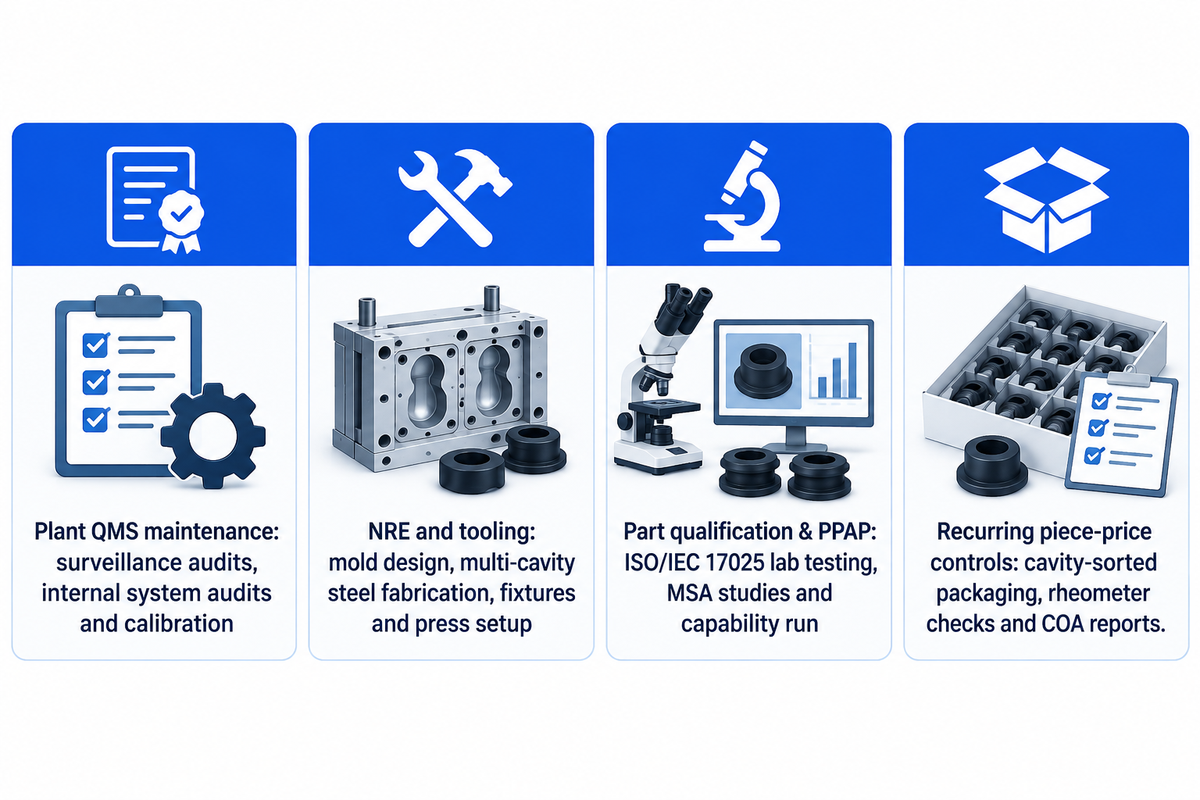
- Plant QMS maintenance covers third-party surveillance audits, internal system audits, and calibration infrastructure maintained across the factory.
- Non-recurring engineering and tooling cover mold design, multi-cavity steel fabrication, checking fixtures, and initial press setup.
- Part qualification and PPAP evidence cover third-party ISO/IEC 17025 material or fluid testing, MSA gage studies, capability run parts, and approval records.
- Recurring piece-price controls cover cavity-sorted packaging, automated vision or gage checks, batch rheometer testing, and certificate-of-analysis reporting on every shipment.
Build the quality requirements into your next RFQ
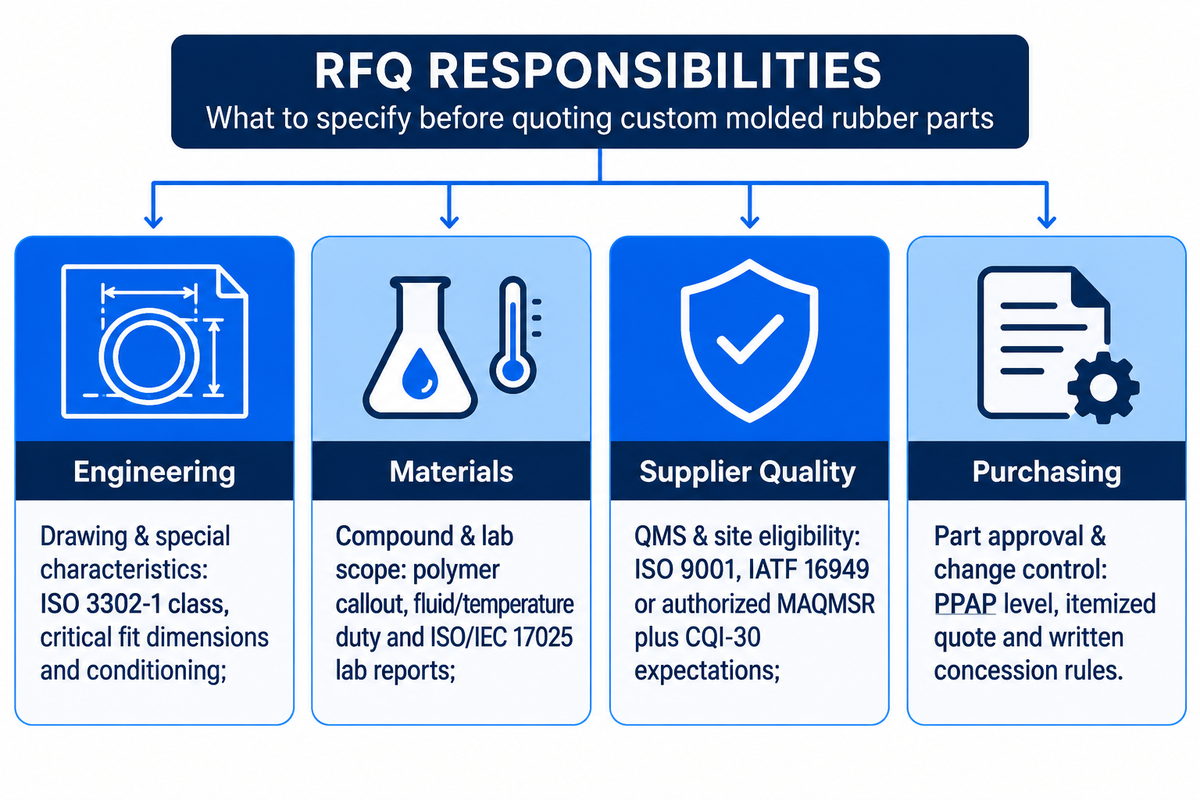
Incorporate quality standards into your next RFQ: Do you’ve set requirements for the QMS baseline, part approval records, compound traceability policies, measurement conditioning level and change-notification requirements before you even send it for final pricing?
A well defined qualification basis list (outline) between engineering, supplier quality and procurement is essential to prevent post award disputes over uncosted test and approval records.
The AIAG CQI-19-2 Sub-Tier Supplier Management Process and Readiness Checklist helps buyers strengthen and regulate sub-tier supplier selection from pre-award readiness through serial production. Whether your project follows a global quality management standard for quality like ISO 9001 or a specialized standard for automotive production, the buyer still owns the acceptance criteria attached to the purchase order.
| RFQ workstream | What to specify before quoting | Deliverable returned with quote or sample | Buyer sign-off owner |
|---|---|---|---|
| Drawing and special characteristics | Drawing revision, critical sealing or fit dimensions, ISO 3302-1 tolerance class, and conditioning interval before measurement | Feasibility review, proposed parting line and flash limits, and fixture measurement plan | Product design engineer |
| Compound and laboratory scope | Elastomer specification (such as polymer and hardness callout), fluid/temperature duty, and whether ISO/IEC 17025 external lab reports are required | Traceable compound code, rheometer batch control method, and named laboratory scope | Materials and quality engineering |
| QMS and site eligibility | Required plant certificate (ISO 9001 and IATF 16949 or customer-authorized MAQMSR progression) and CQI-30 expectations | Current certificate copy with matching manufacturing site address, registrar name, and scope | Supplier quality engineer |
| Part approval and change control | Designated PPAP submission level or first-article package, plus written concession rules for compound, mold, or site changes | Itemized quote separating tooling, PPAP/testing deliverables, and recurring inspection piece price | Purchasing and supplier quality |
Buyer RFQ attachment checklist for molded rubber programs
- Enclose the 2d component drawing with tolerance classes, critical to quality features, and the 3d CAD step file.
- State the polymer family, durometer scale, operating temperature extremes, contact fluids, and regulatory compliance needs (such as RoHS, REACH, or health and safety rules).
- Specify whether the program requires active IATF 16949 registration, ISO 9001 with customer-authorized development, or commercial ISO 9001 to meet your highest standards.
- Name the required PPAP submission level, PFMEA/control plan review, MSA gages, and external ISO/IEC 17025 test reports.
- Specify batch-to-carton labeling, cavity numbering, and required written concession ahead of each change in compound, tool or press-site.
According to Engelhardt’s manufacturing operations overview, first-party services include custom rubber and silicone molding, plastic injection molding, in-house mold design and fabrication, precision hardware, assembly, and packaging. Sharing both your drawing and the checklist above helps align your quotation with your verification scope.
Which ISO and IATF editions apply now?
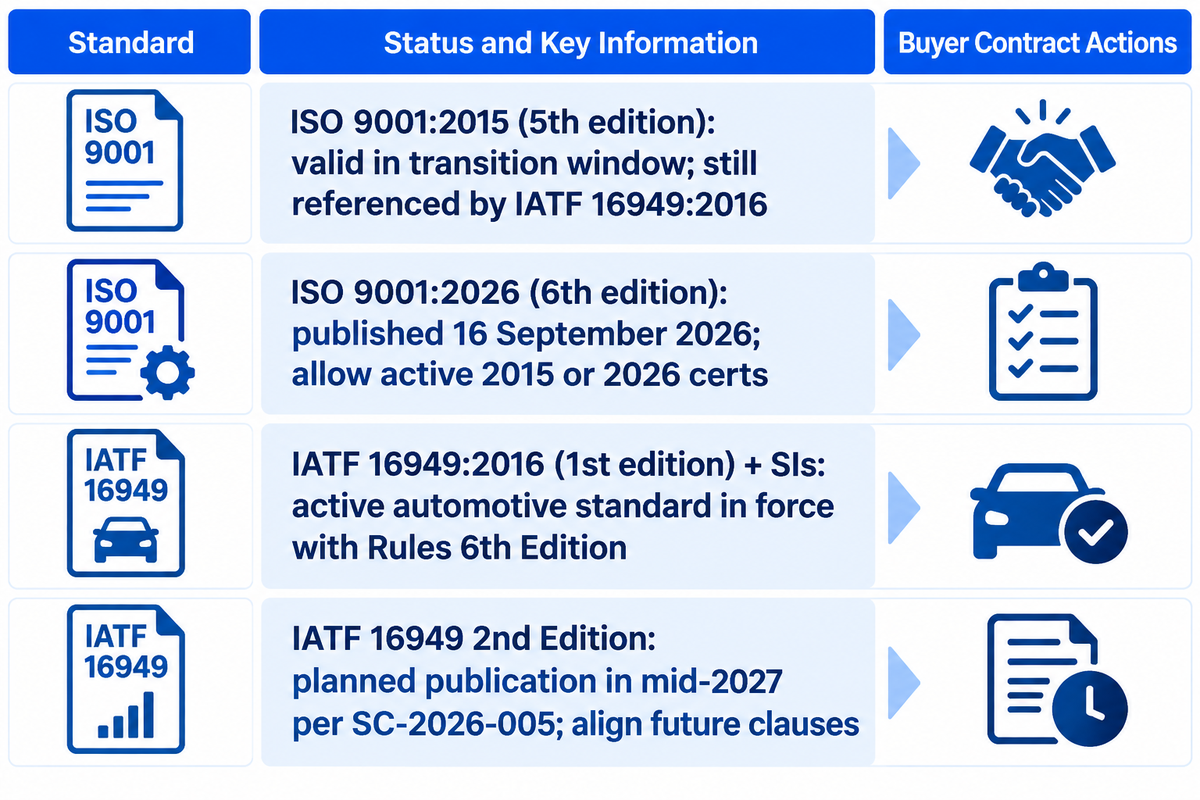
As of November 2026, ISO 9001:2026 (published 16 September 2026) is the latest issued ISO edition, while ISO 9001:2015 certificates remain in active transition under certifier rules. For automotive quality management, IATF 16949:2016 remains the active standard in force, with its second edition planned for mid-2027.
On the official ISO 9001 standard page, ISO confirms that the sixth edition (ISO 9001:2026) was published on 16 September 2026. That revision focuses on quality culture, separated risk and opportunities, and alignment across management systems. Meanwhile, the IATF Stakeholder Communiqué SC-2026-005 (July 2026) states that the IATF 16949 2nd Edition is in development during 2026-2027, with planned publication in mid-2027 and transition end aligned with the ISO 9001 transition.
Is ISO 9001:2015 still valid?
Yes, existing ISO 9001:2015 certificates remain valid during the official transition window after the 16 September 2026 publication of ISO 9001:2026, provided the supplier maintains active surveillance with its accredited certification body. At the same time, IATF 16949:2016 (often written shorthand as IATF16949 alongside ISO9001 in buyer schedules) continues to reference ISO 9001:2015 until the planned mid-2027 second edition takes effect.
| Standard document | Published status as of November 2026 | Step-by-step buyer contract action |
|---|---|---|
| ISO 9001:2015 (5th edition) | Superseded by ISO 9001:2026 on 16 September 2026, but existing certificates remain valid during the accredited transition window; still referenced by IATF 16949:2016 | Accept current active ISO 9001:2015 certificates, check expiry dates, and ask the supplier for its certifier transition schedule |
| ISO 9001:2026 (6th edition) | Published 16 September 2026 by ISO | Update purchasing templates to allow either active ISO 9001:2015 (in transition) or ISO 9001:2026 certificates |
| IATF 16949:2016 (1st edition) + SIs | Current standard in force for automotive QMS certification, read alongside active Sanctioned Interpretations and IATF Rules 6th Edition | Specify IATF 16949:2016 and applicable customer-specific requirements on current automotive RFQs |
| IATF 16949 2nd Edition | In working draft and validation during 2026-2027; planned publication in mid-2027 per SC-2026-005 | Do not demand 2nd Edition certificates before publication; align future contract transition clauses with official IATF notices |
Frequently asked questions
What is the latest IATF 16949 standard?
As of November 2026, the latest published automotive quality management standard is IATF 16949:2016 (first edition), which suppliers apply together with current IATF Sanctioned Interpretations and Rules 6th Edition. In July 2026, IATF Stakeholder Communique SC-2026-005 announced an indicative development timeline targeting mid-2027 for the planned publication of the IATF 16949 second edition.
What has replaced ISO 9001?
Nothing has replaced ISO 9001 as the global quality management standard across industries, but ISO updated the standard by publishing its sixth edition, ISO 9001:2026, on 16 September 2026. In the automotive sector, IATF 16949:2016 does not replace ISO 9001 either; it operates as an automotive supplement alongside ISO 9001:2015.
Is ISO 9001 only for manufacturing?
No, ISO 9001 is not limited to manufacturing plants. According to the International Organization for Standardization, ISO 9001 applies to organizations of any size, maturity, or sector, including service providers, distributors, testing laboratories, and software teams. However, when sourcing molded rubber parts, buyers should verify that the certificate covers manufacturing.
Does IATF 16949 require an external audit or third-party certification?
Yes, claiming IATF 16949 certification requires a third-party audit by an IATF-recognized certification body and registration in the official IATF database. Internal or customer second-party audits alone don’t grant IATF certification.
What is the first step to begin implementing IATF 16949?
The first step is confirming site eligibility and conducting a clause-by-clause gap assessment against ISO 9001:2015, IATF 16949:2016, current Sanctioned Interpretations, and your customer-specific requirements. Before scheduling a third-party Stage 1 readiness review, a rubber molding plant must establish process-based workflows, implement AIAG Core Tools (PFMEA, control plans, MSA, SPC, and PPAP), verify internal and external laboratory competence, and run active automotive production parts so auditors can observe live manufacturing operations.
Who is legally or professionally required to comply with IATF 16949?
IATF 16949 is a contractual automotive supply chain requirement rather than a government statute. Automotive OEMs and Tier 1 suppliers mandate compliance through purchasing contracts for eligible production and service part sites.
How often should an assessment for IATF 16949 be performed?
Maintaining an active IATF 16949 certificate requires regular third-party surveillance audits and a three-year recertification cycle scheduled under IATF Rules 6th Edition, alongside ongoing internal system, manufacturing process, and product audits. On rubber mixing and molding lines, many customers also require an annual self-assessment using the eight-section AIAG CQI-30 Special Process manual to confirm that batch mixing and molding remain compliant before you send your drawing and quality requirements for a project review.
Send your drawing and quality requirements for a project review
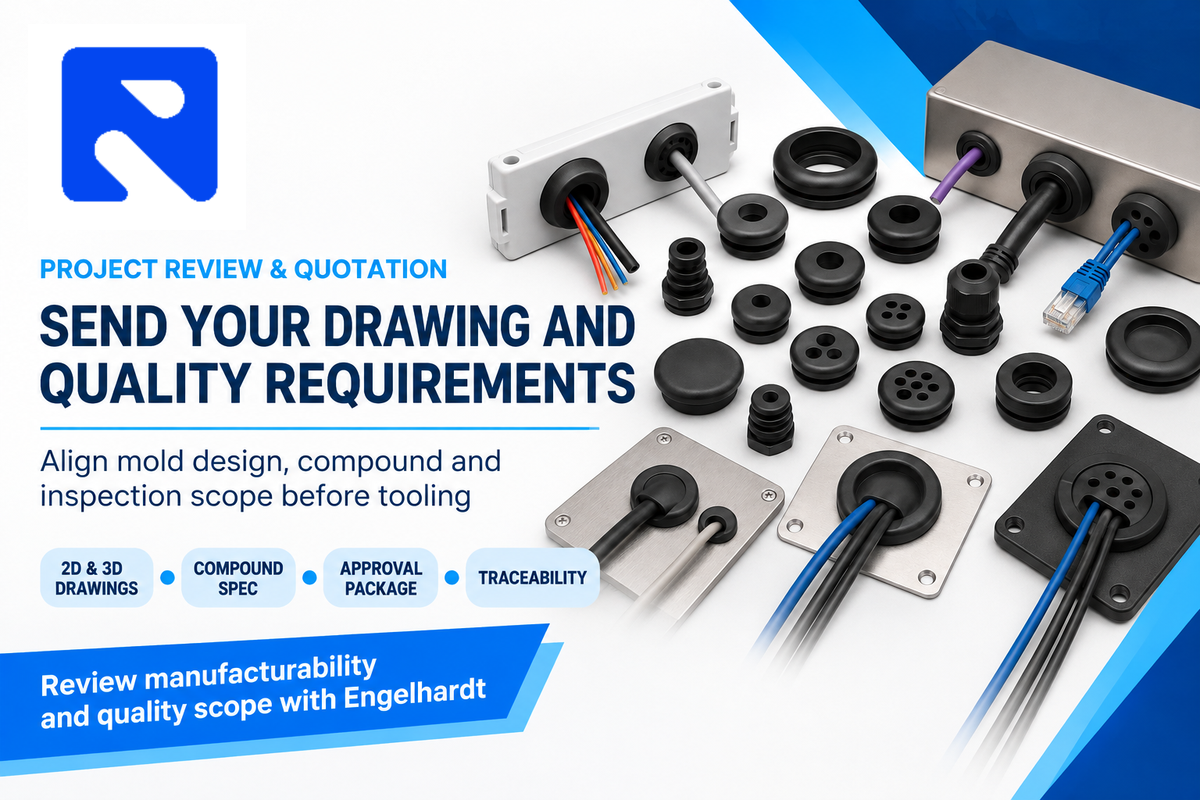
When you’re ready to source a molded seal, grommet, or bonded elastomer component, align the drawing, compound specification, and required approval package before tooling begins. You can discuss your drawing and quality requirements with Engelhardt’s engineering team to review mold manufacturability, material selection, and the inspection records needed for your program.
Related articles
References & Sources
- ISO, ISO 9001 Quality management systems (2026 sixth edition and transition overview)
- ISO, Certification and third-party conformity assessment guidance
- ISO, ISO/IEC 17025 Testing and calibration laboratories
- Automotive Industry Action Group (AIAG), IATF 16949:2016 Automotive Quality Management System Standard
- Automotive Industry Action Group (AIAG), Automotive Quality Core Tools (APQP, PPAP, FMEA, MSA, SPC)
- Automotive Industry Action Group (AIAG), CQI-30 Special Process: Rubber Processing System Assessment (Mixing & Molding)
- Automotive Industry Action Group (AIAG), CQI-19-2 Sub-Tier Supplier Management Process, Readiness Checklist
- International Automotive Task Force (IATF), IATF 16949 Sanctioned Interpretations (November 2025, SIs 8, 9, and 10)
- International Automotive Task Force (IATF), Minimum Automotive Quality Management System Requirements for Sub-Tier Suppliers (MAQMSR, 2nd Edition)
- International Automotive Task Force (IATF), Recognized Certification Bodies and IATF Certificate Validity Check
- International Automotive Task Force (IATF), IATF Rules 6th Edition Sanctioned Interpretations (June 2026)
- International Automotive Task Force (IATF), Stakeholder Communiqué SC-2026-005: IATF 16949 2nd Edition Status (July 2026)
- International Automotive Oversight Bureau (IAOB), Audit Day Calculator (IATF Rules 6th Edition)
- Google Patents, US7433755B2: Process for curing a rubber compound
- Modern Casting, Ted Schorn, “Thirty Years After QS-9000: Changing Requirements and Enduring Lessons” (9 April 2025)
- IndustryWeek, Anthony Hardy (NSF, sponsored), “Effectively Integrating Multiple Third-Party Standards for Quality, Safety, and Environmental Management” (4 December 2024)