Get in Touch with Engelhardt


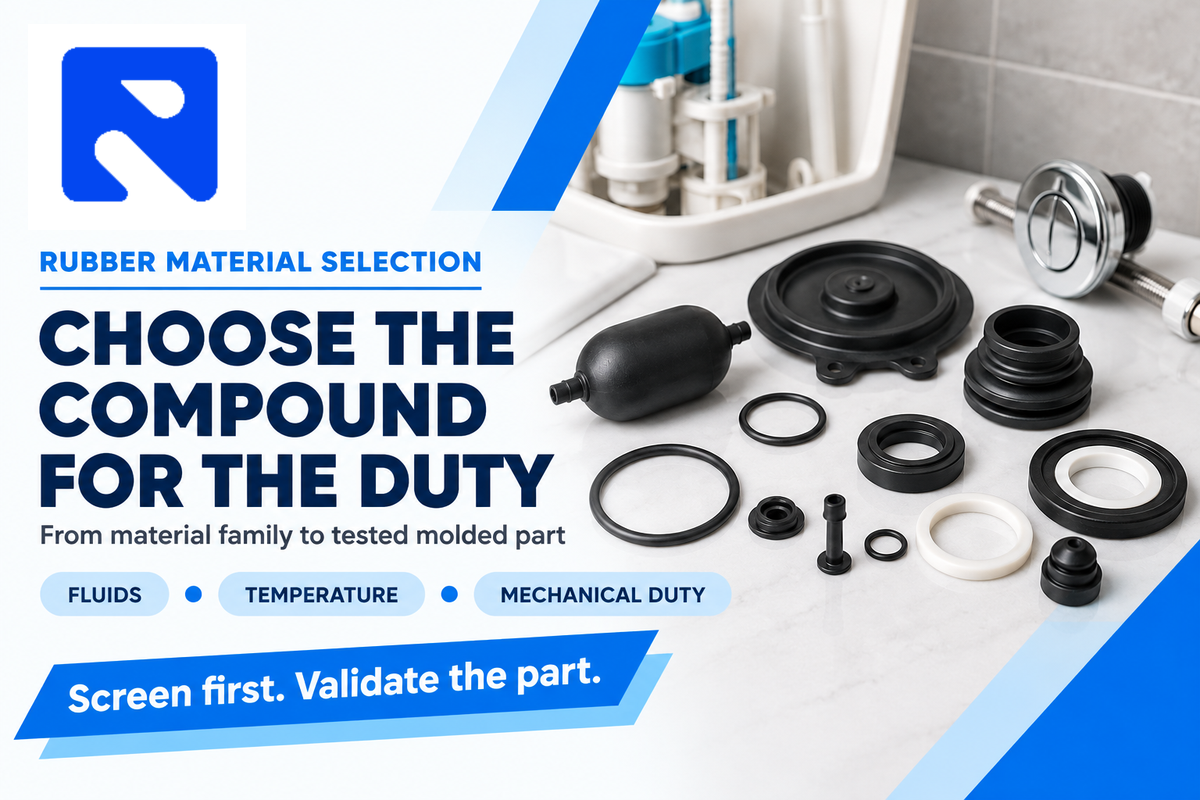
EPDM is a good place to start when there’s exposure to water and weather. NBR is a start when dealing with petroleum oil, but FKM should be included when hot oil demands a different shortlist. This rubber material selection guide compares eight common elastomers, then shows how to narrow a family to a compound and test the molded part under its service condition.
Updated October 2026
Quick selection starting points
- EPDM starts the water-and-weather shortlist; include cleaners and assembly lubricants in the assessment.
- For petroleum oil, start with NBR and investigate HNBR or FKM when heat or wear changes the duty.
- Silicone suits investigation for static thermal duty, with tear and fluid compatibility considered separately.
- Specify the compound designation, drawing, service envelope and acceptance tests.
Rubber material selection is the process of matching an elastomer compound to its fluids, temperatures and mechanical duty. A family chart starts the shortlist. Representative part testing closes the selection.
Start with the service conditions, not a rubber name
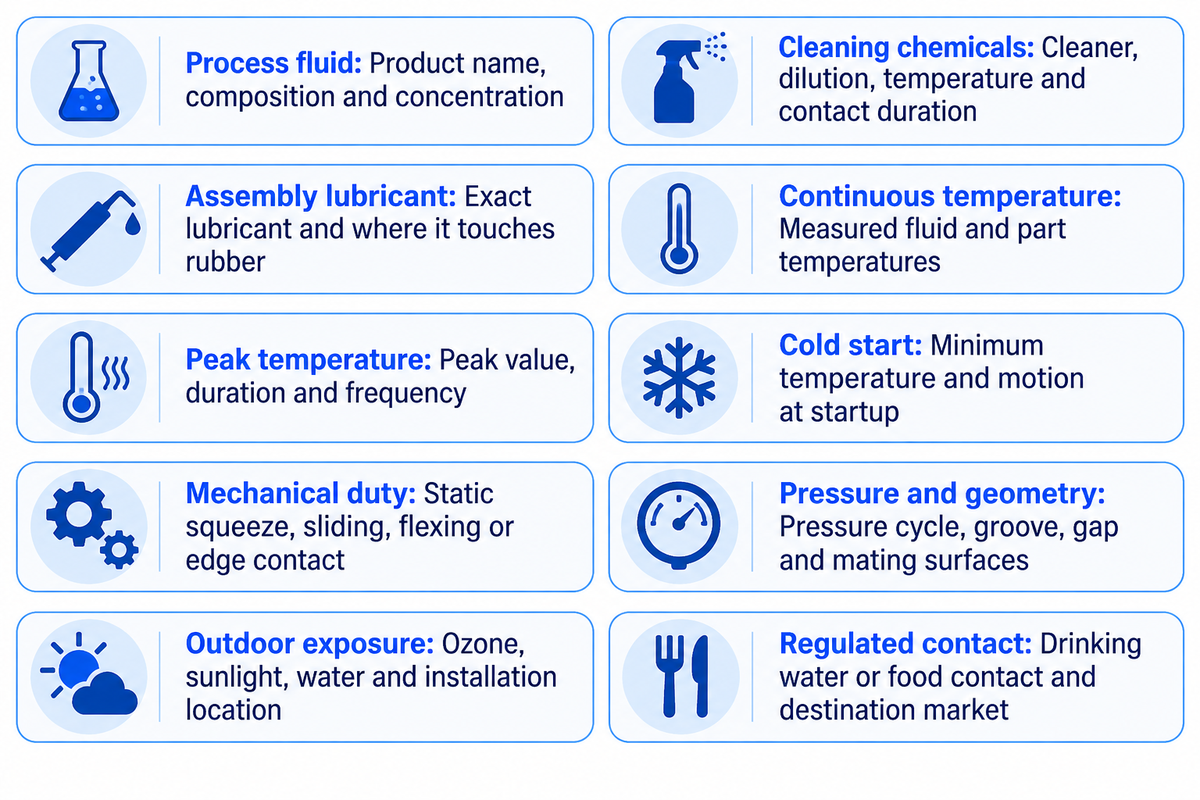
The right rubber should be selected based on the conditions the part will encounter, starting with every fluid and the coldest and hottest operating states. Material selection decisions then move through three levels: polymer family, compounded grade and molded component. Each level gives an answer to a different question starting from the broad compatibility to whether the assembly seals or survives repeated movement.
| Input | Record in the specification | Decision it changes |
|---|---|---|
| Process fluid | Product name, composition and concentration | Initial chemical compatibility shortlist |
| Cleaning chemicals | Cleaner, dilution, temperature and contact duration | Whether the cleaning cycle eliminates a candidate |
| Assembly lubricant | Exact lubricant and where it touches rubber | Installation exposure before normal service |
| Continuous temperature | Measured fluid and part temperatures | Heat resistance required in that medium |
| Peak temperature | Peak value, duration and frequency | Short excursions versus sustained ageing |
| Cold start | Minimum temperature and motion at startup | Recovery and sealing during contraction |
| Mechanical duty | Static squeeze, sliding, flexing or edge contact | Recovery, friction, tear or wear priority |
| Pressure and geometry | Pressure cycle, groove, gap and mating surfaces | Part design and functional test conditions |
| Outdoor exposure | Ozone, sunlight, water and installation location | Weather resistance and surface protection |
| Regulated contact | Drinking water or food contact and destination market | Required material documentation and approvals |
A drawing that states “rubber, 70 Shore A” gives no information about the service environment and fluids. Before quotes are solicited, the engineering staff determine and specify the service conditions, purchasing maintains equivalence, and quality staff decide what’s required to accept samples.
For liquid exposures, ASTM D471 provides comparative testing procedures; it does not replace the assembled-part trial under the recorded service conditions.
Compare rubber materials: EPDM, NBR, silicone, FKM and more
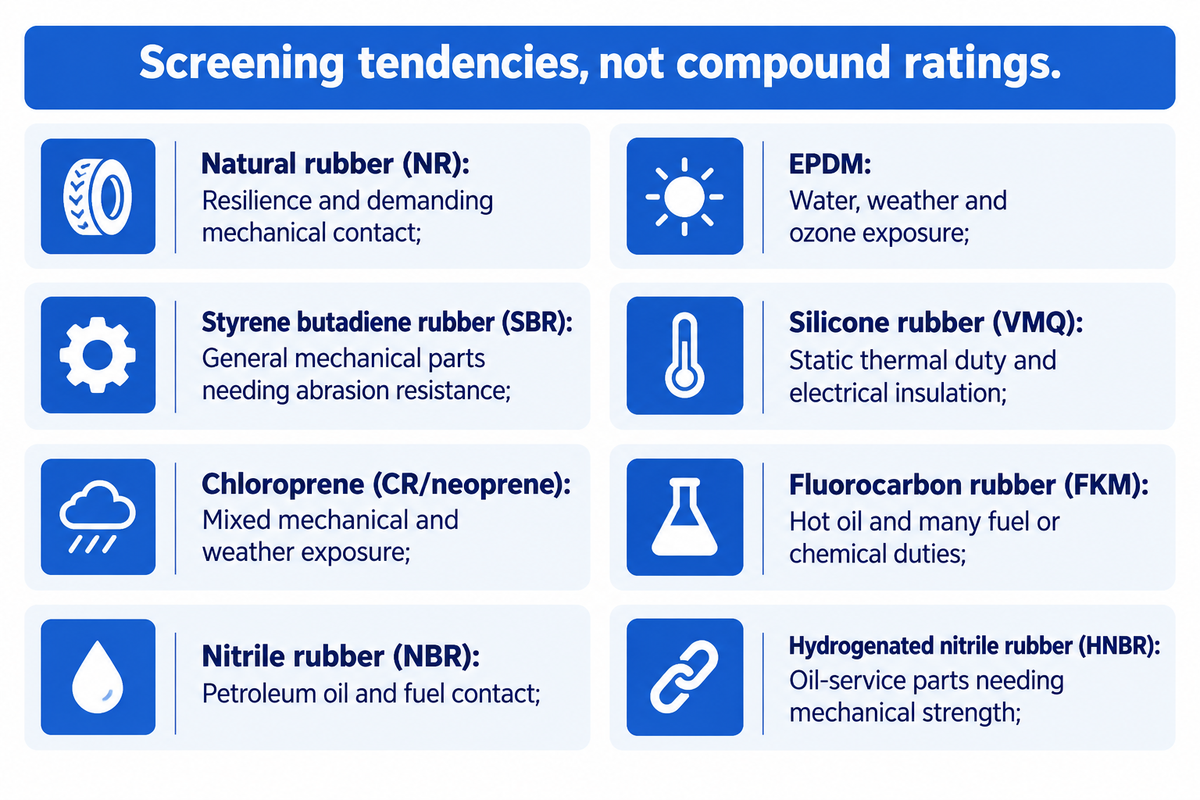
For different exposures, EPDM, NBR, silicone and FKM are starting points; NR, SBR, CR and HNBR extend the shortlist for mechanical or mixed duties. Compare these different types of rubber by their strongest fit and the condition that could exclude them. A preferred material becomes a purchase specification after a particular compound meets the application requirements.
| Family | Useful starting point | Exposure or duty to resolve | Next compound-level check |
|---|---|---|---|
| Natural rubber (NR) | Resilience and demanding mechanical contact | Petroleum fluids and outdoor ozone | Tear, abrasion and fatigue under the working load |
| Styrene butadiene rubber (SBR) | General mechanical parts needing abrasion resistance | Oil exposure and weathering | Wear against the actual mating surface |
| Chloroprene (CR/neoprene) | Mixed mechanical and weather exposure | Only moderate resistance to some petroleum fluids | Exact fluid, ageing and tear requirements |
| Nitrile rubber (NBR) | Petroleum oil and fuel contact | Ozone, cold flexibility and unfamiliar fuel blends | Fluid swelling and cold-start function |
| EPDM | Water, weather and ozone exposure | Mineral oil and petroleum lubricants | Cleaner compatibility and water-service grade |
| Silicone rubber (VMQ) | Static thermal duty and electrical insulation | Rubbing, tearing and incompatible fluids | Recovery, tear strength and fluid exposure |
| Fluorocarbon rubber (FKM) | Hot oil and many fuel or chemical duties | Steam, cold starts and grade-specific chemical exclusions | Exact medium and compound operating window |
| Hydrogenated nitrile rubber (HNBR) | Oil-service parts needing mechanical strength | Fluid formulation and low-temperature requirements | Wear, thermal ageing and assembled function |
Broad trends and behavior, stated as “excellent resistance” or “good resistance” allow families to be screened before individual compounds are compared. Test conditions and the medium to be used must be specified to use these statements in design.
Outside the eight families, butyl is useful to investigate where low gas permeability is of concern; polyurethane deserves attention for wear resistance. High pressure gas and rapid decompression duties require a dedicated qualification plan. A versatile rubber for a protective cover can be wrong for a moving seal.
What is the difference between natural rubber and synthetic rubber?
Natural rubber is derived from the latex of the rubber tree while synthetic rubber is produced through chemical synthesis. Natural rubber is useful for resilience and mechanical properties; synthetic families offer different combinations of oil, heat and weather resistance. Neither category provides the best material properties for every application.
Compounding gives grades within both categories their unique properties. Curing chemistry, polymer blend and fillers affect the finished part. In a 2009 study, Noguchi and colleagues attributed the tear behavior of crosslinked NR/SBR blends to strain-induced crystallization and blend structure. This explains why compounds from familiar rubber types can behave differently when load is applied. Read the original study abstract.
Check chemical compatibility before temperature range
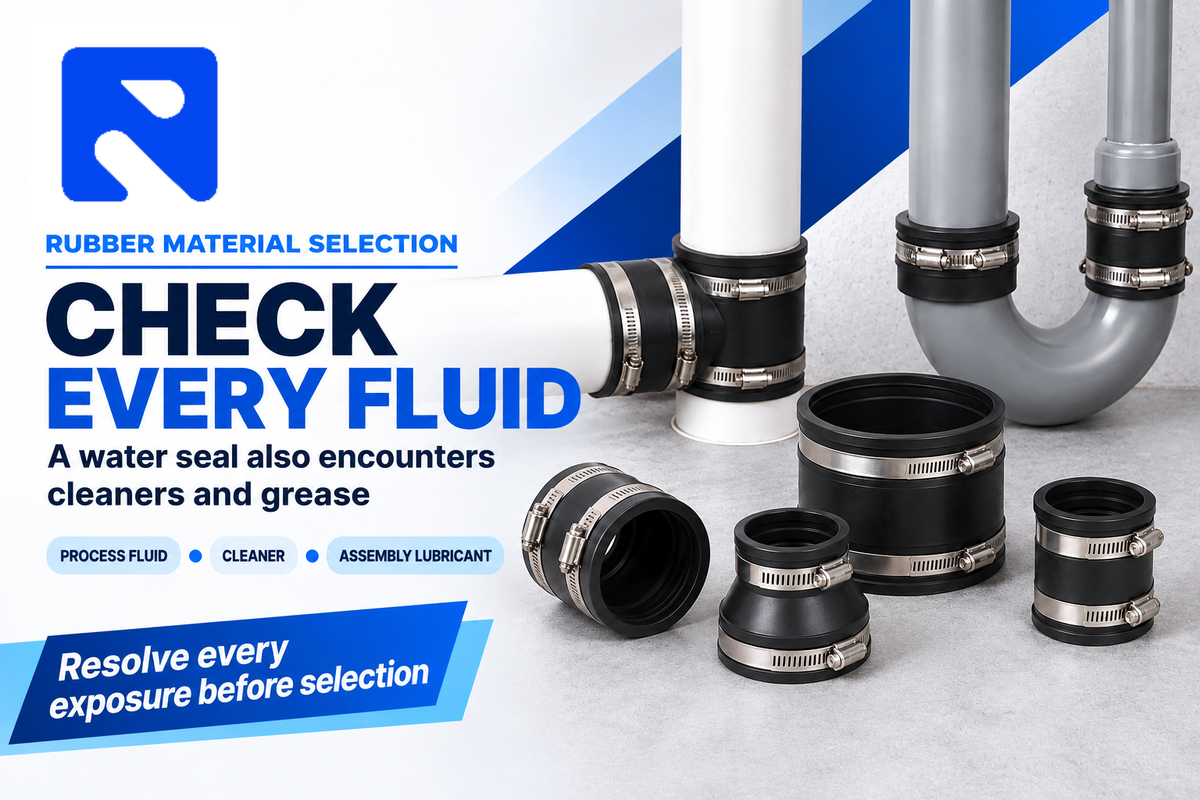
Chemical compatibility can eliminate a candidate prior to temperature comparisons. The process fluid, cleaner and installation lubricant affect the rubber at different stages. Swelling can result in an ill fit, while extraction can cause shrinkage or property loss. A grade from a chemical-resistant family is still needed, suited to the required concentration and exposure.
EPDM water seal: include assembly grease, since petroleum-based lubricants can bring an incompatible exposure to an otherwise suitable water application. For a closer two-material decision, use the EPDM and NBR rubber comparison.
“Oil” covers a range of different liquids. One study from the Oak Ridge National Laboratory immersed 17 elastomers in selected biofuels and diesel at 50 °C for four weeks. The reported swelling response differed between fast-pyrolysis bio-oil and hydrothermal-liquefaction-bio-crude, including for fluoroelastomers. Keep engine oil, hydraulic oil, and another biofuel as separate compatibility questions. The scope of the testing is described in ORNL’s 2021 research abstract.
Strong acids, a polar solvent or a fuel blend with alcohol should stay named in the chemical resistance specification. “Resistant to many chemicals” is too general to distinguish them.
Can FKM be used in steam service?
An FKM compound may be shortlisted for steam service; however, a grade-specific steam rating is required. Consider the steam temperature, exposure duration and cleaning chemistry to evaluate that grade. General FKM oil and fuel resistance is a different selection criterion from resistance to hot water or steam, so a generic oil-service compound is not an automatic substitute.
When considering a compound for service with steam, ask for test conditions, the exposure time and the acceptance criteria. A family designation for FKM compounds doesn’t warrant service with steam.
Read heat, cold and weather resistance together
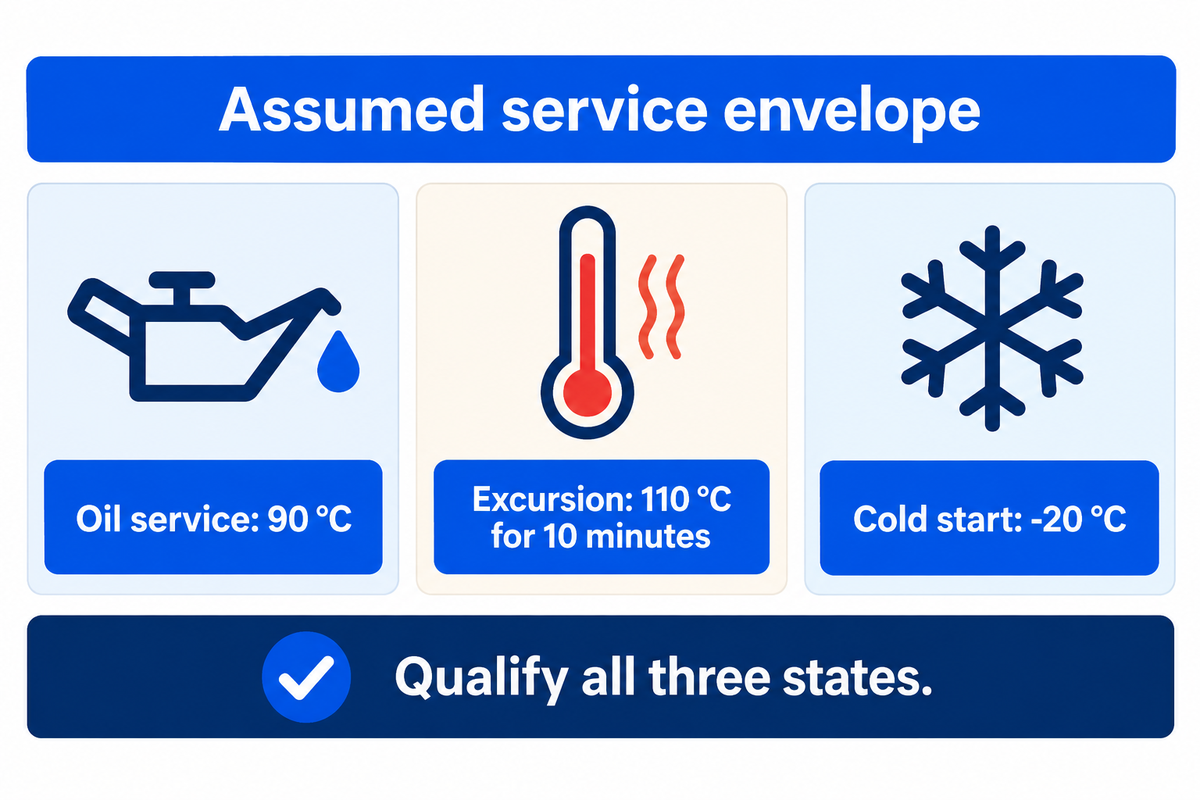
A temperature range, with its medium, exposure duration and required function, should be read together to understand its role. Cold start sealing is different from dry-air heat resistance and hot fluid resistance, and outdoor parts also face ozone and ultraviolet light. Choosing the right compound means keeping those exposures together when comparing high-temperature resistance with flexibility at the cold end.
Example service envelope: a gasket runs in oil at 90 °C, sees a 110 °C excursion for 10 minutes, and must seal during a −20 °C start. These are the three requirements for the same part. Selecting a compound from the 110 °C value alone leaves the cold start unresolved.
ISO 3384-2 addresses temperature cycling by measuring decreasing counterforce while a rubber specimen stays at constant deformation. This supplies a test-method basis for considering the thermal sequence.
- Evaluate continuous heat ageing in the working fluid.
- Record the duration and frequency of temperature peaks.
- Test sealing as the part contracts during cooling after ageing.
- For ozone and UV resistant parts, assess outdoor exposure alongside strain and movement.
EPDM and silicone are good weather-resistant starting points in manufacturer’s guidance. For automotive parts exposed to oil and outdoor conditions, HNBR can be compared to standard NBR. Materials used in the automotive sector still require the duty-specific checks in the drawing; an application label doesn’t set a service limit.
Match hardness, compression set and mechanical properties
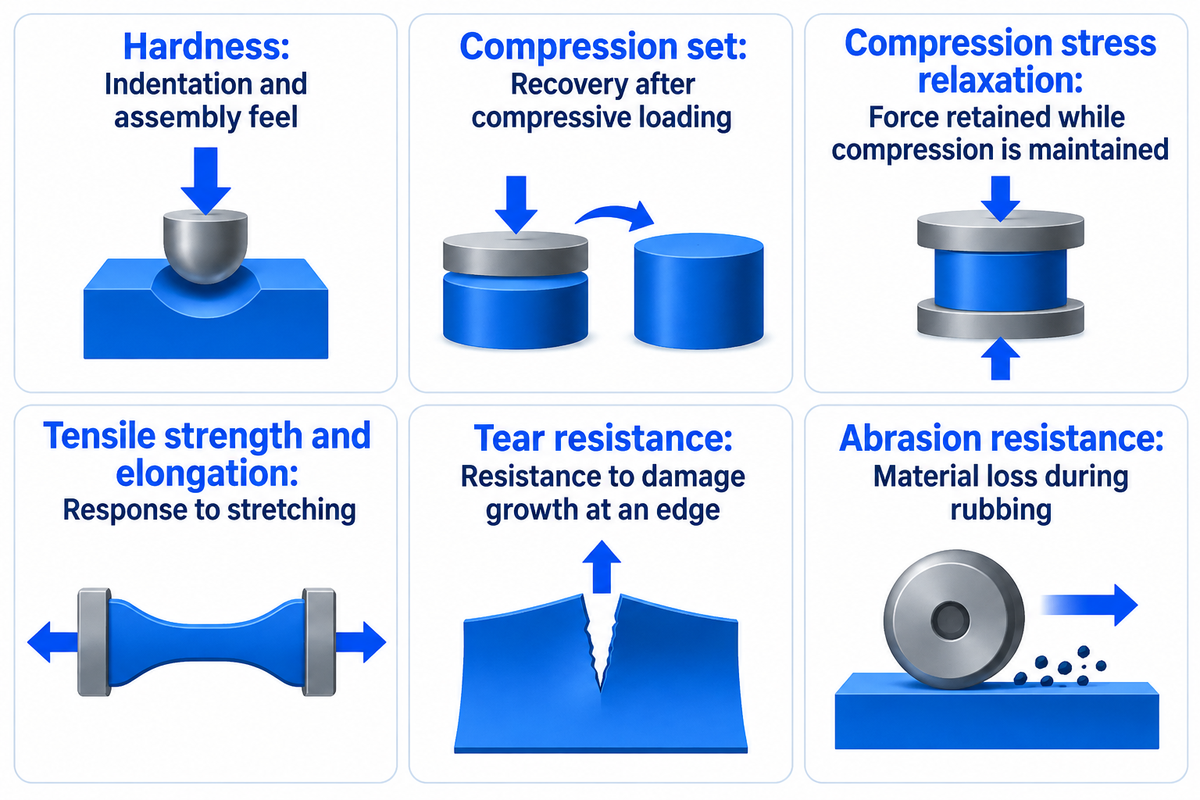
Measures of hardness relate to resistance to indentation. Recovery and retained sealing force refer to different aspects of material behavior. For a static seal, compare compression set under the same conditions, and include force retention when considering the effects of ageing or temperature cycling. For a moving part, add wear, friction and tear requirements instead of selecting the correct rubber from Shore A alone.
| Property | Useful decision | Keep comparable |
|---|---|---|
| Hardness | Indentation and assembly feel | Scale, specimen and measurement conditions |
| Compression set | Recovery after compressive loading | Method, deflection, time, temperature and recovery period |
| Compression stress relaxation | Force retained while compression is maintained | Initial deformation, specimen and temperature history |
| Tensile strength and elongation | Response to stretching | Test method, geometry and conditioning |
| Tear resistance | Resistance to damage growth at an edge | Notch geometry and loading direction |
| Abrasion resistance | Material loss during rubbing | Mating surface, load and wear mechanism |
ASTM D395 defines compression-set test methods primarily relevant to static compressive stresses. A result from one time and temperature should not be ranked directly against a result obtained under another exposure. Two compounds of equal hardness may show different recovery behavior.
For temperature cycling, ISO 3384-2 measures decreasing counterforce while deformation stays fixed. Its Method A includes low-temperature sealing-force checks after high-temperature ageing. This distinguishes a seal that recovers after unloading from one that keeps enough force while installed.
“Comparison of results is valid only when made on test pieces of similar size and shape.”
For an NBR quote, identify the compound rather than specifying acrylonitrile content as a shortcut to all properties. Formulation and cure choices also affect the mechanical behavior of the molded component.
Choose a shortlist for three demanding applications
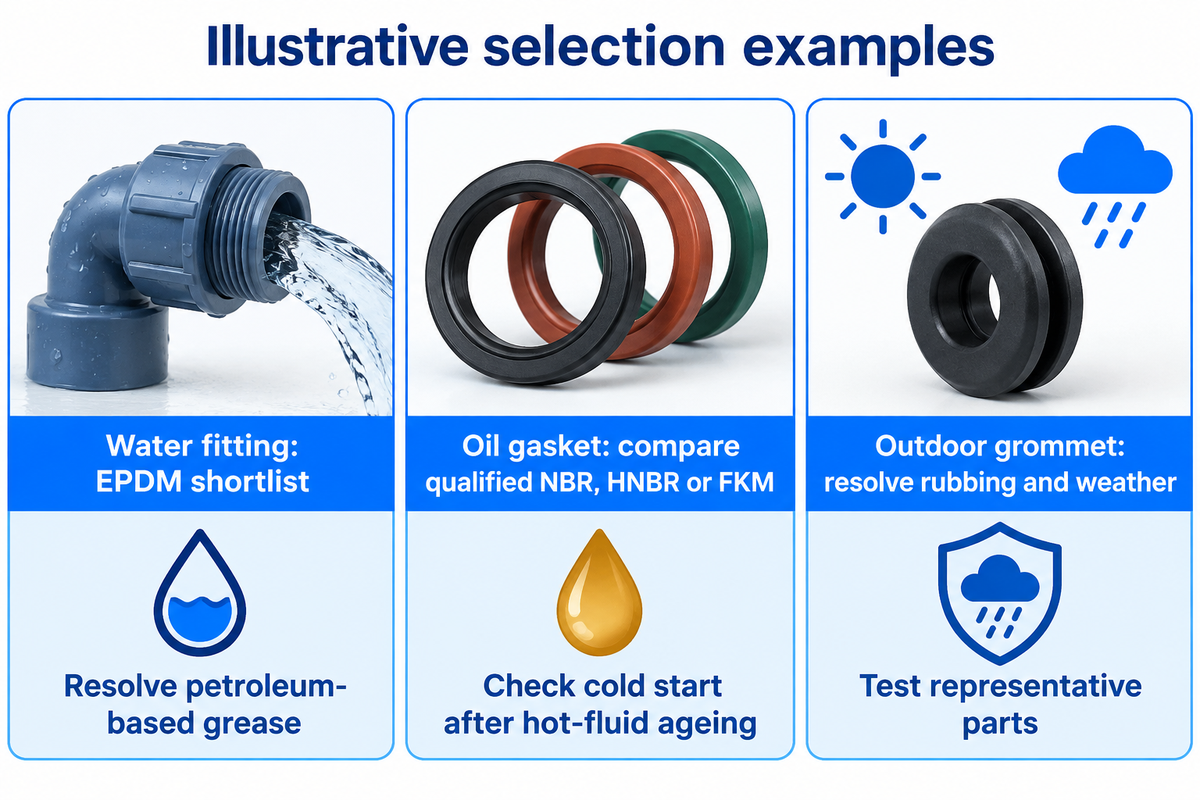
Eliminate materials that are unlikely to satisfy the requirements, and consider the rest. A water seal, oil gasket and rubbing grommet place different demands on rubber. The examples of assumed service given show how to arrive at a specific requirement from a broader, more plausible, family.
Exposure Collision Test
The Exposure Collision Test refers to comparing a candidate against every fluid and operating condition; an unresolved incompatibility stops that candidate from advancing.
An outdoor hot-water fitting
Assume a static fitting handles 60 °C water at 6 bar, goes through a 15 minute cleaning cycle, and is assembled with petroleum based grease. EPDM belongs on the initial water and weather shortlist. The grease is the collision: changing to a compatible assembly lubricant may preserve the EPDM option.
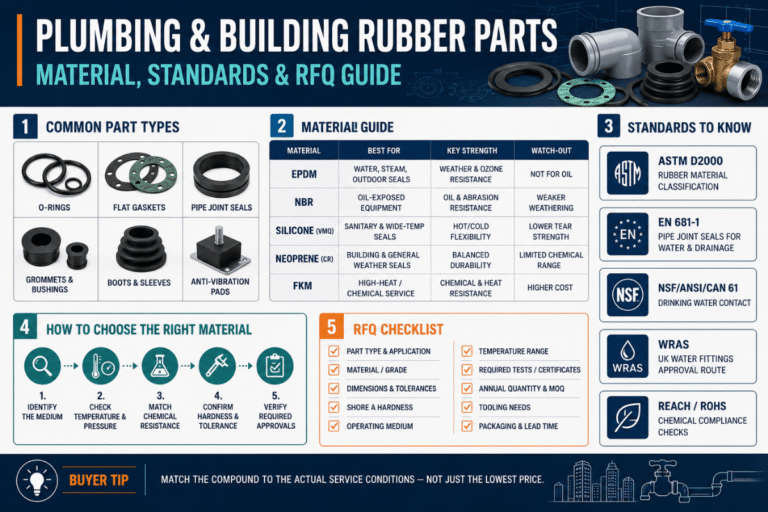
Replacing EPDM with NBR only for resistance to oils introduces a different weather assessment, and potentially a different water and cleaner assessment. Taking a different route, if the lubricant is also not changeable, a water service specialty compound may be evaluated. The assembled fitting is then tested by the quality staff. It’s assessed after the complete exposure sequence, including cooling. Use the plumbing and building rubber parts guide for component application.
A mineral-oil gasket with a cold start
For the earlier oil service duty envelope, start with NBR and compare qualified HNBR or FKM if needed for higher heat or mechanical requirements. The oil specification is kept the same during this comparison. Simultaneously changing the oil and rubber makes it unclear which change affected swelling or leakage.
High-temperature performance can favor a candidate that still needs a different low temperature grade. The deciding trial is the cold start after hot fluid ageing, with the gasket installed in its intended joint.
A grommet exposed to rubbing and weather
Assume a 4 mm cable moves through a protective grommet on an outdoor housing. A 100,000 cycle test is the proposed assessment, not an established material life. EPDM starts with the weather requirement; CR or a suitable wear-focused compound may enter when repeated edge contact dominates.
Standard silicone exhibits thermal properties that merit consideration, but needs careful assessment at the rubbing edge. Reduce sharp contact in the housing and compare wear on representative parts. Buying a harder rubber could leave the same cutting mechanism in place.
Check approvals for the actual compound and use
For drinking-water or food-contact requirements, match the exact compound or component and its conditions of use. EPDM and silicone are family names, and approvals are defined for specific products and applications. Keep health-effects concerns separate from pressure, leak, and mechanical qualification when selecting a rubber part for regulated contact.
NSF explains that NSF/ANSI 61 addresses health effects from substances imparted to drinking water. Mechanical performance, taste and odor, and microbial growth support are outside the requirements addressed in that explanation. A drinking-water material review therefore is parallel to the fitting’s functional tests.
- Engineering defines the contact medium, temperature and intended use.
- Purchasing matches the quoted designation to the supplier’s documentation.
- Quality staff check that production uses the approved designation and agreed process.
For food processing, the request should also include destination market and food-contact conditions. A change in colorant, additive or formulation may require a new review even if the part is still called silicone.
Compare cost after technical fit
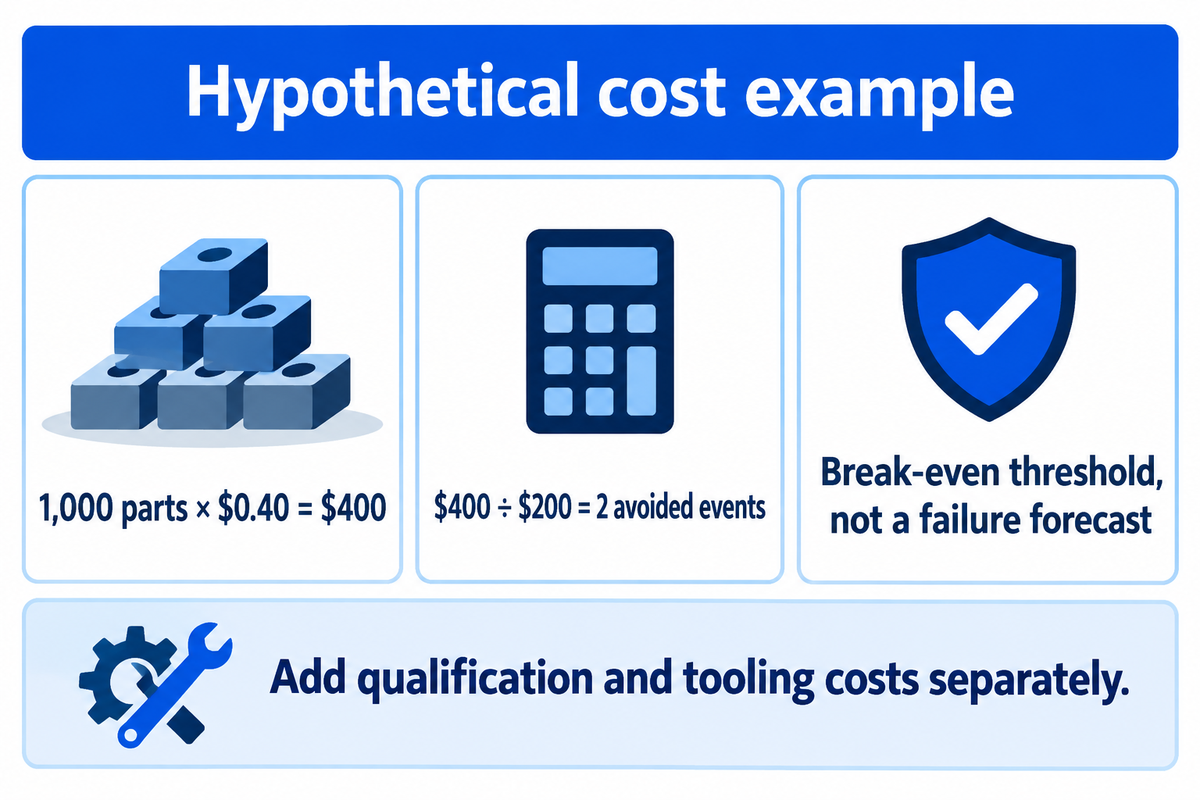
Compare the price of compounds that meet the same technical specifications. The useful question is how much extra spending must be recovered through fewer replacements or other measurable savings. Keep that threshold separate from any forecast that a change in material would allow the savings to be realized. Keep the service period and the part quantity equal to those of the alternatives.
Assumed inputs: 1,000 parts for the same service period, a $0.40 premium per part, and $200 in avoidable cost per replacement event. These are editorial inputs; qualification costs are evaluated separately.
| Calculation | Result |
|---|---|
| 1,000 parts × $0.40 per part | $400 additional purchase cost |
| $400 ÷ $200 per avoided event | 2 avoided replacement events to break even |
The calculation shows the required saving to achieve, not the expected reduction in failures. If a change in material also requires a qualification or tooling, add that to the cost and then evaluate savings. A repair covered by a planned shutdown may also have a smaller avoidable cost than a call-out for an unscheduled shutdown.
This simple threshold relies on an equivalent-function principle discussed in ASTM E917’s building-cost practice. For costs spread over multiple years, a fuller model requires consideration of both timing and discounting, as discussed in FHWA’s life-cycle cost guidance. Neither method makes an incompatible gasket material economically acceptable.
Validate the molded part before production
Verify the selected compound and then evaluate the part in its intended assembly. Material tests reveal changes in physical properties; functional trials reveal whether the geometry, contact and loading still work after exposure. Agree the failure criteria before testing so the same results support engineering approval and production acceptance.
| Question | Evidence to collect | Decision owner |
|---|---|---|
| Is the sample the quoted compound? | Designation, batch and sample record | Purchasing and quality |
| Does fluid exposure change fit? | Volume or dimensional change under specified exposure | Materials engineering |
| Does the compound retain its properties? | Relevant hardness, tensile or elongation measurements | Materials engineering |
| Does recovery meet the duty? | Compression-set data with matched conditions | Design engineering |
| Is sealing force retained? | Stress-relaxation evidence where required | Design engineering |
| Does the assembly seal? | Leak test at agreed pressure and temperature states | Product test team |
| Does motion damage the part? | Wear, tear or flexing trial on representative geometry | Product test team |
| Is contact approval matched? | Applicable documentation for the specified use | Compliance and quality |
| Can production repeat the result? | Approved compound, process and change-control record | Supplier quality |
ASTM D471 covers comparative liquid exposure tests and mentions that material tests may not directly correlate with part performance. Incorrect squeeze, an installation cut or an unsupported gap may still cause seal failure, even if the compound passes a liquid test.
Consider rubber gasket and seal design guidance for sealing applications and combine it with material tests. Keep the initial sample, a used rubber part, and the fluid and temperature record of a test in which a part failed. Separating damage during service from damage during installation is helped by this sample comparison.
Turn your shortlist into a molding specification
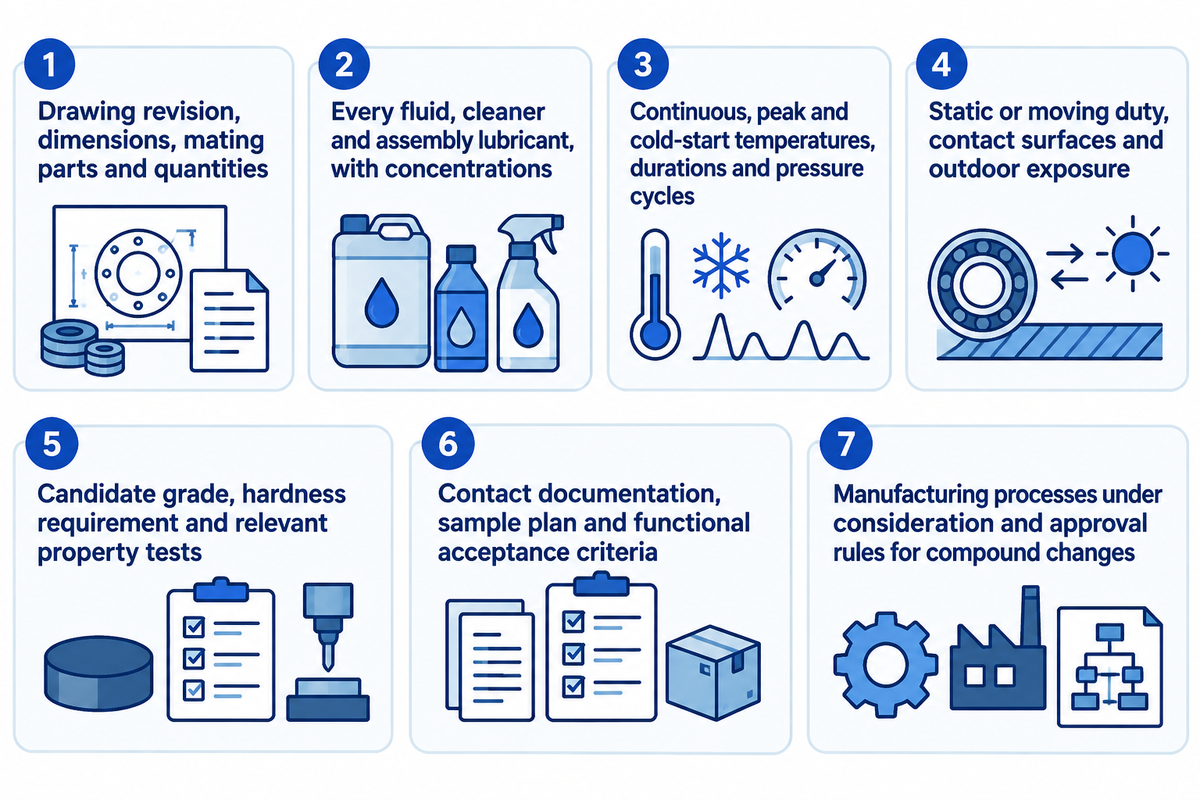
Provide the molder a drawing, specify the exposure conditions, and state the acceptance tests with the candidate compound families. A rubber compound specification should state the part function and stipulate changes that require approval. ASTM D2000 can supply classification language for the relevant property.
ASTM D2000 classifies rubber materials using heat-ageing types and oil-swelling classes. Add the functional and manufacturing requirements that a family name or hardness value leaves open.
Include in the request for quotation
- Drawing revision, dimensions, mating parts and quantities.
- Every fluid, cleaner and assembly lubricant, with concentrations.
- Continuous, peak and cold-start temperatures, durations and pressure cycles.
- Static or moving duty, contact surfaces and outdoor exposure.
- Candidate grade, hardness requirement and relevant property tests.
- Contact documentation, sample plan and functional acceptance criteria.
- Manufacturing processes under consideration and approval rules for compound changes.
Engelhardt can review your requirements for custom rubber parts for plumbing and building applications. Send the drawing and service-input worksheet with the enquiry so the material discussion addresses the fluid and operating duty as well as the shape. Identify any unresolved cleaner, lubricant or contact requirement before requesting samples.
Frequently asked questions
What is the difference between FKM and FFKM?
FFKM offers broader chemical-service options than FKM, with compound selection still required.
Both are fluorinated elastomer families, but their polymer chemistry differs. FKM is commonly considered for oil and fuel resistance, while FFKM grades extend the materials available for aggressive chemical service. The useful operating window still belongs to the particular compound. Match the medium and thermal duty before comparing qualified grades, because a higher-priced family can still have application-specific exclusions.
Is nitrile rubber (NBR) resistant to gasoline?
Some NBR compounds can be used for gasoline contact, with the fuel blend specified.
Fuel resistance changes with the formulation, additives and operating conditions. Gasoline containing alcohol needs its own compatibility assessment rather than a decision based on a generic petroleum oil rating. Include the exact fuel in liquid-exposure testing and examine swelling alongside property changes. For a replacement seal, keep the original fuel specification and temperature conditions visible when comparing the proposed NBR compound.
Is silicone rubber a food-grade safe material?
A silicone compound intended and documented for the relevant food contact can be suitable.
The formulation, additives, food type, contact time and temperature determine the required assessment. Silicone’s family name doesn’t make every finished component suitable for food processing. Match documentation to the exact grade and destination-market requirements, then account for the finished part’s manufacturing and use conditions. A change of formulation or colorant should enter the same approval process as the original material selection.
Is TPE plastic or rubber?
TPE is a thermoplastic elastomer with rubber-like flexibility.
A TPE softens with heat for processing, unlike a permanently crosslinked thermoset. Replacement of a rubber part therefore requires comparison of the grade’s fluids, thermal duty, recovery and component geometry, as well as its initial softness.
Which elastomer has the best abrasion resistance?
Polyurethane is a strong starting candidate for severe wear; the contact mechanism decides the final choice.
Natural rubber, nitrile and other compounds also suit particular abrasion duties. Sliding against a smooth shaft, rubbing against a housing edge and contacting abrasive particles create different damage. Compare wear data with the working load, speed, mating surface and lubrication kept consistent. Tear resistance matters when an edge starts a cut, while heat buildup and fluid exposure can change behavior during use. For a protective grommet, test the molded profile against the intended cable and housing. For a moving seal, include leakage and friction measurements as well as material loss. A highly resistant laboratory specimen can still perform poorly in a different contact geometry.
Can hydrogenated nitrile rubber (HNBR) replace fluorocarbon rubber?
Potentially, for duties where a qualified HNBR grade meets the same requirements.
Compare the exact fluid, thermal extremes and mechanical load before substitution. HNBR’s fuel and oil resistance can make it a candidate, but the chosen grade must pass the application tests and required contact approvals.
Method note: This guide combines public test-method descriptions, published research, and commercial manufacturer literature used as background. Application examples and cost inputs are illustrative engineering examples. Compound limits and sample-acceptance values belong in the project specification.
References & Sources
- Noguchi et al., “Tear Energy of Strain-Induced Crystallization of Natural Rubber/Styrene-Butadiene Rubber Blends,” 2009.
- Oak Ridge National Laboratory, 2021 research abstract on elastomer swelling in two biofuels.
- ASTM D395, compression-set test methods, public scope and significance.
- ISO 3384-2:2019, compression stress relaxation with temperature cycling, public abstract.
- ASTM D471, rubber exposure to liquids, public scope and significance.
- NSF, “NSF/ANSI 61: Drinking Water System Components, Health Effects,” 2024.
- ASTM E917, life-cycle costs of buildings and building systems, public scope.
- FHWA, “Improving Transportation Investment Decisions Through Life-Cycle Cost Analysis”.
- ASTM D2000-18 (2024) e1, classification system of rubber products, public scope.