Get in Touch with Engelhardt


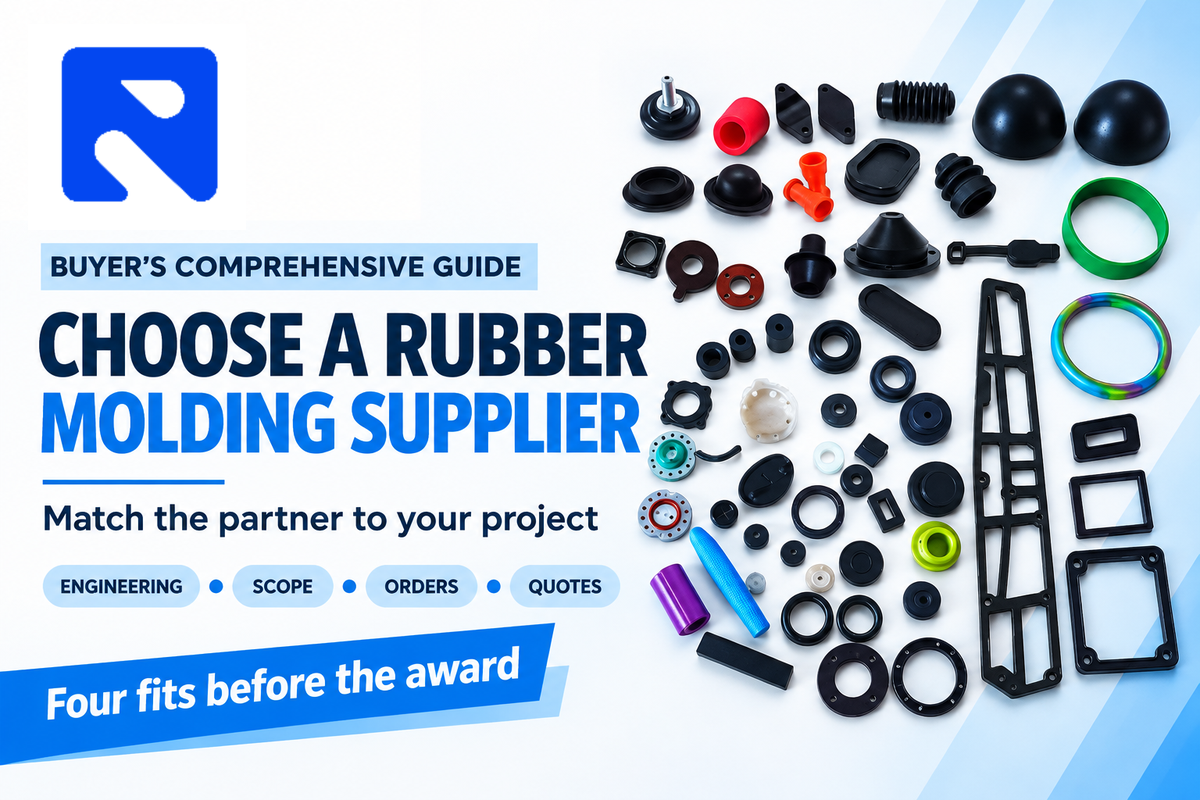
Here’s how to choose a rubber molding supplier for your project: Look for engineering support that dovetails with your unfinished work; define what they’ll deliver; check if your order pattern matches with what they normally supply; and lastly, look for the best deal at the quantity you can defend. Choosing the right manufacturing partner starts with these four fits.
A production-ready drawing and a changing prototype need different kinds of help. So do a loose rubber gasket and a tested assembly containing rubber, plastic, and metal.
Choose a supplier for the job your rubber part must do
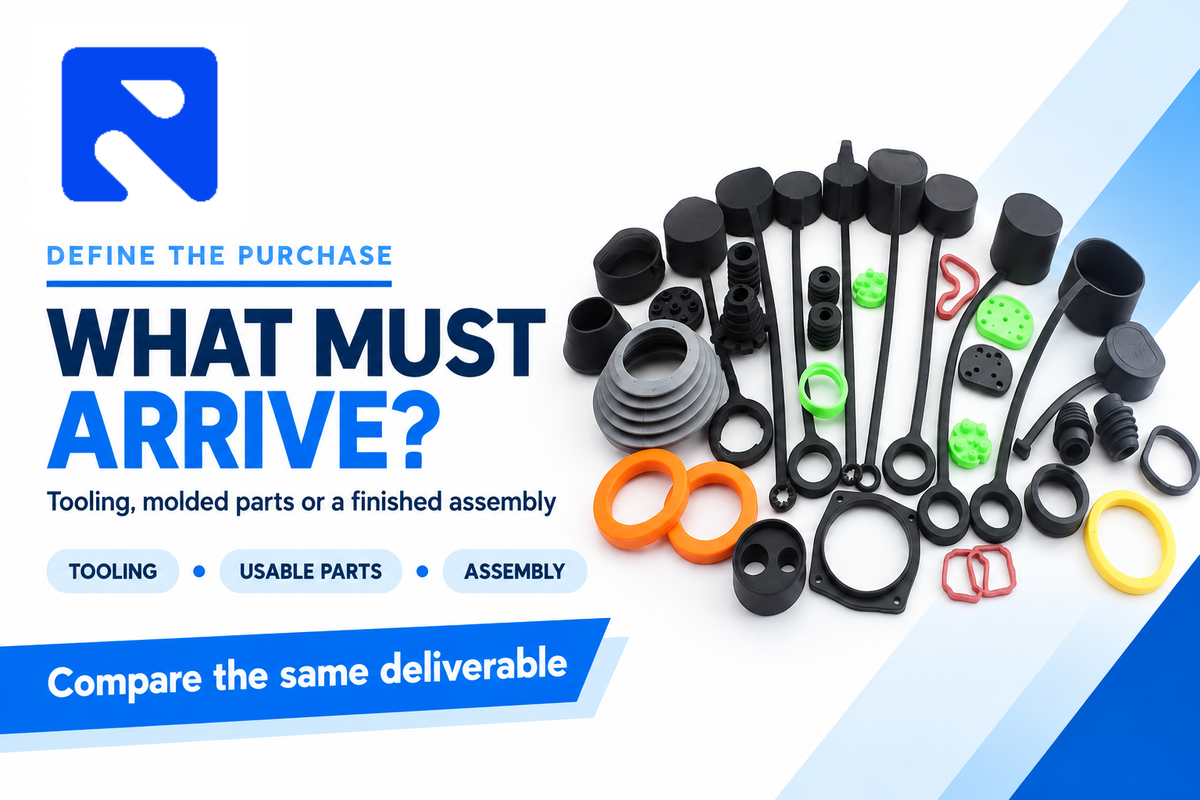
A rubber molding company should deliver the item your team needs: tooling, usable molded parts or a finished assembly. Define the deliverable before creating a shortlist. A mold-only quotation can look attractive next to a parts quotation because the buyer owns the manufacturing work after the tool arrives.
For custom components, capture the need in one sentence. Example: “We need custom molded rubber parts supplied ready for installation, with trimming and inspection included.” A buyer sourcing a complete valve assembly would include the mating components and assembly operation as well as a final functional check.
Match the supplier’s business scope to the operations contained in your order. Engelhardt’s rubber, plastic and hardware manufacturing overview demonstrates scope.
Who are the top rubber manufacturers?
To select the best rubber manufacturers for your project, consider the material, production route and delivery scope. Large rubber extrusion, mold and molding companies address different needs.
Focus on access to someone who can explain manufacturability and tooling changes for a new component. For a stable repeat order, think about a workable production slot and release arrangement. Suppliers experienced with either specialized rubber compounds or complex geometries may help with a difficult seal. An integrated supplier may work better for an assembly with multiple purchased interfaces. These categories are starting points for the selection process, not a company size ranking.
Match the molding supplier to your project stage
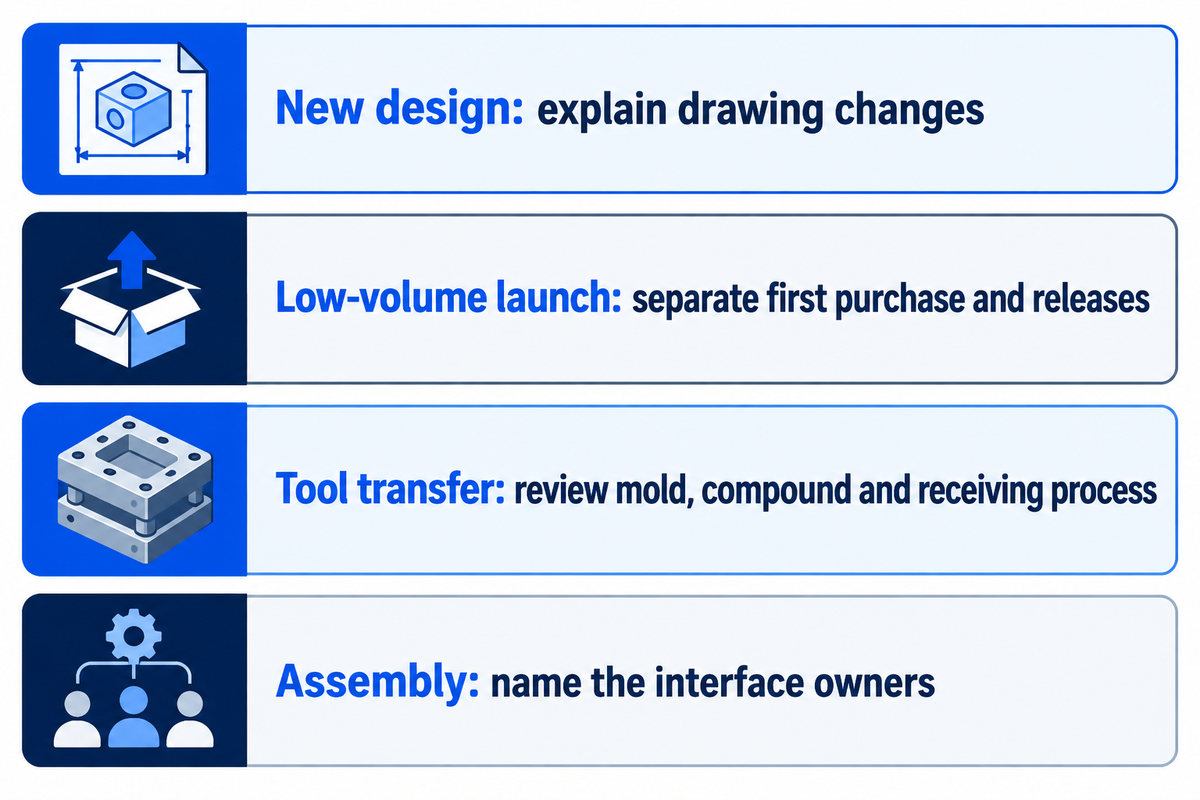
Choose development support for an unfinished design, manageable commitments for a small launch, receiving-tool expertise for a transfer, and clear interface ownership for an assembly. The project stage determines which supplier response is most critical. A good high-volume offer may not be the right response if the project team expects drawing changes.
Choose a supplier that’s able to grow with the product, as recommended in NIST’s guidance on supplier fit, for the product’s life cycle. Smaller customers may receive lower priority than larger orders.
| Project | Useful supplier response | Reason to defer selection | Buyer owner |
|---|---|---|---|
| New design | Marks the drawing and separates essential changes from optional cost reductions. | The team must approve production tooling while the functional geometry is still changing. | Design engineer |
| Low-volume launch | Quotes the first purchase and later releases separately. | The quoted rate requires an annual commitment the business cannot support. | Procurement and finance |
| Existing-tool transfer | Reviews the actual mold, compound history and receiving process. | Acceptance depends solely on photographs or the old supplier’s machine settings. | Manufacturing engineer |
| Multi-material assembly | Names who owns inserts, assembly, interface dimensions and the final check. | Each vendor excludes the fit between its component and the next one. | Project or plant manager |
Consider a launch team whose enclosure opening is still changing. A supplier offering a lower piece price only after an immediate mold commitment exposes the team to redesign expense. A more useful proposal separates the prototype work from production-tool release and identifies which decision would freeze the geometry.
For a drawing that’s stable and a proven part, focus on reliable order handling over development assistance.
What should mold design and compound recommendations explain?
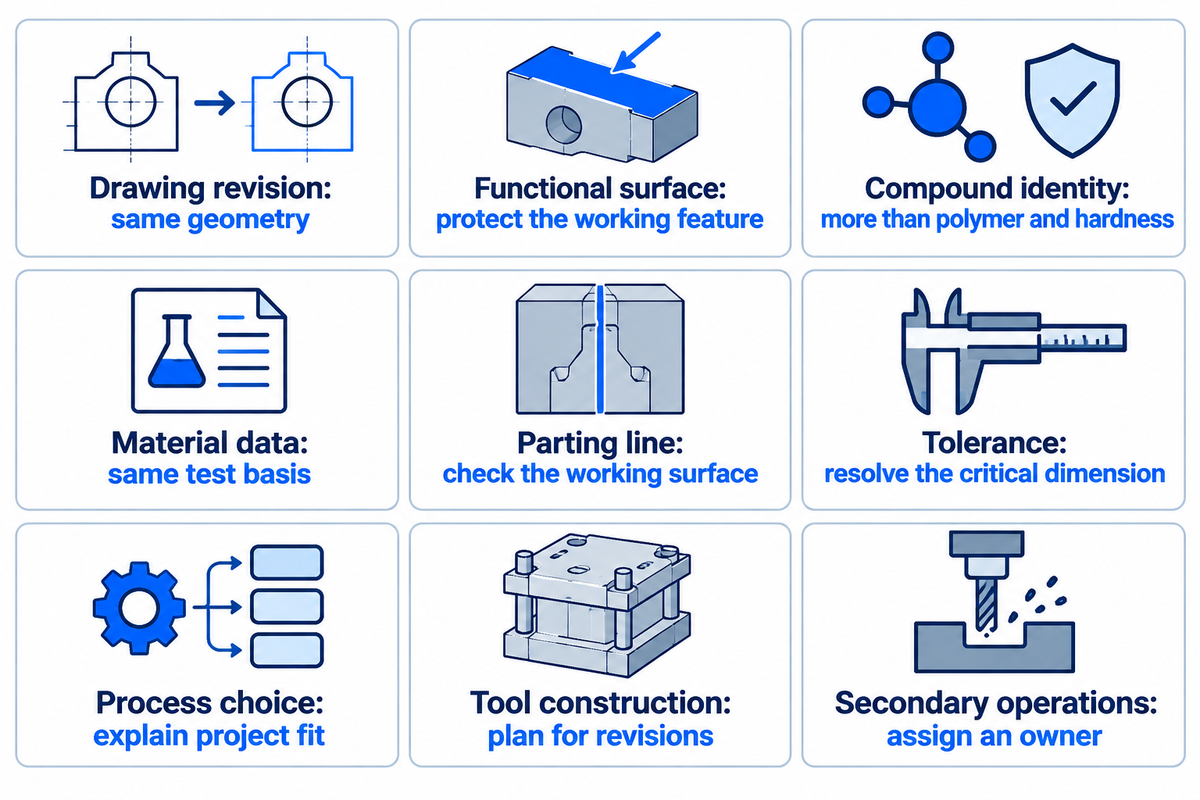
A good engineering response explains how the rubber compound and mold design support the part’s function and identifies unresolved dimensions. It gives a reason for the molding process. Compare those explanations against the same drawing revision and service conditions, so a confident sales answer does not outrank a technically specific one.
For the grommet, compare two fictional replies. “We make high-quality rubber components with high precision” could be interpreted in a number of ways, leaving the engineering decision largely to the buyer. “Move the proposed parting line away from the contact face; retain the hole position and review the sealing lip after the compound is selected” identifies a decision the engineer can assess.
| Point in the reply | What a useful answer contains | Buyer decision |
|---|---|---|
| Drawing revision | The revision quoted and any proposed changes. | Keep every offer on the same geometry. |
| Functional surface | The sealing, locating or contact face that controls performance. | Protect that feature before relaxing other dimensions. |
| Compound identity | The proposed rubber material, compound and service assumptions. | Compare more than a polymer name or hardness. |
| Material data | Test method, specimen and test conditions alongside the values. | Compare data measured on the same basis. |
| Parting line | Its proposed location and the trimming approach. | Check its relationship to the working surface. |
| Dimensional tolerance | Feature-specific limits and a measurement approach. | Resolve the critical dimension before tooling release. |
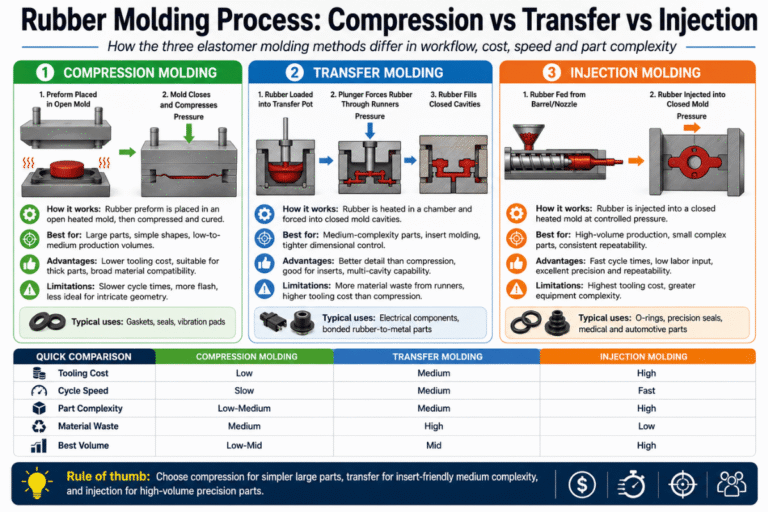
| Process choice | Why compression molding, transfer molding or injection molding is the right process for this part. | Evaluate the explanation against the project route. |
| Tool construction | Cavity arrangement and changeable custom mold components. | Understand what a design revision would require. |
| Secondary operations | Trimming, inserts, finishing and inspection included in the offer. | Assign every operation to an owner. |
Detailed product specifications take precedence over ASTM D2000-18(2024)e1 when requirements conflict; this standard classifies vulcanized rubber by material properties. ISO 3302-1:2014, confirmed in 2024, provides dimensional-tolerance classes for relevant rubber products. Select the applicable class and feature requirements with the supplier; precision toroidal sealing rings require a different applicable specification.
“materials should be compared only when tested under the same conditions.”
Compare proposed compounds’ tensile values at the same test temperature, extension rate, and specimen geometry. Differences in these conditions can affect the comparison.
What role does supplier knowledge play in selecting rubber?
Supplier know-how transforms the application’s conditions into a compound and process recommendation that your engineer can appraise. An objective recommendation explains the materials used, the property that governs service life and how that property is assessed. Usefulness lies in the testable explanation rather than a catalogue with a large range of materials.
During material selection, give both suppliers the same fluid exposure, temperature limits and mechanical duty. Different rubber molding processes can also affect the tooling and finishing work in the offer. For US repeated-use food-contact work, include the finished-article requirements applicable under 21 CFR 177.2600 (e) and (f), which address extraction from the finished food-contact surface. Medical devices and automotive projects also need their specific requirements in the brief.
Molded parts or finished assemblies: which supply scope fits?
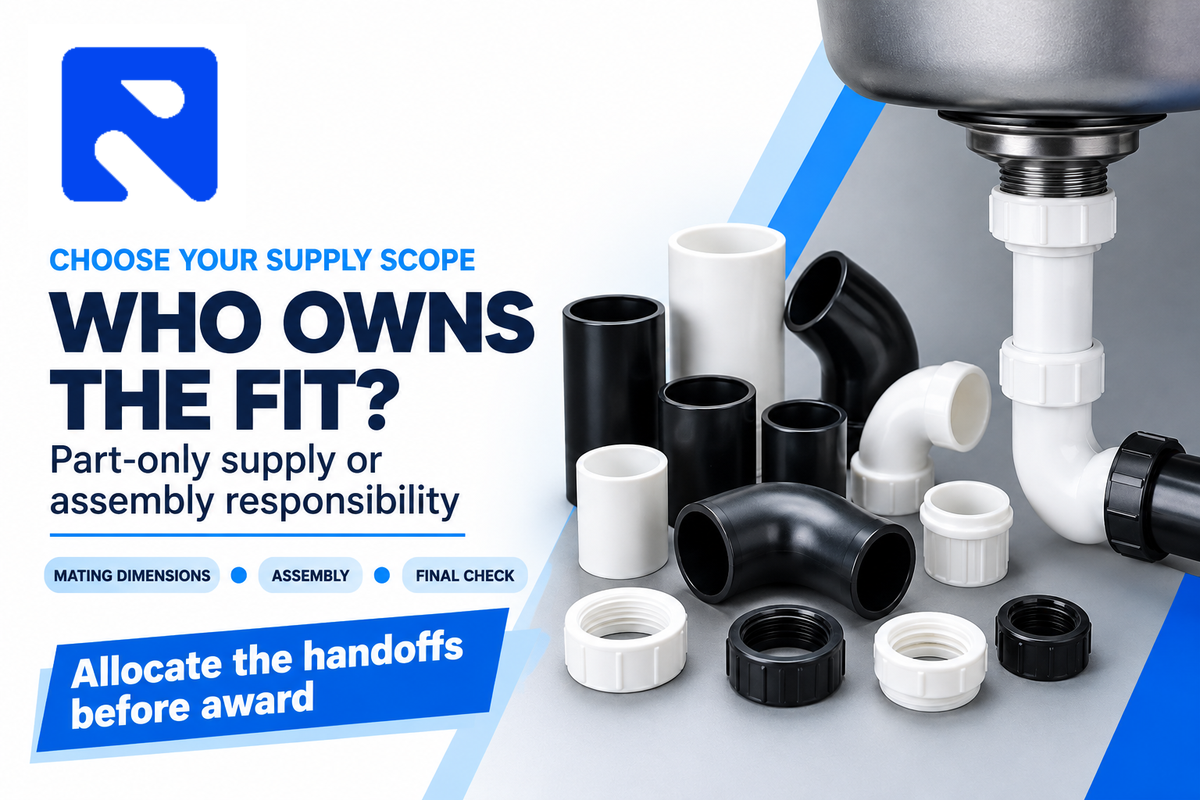
A component specialist fits a project in which the buyer manages the surrounding components and final assembly. A completely integrated supplier fits a project that requires those interfaces to be managed together. Determine scope by where the unresolved work is, and assign ownership of each handoff. Then compare commercial offers.
Engelhardt supplies molded rubber products for custom applications and offers separate plumbing-assembly and overmolding services. Therefore, a rubber product order and a complete assembly order can involve different deliverables for the same supplier relationship.
| Interface | Part-only purchase | Assembly purchase |
|---|---|---|
| Application requirements | Buyer defines part duty. | Buyer defines complete-unit duty. |
| Rubber component | Molder delivers the agreed rubber molded parts. | Assembly supplier includes the agreed part. |
| Mold and revisions | Buyer and molder allocate design changes. | Assembly supplier coordinates affected component changes. |
| Metal insert | Buyer assigns sourcing and preparation. | Offer identifies insert sourcing and preparation. |
| Plastic counterpart | Buyer manages its separate supplier. | Offer includes or identifies that supply route. |
| Mating dimensions | Buyer owns the cross-part tolerance review. | Offer names the person responsible for interface fit. |
| Assembly operation | Buyer performs or separately purchases assembly. | Supplier quotes the assembly operation. |
| Functional check | Buyer arranges the assembled-unit check. | Offer specifies the complete-unit check. |
| Packaging and release | Individual components reach the buyer’s process. | Completed units reach the agreed delivery point. |
Picture a plumbing assembly with a rubber seal, plastic housing and a metal connector. Fit and assembly of separately purchased components are the responsibility of the plant manager. An integrated quote becomes valuable when it takes on that work at an acceptable total cost. An integrated quote provides less value to a buyer that already has an integrated and effective assembly line.
Set a workable order size and delivery plan
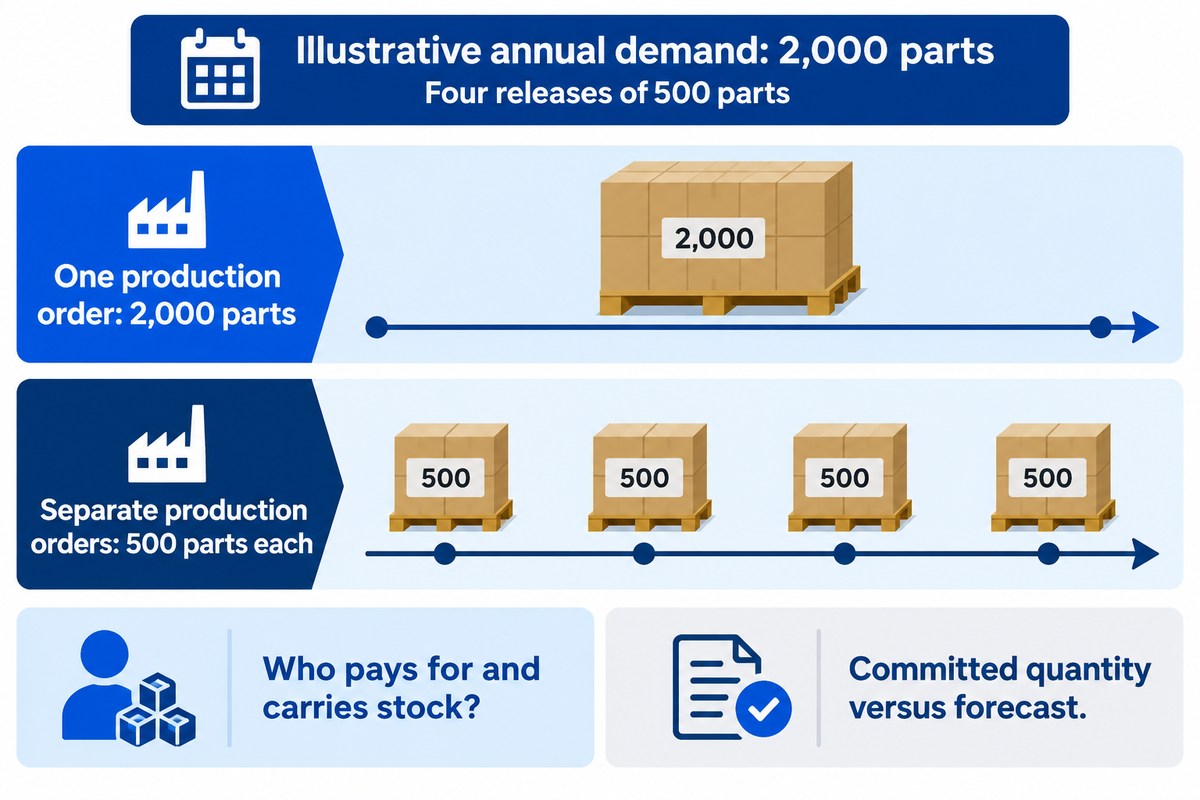
A purchase order and repeated deliveries match the supplier’s production commitment to the quantities your business can actually release. The relevant minimum can apply to a compound batch, color, part number, or release; the quotation should specify which one.
Example: Demand is 2,000 parts per year, released in four order quantities of 500. A supplier willing to produce 2,000 in one production order presents a different arrangement from a supplier willing to produce 500 in each of the four production orders. Finance needs to determine who pays for and carries the remaining stock.
Copy these questions into the quotation request:
- What quantity is committed now, and what quantity is only a forecast?
- Does the minimum apply per order, release, compound or color?
- Does the timing start at drawing approval, material availability or tooling payment?
- Does the promised date mean samples ready, goods dispatched or goods received?
- Who holds inventory, and what happens if the drawing changes before it’s used?
When deciding between offers for a small launch, take into account order priority and launch growth capacity, as advised in NIST’s small-manufacturer guidance. Standard rubber molding services may work for repeat orders, but could make the launch awkward, particularly if the first purchase is small compared to the supplier’s other orders.
Which commercial offer fits the demand you can defend?
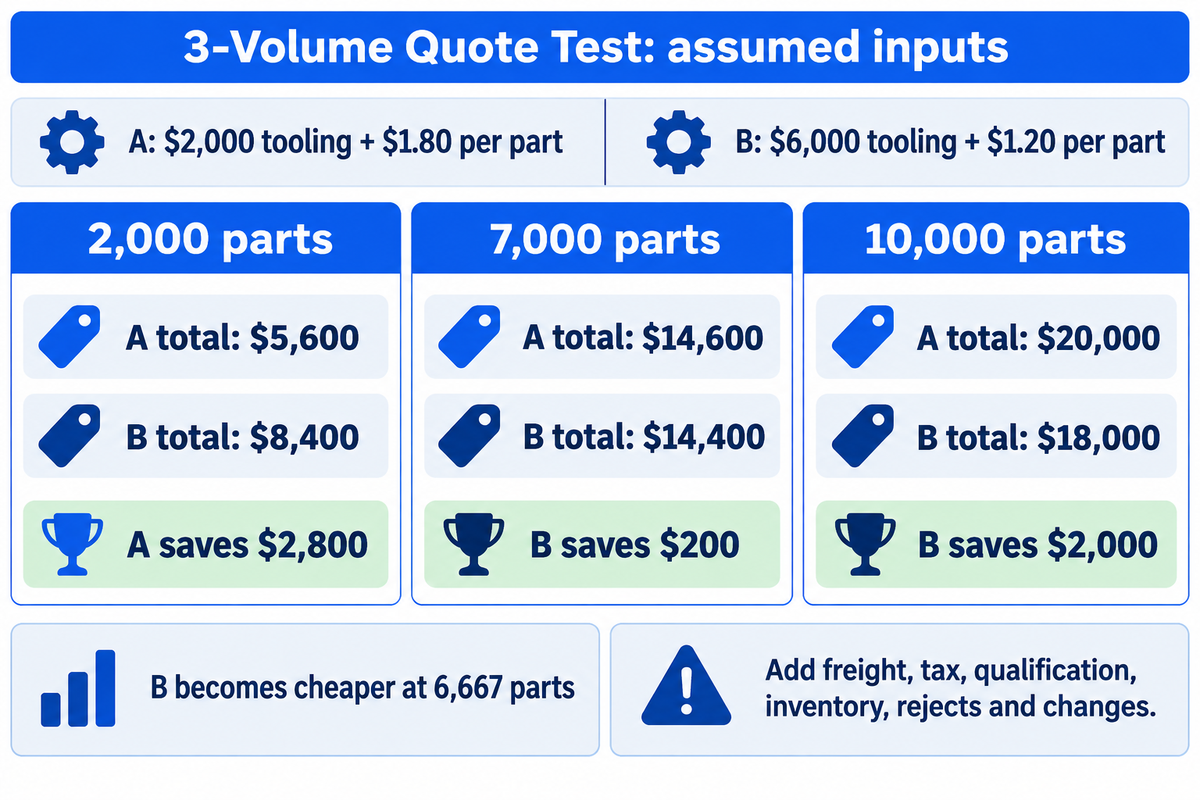
The better commercial offer is the one with the lower comparable total cost at your committed demand. The 3-Volume Quote Test compares tooling plus purchased-part costs at low, base and high demand. Use the same accepted quantity, delivered scope and time horizon, and include all costs prior to making the award.
Assumed inputs: Offer A costs $2,000 for tooling and $1.80 per accepted part. Offer B costs $6,000 for tooling and $1.20 per accepted part. Both offers deliver the same agreed part and tooling is paid once and the rates stay the same. Neither offer requires a different minimum commitment.
| Accepted quantity | Offer A total | Offer B total | Lower modeled spend |
|---|---|---|---|
| 2,000 parts | $5,600 | $8,400 | A, by $2,800 |
| 7,000 parts | $14,600 | $14,400 | B, by $200 |
| 10,000 parts | $20,000 | $18,000 | B, by $2,000 |
The extra tooling spend is $4,000 and the saving is $0.60 per part: $4,000 ÷ $0.60 = 6,666.67 parts, so B becomes cheaper at 6,667 whole parts under these assumptions.
A $200 modeled advantage is easily reversed by unequal freight, tax, qualification, inventory, rejects or design-change costs, all excluded from this first calculation. Total cost guidance from NIST includes costs beyond the purchase price, such as transportation and inventory costs, and managing distant suppliers. The agreed delivery point matters in international trade.
See the separate custom rubber molding cost guide for tooling and processing cost drivers. Keep the calculation tied to the offers in front of you. If only the first purchase is committed, then a high-volume forecast shouldn’t become the justification for a larger upfront payment.
What makes a rubber mold transfer and handover workable?
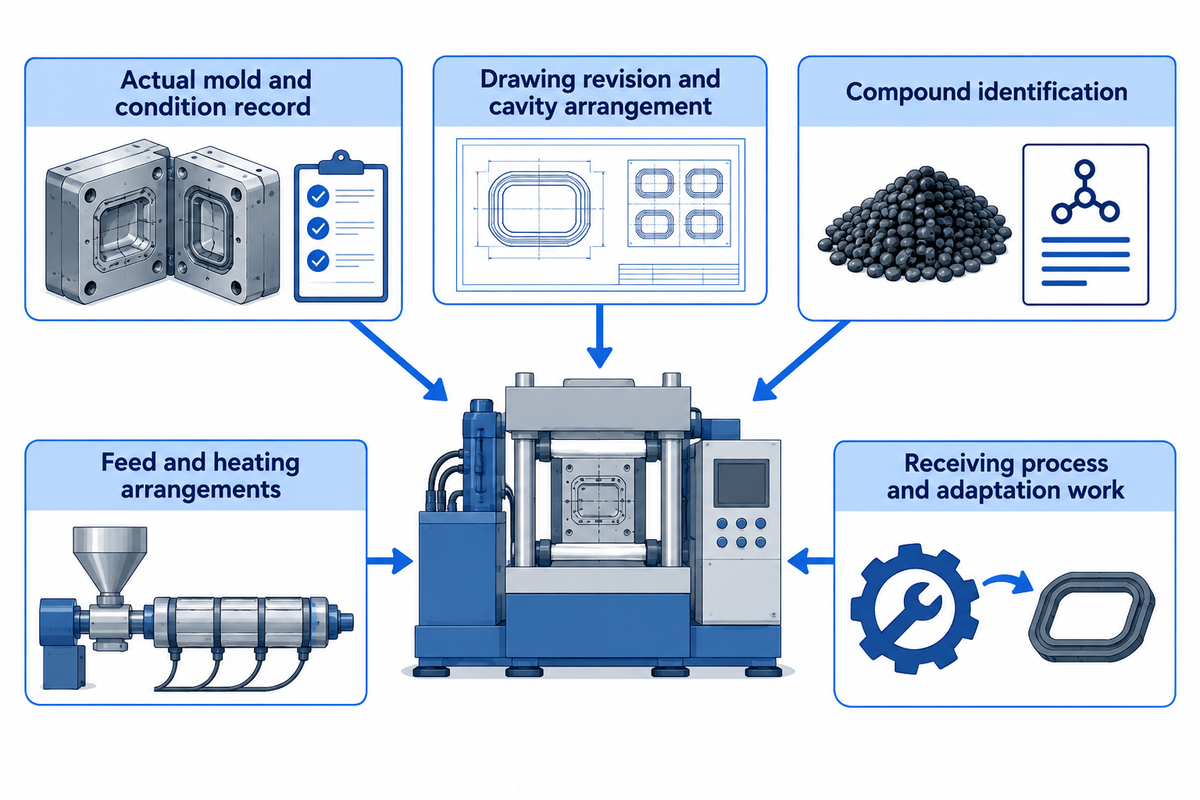
An existing rubber mold is a useful starting asset when the receiving supplier can run it with the proposed compound and production route. Evaluate the actual tool and handover package before committing to the transfer. Include proposed adaptation work in the commercial offer.
The handover package should include the mold drawing and revision, cavity arrangement, feed system, heating arrangement, condition record and compound identification. Include the approved part drawing and information needed to reproduce the production conditions. The receiving molder can then identify adaptation work and can separate it from routine production pricing.
For the material and conditions studied in a 2024 study of styrene-butadiene rubber, a model approved for compression-molded specimens didn’t adequately predict injection-molded specimens made of the same compound. Consider the proposed rubber injection molding process for changing the production route.
For a second source project, the plant manager needs a recovery arrangement covering alternative suppliers and safety stock, as described in NIST’s supply-chain risk guidance. A spare tool held elsewhere offers little immediate help, if the supply of compound and the receiving production slot are still unresolved.
Make and record the supplier selection
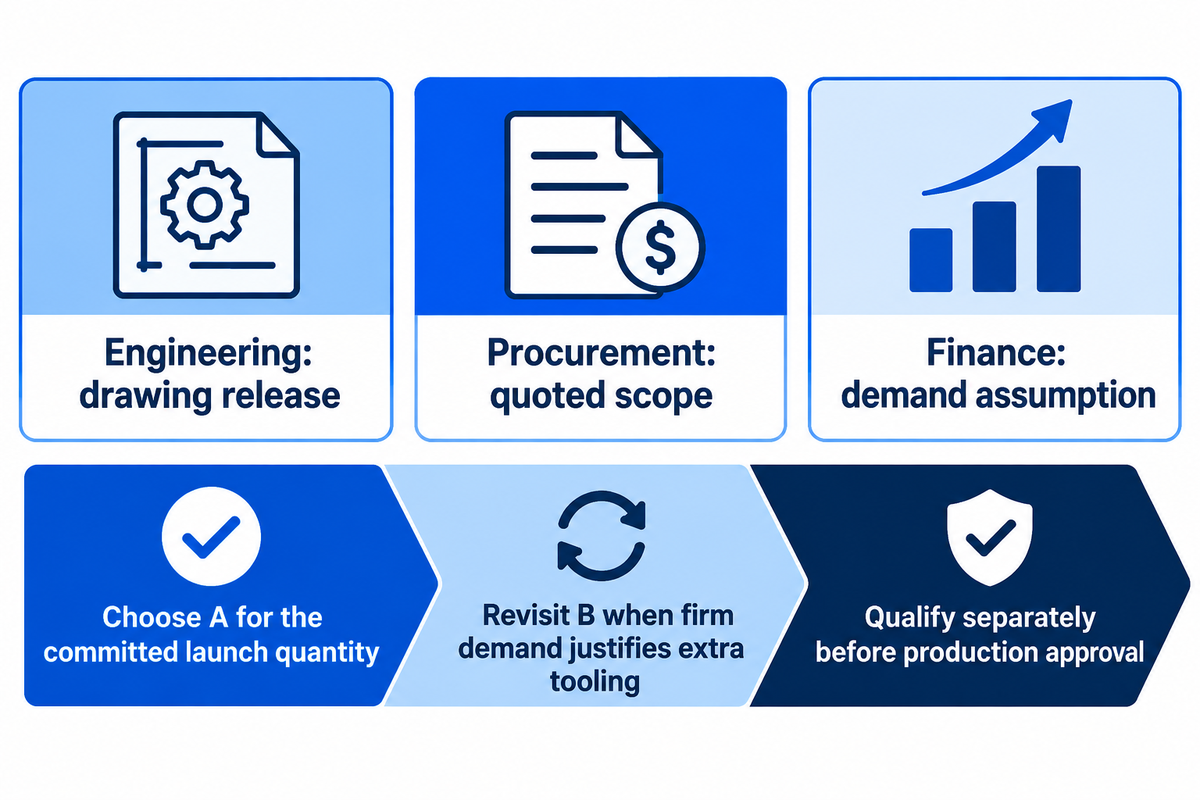
Select the supplier that’s most appropriate for the current project, and identify the assumption that would cause that decision to change. A short selection memo would give Engineering, Procurement and Finance an opportunity to view the rationale. Keep the technical requirements separate from the commercial preference, so a lower offer doesn’t disguise an unresolved functional issue.
Example decision: Choose A for the committed launch quantity after both proposals meet the part requirements. Keep B for consideration if firm demand grows to the extent that it justifies the additional tooling expenditure, after the unequal costs have been included. Engineering controls the drawing release; Procurement controls the quoted scope; and Finance controls the demand assumption.
Complete a separate rubber manufacturer qualification and audit process before production approval. That is where quality management systems, applicable ISO or IATF certification requests, sample evidence and production controls belong.
Frequently asked questions
Where can I get rubber molds?
Buy tooling from a mold maker, or buy delivered parts from a custom rubber molder.
Start by stating whether the purchase ends with the tool or with usable components. Identify who will design, build and maintain the mold, and whether molding trials are included. A casting mold for craft work is a different purchase from production tooling for an industrial rubber part. Keep that distinction in the first inquiry.
What are some common defects in rubber molding?
Common rubber molding defects include flash, short fills, trapped air and dimensional variation.
A sealing face, a thin lip and a locating hole can require different controls, so tie defect requirements to those drawing features. The engineering response should explain the proposed mold and process approach. Define permitted appearance, critical dimensions and functional checks before comparing samples from different suppliers. Record the agreed limits on the current drawing revision.
How can we prototype rubber parts before committing to expensive production tooling?
Use a shape model for fit questions and an appropriate molded sample for compound-and-process questions.
Selecting the right prototype starts with the uncertainty it must resolve. A quick model can reveal an assembly-clearance problem without reproducing production behavior. A sample made with the intended compound answers different questions. Record changes in material, mold construction and molding methods, then use the remaining uncertainty to decide whether the next tooling commitment is justified.
Are rubber and silicone the same?
Silicone rubber is one elastomer family; rubber also covers several other families.
Natural rubber, nitrile rubber (NBR), EPDM rubber and butyl rubber are other examples; FKM identifies fluorocarbon elastomers. Specify the compound and service conditions. Different rubber compounds can require different manufacturing and validation work even when their hardness is similar.
How do you attach rubber to metal?
Rubber can be mechanically retained, adhesively joined or molded around a prepared metal insert.
Choose the route around the joint’s loads and environment. For a bonded insert, the metal specification and surface preparation belong in the engineering discussion alongside the rubber. Allocate responsibility for preparation, molding and bond verification to named parties. A coating change on a purchased insert can change the joint, even if its dimensions stay the same. A specialist rubber molder and an integrated assembly supplier may offer different divisions of that work.
Do rubber and LSR molds require different steel grades than standard plastic molds?
Mold steel should be selected for the compound, tool design and production conditions.
Liquid silicone rubber injection molding and plastic injection can impose different tool requirements. The toolmaker should explain the proposed grade and finish; a familiar steel designation alone is insufficient to approve reuse of an existing tool.
Should I choose the supplier with the lowest unit price?
Choose the lowest comparable total cost among suppliers that meet the project requirements.
Include the upfront commitment and the quantities you can reasonably buy. The quote test shows how a lower piece price can require more demand before it becomes cost-effective. A large forecast is a weak basis for spending more when the first order is the only firm purchase. Record the demand assumption and the costs left outside the calculation, then revisit the choice when the commercial facts change. Qualify the supplier separately before approving production.
Shortlist a supplier for your next molding project
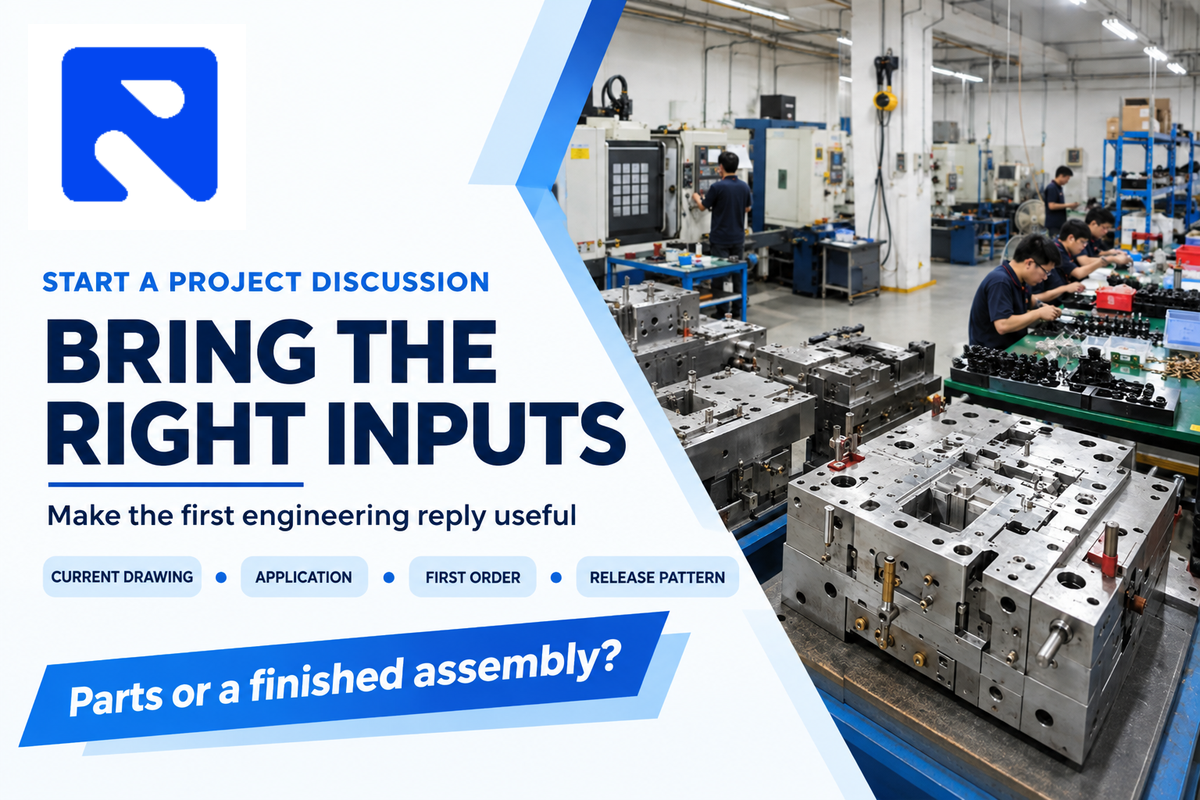
Send Engelhardt the current drawing and application conditions, first-order quantity and anticipated release pattern. Indicate if you require custom rubber parts or an assembled product. This will give the engineering staff a starting point for discussing compound, tooling and delivery scope.
Discuss your rubber molding project
References & Sources
- ISO 3302-1:2014, dimensional tolerances for rubber products.
- ASTM D2000-18(2024)e1, public scope and material-classification notes.
- ASTM D412-16(2021), public significance and use.
- NIST, supplier fit and supply-chain risk management for small manufacturers.
- NIST MEP, supply-chain management and total cost of ownership.
- Traintinger and colleagues, 2024, process design and mechanical properties of rubber vulcanizates.
- 21 CFR 177.2600, rubber articles intended for repeated use.