Get in Touch with Engelhardt


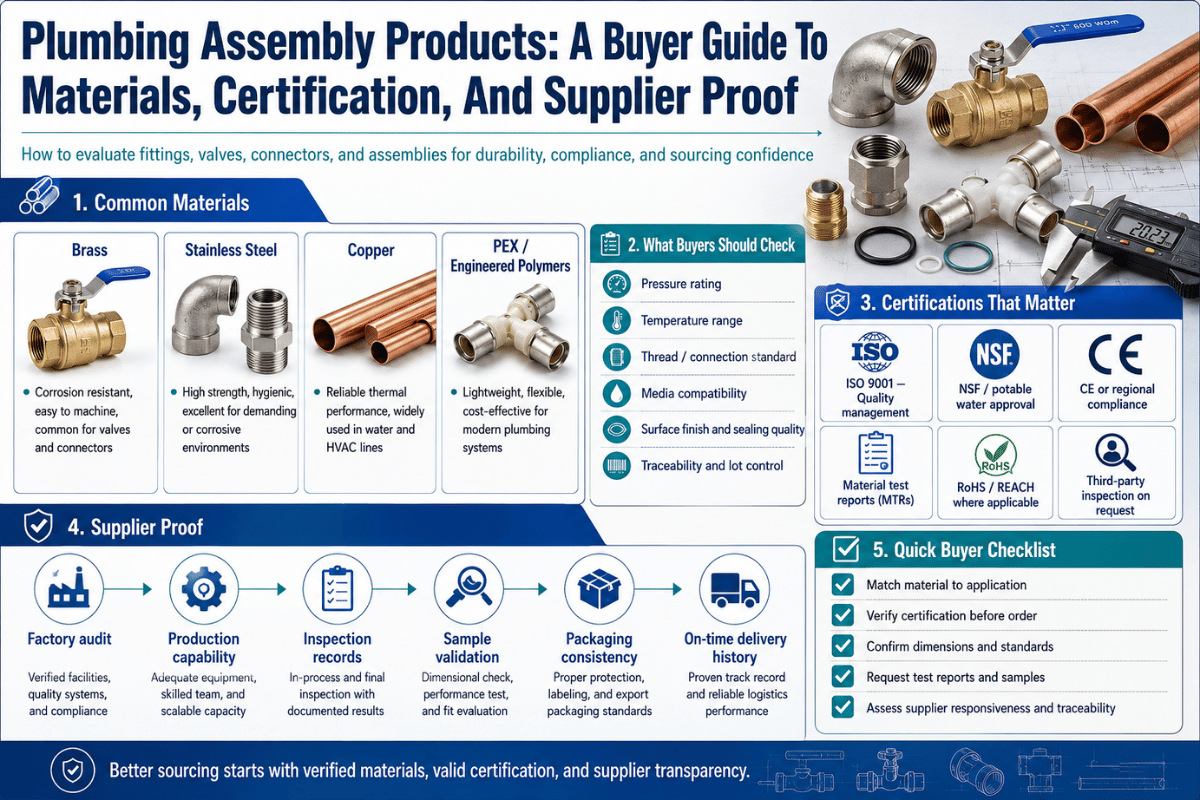
Plumbing assembly products seem simple on a catalog page, but a buyer sourcing custom plumbing assembly products manufacturing has to settle body material, seal design, thread fit, certificate path, and assembly proof before tooling starts.
For this guide, a custom-manufactured assembly product – whether a drain assembly, a floor drain, a sanitary fitting, connector, gasket, valve-adjacent kit, or a test bag – is considered one working part. Visible pieces get the first look, but hidden interfaces often determine whether the item installs cleanly, passes inspection, and keeps water contained.
Scope note: this is not a full line catalog for ball valves, stop valves, gas shut-off parts, or homeowner repair packs. It is a customer sourcing guide for OEM teams, distribution teams, and any professional plumber who later has to install or service the kit.
Quick Specs
| Assembly families | Drain assemblies, floor drains, bath waste and overflow, pipe sleeves, pipe bends, connectors, sanitaryware gaskets, seals, and pneumatic pipe test bags. |
|---|---|
| Material set | Brass, stainless steel, zinc alloy, PVC, ABS, rubber, silicone, and hardware inserts. |
| Buyer proof | Drawing, material sheet, target certificate, inspection plan, leak test plan, traceability sample, and packaging or label spec. |
| Main failure point | The boundary between body, seal, thread, finish, and installer touch point. |
| Best next step | Match application, material, market, and test evidence before asking for a unit price. |
What Counts As A Plumbing Assembly Product?
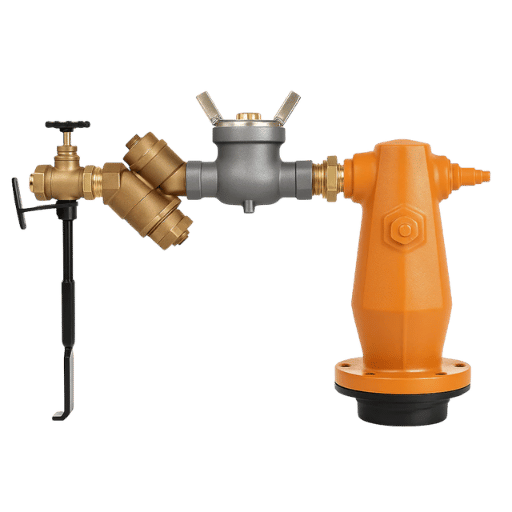
In custom manufacturing terms, a plumbing assembly product is a semi-finished or finished group of components built to work as one unit. It can connect, direct, drain, seal, isolate, protect, or test a water, waste, or gas path. The body, seal, connector, moving mechanism, accessory, and finish all have to be judged together.
Engelhardt’s public plumbing line lists 6 families: drain assemblies and pop-up drains, floor drains, bathtub waste and overflow assemblies, pipe sleeves and connectors, sanitaryware gaskets and seals, and pneumatic pipe test bags. That range is the reason this article starts with classification rather than price.
| Family | What the buyer is really sourcing | First question to settle |
|---|---|---|
| Drain assembly | Body, stopper, gasket, nut, linkage, and finish. | Which body and seal interface must survive repeated install cycles? |
| Floor drain | Grate, frame, outlet, trap path, and corrosion exposure. | Is the grate decorative, industrial, or code-bound? |
| Bath waste and overflow | Overflow face, linkage, waste elbow, gasket, trim, and packaging. | Does the kit match the tub wall, drain hole, and target market? |
| Pipe connector | PVC, ABS, rubber, brass, or stainless interface between pipe sections. | Which material touches water, cleaner, gasket, and thread? |
| Sanitaryware gasket | Rubber or silicone seal shaped around ceramic, plastic, or metal. | What compression and surface finish control leakage? |
| Pipe test bag | Reinforced rubber body, plug, valve, inflation path, and label. | What pressure, diameter, and safety marking must be proven? |
For early sorting, use Engelhardt’s product line selector. If the part depends on an elastomer seal, also compare the related rubber gaskets and seals page before locking the drawing.
What does assembly mean in plumbing?
In plumbing, assembly means the parts are judged together. A drain body may be brass, the collar may be plastic, the washer may be rubber, and the visible trim may be plated. If one piece changes, the whole product may need another fit check, certificate review, or packaging file.
Body-Seal-Thread Failure Stack: How Materials Decide Fit
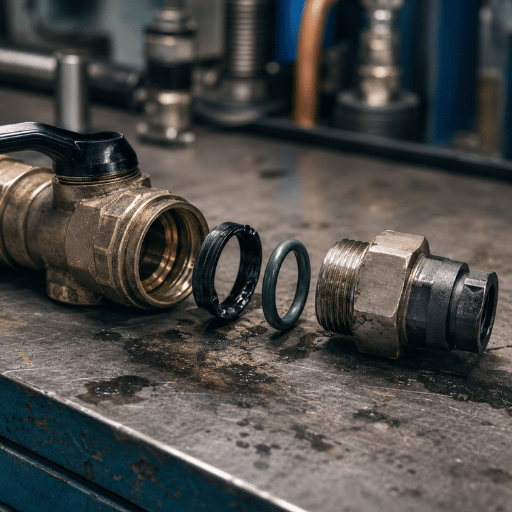
A simple way to review custom and semi-finished plumbing assemblies is the Body-Seal-Thread Failure Stack. Start with the largest visible component, then work inward through the seal, thread or mating interface, finish, and hand force needed during assembly and use.
Field troubleshooting threads show a repeated pattern: leaks are blamed on the gasket, but the real problem may be thread fill, seal orientation, dirt on mating faces, a small surface divot, or a collar that does not draw the gasket squarely. B2B sourcing should turn those field failures into drawing and test controls.
| Interface | Useful material choice | Risk to check before tooling | Evidence to request |
|---|---|---|---|
| Visible drain body | Brass or zinc alloy | Plating, thread form, and corrosion exposure. | Finish spec and salt or cleaner review. |
| Floor drain grate | Stainless steel | Load, heel contact, cleaning chemical, and slot edge. | Material grade and dimensional inspection plan. |
| PVC or ABS connector | Plastic body | Thread creep, solvent contact, and molded shrink. | Material sheet and gauge check. |
| Flat washer | Rubber | Compression set, edge burr, and chemical swell. | Hardness, thickness, and compression set test. |
| Soft gasket | Silicone | Tear strength and contact with hot water or cleaner. | Compound file and aging result. |
| Plastic threaded collar | ABS or reinforced plastic | Cross-threading and uneven clamp force. | Thread gauge and assembly torque note. |
| Metal linkage | Brass or stainless steel | Movement, finish wear, and bath chemical exposure. | Cycle check and finish review. |
| Test bag body | Reinforced rubber | Inflation pressure, wall abrasion, and valve bond. | Pressure test and batch trace. |
| Package and label | Carton, bag, or retail label | Wrong SKU, missing certificate mark, or mixed revisions. | Label artwork and traceability sample. |
Engineering Note: Do not approve a drain assembly by body material alone. A brass body with a poorly seated washer can fail sooner than a lower-cost body with a better seal interface. Review mating surface, gasket compression, thread engagement, and installer hand force as one stack.
Product innovation only helps if durability and performance evidence move with it. A chemical-resistant seal, cleaner-resistant finish, and repeatable package trace can create real cost savings by reducing rework, not by hiding risk in a lower unit price.
If material selection is the open question, begin with Engelhardt’s material selection calculator, then explore rubber-specific issues in rubber molding tolerances.
Certification-To-Market Matrix For Plumbing Products
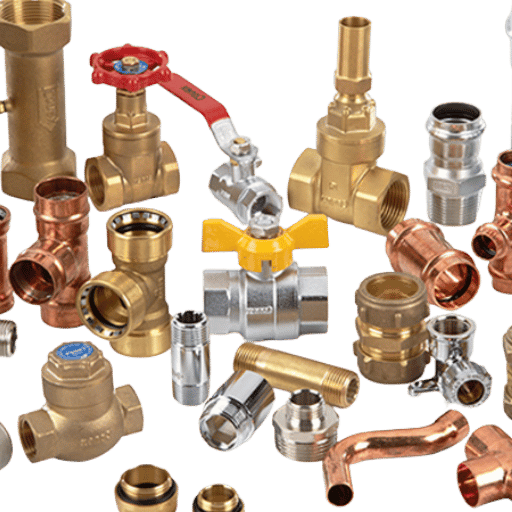
Certification is not one universal file for every assembly. IAPMO R&T frames plumbing certification around product standards and listed-product marks, while WRAS and ASME each define different approval or standard boundaries. Build the market path before the supplier freezes the drawing.
IAPMO R&T’s USA and Canada plumbing certification page states that IAPMO and IAPMO R&T have certified plumbing products since the 1940s, and it presents the cUPC mark within a North American product-standard path. That makes IAPMO a useful source when a buyer asks which proof belongs with North American plumbing products.
| Market or product path | Certificate or standard to check | What the buyer should ask for |
|---|---|---|
| United States and Canada | IAPMO/cUPC or applicable North American product listing | Listing scope, model number, mark use rule, and report owner. |
| Drinking-water contact | NSF/ANSI/CAN 61 | Compound, section, contact condition, and certified product scope. |
| UK water fittings | WRAS Approval or NSF REG4 path | Test report, lab status, sample selection, and approval boundary. |
| Waste fittings NPS-2 and smaller | ASME A112.18.2/CSA B125.2 – 2020 (R2025) | Confirm the product sits inside the waste-fitting scope, not supply fittings or connectors under pressure. |
| Plastic piping components | NSF plastic piping or relevant ASTM/CSA/IAPMO path | Material grade, pipe/fitting match, and listing record. |
| Joining and sealing materials | NSF joining/sealing material service or NSF/ANSI/CAN 61 section review | Gasket material, extraction condition, and finished-use file. |
| Metal finish and corrosion exposure | ASTM or product-specific coating test | Finish thickness, salt or cleaner exposure, and inspection method. |
| Food-contact adjacent seals | FDA or LFGB file if the actual use asks for it | Compound statement tied to end use, not a generic material label. |
| Electrical or powered plumbing accessory | UL or other safety listing if applicable | Exact electrical scope and product category. |
| Europe or Germany water contact | REG4, WRAS, KTW, CE, or country-specific route | Destination country, product family, material file, and local acceptance path. |
Engineering Note: ASME lists A112.18.2/CSA B125.2 – Plumbing Waste Fittings as 2020 (R2025), reviewed and reaffirmed in 2025. ASME says the standard covers plumbing waste fittings of sizes NPS-2 and smaller, while excluding supply fittings and flexible water connectors under continuous pressure. Use that boundary before copying the standard name into an RFQ.
For drinking-water contact, NSF/ANSI/CAN 61 is not a synonym for good plastic or safe rubber. UL describes drinking-water system component certification around health-effects testing for products that contact drinking water, including NSF/ANSI/CAN 61 and NSF/ANSI/CAN 372 review paths.
Before a sample is approved, route the destination market through Engelhardt’s certification market checker. Then ask the supplier which file belongs to the exact model, compound, label, and contact condition.
For a quality plumbing program, the key industry question is not which logo appears on the sample. What matters is whether the certificate, material specification, and product label survive review. If lead-free legislation or a specific drinking-water rule applies, list it before any sample is shipped.
If ADA clearance, local fixture access, or project-specific installer guidance applies, keep that requirement in the drawing file. It should not be left as a field assumption after the assembly is packed.
What is the 135 rule in plumbing?
Some people in the plumbing industry say this, but it’s not a worldwide sourcing mandate for every kind of plumbing assembly. Treat it as the signal to dig into code, inspector guidance and product standard where the plumbing will go. Do not okay parts from an imprecise rule name.
6-Document Procurement Gate For Assembly Buyers
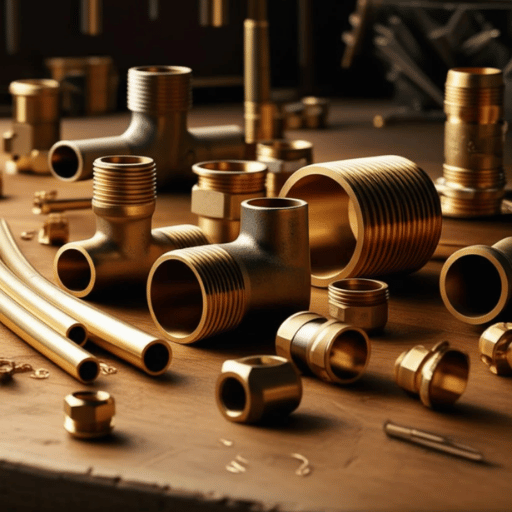
An RFQ asking for plumbing assemblies becomes something more than a price exercise only once body, seal, thread, test, certificate, and packaging information have been included. Ensure you have what is required in the 6-document procurement gate before weighing suppliers.
Engelhardt’s public site gives useful scale signals for this gate: founded in 2009, a 26,000 sqm Zhongshan facility, 300+ team members, 700 injection machines, 80+ vulcanizing machines, 3,000 tons of annual rubber and silicone output, 30M+ hardware units per year, and 500 mold sets per year. These facts support capability review, but they do not replace part-level proof.
If a supplier cites ISO 9001 quality management, treat it as a management-system signal. It still has to be paired with drawing control, inspection records, and model-specific approval evidence.
| Gate | Document to request | Why it matters |
|---|---|---|
| 1 | Part drawing and revision level | Prevents sample approval against an old body, nut, gasket, or label. |
| 2 | Material sheet by component | Separates metal, plastic, rubber, silicone, and finish evidence. |
| 3 | Certification target by market | Keeps the certificate path visible before tooling money is spent. |
| 4 | Dimensional inspection plan | Controls threads, gasket seat, wall thickness, and mating features. |
| 5 | Leak, aging, and corrosion test plan | Moves pass/fail logic from opinion to measured evidence. |
| 6 | Traceability sample and packaging spec | Protects SKU, mark, revision, and market information after production starts. |
Rubber-heavy assemblies also need material tests chosen for the actual failure path. Physical, mechanical, and chemical-property checks belong in the RFQ when a gasket, washer, or molded seal carries the water-control risk.
The worksheet below uses example field values only. Replace every value with the buyer’s drawing, destination market, and lab-approved test plan before it becomes an acceptance limit.
| RFQ measurement field | Example value format | Why the value belongs in writing |
|---|---|---|
| Washer thickness | 3.0 mm nominal with 0.2 mm tolerance | Prevents a loose seal seat from becoming a field leak. |
| Gasket compression check | 25 % compression after 22 hours | Turns recovery into a measured record instead of a hand feel. |
| Leak hold check | 15 psi for 1 hour | Makes the pass/fail method repeatable across sample rounds. |
| Cleaner exposure screen | 5 % solution for 70 hours | Keeps cosmetic finish and rubber swell from being checked too late. |
| Thread engagement | 6 mm engagement with 0.5 mm tilt limit | Connects installer hand force to the actual clamping surface. |
| Flash and burr control | 0.3 mm flash maximum and 0.1 mm burr review | Protects gasket seating, label fit, and user handling. |
| Package handling check | 10 kg carton review and 1 m drop screen | Catches mixed hardware, cracked trim, and label damage before shipment. |
| Approval-file refresh | 12 months review and 2 years retention | Keeps certificate, drawing, and package revision history aligned. |
| Test-bag pressure note | 30 psi limit with 2 hours hold | Keeps inflation and label claims tied to a repeatable check. |
| Fixture-load screen | 3 kg load for 24 hours | Shows whether the assembly distorts after storage or handling. |
| Seal-lip geometry | 2 mm lip height and 4 mm seat width | Keeps molded rubber shape tied to the mating body. |
| Retain-sample check | 72 hours hold and 6 months retain sample | Gives quality teams a repeat point when a later batch is disputed. |
| Assembly stress screen | 5 kg load and 50 psi pressure cap | Separates handling damage from pressure-path failure. |
| Record review cadence | 6 months label check and 10 years file retention | Keeps model, label, and certificate records from drifting apart. |
When a buyer later compares production outcome against the approved sample, these fields make rework rate, leak findings, and field implementation notes easier to trace back to one drawing revision.
“On a drain assembly, the drawing tells us the shape. A proof packet tells us whether the seal, thread, certificate, and package can repeat in production.”
– Engelhardt Engineering and Quality Team
Capability review can include Engelhardt’s about us page, the custom rubber molding overview, and the custom rubber parts page. For a mixed assembly, the document gate still belongs inside the RFQ.
OEM Vs ODM Plumbing Assemblies: Tooling, Samples, And Ownership
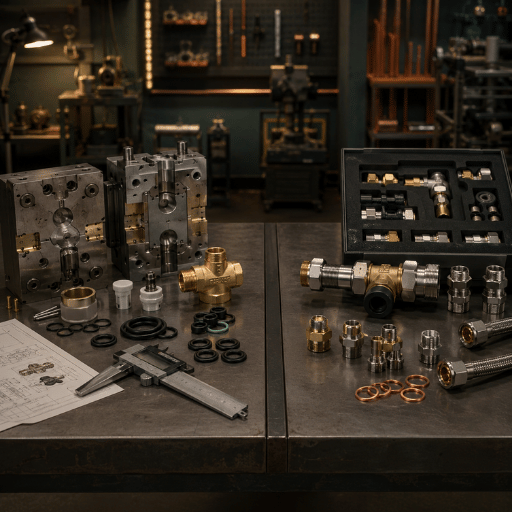
OEM and ODM are not just sales labels. They decide who owns the drawing, who carries the certificate work, who controls packaging, and how much of the assembly can be reused across a brand’s product line.
| Decision trigger | OEM path fits when… | ODM path fits when… |
|---|---|---|
| Drawing ownership | Buyer controls geometry and revision changes. | Supplier adapts an existing design family. |
| Speed | Custom geometry matters more than quick sample release. | A known design can be adjusted without new core geometry. |
| Exclusivity | The assembly creates brand or product differentiation. | Standard function is acceptable and packaging carries the brand. |
| Certificate owner | The buyer needs a file tied to its model and market. | An existing supplier file can be reviewed for the exact use. |
| Sample risk | More first-article checks are expected. | Sample starts closer to a proven product family. |
| Packaging | Private label, SKU logic, barcode, and instruction sheet are fixed by buyer. | Supplier packaging can be modified with fewer changes. |
OEM Advantages
OEM gives the buyer more control over geometry, branding, certificate ownership, and future design changes. It fits a drain, floor drain, or sanitaryware program where the assembly becomes part of the buyer’s product identity.
OEM Limits
OEM usually asks for more drawing control, mold review, inspection planning, and sample approval work. Buyers should budget time for first-article review and market evidence.
Use the OEM/ODM decision guide when the drawing is still open. When the part family is already clear, send the proof packet through Engelhardt’s RFQ contact form.
Testing The Interfaces Most Likely To Leak
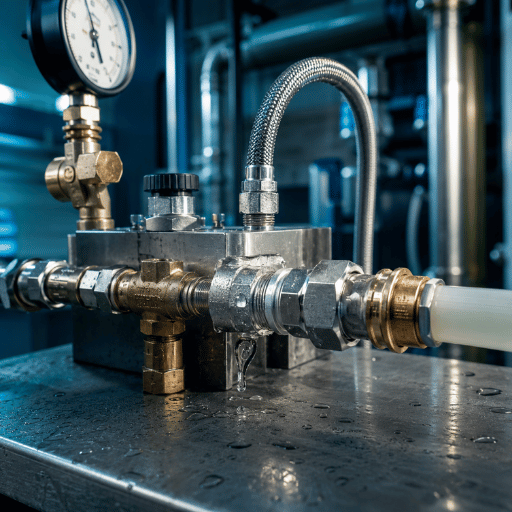
A visual check catches scratches and missing parts. It does not prove gasket recovery, thread fit, aging behavior, corrosion response, or carton handling. Interface tests should be chosen from the product’s actual failure path.
WRAS product approval resources list example checks such as visual inspection, leak tightness, endurance, tensile pull-out, accelerated aging, marking for identification, and material or water-quality evidence. Those headings are useful reminders even when the buyer is not selling into the UK.
| Leak path | Test or review | What it catches |
|---|---|---|
| Gasket seat | Dimensional fit and surface review | Warp, burr, sink mark, or uneven seating face. |
| Rubber washer | Hardness, thickness, and compression set | Low recovery after clamp load and heat exposure. |
| Threaded collar | Thread gauge and assembly torque note | Cross-threading, shallow engagement, and uneven squeeze. |
| Metal finish | Cleaner or corrosion exposure review | Finish attack, edge rust, or appearance claims that fail later. |
| Plastic connector | Shrink, wall, and gauge check | Ovality, poor pipe fit, and sealing stress. |
| Packaged kit | Drop, label, and mixed-revision review | Wrong parts in the carton or damage during handling. |
A supplier can mold a good rubber part and still ship a weak assembly if the nut, metal body, gasket, and instruction sheet are not tested together. For rubber-heavy assemblies, compare Engelhardt’s rubber molding process guide and the related plumbing rubber parts guide.
What Is Changing In Plumbing Product Sourcing For 2026?

Recent keyword data returned only short monthly rows for adjacent terms, so the trend view here is directional. Buyer demand still appears active around floor drain, pipe fittings, pop-up drain assembly, trap primer floor drain, and sanitary fittings, while the exact phrase Plumbing Assembly Products has shallow search data.
Compliance creates the clearer sourcing pressure. WRAS applicant guidance ties UK water fitting approval to product quality and standard requirements, valid test evidence, and defined approval scope. That kind of paper trail should be settled before tooling, not after a shipment is packed.
| 2026 sourcing pressure | Buyer action | Evidence to keep in the file |
|---|---|---|
| Certificate questions arrive earlier | Name target market before mold release. | Certification route, owner, and model scope. |
| Mixed-material assemblies create more handoffs | Avoid split-vendor sourcing where body, seal, and thread fit is the main risk. | Assembly drawing and interface inspection plan. |
| Traceability matters after the first order | Link packaging, batch, drawing revision, and material sheet. | Trace sample, SKU record, and label proof. |
| Installation failures reflect design choices | Test the likely field assembly path, not only a bench-perfect sample. | Installer note, torque cue, and leak test record. |
Safe sourcing starts by putting certification, traceability, and interface evidence before price negotiation. A low unit cost does not help if the water-contact file is wrong, the gasket loses recovery, or the kit cannot be traced after a revision change.
For a broader rubber and plastic assembly discussion, review rubber O-rings, the rubber elastomer compound selector, and Engelhardt’s manufacturing services.
FAQ
What are plumbing assembly products?
They are grouped parts sold and tested as one product: body, seal, connector, trim, label, and sometimes a moving or test component.
What information should be included in a plumbing assembly RFQ?
Include a drawing, material targets, target market, required certificate path, expected water or chemical exposure, quantity, packaging requirement, test plan, and who will own the approval file. Add a sample photo only as support, not as the main spec.
Which material is best for a drain assembly?
There is no single best material. Brass can suit visible bodies, stainless steel can suit grates, PVC or ABS can suit connectors, and rubber or silicone can suit sealing points. Selection depends on water contact, cleaner exposure, thread fit, surface finish, certificate target, expected installation force, and the way the user tightens or handles the assembly in the field. A raw-material enquiry using stainless steel products from TiAlloy should state the grade, finish and required evidence for the finished plumbing component.
Which certifications matter for North American plumbing products?
Common review paths include IAPMO/cUPC for listed plumbing products and NSF/ANSI/CAN 61 for drinking-water contact where the product scope requires it. Correct proof depends on product type, code jurisdiction, material, and exact contact condition.
Is OEM or ODM better for plumbing assemblies?
Choose OEM when drawing control, exclusivity, private-label detail, and certificate ownership matter. Choose ODM when an existing product family can satisfy the target market with fewer changes. In either case, review the proof packet before production approval.
Can Engelhardt assemble rubber, plastic, and hardware in one product?
Engelhardt’s site presents the company as a vertically integrated manufacturer covering rubber, silicone, plastic, precision hardware, mold making, and assembly. For a project-specific answer, send the drawing, material target, and market requirement so the engineering and quality teams can check fit, test path, and packaging scope.
References And Sources
IAPMO R&T Plumbing Certification
IAPMO R&T Plumbing Certification, USA and Canada
ASME A112.18.2/CSA B125.2 Plumbing Waste Fittings
UL Drinking Water System Components Certification
Send The Assembly Brief
For a drain assembly, sanitary fitting, rubber gasket, connector, or test bag project, send the drawing, target market, material list, annual quantity, and proof requirements. Engelhardt can review the body, seal, thread, test, and packaging path before quoting.