Get in Touch with Engelhardt


Updated October 2026 · Guangdong Engelhardt-Meitu Rubber & Plastic Technology Co., Ltd. technical team
Rubber is an amorphous, lightly crosslinked polymer, also labelled as an elastomer under ISO 1629 and ASTM D1418. Coiled molecular chains stretch up to 534% under tensile load and snap back to its original shape. Producers can harvest natural rubber latex from tropical Hevea rubber trees, or they can polymerize synthetic rubber from petroleum by-products. Matching polymer chemistry, cure system, and Shore A durometer stops oil swelling and premature gasket leaks.
Quick Answer: Rubber is a resilient elastomer operating above its sub-zero glass transition temperature (-50 °C to -125 °C). Natural Hevea latex excels in tear and fatigue strength, while synthetic grades (EPDM, NBR, FKM, silicone) resist oils, ozone, and temperatures up to 230 °C.
Quick Specs
| Chemical Class (ISO 1629 / ASTM D1418) | Lightly crosslinked amorphous elastomer (natural cis-1,4-polyisoprene or synthetic petrochemical/siloxane polymers) |
| Glass Transition Window (Tg) | -125 °C (VMQ silicone) to -20 °C (standard FKM fluoroelastomer) |
| Commercial Durometer Span | 10 to 95 Shore A (standard molding tolerance ±5 Shore A) |
| Dry-Air Continuous Service Range | -60 °C to +230 °C across 30+ stocked compound families (derate 25–50 °C in hot fluids) |
| Press Vulcanization Window | 150 °C to 200 °C via sulfur, organic peroxide, or platinum addition curing |
| Typical OEM Production Benchmarks | 10–50 pcs prototypes in 2–3 weeks; 1,000–2,000 pcs production MOQs |
What Is Rubber? Polymer Chains, Glass Transition, and Why Elastomers Snap Back
Rubber is a lightly cross-linked macromolecular substance, which operates far above its sub-zero glass transition temperature of -50 °C to -125 °C. Coiled chains uncoil to an astonishing length of 534% under tensile load and recoil to their original shape once the load is released. Above 120 °C or in the presence of hydrocarbon oils, polyisoprene degrades and a synthetic elastomer should be used instead.
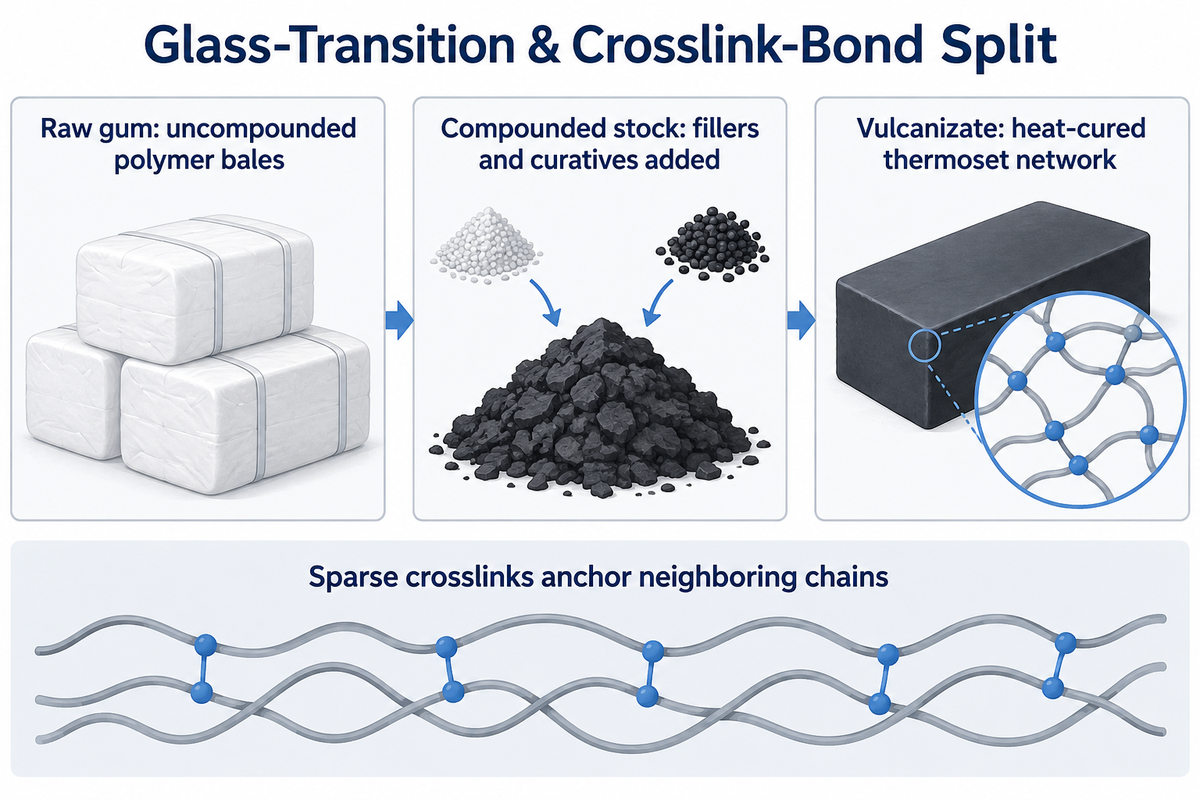
At room temperature, a cured rubber material neither behaves like a rigid crystal nor a viscous liquid. Long polymer chains remain in random coils. Thermal energy allows each monomer to freely rotate and keeps the chains tangled in random coils. Sparse crosslinks anchor neighboring chains to each other and explain the difference between true elastomers and thermoplastics.
Pulling or squeezing a seal over a surface forces long polymer chains into more aligned, straighter configurations. Once the external force is removed, thermal energy drives the long polymer chains back to their original, random coiled configurations. Therefore, a properly cured resilient material will not remain deformed even after being subjected to a heavy load.
This design boundary is called the Glass-Transition & Crosslink-Bond Split. Sub-zero cold flexibility comes from a low backbone glass transition temperature (-70 °C for cis-1,4-polyisoprene and -125 °C for silicone). Sealing survival is provided by the high temperature covalent crosslinks. A 2026 Scientific Reports study on crosslinked EPDM networks indicates that the modulus and tear strength of a network are governed by the density of crosslinks.
On technical prints, ISO 1629:2025 rubber and latices nomenclature separates three distinct stages. Raw gum refers to uncompounded polymer bales. Compounded stock adds reinforcing fillers and curatives, while vulcanizate names the heat-cured thermoset network with stable elastic properties.
Does rubber obey Hooke’s law under large strain?
Rubber obeys Hooke’s law only below 5% to 10% tensile strain. Above 10% strain, uncoiling of the chains results in a J-shape hyperelastic behavior. Internal friction between the chains absorbs shock and converts machine vibrations to heat.
Natural and Synthetic Rubbers: From Hevea Latex Sap to Petroleum Monomers
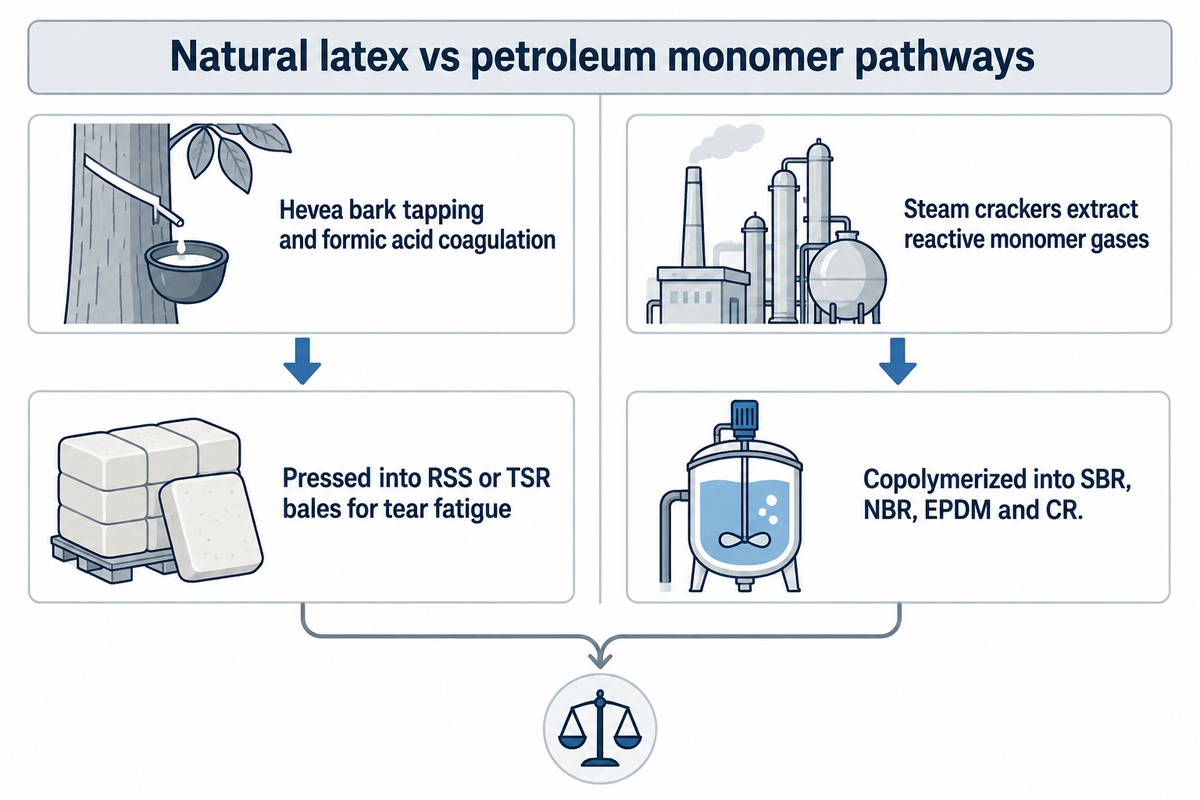
Natural rubber comes from latex tapped on tropical Hevea brasiliensis plantations. Chemical plants produce synthetic rubbers by polymerizing monomers derived from crude-oil naphtha, such as styrene, butadiene, ethylene, propylene, and acrylonitrile. Specify natural polyisoprene for extreme tear fatigue, and switch to synthetic grades for oil, ozone, or 100 °C heat.
32.49M t2025 global rubber demand (IRSG)
91%–94%cis-1,4-polyisoprene in dry NR gum
61%world NR share from Thailand, Indonesia & Vietnam
The Hevea rubber tree is native to the Amazon basin of South America. About a century ago, commercial production was moved to Southeast Asia. Currently, smallholder producers there supply the majority of natural rubber. Thailand, Indonesia and Vietnam account for 61% of global supply. To collect latex, tappers make spiral cuts in the bark laticifers at dawn, without damaging the tree.
Latex is colloidal rather than true xylem sap. Mill workers filter the liquid and add formic acid to help coagulate the particles into wet sheets. The sheets are then dried and pressed into Ribbed Smoked Sheet (RSS) or Technically Specified Rubber (TSR 10 and TSR 20). According to natural rubber polymer chemistry data, natural gum contains 91% to 94% cis-1,4-polyisoprene hydrocarbon chains. These chains strain-crystallize at crack tips and consequently, provide self-reinforcing mechanisms. This gives Heavy Truck and Aircraft tires an outstanding green tack, or stickiness, and cut growth resistance.
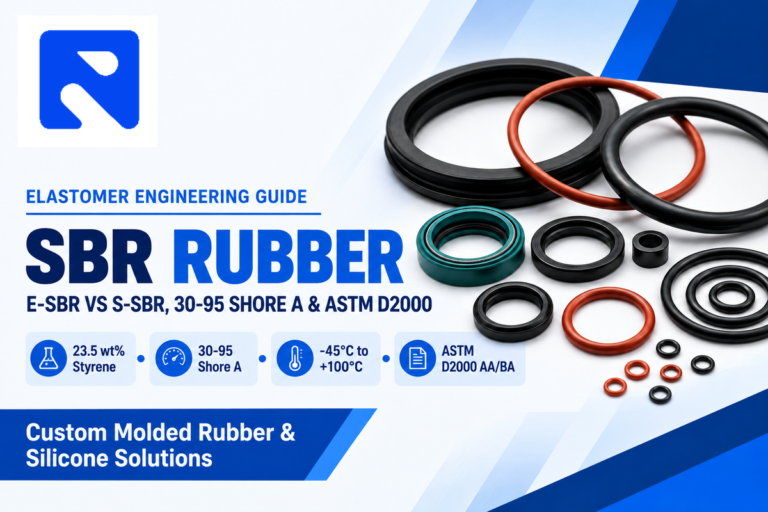
Across natural and synthetic rubbers, global consumption is split at about 46% natural and about 54% synthetic. Steam crackers break down petroleum by-products into hydrocarbon streams which extract reactive monomer gases. These reactive monomer gases are copolymerized with styrene and butadiene to create styrene-butadiene rubber (SBR) which is used to manufacture passenger tires. Other combinations use acrylonitrile to make NBR, ethylene and propylene to make weatherproof EPDM, and chloroprene to yield polychloroprene which is flame retardant.
How Vulcanized Rubber Works: Sulfur, Peroxide, and Platinum Cure Systems
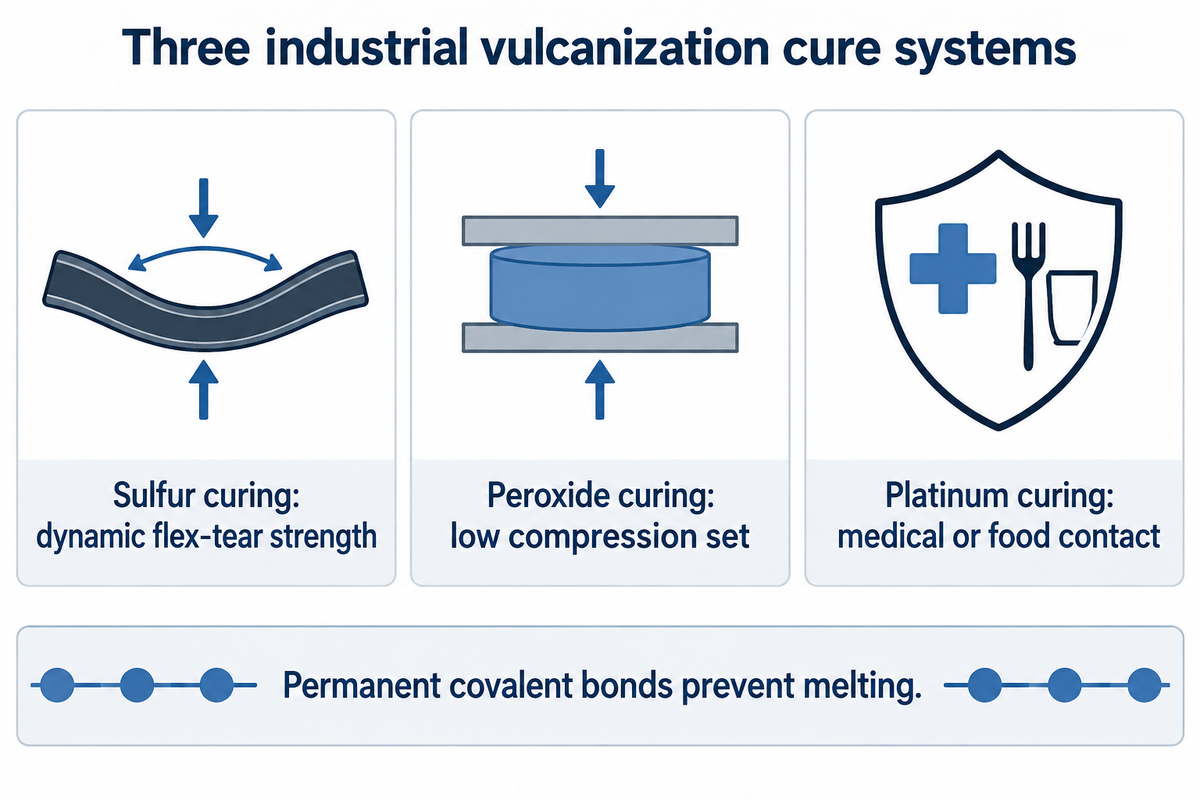
Vulcanization heats compounded gum rubber at 150 °C to 200 °C with sulfur, organic peroxides, or platinum catalysts to form a three-dimensional thermoset network. Choose sulfur curing for dynamic flex-tear strength. Use peroxide curing above 100 °C to achieve low compression set. Use platinum curing for medical or food contact applications.
Without curing, natural gum is sticky and unstable across seasons. In 1839, it was discovered that heating natural gum with sulfur turned tacky latex into a tougher, elastic solid which maintains its shape.
Specifying a base polymer is only half of a compound specification. Elemental sulfur and organic peroxide, for instance, behave very differently in a 70 Shore A EPDM or nitrile seal. A 2025 Polymers study on elastomer vulcanization kinetics illustrates scorch safety (t10) and optimum cure time (t90) for crosslink network uniformity. Balanced filler dispersion aids also help to lower dynamic heat build-up.
| Cure System | Crosslink Bridge & Bond Energy | Mechanical & Sealing Strengths | Service Disqualification Boundary |
|---|---|---|---|
| Conventional / Semi-EV Sulfur | Polysulfidic & disulfidic C–Sx–C (~225–270 kJ/mol) | Highest tear strength, flex-cut resistance, and hot-air oven curing compatibility | Reverts above 90–100 °C; compression set can reach 70%–80% leak limit; stains copper contacts |
| Organic Peroxide | Direct carbon-carbon C–C (~348 kJ/mol) | Raises continuous heat limit by +15 °C to +25 °C; improves ASTM D395 compression set by up to 38% | 10%–20% lower hot tear strength; oxygen inhibits open-air curing; requires post-cure oven baking |
| Platinum Addition (Hydrosilylation) | Ethylene-siloxane Si–CH2–CH2–Si (~318–355 kJ/mol; Si–O backbone ~445 kJ/mol) | Zero peroxide by-products, odorless, non-yellowing, rapid 15–45 s LSR injection cure | Catalyst poisoned by sulfur, tin, or amine residues; restricted to silicone (LSR/VMQ) systems |
Source: Polymer bond dissociation data, US20240026139A1 peroxide/TAIC crosslinking disclosures, and Engelhardt compounding lab records.
Repeatable crosslink density begins in the mixing room. At Engelhardt, automated compounding lines hold batching accuracy of ±0.3% across base elastomers, zinc oxide, curatives, and reinforcing fillers. Press lines then cure parts at temperatures between 150 °C and 200 °C using compounds from the 30+ stocked families. Moving die rheometer tests are performed on every batch. If under-cure is detected, that batch isn’t processed any further.
Can vulcanized rubber melt when reheated?
No, vulcanized rubber can’t melt or flow back into a liquid mold charge as the covalent bonds that link its polymer chains are permanent. Heating a cured thermoset past its thermal ceiling (120 °C for natural rubber up to 300 °C for specialty fluoroelastomers) will cause it to harden, undergo scission, or pyrolyze.
Is Rubber a Plastic? Thermoset Elastomers vs Synthetic TPE and TPU
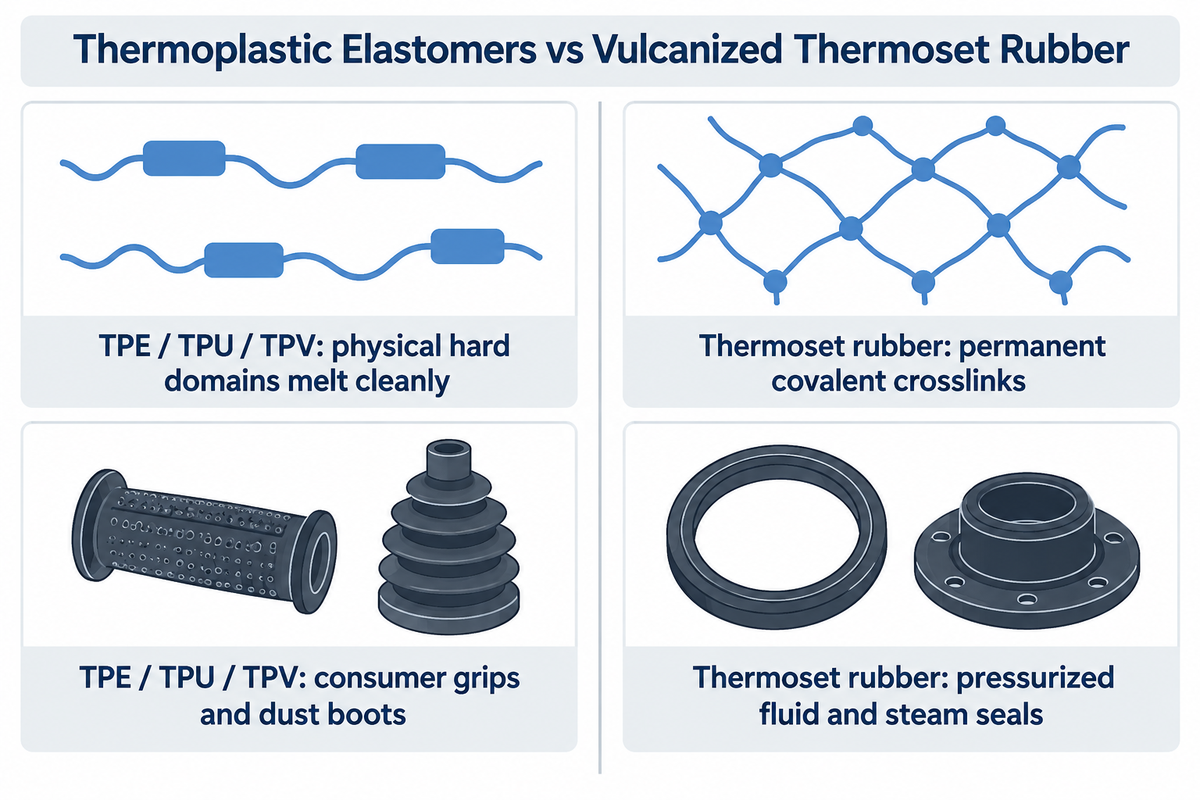
While both plastics and rubbers are polymers, cured thermoset rubber isn’t a rigid plastic because it contains covalent crosslinks. Rubber remains elastic and won’t melt. Unlike rubber, thermoplastic elastomers (TPE, TPU, TPV) can be repeatedly softened by heating and hardened by cooling. Replace thermoplastic elastomers (TPE, TPU, TPV) with vulcanized rubber whenever continuous sealing temperatures exceed 70 °C to 90 °C or hydrocarbon oils contact the joint.
Designers often argue about whether grips, bellows, and housing gaskets should be made of rubber or made from TPE pellets. TPEs consist of hard crystalline domains and soft rubbery blocks. Heating melts those plastic domains for 15-to-45-second injection cycles, and cooling locks physical tie-points without chemical curing. Cycle times are 15-45 seconds.
Thermoplastic Elastomers (TPE / TPU / TPV)
- Physical phase-separated hard domains melt and reprocess cleanly
- Fast 15–45 s thermoplastic injection cycle with recyclable runners
- Compression set approaches 70%–80% leak limit near 70–100 °C
- Best for consumer goods grips, dust boots, and ambient strain reliefs
Vulcanized Thermoset Rubber (EPDM / NBR / LSR / FKM)
- Permanent covalent crosslinks hold shape up to 150–230 °C
- 45–240 s press or injection cure cycle; runners cannot be remelted
- Holds 10%–25% ASTM D395 compression set under multi-year bolt load
- Mandatory for pressurized fluid seals, under-hood mounts, and steam gaskets
Physical phase separation sets a strict thermal ceiling. As ambient heat approaches 70 °C to 100 °C, TPE and TPU hard blocks soften and let gaskets creep under bolt torque. Covalently crosslinked compositions, such as those tested in EP4403603A1 heat-aged crosslinked rubber disclosures retain hardness stability after 72-hour aging at 100 °C. New materials in the TPV family also perform well in splash light shields. Pressurized valves across this variety of applications still require custom rubber molding services using thermoset compounds and polymers.
Natural Rubber vs Synthetic Rubber: 9 Industrial Compounds Compared
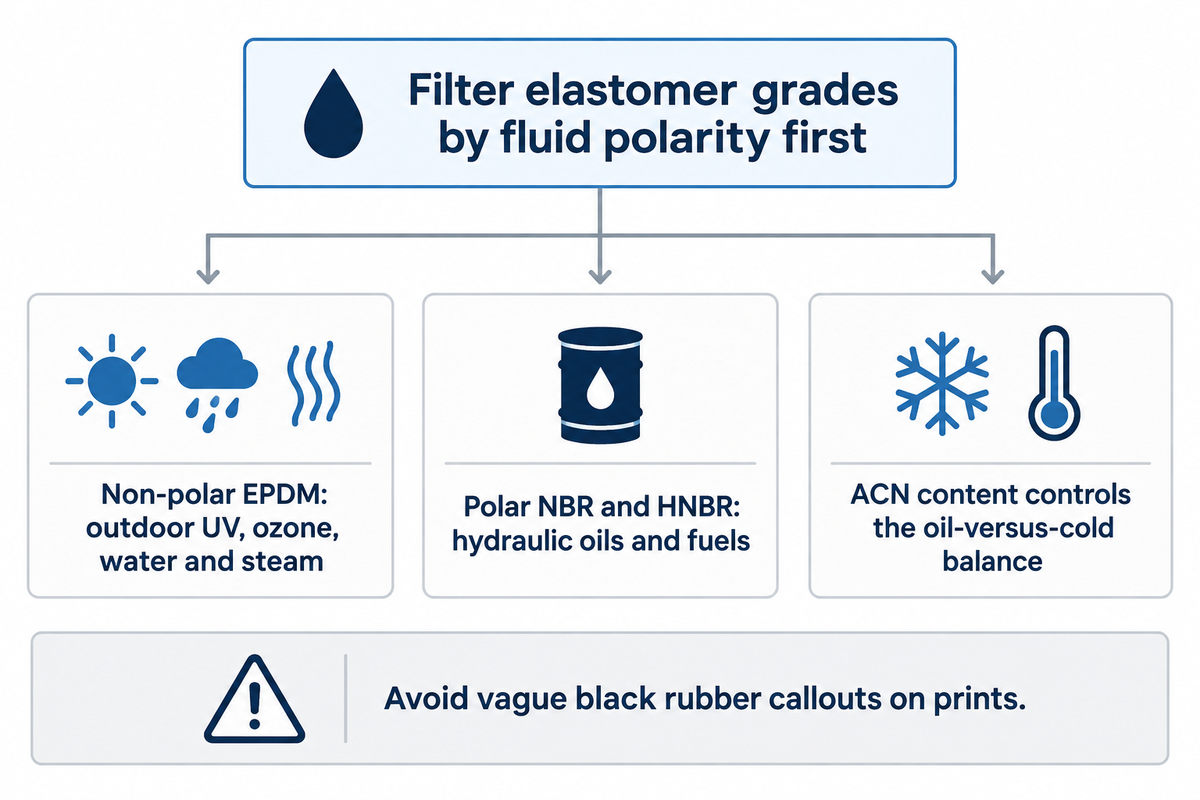
Nine commercial elastomer families cover over 95% of industrial rubber products, from high-rebound natural rubber (-55 °C to +70 °C) to FKM fluoroelastomers (+230 °C). Filter grades by fluid polarity first: non-polar EPDM survives steam and glycol but swells severely in mineral oil, where polar NBR, HNBR, or FKM excels.
Versatile grade rubber is adaptable enough to be used to make both 10 Shore A medical valves and 90 Shore A hydraulic wipers. Writing a vague “black rubber” note on an engineering print will result in instant field leaks. In 70 MPa O-ring failure tests across NBR, EPDM, FKM, and VMQ, polymer polarity and glass transition temperature govern extrusion, cracking and fluid swelling.
| Rubber Family (ISO 1629 / ASTM D2000) | Shore A Range | Dry-Air Temp Window | Primary Media & Mechanical Strength | Disqualifying Exposure |
|---|---|---|---|---|
| Natural Rubber (NR, AA) | 30–90 A | -55 °C to +70 °C | Peak tensile (20–30 MPa), tear strength, and NVH vibration isolation | Petroleum oils, fuels, outdoor UV/ozone (>50 pphm), and continuous heat >80 °C |
| Styrene-Butadiene (SBR, AA/BA) | 40–90 A | -50 °C to +100 °C | Economical dry abrasion resistance for tire treads, pedals, and grommets | Hydrocarbon oils, aromatic solvents, and unshielded outdoor ozone |
| EPDM (BA/CA/DA) | 30–95 A | -50 °C to +150 °C | Outdoor UV/ozone, potable water, 150 °C steam, and glycol DOT 3/4 brake fluids | Mineral oils, diesel, gasoline, and petroleum greases (severe hydrocarbon volume swell) |
| Nitrile / Buna-N (NBR, BF/BG/BK/CH) | 40–90 A | -40 °C to +120 °C | Hydraulic mineral oils, greases, aliphatic fuels, and general O-rings | Ketones, glycol brake fluid, strong ozone, and continuous oil heat >110 °C |
| Hydrogenated Nitrile (HNBR, DH) | 50–90 A | -30 °C to +150 °C | Hot sour motor oils, R-1234yf refrigerants, amine additives, and high abrasion | Aromatic esters, polar ketones, and dry heat above 160 °C |
| Polychloroprene / Neoprene (CR, BC/BE) | 40–90 A | -40 °C to +110 °C | Balanced weather, moderate oil splash, refrigerant, and flame self-extinguishing duty | Aromatic fuels, concentrated oxidizing acids, and deep sub-zero flex <-40 °C |
| Silicone (VMQ & LSR, FC/FE/GE) | 10–80 A | -60 °C to +230 °C | Widest thermal span, UV/ozone immunity, FDA food and USP Class VI medical purity | Dynamic sliding wear, pressurized steam >130 °C, concentrated fuels, and silicone oils |
| Butyl & Halobutyl (IIR / CIIR / BIIR, AA/BA) | 40–80 A | -45 °C to +120 °C | 8x–10x lower gas permeability than NR; high shock damping and pharma vial stoppers | Petroleum oils, coal-tar solvents, and high-rebound dynamic springs |
| Fluoroelastomer (FKM, HK) | 60–90 A | -20 °C to +230 °C | Aggressive hydrocarbon fuels, sour gas, mineral acids, and 200 °C engine seals | Hot amines, ketones, superheated steam (unless specialty peroxide FKM), and <-25 °C cold |
Source: ASTM D2000 / ISO 1629 designations and Engelhardt compound testing capability data (-60 °C to +230 °C, 10–95 Shore A).
Within nitrile rubber alone, acrylonitrile (ACN) content controls the oil-versus-cold balance. High-ACN grades (40% to 50% ACN) hold hydrocarbon fuel swell below 10%. Low-ACN grades (18% to 25% ACN) trade oil resistance to stay flexible down to -50 °C. Engineers comparing grades across this variety of products can test media compatibility in Engelhardt’s interactive elastomer compound selector. Teams needing medical micro-seals can also evaluate platinum-cured LSR injection molding for 10–40 Shore A flashless parts.
Mechanical and Electrical Properties of Rubber: Durometer, Compression Set, and ASTM D2000
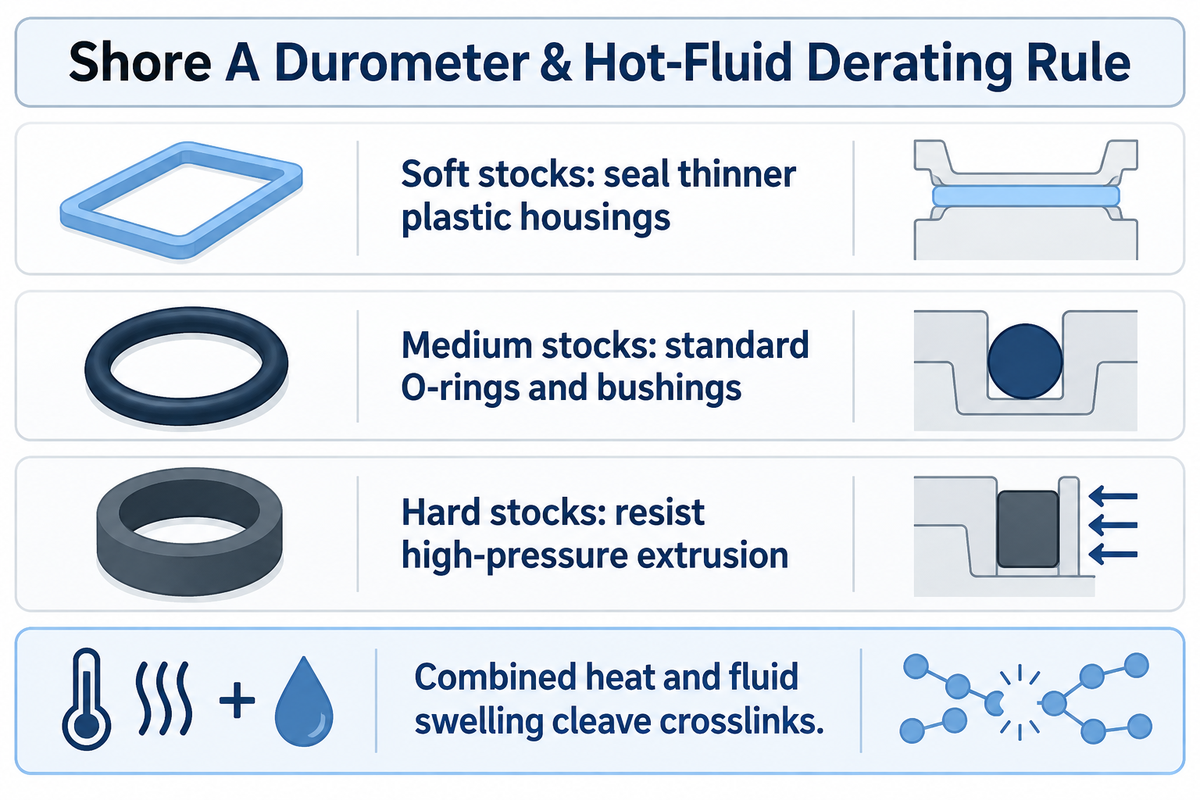
Engineering drawings give properties of rubber with Shore A durometer (±5 A), tensile strength, ASTM D395 compression set, DIN ISO 815 heat relaxation, and ASTM D2000 line callouts. Relying on dry-air temperature charts alone will result in flange leaks as hot oils and coolants accelerate seal relaxation.
Shore A durometer measures indentation hardness. Gaskets are made of soft 20 to 40 Shore A materials which are designed to seal the thinner plastic housings. Medium 50 to 70 Shore A stocks fit standard O-rings and bushings, while 80 to 95 Shore A grades resist extrusion above 10 MPa hydraulic pressure. The 80 to 95 Shore A materials are used for seals that are designed to withstand extrusion by hydraulic pressure greater than 10 MPa.
Tensile strength of 15 to 25 MPa by itself will not guarantee leak tightness. Bolts typically compress a static O-ring by 20% inside its machined gland. Once the ASTM D395 compression set reaches 70% to 80% at operating temperature, contact stress drops to zero, and fluid weeps during cold startup.
The Dry-Air vs Hot-Fluid Derating Rule prevents premature relaxation. Always derate dry-air continuous temperature ceilings by 25 °C to 50 °C when elastomers run submerged in oils, steam, or amine engine coolants. Crosslinked rubber heat aging disclosures and 70 MPa elastomer seal degradation studies show that combined heat and fluid swelling cleave crosslinks far faster than dry oven air.
| Operating Scenario | Fluid / Media Polarity | Derated Liquid Temp Ceiling | Recommended Grade & Cure | Target ASTM D2000 Callout |
|---|---|---|---|---|
| Heavy machinery isolation mount | Dry ambient air (oil-shielded) | +70 °C continuous | 55A NR, semi-EV sulfur cure | M2AA517 A13 B13 F17 |
| Outdoor solar / telecom enclosure gasket | UV, 100 pphm ozone, rain | +125 °C dry / +100 °C wet | 60A EPDM, peroxide cure | M3CA610 A25 B35 C32 |
| Potable hot-water & steam valve seal | Polar water / 130 °C steam | +130 °C continuous wet | 70A EPDM, peroxide cure (NSF 61) | M3DA710 A26 B36 EA14 |
| Hydraulic cylinder mineral-oil O-ring | Non-polar ISO VG 46 oil | +100 °C in hot oil | High-ACN 70A NBR (40% ACN), peroxide cure | M2BG714 B14 EA14 EF11 EO34 |
| Automotive timing / refrigerant seal | Sour oil + amine additives + R-1234yf | +135 °C in hot oil | 75A HNBR, peroxide cure | M2DH715 A26 B36 EO86 |
| HVAC refrigerant & outdoor boot | Moderate grease splash + weather | +90 °C oil splash | 60A Neoprene (CR), metal-oxide cure | M2BC614 A14 B14 C12 EO14 |
| Medical check valve & food dosing diaphragm | Aqueous food / CIP sanitizers | +180 °C dry / +110 °C wet | 50A LSR, platinum addition cure | M2GE506 A19 B37 EA14 |
| Pneumatic gas accumulator bladder | Pressurized N2 / CO2 dry gas | +105 °C dry gas | 60A Chlorobutyl (CIIR), resin/sulfur cure | M2BA610 A14 B13 |
| Turbocharger & biodiesel fuel rail seal | Aromatic fuel, B20 biodiesel, blow-by gas | +190 °C in hot hydrocarbon | 75A FKM, peroxide/TAIC cure | M2HK710 A1-10 B38 EF31 EO78 |
Source: ASTM D2000 Type/Class tables and fluid derating synthesis across ASTM D395 and DIN ISO 815 heat-relaxation tests.
📐 Worked Seal Squeeze & ASTM D2000 Calculation
Take a 3.53 mm cross-section NBR O-ring (ASTM D2000 M2BG714 B14 EA14 EF11) seated in a 2.82 mm deep static face groove. Initial squeeze equals (3.53 – 2.82) / 3.53 = 0.71 / 3.53 = 20%, keeping seal fill safely below the 85% groove-volume limit. If 100 °C oil aging produces 20% ASTM D395 compression set, retained elastic recovery equals 0.71 mm × (1 – 0.20) = 0.57 mm of active sealing interference.
Why does carbon black change rubber from an electrical insulator into a conductive shield?
Stocks of unfilled or mineral-filled EPDM and silicones are insulators with volume resistivity in the range of 1013 to 1015 ohm-cm and dielectric strength of 18 to 25 kV/mm. A network of electron-tunneling is formed by a percolating structure of conductive carbon black in an amount of 20 to 40 phr, resulting in a resistivity of 10 to 104 ohm-cm, thus making the elastomer suitable for making ESD boots and EMI gaskets.
How Rubber Parts Are Molded: Compression, Transfer, Injection, and Extrusion
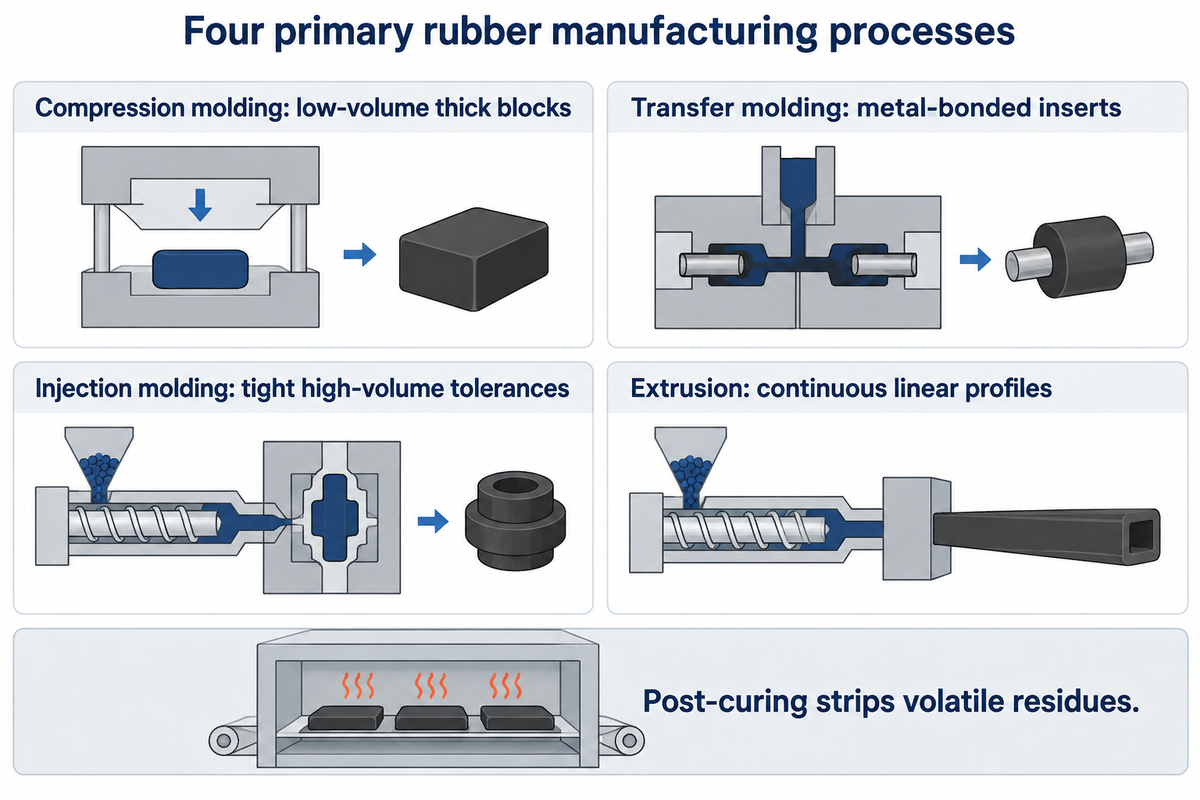
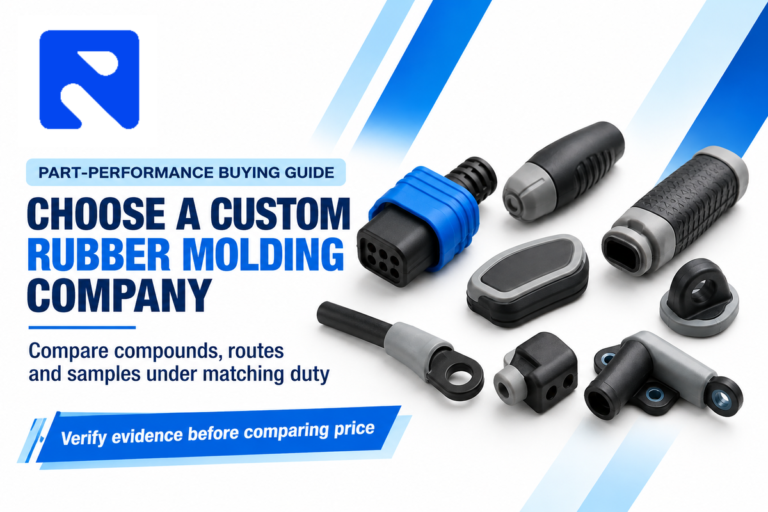
Factories mold custom rubber parts through four primary processes. Compression molding fits low-volume thick blocks, transfer molding protects metal-bonded inserts, injection molding holds tight high-volume tolerances, and extrusion forms continuous linear profiles. Part weight, insert geometry, ISO 3302-1 class, and annual volume govern landed piece cost.
Every durable molded lot starts upstream in internal Banbury mixers or dispersions kneaders. Raw bales mix with reinforcing fillers and curatives before passing across two-roll sheeting mills. Quality labs then run a moving die rheometer check on each mixed batch. Models in peer-reviewed MDR vulcanization process studies and 175 °C crosslinked elastomer curing trials verify scorch safety and t90 cure completion before press release.
| Manufacturing Process | ISO 3302-1 Tolerance Class | Typical Cure Cycle | Economic Annual Volume | Ideal Part Geometry |
|---|---|---|---|---|
| Compression Molding | Class M3 (general) / M2 | 120–360 s (up to 15 min thick blocks) | 500–10,000 pcs/yr | Thick NVH mounts, large gaskets, and soft <35 Shore A parts |
| Transfer Molding | Class M2 (precision) | 90–210 s | 5,000–50,000 pcs/yr | Rubber-to-metal bonded mounts, brass/steel inserts, multi-recess boots |
| Rubber & LSR Injection Molding | Class M1 / M2 (tightest) | 15–90 s | 25,000–500,000+ pcs/yr | Flashless LSR valves, thin-wall seals, high-cavity automotive connectors |
| Continuous Extrusion | Class E1 / E2 | Continuous microwave / salt / autoclave | 500–50,000+ meters/yr | Door weatherstrips, tubing, glazing channels, and spliced O-ring cord |
Source: ISO 3302-1 dimensional tolerance classes and industrial rubber press cycle benchmarks.
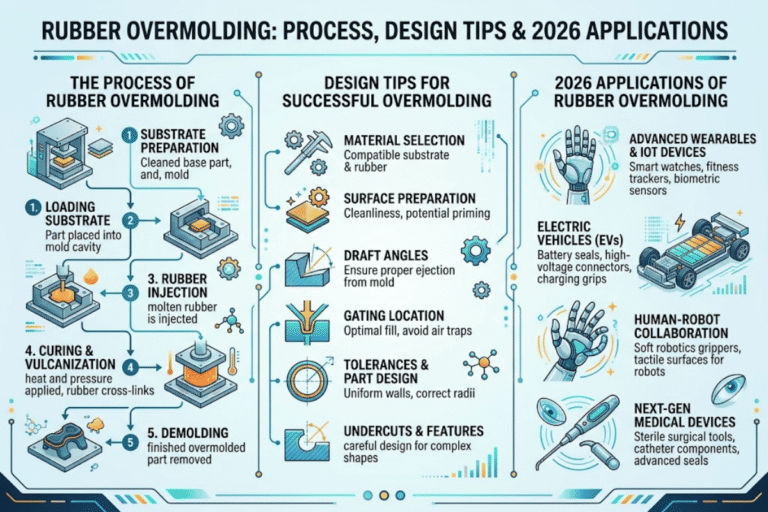
For metal-insert mounts, transfer and injection tools clamp steel or brass hardware before rubber enters the cavity. Grit-blasted metal receives primer and covercoat adhesives verified to ASTM D429 rubber-tear standards. After cryogenic nitrogen deflashing, FKM and peroxide silicone parts enter secondary post-cure ovens (4 hours at 200 °C). Post-curing stabilizes ISO 3302-1 rubber molding tolerances and strips volatile residues.
Tire and Tyre Compounds, Automotive Seals, and Failure Modes in Molded Rubber
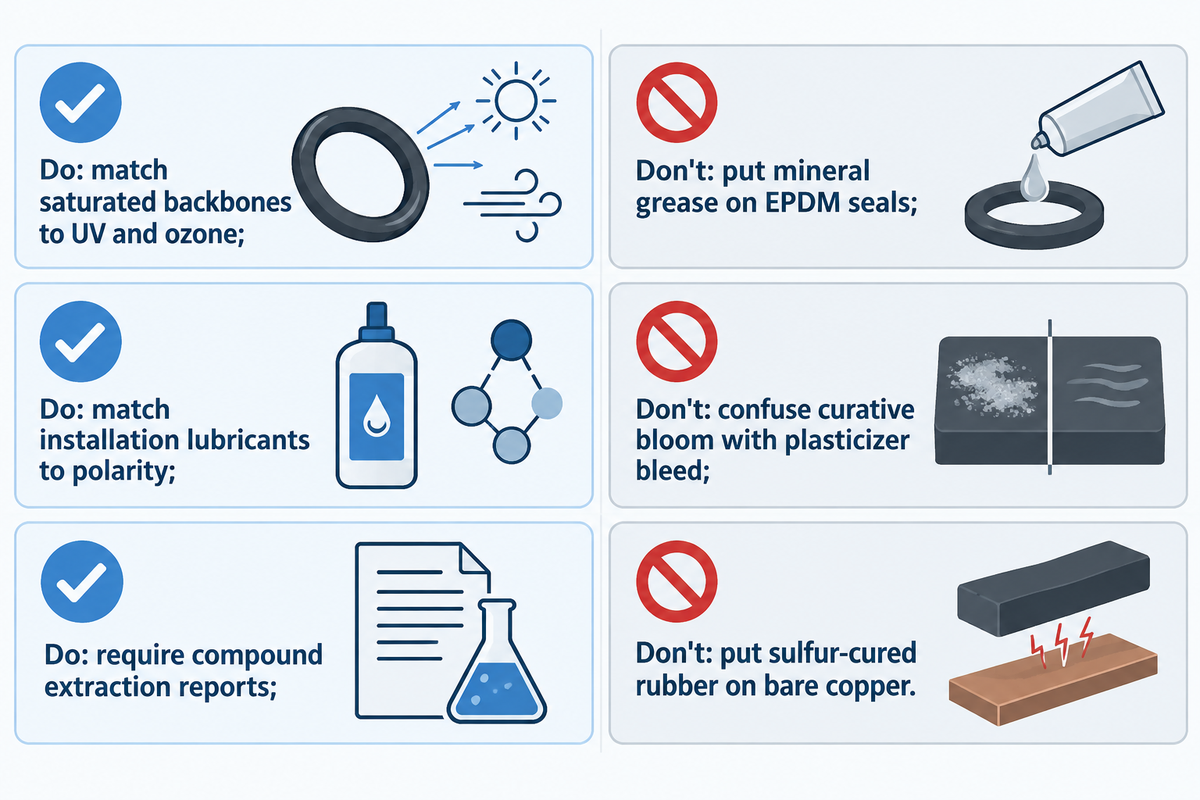
About 70% of world rubber output is used by Global tire and tyre plants with multi-compound tread, sidewall and halobutyl innerliner designs. Non-tire automotive and industrial seals concentrate on fluid resistance and low compression set, and field failures are caused by ozone cracking, hydrocarbon swelling, surface bloom and the absence of extraction tests.
Within narrow tolerances of molded parts and post curing, the wrong compound choice can lead to rapid part failure. A radial tire, spelled tyre in the UK and ISO standards, uses several rubber compounds. This tire contains three distinct elastomers. Passenger treads use solution SBR filled with silica-silane for wet grip, heavy truck sidewalls use natural polyisoprene for flex life, and the innerliner retains compressed air.
Under the hood seals, grommets, bushings, and food diaphragms fail due to chemical attack rather than tread wear. In NBR or natural rubber, if a boot is stretched 10% to 20% outdoors, there is ample opportunity for the double bonds to be attacked by ambient ozone (>50 pphm), resulting in cracks perpendicular to the tensile direction. EPDM O-rings in contact with coolant tend to swell when lubricated with shop grease.
Do
- Specify saturated EPDM, silicone, or CR for stretched outdoor boots exposed to UV and ozone
- Match installation lubricants to backbone polarity (silicone grease on EPDM; mineral oil on NBR/FKM)
- Require compound-specific FDA 21 CFR 177.2600 extraction reports for repeated food contact
- Verify PPAP Level 3 and Cpk >= 1.33 capability data on critical automotive sealing dimensions
Don’t
- Assemble EPDM brake or water seals with petroleum jelly or mineral-oil shop grease
- Confuse dry frosty curative bloom (cosmetic) with oily plasticizer bleed (causes shrinkage)
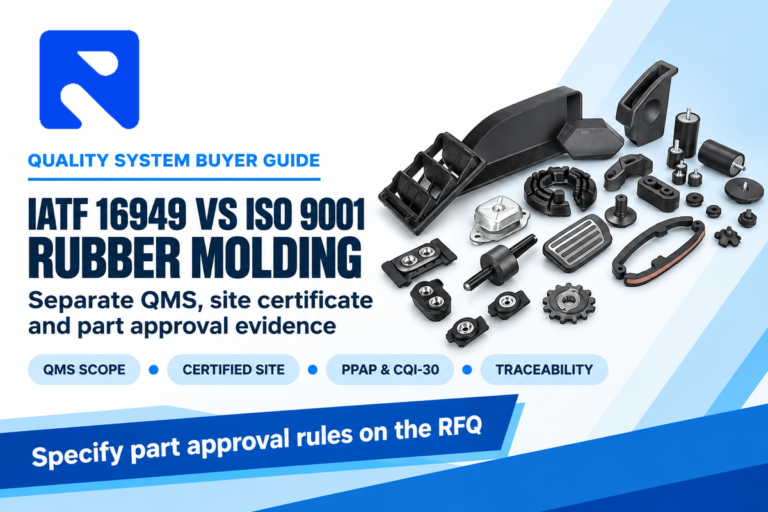
- Accept a generic factory ISO 9001 certificate as proof of food-grade compound compliance
- Specify sulfur-cured rubber directly against bare copper PCB traces or silver contacts
“Rubber articles intended for repeated use in contact with aqueous food shall yield total extractives not to exceed 20 milligrams per square inch during the first 7 hours of refluxing, and 1 milligram per square inch during the succeeding 2 hours.”
U.S. Food and Drug Administration, eCFR 21 CFR § 177.2600 (Rubber Articles Intended for Repeated Use)
During a supplier audit, it is important to distinguish between compound extraction rules and plant quality certifications. Under 21 CFR 177.2600 food-contact rubber extraction limits, fatty-food seals also face n-hexane reflux caps (175 mg/in² over 7 hours; 4 mg/in² over the next 2 hours) and a 50 wt% carbon-black ceiling. Plant-level IATF 16949:2016 certification governs statistical process control and lot traceability across IATF 16949 automotive rubber parts and custom molded rubber gaskets and seals.
Why do rubber handles and aged natural rubber parts turn sticky over time?
There are two mechanisms that can lead to sticky surfaces. One occurs when some elastomers break down over time. In the case of aged natural rubber, polysulfidic crosslinks are cleaved by heat or UV, and polyisoprene chains are oxidized to a tacky, low-molecular-weight oligomer. With some soft-touch consumer handles, ester-based polyurethane coatings and incompatible plasticizers break down and exude a gummy film.
Custom Rubber Tooling Costs, MOQ, Supply Chain Rules, and IATF 16949 Sourcing
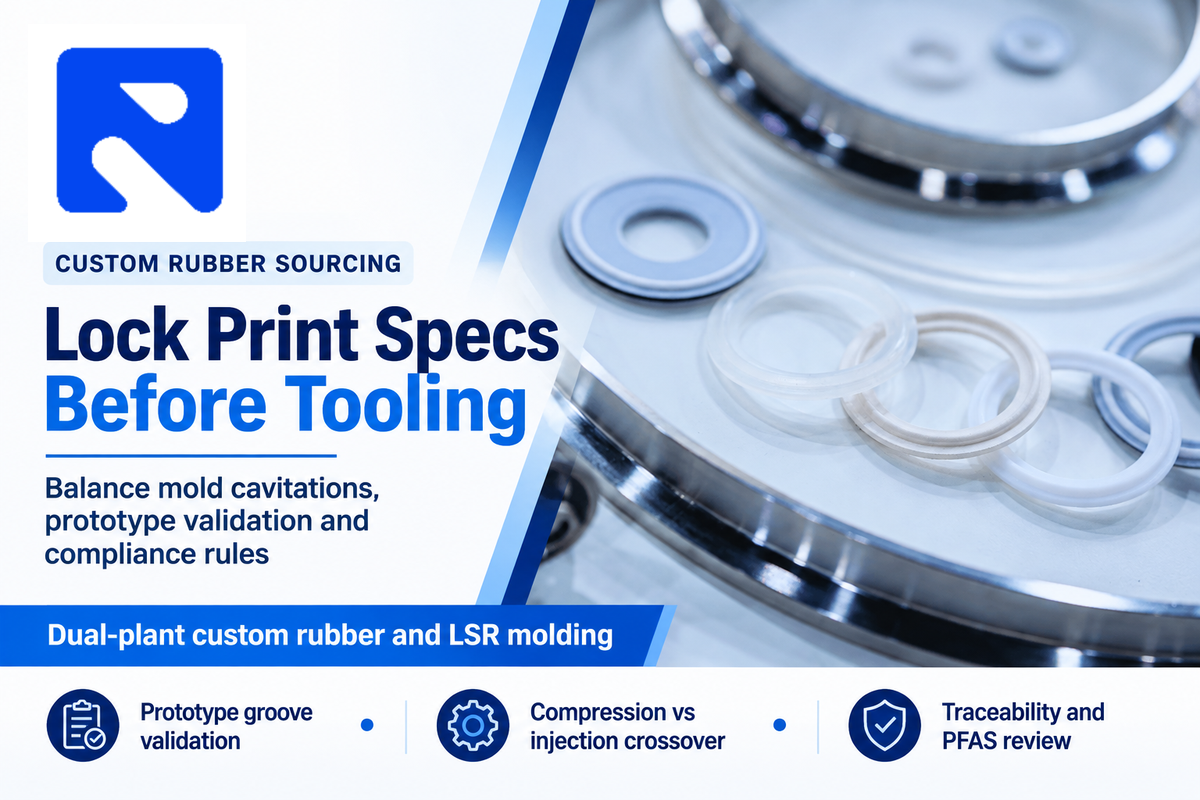
Expect 2 to 3 weeks for 10 to 50 validation samples, 1,000 to 2,000 piece MOQs, and stricter 2026 EUDR traceability and PFAS reviews. More stringent 2026 EUDR requirements and PFAS restrictions also apply.
Once food-contact extraction or IATF 16949 requirements are set, raw compound selection sets the material baseline. Indexed to standard SBR or EPDM at 1.0x per kilogram, natural rubber runs 1.1x to 1.4x, while NBR and polychloroprene run 1.3x to 2.0x. Solid VMQ silicone runs 2.5x to 4.0x, platinum LSR and HNBR run 4.5x to 8.0x, and FKM reaches 8.0x to 15.0x+. Exact mold steel and piece pricing are quoted per 3D CAD geometry and compound callout.
Engineering teams on Engelhardt’s custom molding programs turn prototype validation runs of 10-50 pieces in 2-3 weeks (air freight) to verify groove fit and durometer. MOQs for off the shelf standard elastomers are 1,000 pieces, while 2,000 pieces is the MOQ for custom formulations. Backed by 500 mold sets/year of in-house CNC tooling and 3,000 tons/year of molded rubber output, that footprint insulates OEMs from single-corridor tariff and shipping disruptions.
📐 Worked Tooling Amortization & Process Crossover Example
Industry mold benchmarks span $500 to $2,500 for extrusion dies, $2,000 to $15,000 for compression molds, and $10,000 to $50,000+ for multi-cavity injection tools (part-specific piece prices are quoted per 3D drawing). Across an annual demand for rubber seals of 25,000 pieces, a $2,500 compression mold adds $2,500 ÷ 25,000 = $0.10/pc in Year-1 tooling amortization at 180-second manual cycles. Stepping up to a $10,000 automated injection mold adds $10,000 ÷ 25,000 = $0.40/pc in Year 1 ($0.10/pc across 100,000 pieces over 4 years) while cutting cure time by 75% to 45 seconds.
There are three regulatory shifts for the 2026-2027 sourcing plans. First, the timetable for EUDR implementation set by the European Commission requires EU natural rubber imports to provide plot level deforestation free geolocation data from 30 December 2026 (30 June 2027 for micro and small firms). Second, both the EU and U.S. PFAS regulations encourage the use of HNBR and Platinum LSR over fluoropolymer FKM. Third, cold-runner LSR molds and crumb recycling are favored for sustainability audits. These audits also favor a reduction in cured scrap during part batch production. Buyers can explore tooling and batch trade offs in Engelhardt’s custom rubber parts cost driver estimator.
Key takeaway
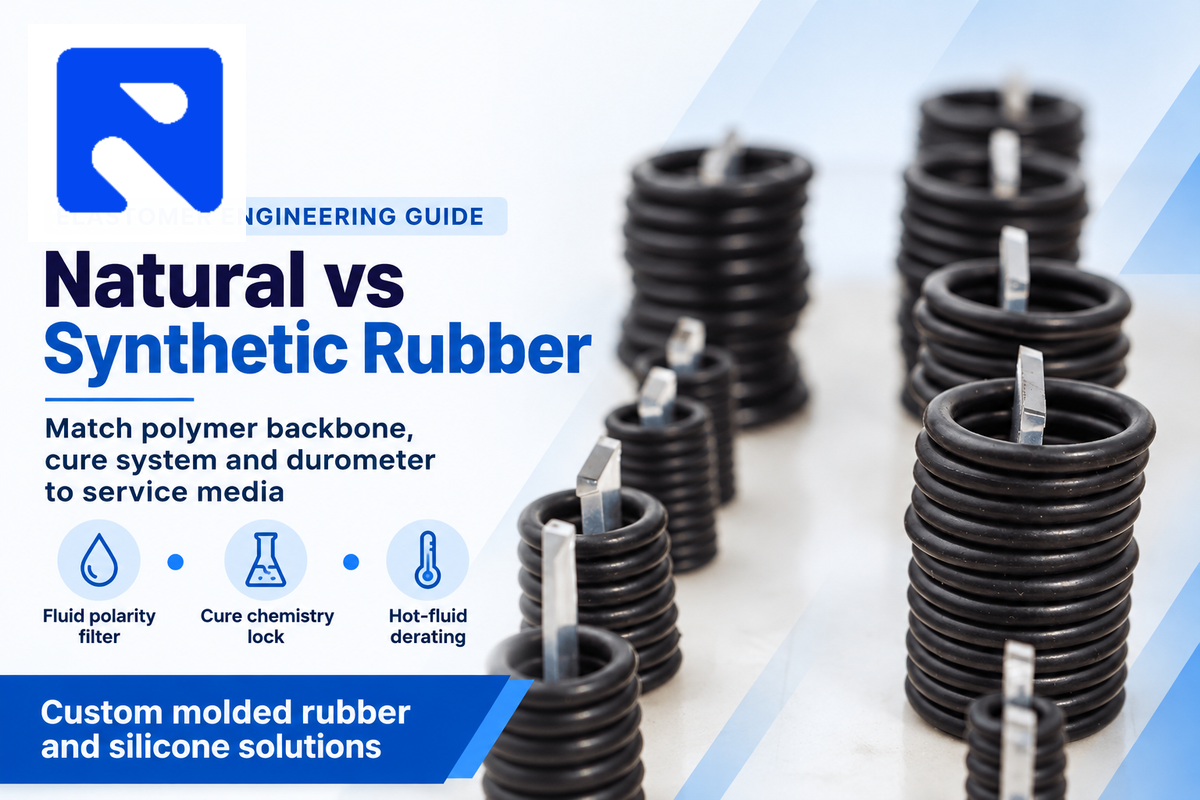
Match polymer polarity to fluid media first, and derate dry-air temperature limits by 25–50 °C in hot liquids. Lock cure chemistry and ASTM D2000 suffix tests on your print before cutting steel.
Frequently Asked Questions
Q: What is synthetic rubber, and does it trigger natural latex allergies?
Synthetic rubber is an artificial elastomer, derived from petrochemical or siloxane monomers, that contains zero natural Hevea proteins that cause Type I latex allergies.
Polymer grades like NBR, EPDM, polychloroprene, butyl, VMQ/LSR, and FKM completely eliminate plant-protein sensitization risk. For wearable or skin-contact medical parts, specify platinum-cured LSR or accelerator-free compounds. This step eliminates the risk of Type IV contact dermatitis from sulfur accelerators.
Q: Does the USA produce rubber domestically?
Yes for petrochemical synthetic rubber, but no commercial Hevea rubber tree plantations operate in the U.S. due to frost-free equatorial climate needs.
Chemical complexes along the Texas and Louisiana Gulf Coast manufacture large volumes of SBR, polybutadiene, EPDM, nitrile, and halobutyl elastomers. Domestic natural-rubber harvesting is limited to arid-crop guayule pilot farms in Arizona. Thus, U.S. tire and industrial molders rely on Southeast Asian natural rubber imports.
Q: Will we run out of natural rubber as global tire demand grows?
Natural rubber is a renewable tree crop rather than a finite mineral, yet compliant tonnage tightens whenever smallholder replanting lags or leaf disease spreads.
Newly planted Hevea trees take 6 to 7 years to mature enough for bark harvesting. Companies strive to move away from at-risk supply chains with the EU Deforestation Regulation (EUDR) geolocation rules beginning in the last quarter of 2026. Manufacturing using qualifying dual-plant grades of synthetic SBR, EPDM, or HNBR helps avoid supply shortages in a single region.
Q: Does solid vulcanized rubber absorb water in submerged plumbing seals?
No, closed-network peroxide-cured EPDM and butyl seals repel water.
Non-polar hydrocarbon backbones block moisture uptake, whereas open-cell sponge rubber wicks water mechanically and ester polyurethanes hydrolyze above 60 °C.
Q: How do you decode an ASTM D2000 callout like M2BG714 B14 EA14 EF11?
Decode each token from left to right: M sets metric units (MPa and °C), 2 selects Grade 2 suffix tests, B sets 100 °C heat aging, and G caps IRM 903 oil swell at 40%.
Next, 7 specifies 70 ± 5 Shore A hardness and 14 mandates 14 MPa minimum tensile strength, pointing to a 70A NBR nitrile grade. Suffix B14 caps 22-hour, 100 °C compression set. Codes EA14 and EF11 control 100 °C water immersion and Reference Fuel A swell limits.
Q: What are 5 industrial products made from rubber and which grade fits each?
Five core rubber products include truck tires (NR/SBR), hydraulic O-rings (NBR/FKM), outdoor enclosure gaskets (EPDM), medical check valves (platinum LSR), and engine mounts (NR/HNBR).
All components match polymer chemistry to their major service stress e.g. tear fatigue, hydrocarbon oils, ultraviolet/ozone, biocompatibility, or dynamic shear.
Q: How does FDA 21 CFR 177.2600 compliance differ from IATF 16949 certification?
FDA 21 CFR 177.2600 is a compound-level food-contact regulation verified by water and n-hexane extraction lab tests, whereas IATF 16949:2016 is an audited factory quality system.
The FDA never issues factory certificates for rubber molders; buyers must review formulation whitelists and lot extraction reports for the exact cured recipe. An IATF 16949 plant certificate verifies statistical process control, FMEA defect prevention, gage R&R, and PPAP Level 3 discipline across automotive production lines.
Specify the Right Elastomer & Molding Process Before Cutting Steel
Share your 3D CAD file, operating temperature, fluid media, and target annual volume with Engelhardt’s compounding and tooling engineers. We formulate 30+ stocked rubber and LSR grades under IATF 16949 & ISO 9001 across our China and Thailand plants, delivering 10–50 pcs validation prototypes in 2–3 weeks.
About This Elastomer Engineering Guide
We included vulcanization cure tables, ASTM D2000 call out rules, and fluid derating thresholds in this report, based on peer-reviewed elastomer degradation studies and Federal 21 CFR 177.2600 extraction standards. The MOQ, batching tolerance, and lead-time figures reflect the compounding capabilities of the Zhongshan and Thailand rubber molding plants. Part specific mold prices and cure cycles are dependent on 3D part geometry and immersion media. This report was reviewed by the Guangdong Engelhardt Meitu Rubber & Plastic Technology Co., Ltd. technical team.
References & Sources
- Crosslink Network Structure, Shore A Hardness, and Thermo-Oxidative Aging in EPDM Elastomers (2026) Scientific Reports / NIH PubMed Central
- ISO 1629:2025 Rubbers and Latices, Nomenclature (5th Edition) International Organization for Standardization (iTeh Standards Catalog)
- Natural Rubber: Cis-1,4-Polyisoprene Chemistry, Hevea Latex Harvesting, and Strain Crystallization Wikipedia Foundation Reference
- Vulcanization Kinetics (t10/t90), Filler Dispersion, and Dynamic Loss Tangent in Elastomer Compounds (2025) Polymers / NIH PubMed Central
- US20240026139A1: Crosslinkable Fluoroelastomer Composition and Low Compression Set Molded Articles United States Patent Application Publication
- EP4403603A1: Crosslinked Rubber Composition and 100 °C Heat-Aging Hardness Retention European Patent Office Publication
- High-Pressure O-Ring Failure Modes, Glass Transition, and Compression Set Across NBR, EPDM, FKM, and VMQ (2025) Polymers / NIH PubMed Central
- Thermal Press Curing at 175 °C and Mechanical Resilience of Crosslinked Elastomers NIH PubMed Central
- 21 CFR § 177.2600, Rubber Articles Intended for Repeated Use U.S. National Archives Electronic Code of Federal Regulations (eCFR)
- 21 CFR § 177.2600 Distilled-Water and n-Hexane Reflux Extraction Limits Cornell Law School Legal Information Institute
- EU Deforestation Regulation (EUDR) Application Timeline for Natural Rubber Supply Chains European Commission Environment Directorate