Get in Touch with Engelhardt


Updated November 2026 · Technical review by the Guangdong Engelhardt Rubber & Plastic Technology Co., Ltd. (Engelhardt-Meitu) technical team
SBR rubber (styrene-butadiene rubber) is a general-purpose synthetic rubber copolymer made from two monomers: styrene and 1,3-butadiene. Standard cold-polymerized E-SBR grades consist of 23.5 wt% bound styrene and 76.5 wt% butadiene (SpecialChem SBR Guide). Solution S-SBR grades cover a higher styrene spectrum. First generated on an industrial scale as Buna-S and GR-S, this widely used synthetic rubber is a common type of rubber for dry wear applications. Engineers specify it when dry sliding abrasion resistance, impact resilience, and low polymer cost ($1.70 to $2.67/kg in 2025–2026) outweigh the risks of ozone or oil exposure.
23.5 wt%
E-SBR 1500/1502 Bound Styrene (Tg ≈ -55°C to -50°C)
30–95 Shore A
Molded Durometer & -45°C to +100°C Working Range
$1,695–$2,670/MT
2025–2026 Regional Raw Polymer Benchmark
±2% Mass
Preform Envelope & 40+ Presses at Engelhardt-Meitu
Using an inappropriate SBR grade or an unshielded compound outdoors leads to quick failures in the field. Below, our compounding engineers discuss SBR’s copolymer architecture of E-SBR and S-SBR, the property limitations, and the trade offs. We give a 5 elastomer cost-performance matrix, and drawing call-outs under ASTM D2000-18 (2024) e1.
What Is SBR Rubber? E-SBR (1500, 1502, 1712, 1723) vs S-SBR Copolymer Architecture
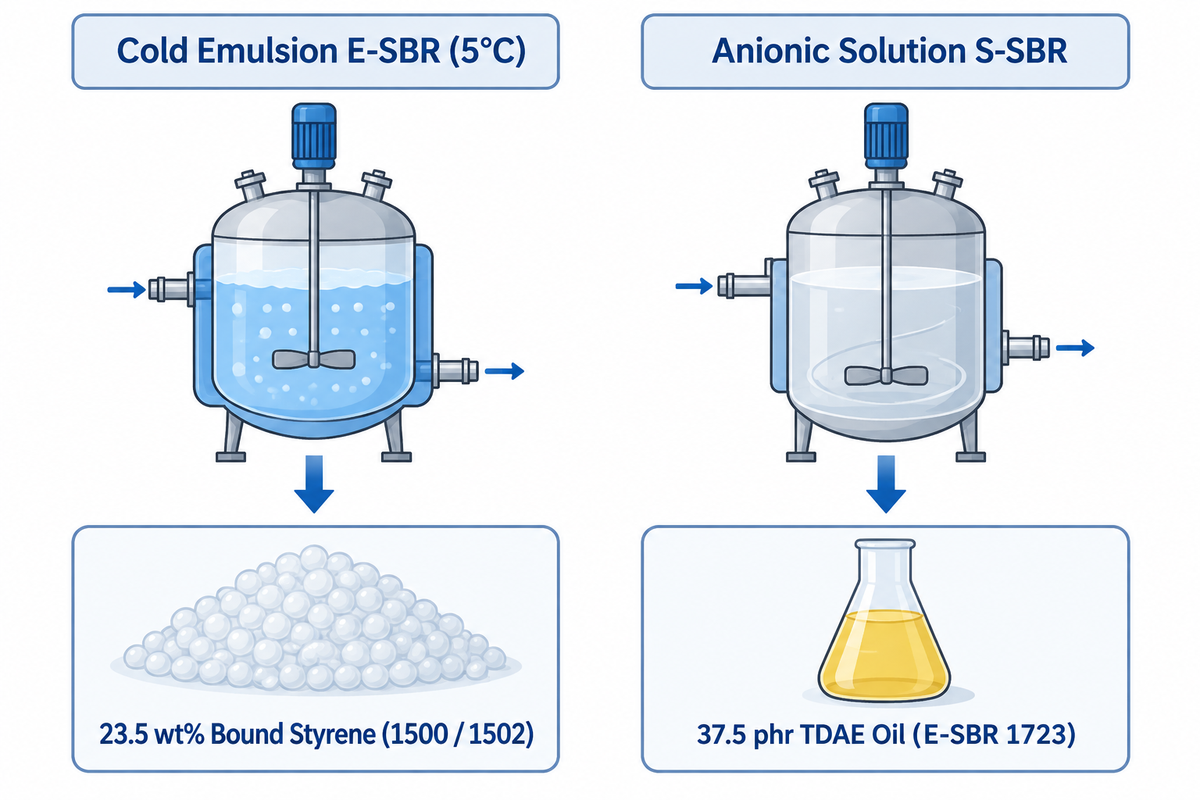
Styrene-butadiene rubber is a non-polar hydrocarbon copolymer synthesized from styrene and 1,3-butadiene. Producers react these monomers via cold emulsion polymerization (E-SBR) at 5°C or anionic solution polymerization (S-SBR) in hydrocarbon solvent. Non-oil-extended E-SBR 1500 and 1502 grades contain 23.5 wt% bound styrene with a glass transition temperature (Tg) of -55°C to -50°C. Solution S-SBR tunes styrene and vinyl content for lower hysteresis in dynamic treads.
According to synthesis data in the US EPA HERO polymer characterization archive (ID 10193402), emulsion and solution pathways produce different molecular weight distributions. In cold emulsion polymerization, radicals are generated by redox initiators, and the polymerization occurs in latex particles which are supplied by the monomer in the aqueous soap medium. Within these polymer chains, the styrene and butadiene units are randomly (styrene and butadiene) arranged and randomly arranged in a repeating manner without crystalline blocks; consequently, the chemical composition is amorphous. Because of this, neat SBR requires reinforcing fillers for mechanical strength.
When compounds are made, engineers review natural rubber latex vs synthetic elastomer grades. These include non-extended 1500-series bales and 37.5 phr oil-extended 1700-series masterbatches. As detailed in European Patent EP0942042B1 on emulsion SBR copolymerization, cold polymerization at 5°C limits chain branching. It also holds trans-1,4, cis-1,4, and 1,2-vinyl butadiene isomers at a controlled ratio (US EPA HERO ID 4710929).
| SBR Grade | Polymerization & Stabilizer System | Bound Styrene & Extender Oil | Typical Tg & Mooney Viscosity (ASTM D1646) | Extender Oil PAH Status & Primary Applications |
|---|---|---|---|---|
| E-SBR 1500 | Cold emulsion (5°C), rosin acid soap, staining amine antioxidant | 23.5 wt% styrene; 0 phr oil (neat) | -50°C to -55°C; ~50 MU (ML 1+4 @ 100°C) | Non-oil-extended neat polymer; black conveyor belts, industrial mounts, and tires |
| E-SBR 1502 | Cold emulsion (5°C), mixed rosin/fatty acid soap, non-staining stabilizer | 23.5 wt% styrene; 0 phr oil (neat) | -50°C to -55°C; ~50 MU (ML 1+4 @ 100°C) | Non-oil-extended neat polymer; light-colored shoe soles, flooring, and red flange gaskets |
| E-SBR 1712 | Cold emulsion (5°C), staining stabilizer, high-aromatic (DAE) oil | 23.5 wt% styrene; 37.5 phr DAE oil | Oil-shifted Tg; reduced viscosity masterbatch | High-PAH aromatic oil; restricted in EU tire production under REACH Entry 50 Paragraph 1 |
| E-SBR 1723 / 1783 | Cold emulsion (5°C), treated distillate aromatic extract (TDAE) oil | 23.5 wt% styrene; 37.5 phr TDAE oil | Oil-shifted Tg; low-PAH oil masterbatch | Extender oil meets REACH Entry 50 Paragraph 1 tire-oil limits (≤1 mg/kg BaP, ≤10 mg/kg 8 PAHs) |
| S-SBR (Solution) | Anionic organolithium solution in hydrocarbon solvent | Tunable styrene & vinyl; neat or TDAE-extended | Tunable Tg by styrene/vinyl ratio | Narrow molecular weight distribution; silica-coupled green car tires and EV treads |
Raw polymer evaluation follows ISO 2322:2023 and ASTM D3185-06(2026) standard test recipes. These standards govern raw bale and 37.5 phr oil-extended masterbatch evaluation. By contrast, finished molded part qualification relies on ASTM D2000. On our factory floor, incoming bales are checked for Mooney viscosity under ASTM D1646 (ML 1+4 at 100°C). In this test, 1 Mooney unit equals 0.083 N·m of rotor torque. Consistent batch viscosity supports repeatable processing. Shot volume, runner geometry, and scorch safety also govern cavity filling during 300-ton injection molding.
“EU REACH Annex XVII Entry 50 Paragraph 1 sets tire extender-oil limits of ≤1 mg/kg benzo[a]pyrene and ≤10 mg/kg for all eight listed PAHs. Under Paragraphs 5 and 6, consumer articles with direct, prolonged, or repetitive skin or oral contact must not exceed 1 mg/kg per individual PAH. Covered toys and childcare articles face a stricter 0.5 mg/kg limit per PAH. Specifying TDAE-extended E-SBR 1723 addresses extender-oil PAH limits, while finished consumer parts also require low-PAH carbon black fillers.”
Compounding & Regulatory Compliance Note, Guangdong Engelhardt Rubber & Plastic Technology Co., Ltd.
SBR Rubber Properties: Mechanical Strength, Durometer (30–95 Shore A), and Temperature Range
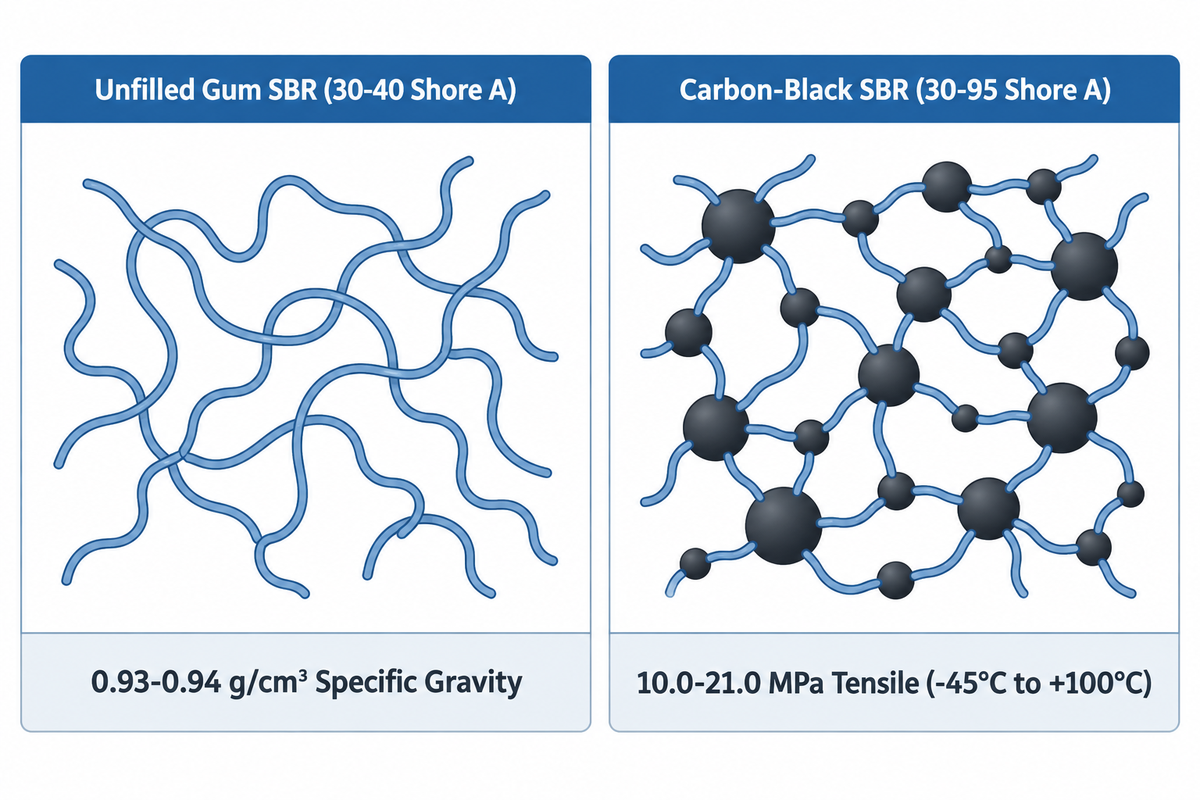
Molded durometer spans 30 to 95 Shore A. Reinforced vulcanizates achieve tensile strength between 10.0 and 21.0 MPa (1,450 to 3,000 psi) along with excellent abrasion resistance. When continuous dry operating temperatures exceed +100°C, replace SBR with peroxide-cured EPDM (+150°C) or silicone.
Natural rubber is self-reinforcing by aligning its cis-1,4 polyisoprene chains into crystallites at high elongation. Amorphous SBR has an irregular backbone. Unfilled gum SBR has low neat tensile strength without the incorporation of reinforcing carbon black or mineral fillers. According to a polymer compounding study in the US EPA HERO archive on SBR with industrial carbon black (ID 3986127), compounding furnace filler like carbon black (N330 or N550) builds the reinforcing network. This filler network creates the mechanical properties, high tensile resilience and good abrasion resistance required for industrial bushings.
| Property | Evaluation Method / Source | Unfilled Gum SBR | Carbon-Black-Reinforced SBR | Design Impact for OEM Parts |
|---|---|---|---|---|
| Specific Gravity (Density) | ASTM D297 / SpecialChem | 0.93–0.94 g/cm³ | 1.15–1.35 g/cm³ | Governs shot weight and $/part raw material cost |
| Hardness (Durometer) | ASTM D2240 / Rahco Rubber | 30–40 Shore A | 30–95 Shore A | 70 Shore A standard for water flanges; 50A for isolators |
| Tensile Strength | ASTM D412 / Rahco Rubber | Low neat gum strength (requires filler) | 10.0–21.0 MPa (1,450–3,000 psi) | Minimum tensile strength for dynamic-mount specifications: ≥14 MPa |
| Elongation at Break | ASTM D412 / SpecialChem | 350%–500% | 300%–600% (450%–600% typical) | Allows stretch installation of panel grommets without tearing |
| Compression Set (22h @ 70°C) | ASTM D395 Method B | 35%–50% | 18%–30% (Semi-EV / Peroxide) | Controls long-term bolt torque retention and rebound to original shape |
| DIN Abrasion Volume Loss | ISO 4649 / ASTM D5963 | Higher volume loss (unreinforced) | Lower volume loss with N330/N220 black | Lower volume loss indicates less material lost under standard drum test conditions |
| Heat-Aging & Brittleness Tests | Heat-aging: ASTM D573; brittleness: ASTM D2137 | Evaluated per compound recipe | 70°C or 100°C aging; -40°C brittleness | Oxidative crosslinking hardens SBR rapidly above +100°C |
| Volume Resistivity | ASTM D257 / SpecialChem | 10^14 to 10^15 Ω·cm | 10^5 to 10^12 Ω·cm (varies by black) | Mineral-filled E-SBR 1502 acts as a dry electrical insulator |
As shown in SpecialChem’s SBR material property benchmark, properly compounded SBR can withstand temperatures ranging between -45°C and +100°C. Typical installations include cold-storage dock bumpers and warm industrial air ducts. Unlike natural rubber, which softens via chain scission during thermal over-aging, SBR undergoes oxidative crosslink marching. Prolonged heat resistance exposure above +100°C causes the durometer to climb while elongation drops.
What Is Styrene-Butadiene Polymer and How Does 23.5% Bound Styrene Control Tg?
Styrene-butadiene polymer is a synthetic bipolymer whose monomer weight ratio governs its glass transition temperature (Tg), with 23.5 wt% bound styrene in E-SBR 1500 and 1502 yielding a Tg of -50°C to -55°C. The copolymer contains rigid aromatic styrene rings with flexible 1,3-butadiene segments, making it low-temperature flexible with wet traction and resistance to wear. Raising bound styrene content shifts Tg upward, which increases hysteresis damping but increases stiffness at low temperatures.
SBR Rubber vs EPDM, Neoprene, Nitrile (NBR), and Natural Rubber: Engineering Trade-Off Matrix
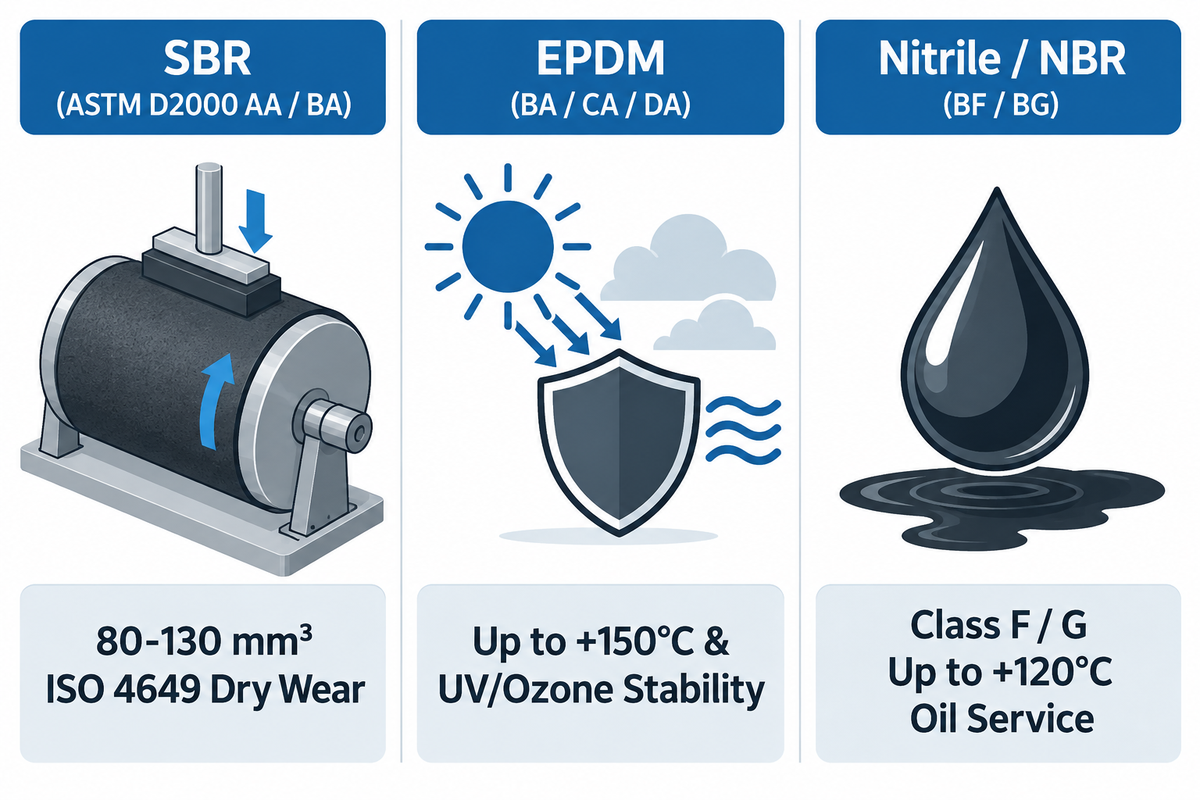
Carbon-black-reinforced SBR rubber delivers strong dry sliding wear resistance at the lowest raw polymer baseline cost ($1.70 to $2.67/kg across 2025–2026 regional indices). However, it rapidly deteriorates in outdoor environments and petroleum oils. Use our 5-Elastomer Wear-vs-Weathering Matrix below to match elastomers to service media. SBR suits indoor dry-wear parts, and dedicated brake-service SBR compounds serve non-mineral glycol brake cups. EPDM and some NBRs are good for outdoor environments and mineral oils.
Historically, chemists developed SBR as a strategic replacement for natural rubber and a cost-effective alternative to natural rubber. Both SBR and natural rubber have unsaturated carbon-carbon double bonds in their polymer backbones. However, SBR is a styrene-butadiene copolymer, whereas natural rubber is cis-1,4-polyisoprene. When weighing the advantages and disadvantages of SBR among general-purpose rubbers, the main concern is its sensitivity to ozone and hydrocarbon solvation. A 2025 ScienceDirect failure analysis on elastomer ozonolysis mentioned that ozone cleaves unprotected C=C double bonds in SBR polymer chains. Not having an adequate antiozonant loading can also increase localized crack depth.
| Criterion | SBR (ASTM D2000 AA / BA) | EPDM (BA / CA / DA) | Neoprene / CR (BC / BE) | Nitrile / NBR (BF / BG) | Natural Rubber / NR (AA) |
|---|---|---|---|---|---|
| Polymer Backbone | Unsaturated C=C (Styrene-Butadiene) | Saturated polymethylene main chain | Chlorinated diene (Polychloroprene) | Polar unsaturated (Acrylonitrile-Butadiene) | Unsaturated cis-1,4-polyisoprene |
| Typical Working Temp | -45°C to +100°C (Custom Rubber Corp.) | Up to +150°C continuous heat | Up to +120°C moderate service | Up to +120°C oil service | Up to +85°C dynamic service |
| Dry Abrasion & Wear | Excellent dry sliding wear (80–130 mm³ ISO 4649) | Moderate dry sliding wear | Good mechanical wear and flex resistance | Very good wet and oily abrasion resistance | High sliding wear and tear fatigue resistance |
| UV & Ozone Weathering | Poor (cracks without wax/antiozonant) | Outstanding outdoor UV/ozone stability | Very good weather and flame resistance | Poor to fair (unless PVC-blended) | Poor (rapid ozone chain scission) |
| ASTM D471 Mineral Oil Swell | Severe swelling (Class A: no oil-swell rating) | Severe swelling in petroleum oils | Moderate swelling (Class B / C) | Low swelling (Class F / G oil-resistant standard) | Severe swelling in petroleum oils |
| DOT 3 / DOT 4 Glycol Brake Fluid | Compatible (dedicated brake-cup SBR grades) | Excellent (primary brake seal elastomer) | Fair (swells at elevated temperatures) | Incompatible with glycol brake fluids | Used in legacy low-temp glycol cups |
| Raw Polymer CostTier | $1.70–$2.67/kg (2025–2026 benchmark) | Moderate premium over general-purpose SBR | Higher specialty polychloroprene cost tier | Moderate nitrile copolymer cost tier | Commodity tier (subject to harvest volatility) |
Compared to natural rubber, uncured SBR compounds offer predictable mold flow and extrusion scorch control when viscosity and curatives are balanced. SBR can also be modified to improve dry crack-initiation resistance, as is the case with NR. However, NR retains lower hysteresis heat buildup than SBR in thick cross-sections such as solid forklift tires. For a more in-depth look at the trade-offs between oil and weather resistance, please see our article on EPDM vs. NBR.
What Is the Difference Between EPDM and SBR in Outdoor Weathering vs Dry Abrasion?
Carbon-black-reinforced SBR provides superior dry sliding abrasion resistance (80–130 mm³ ISO 4649 volume loss) at lower polymer cost. By contrast, EPDM resists outdoor UV exposure, ozone resistance degradation, and weathering because of its saturated polymethylene backbone. Unsaturated carbon-carbon double bonds in SBR’s polybutadiene segments remain vulnerable to ozone attack under tensile strain. Specify SBR for indoor wear pads, chute liners, and dry dust boots. Specify EPDM for outdoor rooftop gaskets, solar mounts, and weatherstripping.
How to Select 50, 70, and 80 Shore A SBR Compounds for Gaskets, Grommets, and Vibration Mounts
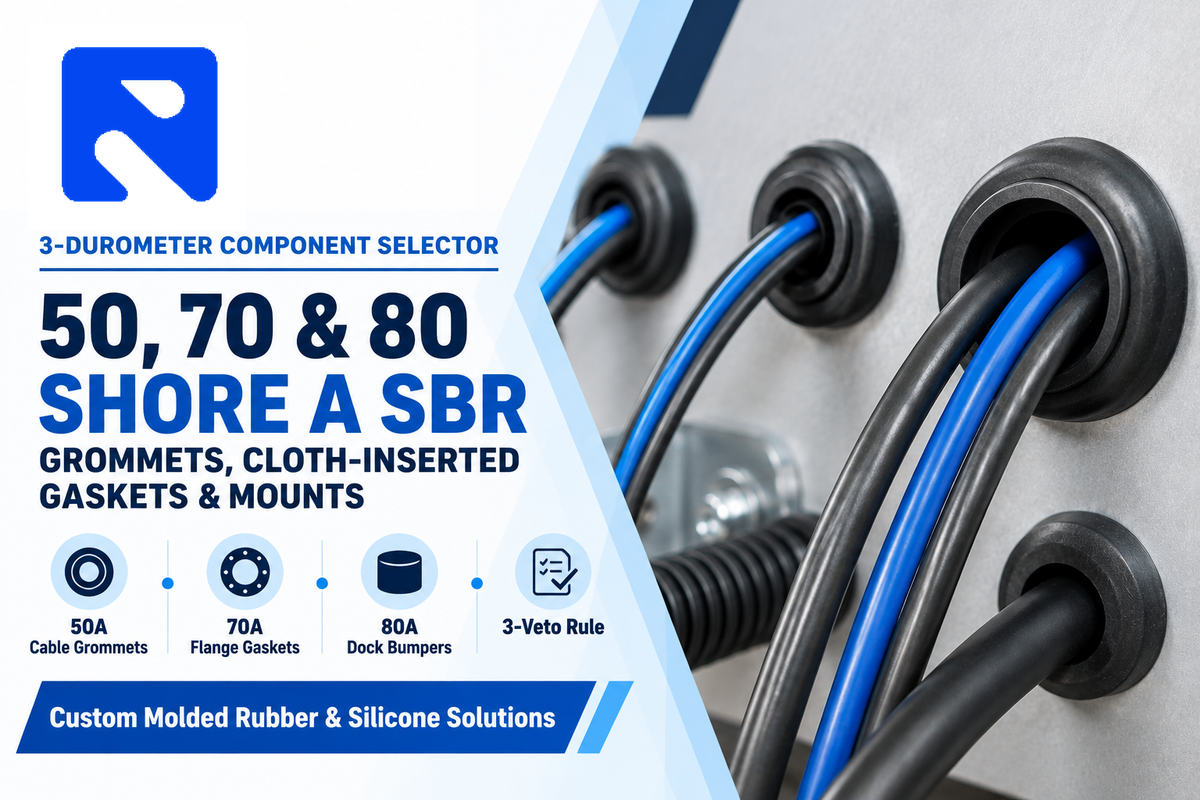
Select 50 Shore A SBR for low-frequency vibration isolators and low-bolt-load PVC pipe flanges. Choose 70 Shore A (often cloth-inserted) for standard ASME B16.21 water and air flange gaskets, and 80 Shore A for high-impact dock bumpers and conveyor skirtboards. Before finalizing any Shore A durometer, enforce The Unsaturated-Backbone 3-Veto Rule. Immediately disqualify unshielded SBR if the part faces continuous outdoor UV/ozone, dry heat above +100°C, or petroleum hydrocarbon oils.
Across industrial applications, SBR is used to manufacture high-volume automotive parts, car tires, tyre treads, shoe soles, abrasion-resistant hose covers, and molded rubber goods. When matching specific applications (bolt seating stress) to durometer hardness, our 3-Durometer SBR Component Selector (below) accounts for viscoelastic creep and maps 50A, 70A, and 80A SBR to various geometry and reinforcement needs of industrial rubber seals and flange gaskets.
| Durometer Tier | Deflection & Stiffness Profile | Reinforcement & Cure System | Primary OEM Applications of SBR | Mandatory Veto / Failure Mode |
|---|---|---|---|---|
| 50 Shore A (±5) | High deflection compliance for low-bolt-load sealing and isolation | E-SBR 1502 / 1723 with N550 black; low-modulus sulfur cure | Thin-wall firewall cable grommets, light instrument mounts, low-torque plastic flange seals | Extrudes and splits under high steel flange clamping torque |
| 70 Shore A (±5) | Balanced seating stress and rebound for general industrial joints | N330 carbon black + optional 1-ply or 2-ply polyester/cotton duck cloth insertion (CIR) | ASME B16.21 Class 150 water/air flange gaskets, machinery isolation mounts, brake dust boots | Unreinforced 70A red SBR creeps radially under heavy bolt torque without cloth ply |
| 80 Shore A (±5) | High compressive modulus for heavy impact and anti-extrusion | High-structure N220/N330 carbon black (60–75 phr) + high crosslink density | Mining chute liners, loading dock bumpers, heavy AGV caster treads, and leveling feet | Insufficient conformity for sealing low-torque or uneven cast-iron pipe faces |
In water utilities and HVAC piping, unreinforced 70 Shore A red SBR sheet (Hennig Gasket benchmark) often suffers radial extrusion under heavy bolt torque. Adding a 1-ply or 2-ply woven polyester or cotton duck fabric layer to SBR creates cloth-inserted SBR (CIR). This also improves the resistance to extrusion and flange blowout. Specify the fabric ply count and durometer when sourcing custom die-cut and molded rubber gaskets and seals. Apply the same tolerance to custom molded SBR rubber grommets and vibration bushings.
Do Specify SBR Rubber When:
- For indoor SBR vibration mounts, the forcing-to-natural-frequency ratio (ω/ωn) exceeds √2 (1.414) between -40°C and +90°C.
- Sealing non-potable water or air flanges up to 1.0 MPa (approximately 145 psi) using 70 Shore A cloth-inserted SBR.
- Formulating low-rolling-resistance S-SBR/silica treads with improved wet grip and rolling resistance balance.
Do Not Specify SBR Rubber When:
- Contact with ASTM D471 hydrocarbon oils (IRM 903), diesel, kerosene, or aromatic solvents is present (Veto 1: hydrocarbon swelling).
- Dynamic outdoor flexing occurs without protective 6PPD and paraffin wax bloom (Veto 2: rapid ozone chain scission).
- Continuous dry thermal exposure exceeds +100°C (+212°F), which accelerates oxidative hardening (Veto 3: thermal ceiling).
Is SBR Rubber UV Resistant or Safe for Petroleum Oils vs DOT 3/4 Glycol Brake Fluids?
No, standard SBR rubber is neither UV resistant nor safe for petroleum oils. It shows severe volume swell in ASTM D471 hydrocarbon test fluids such as IRM 903 (the ASTM D5964-16 (2021) replacement for ASTM Oil No. 3). However, polyalkylene glycol ether fluids (DOT 3 and DOT 4) are polar and non-petroleum. Specially compounded SBR is used in hydraulic brake cups for non-mineral glycol DOT 3 and DOT 4 fluids (GMORS and Techno Ad material guides). In these assemblies, FMVSS 116 (49 CFR 571.116) and SAE J1703 define brake-fluid performance and rubber compatibility. Never use general purpose commercial red SBR gasket sheet for hydraulic brake cylinders.
SBR Rubber Price per Kg, Custom Molding Cost Drivers, and ASTM D2000 AA/BA Line Callouts
Across the regional benchmarks in Table 5, raw SBR polymer prices ranged between $1,695 and $2,035 per metric ton (approximately $1.70 to $2.04/kg) in Q2–Q3 2025. By Q3 2026, regional benchmarks stood between $1,955.44 and $2,670.00/MT ($1.96 to $2.67/kg). In custom molded SBR parts, total piece price depends on compound formulation, filler loading, metal insert preparation, press cycle time, mold cavitation, and ASTM D2000 testing. Always lock material performance on drawings using an application-specific ASTM D2000-18(2024)e1 AA or BA line callout.
When procurement teams benchmark a custom SBR material quote, they must differentiate raw bale feedstock indices from compounded masterbatch prices. According to the IMARC Group 2025 SBR Pricing Report and Procurement Resource Q3 2026 SBR Price Trend Index, prices are dictated by butadiene monomer cracker feedstocks and ocean freight differentials.
| Region / Market | Q2, Q3 2025 Benchmark ($/MT) | Q3 2026 Benchmark ($/MT & $/kg) | Incoterm & Grade Scope | Verified Data Source |
|---|---|---|---|---|
| China (Mainland) | $1,750/MT ($1.75/kg, Q3 2025) | $1,955.44–$2,102.66/MT ($1.96–$2.10/kg) | EXW Domestic E-SBR 1502 / 1500 | IMARC Group / Procurement Resource |
| United States / North America | $1,907–$2,035/MT ($1.91–$2.04/kg) | $2,259.00–$2,440.00/MT ($2.26–$2.44/kg) | CIF US Gulf / Regional Index | IMARC Group / Procurement Resource |
| Europe (Germany / Spain) | $1,990/MT ($1.99/kg, Spain Q3 2025) | $2,217.00–$2,670.00/MT ($2.22–$2.67/kg) | CIF Germany / European Index | IMARC Group / Procurement Resource |
| South Korea / NE Asia | $1,695/MT ($1.70/kg, Q2 2025) | $2,260.00–$2,390.00/MT ($2.26–$2.39/kg) | FOB South Korea / NE Asia Index | IMARC Group |
| India (CIF Import) | $1,820–$1,910/MT ($1.82–$1.91/kg) | $2,194.00/MT ($2.19/kg) | CIF India Import Benchmark | Procurement Resource |
📐 Worked Engineering & Cost Calculation: 10,000-Piece Molded 70 Shore A SBR Vibration Mount Order
Consider an illustrative cylindrical SBR vibration isolator with net volume V = 35.0 cm³. We mold this general-purpose isolator from a 70 Shore A ASTM D2000 M2AA706 compound with specific gravity ρ = 1.25 g/cm³. Note that code 706 sets a 6.0 MPa minimum tensile strength, whereas code 714 specifies 14.0 MPa for structural mounts:
- Calculating net part mass and gross shot weight gives mnet = 35.0 cm³ × 1.25 g/cm³ = 43.75 g (0.04375 kg). With a 12% compression-molding flash allowance, gross compound weight per part is mgross = 43.75 g × 1.12 = 49.0 g (0.049 kg).
- Estimating material cost per piece uses an illustrative compounded black E-SBR masterbatch rate of $2.15/kg (based on China EXW polymer at $1.96–$2.10/kg plus curatives). Multiplying 0.049 kg by $2.15/kg yields $0.105 per part.
- Adding press cycle and tooling amortization (10,000 pcs) from a 36-cavity compression mold ($1,800 tooling cost) adds $1,800 / 10,000 = $0.180 per part. At 540 pcs/hour and $38/hour, conversion costs approximately $0.07037 per part; adding the unrounded material cost of $0.10535 and tooling amortization of $0.180 gives an initial Ex-Works price of approximately $0.356/pc (or $0.176/pc on repeat orders).
For more details on amortization of multi-cavity molds and flash ratios, see our Custom rubber Molding tooling and unit price breakdown.
How Do You Decode an ASTM D2000 M2AA706 Line Callout and EU REACH Entry 50 PAH Limits?
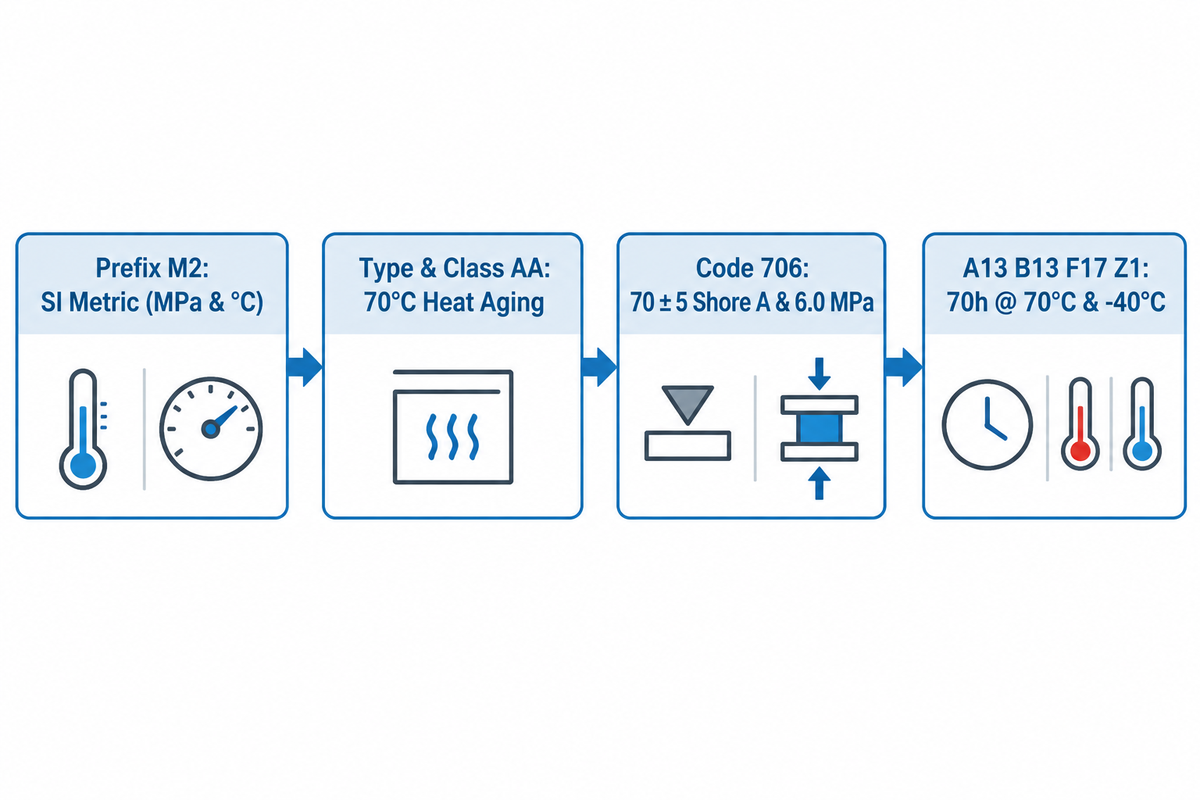
According to ASTM D2000-18 (2024) e1 and SAE J200 202303, a drawing showing “SBR 70 Shore A” does not define any limit for tensile, aging, or compression set. In an ASTM D2000 callout such as ASTM D2000 M2AA706 A13 B13 F17 Z1, Z1 identifies a separately defined special requirement whose test conditions and acceptance limits are supplied in an accompanying drawing note:
- Prefix M2 indicates SI metric units (MPa for tensile strength, °C for test temperatures) and Grade 2 suffix test requirements.
- Type and Class AA (or BA) set a 70°C heat-aging test temperature for Type A (or 100°C for Type B). Class A indicates no maximum volume swell requirement in ASTM D471 IRM 903 oil.
- Three-digit code 706 specifies 70 ± 5 Shore A durometer (first digit 7) and a 6.0 MPa minimum tensile strength (last two digits 06). Specify code 714 when structural mounts require 14.0 MPa.
- Suffixes A13 and B13 specify ASTM D573 heat aging for 70 h at 70°C (with hardness change limited to ±15 points and tensile strength loss limited to 30%) and ASTM D395 Method B compression set for 22 h at 70°C.
- Suffixes F17 and Z1 cover ASTM D2137 low-temperature brittleness at -40°C (F17) and a separately defined drawing requirement (Z1). Under EU REACH Entry 50, Z1 can specify virgin copolymer of styrene and butadiene (copolymer of butadiene and styrene) with ≤1 mg/kg per listed PAH for covered consumer skin/oral-contact parts (≤0.5 mg/kg for covered toys/childcare).
How to Qualify a Custom SBR Rubber Molding Manufacturer: IATF 16949, ASTM D5289, and ISO 3302-1
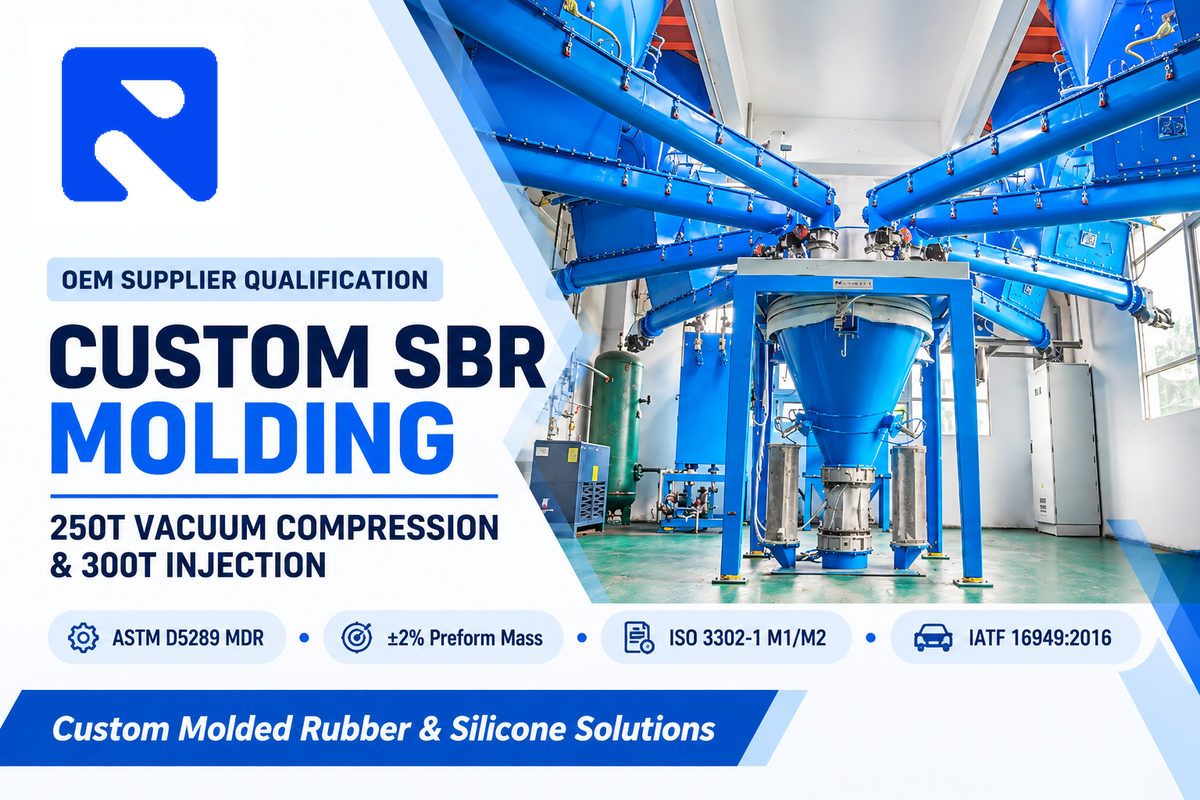
Qualify a custom SBR rubber molding manufacturer by auditing three factory controls: batch-level ASTM D5289 moving-die rheometer (MDR) cure curves, ±2% automated preform mass tolerances, and ISO 3302-1 dimensional classes (M1, M2, or M3). IATF 16949:2016 covers eligible automotive supply programs, while ISO 9001:2015 provides the baseline quality-management framework for industrial and plumbing suppliers.
Because SBR is easy to process during internal mixing, calendering and extrusion, its vulcanisation curve shows a flatter plateau compared to natural rubber. However, lot-to-lot variations in the bound ratio of styrene to butadiene or accelerator dispersion can shift t 90 optimum cure time. Without MDR gatekeeping on every mixed batch and adequate press cure time for thick-section cores, under-cured SBR bushings exhibit high compression set. At Guangdong Engelhardt Rubber & Plastic Technology Co., Ltd. (Engelhardt-Meitu), our 53,000 m² Zhongshan facility and 60,000 m² Thailand expansion operate 40+ vulcanizing presses. These include 250-ton vacuum compression vulcanizers, and 300-ton rubber injection presses. Together, our plants manufacture 2,000 metric tons of molded rubber parts annually for American Standard, Kohler, Amphenol, Oatey, SFA, and Nestlé.
| Molding Process | Engelhardt-Meitu Press Equipment | Typical Production Volume | ISO 3302-1 Tolerance Class | Ideal SBR Component Geometry |
|---|---|---|---|---|
| Vacuum Compression Molding | Up to 250T Vacuum Hydraulic Press | Prototype to medium-volume runs | ISO 3302-1 Class M2 / M3 | Thick dock bumpers, heavy vibration pads, cloth-inserted diaphragms |
| Transfer Molding | Pot-and-Plunger Transfer Press | Medium-volume insert runs | ISO 3302-1 Class M2 | Rubber-to-metal bonded SBR bushings, brass-insert mounts, multi-step seals |
| Rubber Injection Molding | Up to 300T Screw Injection Press | High-volume automated runs | ISO 3302-1 Class M1 / M2 | High-precision automotive grommets, dust boots, flashless seals |
When preparing a request for quotation for IATF 16949 custom molded rubber parts manufacturing, the specification table below outlines material, process-control, dimensional, and documentation requirements for a supplier quality agreement. Locking these parameters helps preserve the desired properties of the elastomer while delivering the beneficial properties of carbon-black reinforcement in service.
RFQ checklist — copy these into your quote request:
| Parameter | Recommended range | Why it matters | How to verify |
|---|---|---|---|
| Compound Performance & Identity | Full ASTM D2000 AA or BA line callout plus Z1 drawing note requiring virgin E-SBR 1500/1502/1723 | Defines compound performance while the Z1 note excludes unauthorized reclaimed rubber | Batch Certificate of Analysis (COA) with ASTM D412 & D573 lab test reports |
| Rheometer & Core Cure Control | Batch ASTM D5289 MDR tracking (ML, MH, ts2, t90) plus validated mold temperature and cure time | Batch rheometer testing detects changes in compound cure behavior; thick-section core cure also requires sufficient molding time for heat to reach the core | ASTM D5289 moving-die rheometer (MDR) curve per compounding lot |
| Preform Mass Tolerance | ±2% preform mass control envelope (Engelhardt-Meitu factory benchmark) | Controls parting-line flash thickness and cavity pressure uniformity | Automated preform cutter check-weigher logs in production control plan |
| Dimensional Tolerance Class | ISO 3302-1 Class M1 (precision injection) or Class M2 (general molded), separating fixed (F) and closure (C) dimensions | Matches housing bore interference and accounts for parting-line closure variation | First-article dimensional inspection report across all mold cavities prior to production release |
| EU REACH Entry 50 PAH Limits | Tire-production extender oils: ≤1 mg/kg BaP and ≤10 mg/kg for the sum of the eight listed PAHs; covered consumer components with direct, prolonged or repetitive short-term skin or oral contact: ≤1 mg/kg per PAH (≤0.5 mg/kg covered toys/childcare) | Verifies compliance with EU REACH Annex XVII Entry 50 PAH restrictions | Third-party AfPS GS 2019:01 PAK or GC-MS test report |
| Quality Management System | ISO 9001:2015 baseline; IATF 16949:2016 + PPAP Level 3 for eligible automotive programs | Ensures full traceability from raw bale lot to finished shipment | Valid IATF/ISO registrar certificate and PFMEA / Control Plan package |
2026–2034 SBR Market Outlook: PAH-Free TDAE Extender Oils, Anti-Dumping Duties, and EV Battery Binders
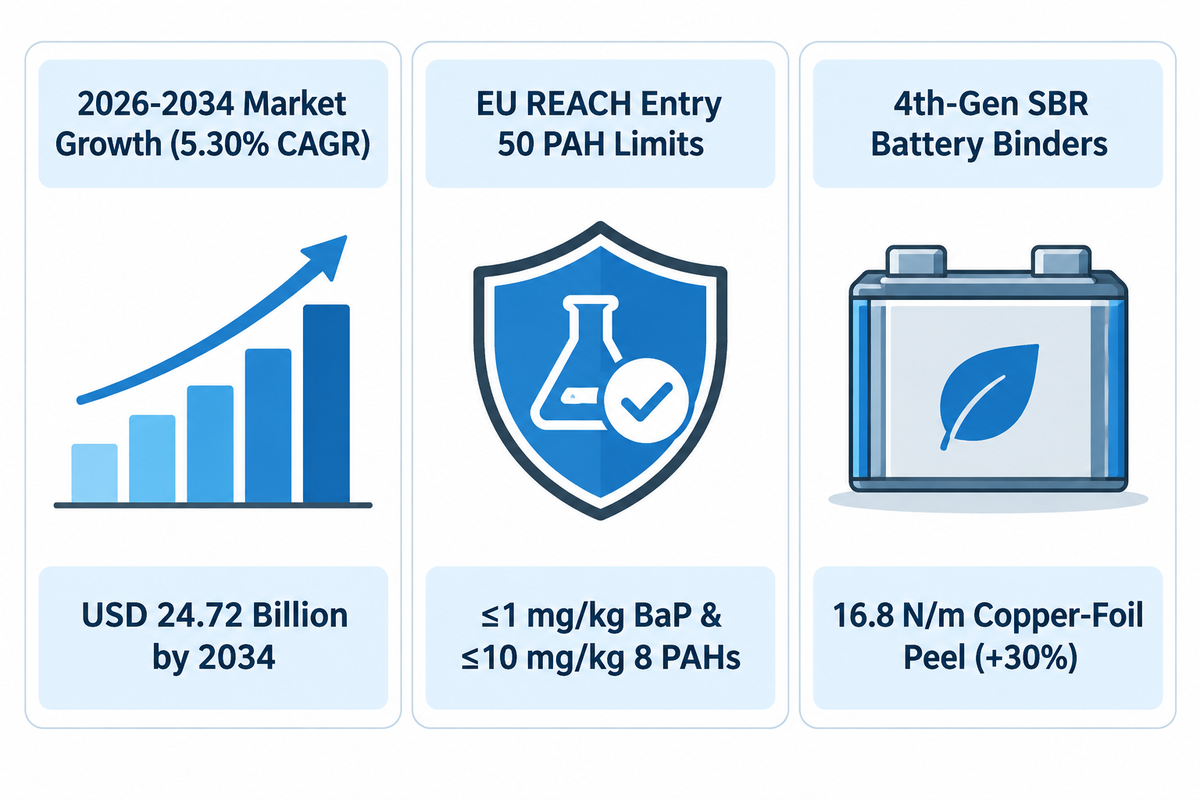
Three structural forces are reshaping global SBR rubber procurement between 2026 and 2034. First, EU REACH Entry 50 PAH limits drive adoption of low-PAH TDAE extender oils in regulated tire and consumer goods. Second, US and Indian 1500-series E-SBR anti-dumping duties create regional price spreads. The last relates to rapid market penetration of functionalized S-SBR and aqueous battery anode binders. Multi-country molding footprints in China and Thailand insulate OEM buyers from tariff volatility.
According to the Fortune Business Insights 2025–2034 SBR Market Analysis, global styrene-butadiene rubber demand grew from USD 15.49 billion in 2025 to USD 16.32 billion in 2026. The market is projected to reach USD 24.72 billion by 2034 at a 5.30% compound annual growth rate (CAGR). Asia Pacific generated USD 8.23 billion in 2025 and USD 8.73 billion in 2026 (53.13% in 2025 and 53.49% in 2026, or roughly 53% of global value). Meanwhile, Mordor Intelligence’s 2025–2030 SBR Industry Report confirms that tire applications account for 68.72% of global revenue. Various industrial goods, footwear, construction adhesives, and polymer modification represent the remaining 31.28%.
From a procurement perspective, rubber manufacturers face similar challenges.
- Qualifying a molder with dual plants, such as Engelhardt-Meitu’s 53,000 m² Zhongshan and 60,000 m² Thailand facilities, improves shipment routing flexibility.
- Functionalized 4th-Generation SBR Aqueous Anode Binders: Beyond molded elastomers, carboxylated and hybrid styrene-butadiene latex dispersions bind graphite and silicon-carbon anodes in EV and energy storage Li-ion cells. Newer functionalized 4th-generation hybrid SBR-acrylic aqueous binders offer an increase of up to 30% in copper-foil electrode peel strength, reaching 16.8 N/m compared with reference commercial SBR latices.
- Bio-Attributed & Recycled Carbon Black Compounding: More automotive OEMs in Europe are assessing ISCC PLUS mass-balance bio-attributed S-SBR in combination with rCB. Compounds have to pass ASTM D2000 AA and BA heat-resistance types, Class A oil-swell limits, as well as numerical hardness and tensile strength requirements.
Frequently Asked Questions About SBR Rubber
Does the US produce synthetic SBR rubber, and where is global production concentrated?
Yes, the U.S. produces hundreds of thousands of metric tons of Emulsion and Solution SBR annually in the petrochemical complexes of Texas and Louisiana.
North American production originated under the World War II U.S. Government Rubber-Styrene (GR-S) synthetic rubber program. It remains a major domestic feedstock for automotive tires and industrial goods. Globally, Asia Pacific leads regional market value at USD 8.73 billion in 2026 (53.49% of the USD 16.32 billion global total). Major production hubs operate across China, South Korea, Japan, and Thailand.
Is SBR rubber waterproof, and can it be used for potable plumbing or cold-water flange gaskets?
Yes, vulcanized SBR rubber is waterproof and exhibits low water swelling in non-potable cold and warm water pipe flanges up to +80°C.
However, standard commercial SBR is not recommended for chlorinated municipal drinking water lines or NSF/ANSI 61 potable plumbing systems. Chloramines and free chlorine attack the unsaturated butadiene double bonds. This reaction causes surface leaching, black water discoloration, and odor failure. Specify NSF-61 certified peroxide-cured EPDM for potable drinking water seals.
Is SBR rubber food safe or FDA 21 CFR 177.2600 compliant?
Standard black industrial E-SBR 1500 and oil-extended E-SBR 1712 are not food safe and must never come in contact with food or beverage products.
White or off-white food-grade SBR compounds use non-staining E-SBR 1502, USP mineral oil, zinc oxide, and FDA-listed antioxidants to meet FDA 21 CFR 177.2600 extraction limits in aqueous foods. For harsher sanitary service, food-contact-compliant EPDM formulations serve hot-water and steam lines. Food-contact-compliant white Nitrile (NBR) handles fatty oils, and platinum-cured silicone covers high-heat lines.
Why does SBR rubber smell, and how do non-staining E-SBR 1502 compounds reduce odor?
SBR rubber odor comes from trace unreacted styrene monomer, aromatic extender oils, and sulfur-accelerator decomposition byproducts.
The use of steam-stripped E-SBR 1502 with low-odor TDAE plasticizers and peroxide curatives reduces indoor odor.
What is the shelf life of molded SBR rubber parts under ISO 2230 storage guidelines?
Under ISO 2230 warehouse guidelines, vulcanized SBR parts belong to Group A elastomers. They carry an initial storage period of 5 years and a possible 2-year extension after inspection.
Store parts below +25°C in UV-opaque polyethylene bags away from electric motors or ozone sources.
How do you bond SBR rubber to steel, aluminum, or brass inserts during vulcanization?
A two-coat heat activated primer and cover-coat adhesive system is used to bond SBR to metal inserts during vulcanization. Peel testing, using ASTM D429 Method B, determines the adhesion strength of the coating. Cohesive failure is indicated by rubber tearing.
First, degrease the metal insert and grit-blast carbon steel or apply a zinc phosphate conversion coating. Second, apply a coat of phenolic-chlorinated rubber primer (for example, Chemlok 205), and follow with a general-purpose elastomer topcoat (for example, Chemlok 220 or 250). Crosslinking of the elastomer topcoat with SBR diene happens during the press vulcanization process. Refer to our full engineering guide on various vulcanized rubber-to-metal bonding methods and primer systems.
What are SBR rubber granules and how are recycled tire crumbs used?
SBR rubber granules are crushed tire particles. Passenger and truck tire particles are cryogenically or ambient-ground to elastomeric particles.
Product uses of polyurethane-bound SBR crumb include playground surfaces, athletic running tracks, gym weight plates, and acoustic sub-floor mats.
References & Sources
- Emulsion (ESBR) and Solution (SSBR) Pathways for Synthesis of Styrene-Butadiene Rubber (HERO ID 10193402) – U.S. Environmental Protection Agency (US EPA HERO Database)
- Characterization of Solution Styrene-Butadiene Rubber (SSBR) and Blended Compounds (HERO ID 4710929) U.S. Environmental Protection Agency (US EPA HERO Database)
- U.S. Environmental Protection Agency (US EPA HERO Database), Structure and Properties of Styrene-Butadiene Rubber (SBR) with Industrial Carbon Black (HERO ID 3986127).
- ASTM D2000-18(2024)e1 Standard Classification System for Rubber Products in Automotive Applications ASTM International
- ISO 2322:2023 Styrene-Butadiene Rubber (SBR) Emulsion- and Solution-Polymerized Types Evaluation Procedures International Organization for Standardization (ISO)
- EP0942042B1 Emulsion Styrene-Butadiene Rubber Copolymerization Composition European Patent Office / Google Patents
- An article titled “Ozone Cracking Failure Mechanisms and C=C Double-Bond Scission in Unsaturated Diene Rubbers” has been published in ScienceDirect in the Engineering Science & Technology section.
- Styrene-Butadiene (SBR) Rubber: Uses, Structure & Material Properties Guide SpecialChem Elastomer Knowledge Base
- Styrene Butadiene Rubber Market Size, Share & Global Forecast 2025–2034 | Fortune Business Insights
- Styrene Butadiene Rubber (SBR) Market Revenue & Segment Analysis 2025–2030 Mordor Intelligence
- Global Styrene Butadiene Rubber (SBR) Pricing Report (USA, Europe, China, South Korea) IMARC Group
- Styrene Butadiene Rubber Price Trend & Regional Index Q3 2026 Procurement Resource
Related Articles
About This Engineering Analysis
This SBR rubber specification guide combines ASTM D2000-18(2024)e1 and ISO 2322:2023 testing standards with production compounding data from our 53,000 m² Zhongshan and 60,000 m² Thailand molding facilities. Our laboratory verifies every E-SBR 1500, 1502, and 1723 batch on moving-die rheometers under IATF 16949:2016 quality controls. Reviewed by the Guangdong Engelhardt Rubber & Plastic Technology Co., Ltd. (Engelhardt-Meitu) technical team.