Get in Touch with Engelhardt


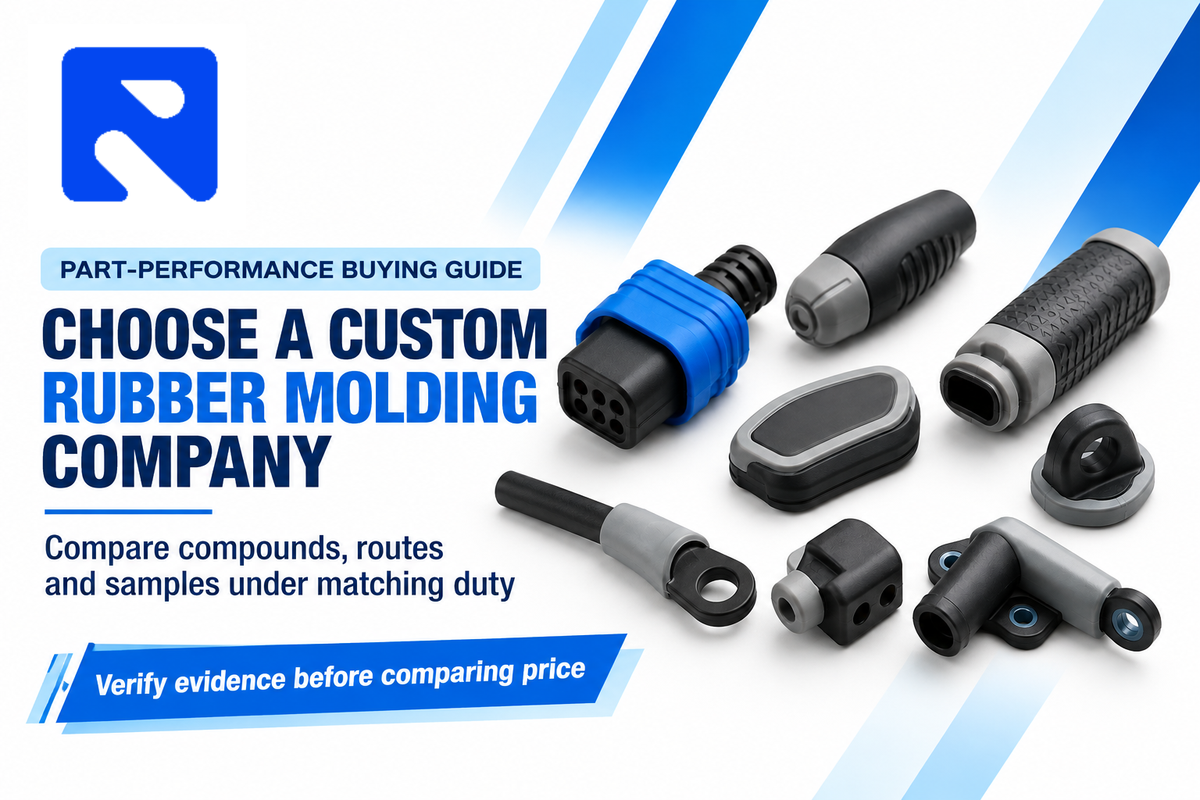
Here’s how to pick a custom rubber molding company: think about the kind of failure your part is stopping, compare compounds, molding routes and sample results under similar service conditions. Choose the supplier whose evidence best answers your questions.
Two suppliers can quote the same hardness while testing different samples. One may test a button sample, the other may test a finished seal. Look into what the quoted numbers are based on before going with the cheaper option.
By Aurora · Updated November 2026
At a glance
- Define the service duty before choosing a rubber compound.
- Compare material screening, drawing conformance and assembly function separately.
- Use representative samples to resolve the remaining technical question.
- Compare commercial terms once the evidence is comparable.
Choose rubber molding companies by the failure your part must prevent
First look for companies whose molding capabilities correspond with the intended function of your part and the service condition. A seal that must prevent leakage needs a different development discussion from a cable grommet or vibration mount. The useful question is how each supplier will establish that the proposed custom molded rubber parts work in your assembly.
It’s important to first state what the failure is, i.e. loss of liquid, a cable that slips or a mount that separates. That description helps engineering and purchasing distinguish relevant top rubber molding services from a long equipment list.
When a company specializes in custom rubber molding, their first response should be to turn those quality custom rubber molding needs into a development question. For large parts, that question might concern handling during assembly; for a small seal, it might concern access to the critical measurement surface.
- Duty fit: experience with the material, exposure and load combination you need to investigate.
- Evidence fit: a practical way to test the critical feature or assembled function.
- Development fit: a workable path from the present drawing or concept to representative molded parts.
Hypothetical selection example: Consider a buyer looking to purchase a cable-entry grommet for a metal enclosure. In response to the buyer’s request, one rubber manufacturer provided the material name and molding capacity. Another, in response to the same request, provided the panel edge, cable jacket and installation direction, and sample fixture. The second response provided the team with a better next step. It stated to assess installation damage and retention against the criteria defined by the project, and insert the grommet along with the cable and panel.
The buyer can now request the missing fixture details from both companies. How long a company has been manufacturing similar parts can inform an initial discussion; the proposed fixture addresses the present design question. A softer sample may simply make installation easier while leaving retention unaddressed.
For company-wide qualification, use the separate rubber manufacturer qualification guide. This article focuses on the evidence for your particular part.
Turn service conditions into a testable rubber product brief
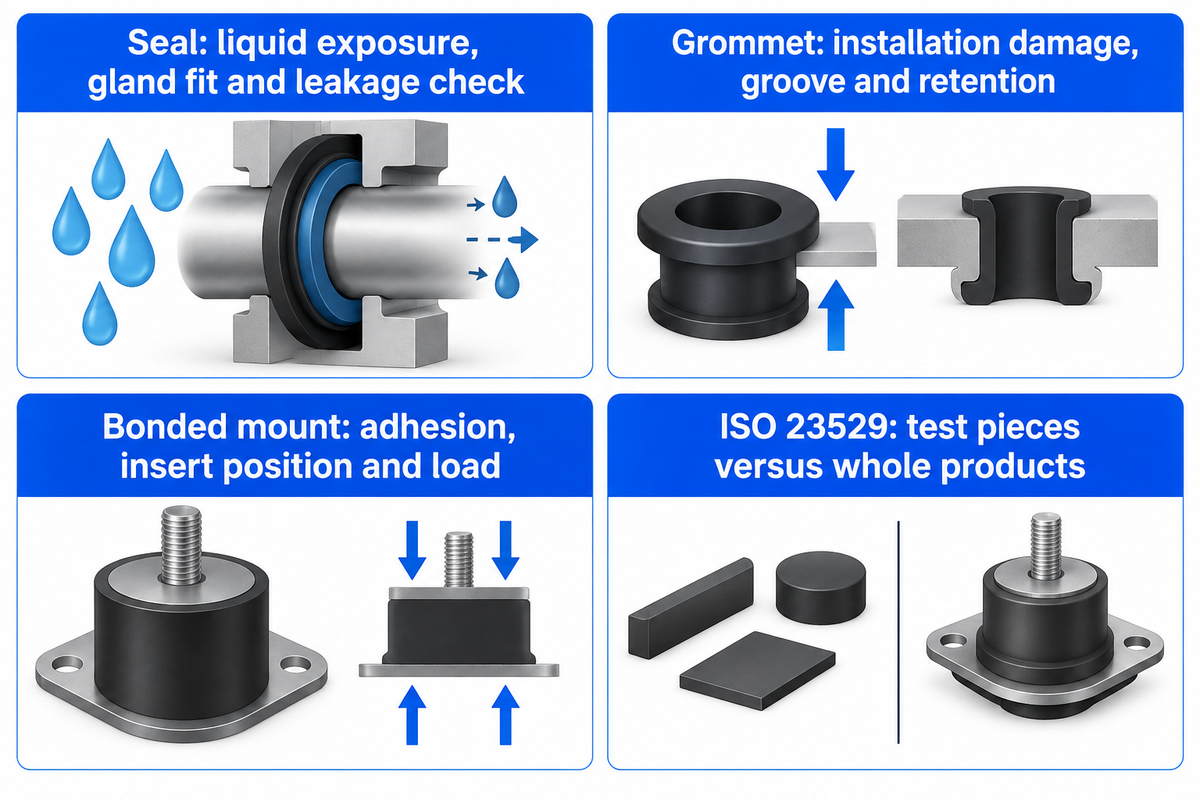
Give the molder a description of the installed duty alongside drawings of your custom rubber products. Include contact media, temperature exposure, motion, mating parts and failure criteria that are of interest to the rubber product. The brief should address each of the major requirements and state the rationale for the design.
Separate normal operation from cleaning, storage and installation. A rubber seal may encounter one liquid during use and another during maintenance; a grommet may experience its largest deformation during assembly. These details may change the type of material to recommend.
| Part and question | Evidence to develop | Decision it informs |
|---|---|---|
| Seal: does the liquid alter the compound? | Material changes after the specified liquid exposure | Keep or revise the candidate compound |
| Seal: does its section fit the intended gland? | Critical dimensions in the agreed measurement state | Resolve drawing or tooling corrections |
| Seal: does the assembly control leakage? | Leakage assessment with relevant pressure, motion and exposure | Accept the demonstrated duty or revise the design |
| Grommet: will installation damage the material? | Material screening and inspection after the intended installation | Adjust compound, geometry or installation approach |
| Grommet: does the groove engage the panel? | Groove, panel thickness and cable interface measurements | Resolve interface mismatch |
| Grommet: does it stay seated? | Retention check in the intended panel and cable assembly | Accept retention or change the proposal |
| Bonded mount: is the joining route suitable? | Adhesion screening for the specified rubber and rigid substrate | Develop the bond preparation and process |
| Bonded mount: are the interfaces positioned correctly? | Insert location and mounting-face inspection | Correct positioning before assembly testing |
| Bonded mount: does it perform under the intended load? | Assembly response under the specified load direction and exposure | Assess the proposed mount for that application |
ISO 23529 addresses general preparation, measurement and conditioning of rubber test pieces; special requirements for testing whole products sit outside that scope. A reproducible material test and an application test therefore serve different purposes.
Specify rubber parts using the known service conditions, and the unknown inputs have to be treated as open questions. An unspecified cleaner or an unavailable mating part is relevant information for a development discussion. In the absence of such information, a comparison of the sample may be necessary.
The brief is applicable to custom rubber molded components, whether the starting material is natural rubber or a synthetic elastomer. Natural and synthetic rubber candidates still need an application-specific comparison, and a familiar name of a polymer leaves the compound formulation and relevant exposure questions open.
For an incomplete concept, the molder may move to a manufacturability assessment. Explain the tradeoff between wall thickness, parting lines, and inserts. Accepted changes to the concept drawing are to be documented. Sample trials resolve the remaining functional gaps. The drawing may be released for production tooling.
Compare rubber compound results under the same conditions
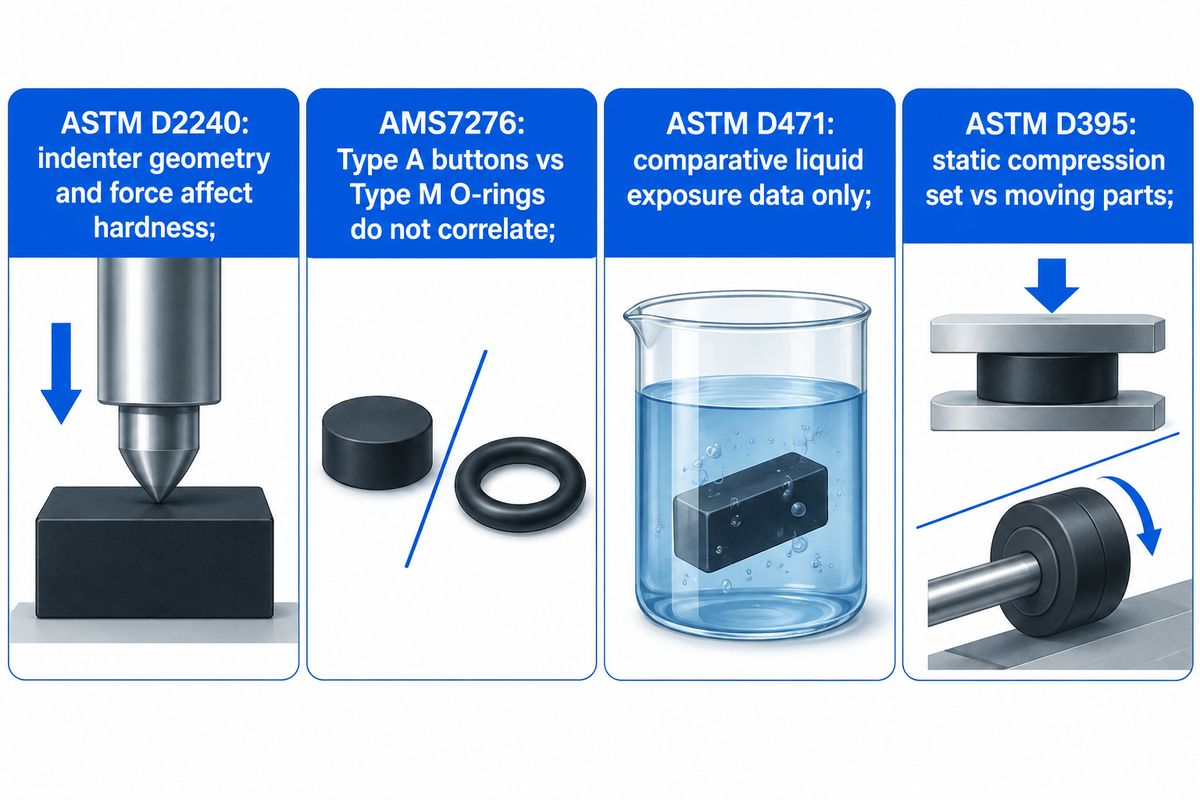
Compare compound results only after alignment of test method, specimen, preparation, and exposure. Hardness, fluid response, and compression set describe different aspects of the behavior of rubber material. A company providing and offering custom compounds should identify which property addresses the need, and which question is left open for sample trial.
If custom mixing is part of the proposal, associate the candidate compound identifier to every sample report. Describing a batch as high-quality rubber gives purchasing less helpful information than a traceable identity and relevant properties for its intended use.
How do I accurately specify the durometer for my custom rubber part?
Tie the range to the required function of the part, define the measurement conditions, and agree how incoming parts will be inspected. For small and/or curved rubber molded parts, specify whether the acceptance criterion is a finished part measurement or an acceptable reference specimen.
As explained by ASTM D2240, the indenter geometry and the force applied will affect the hardness reading. Generally, there is no direct correlation between indentation hardness and a fundamental material property. Therefore, hardness values alone can not be used to determine the installed force for a customized rubber product.
A study of AMS7276 fluorocarbons shows how measurements of different types of specimens don’t correlate. A study of AMS7276 fluorocarbons illustrates the problem: Type A measurements on buttons or disks didn’t have a simple correlation with Type M measurements on O-rings. There’s a need to keep your comparison method consistent based on the findings from different types of specimens.
Match the test to the property you need
Fluid exposure: compare changes after the same liquid, concentration, temperature and duration. ASTM D471 regards these types of comparisons as relative data and warns that they do not directly correlate to the actual performance of the part.
“It yields comparative data on which to base judgment as to expected service quality.”
Compression set: compare results obtained with matching deformation, exposure and recovery conditions. ASTM D395 mainly covers service conditions with static stresses. The development plan also needs to consider other service conditions if the part under consideration is moving or loaded repeatedly.
Hypothetical report comparison: Purchasing is evaluating gaskets for an enclosure, and two reports are presented that show tests for different conditions. One report describes a test specimen immersed in the operating liquid, and the other report describes a gasket exposed to a cleaning solution. Based on the amount of change reported, the second gasket is preferred.
Engineering separates the questions: For compatibility with the operating liquid and exposure to the cleaning liquid, both conditions apply, but the reports address different conditions. The team keeps both reports, determines the missing exposure for both conditions, and agrees upon a common condition for comparison. They assign an owner for the missing test, and leave the choice of compound open until those test results come back.
Judge the molding process by the parts it produces
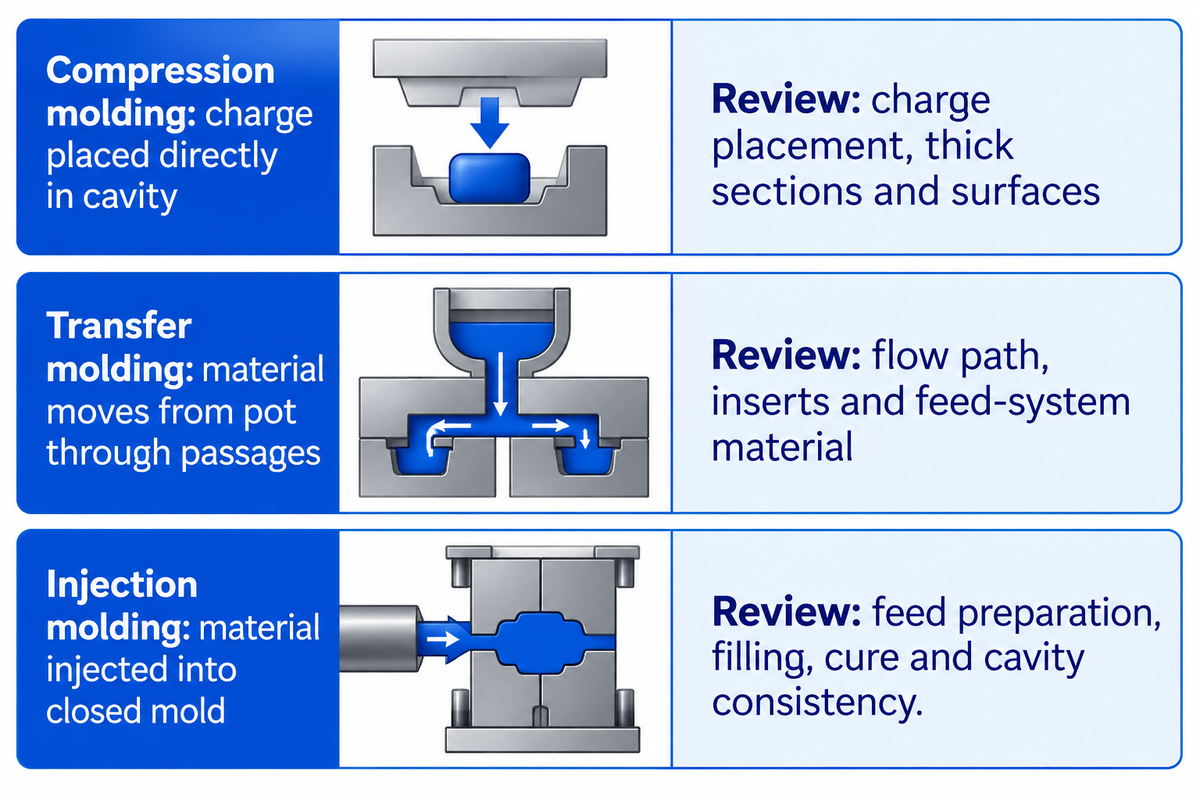
Evaluate the molding process for the material, geometry, critical surfaces and the intended mode of production. Compression, transfer and injection molding offer various options to fill and cure a mold. An adequate proposal connects the chosen route to your part and explains how available samples will demonstrate its critical features.
For custom rubber injection molding, review the material feed and cavity arrangement with the supplier. With injection molding processes, focus on the compound and the critical feature. The number of molding presses alone doesn’t tell you much about that combination.
| Route | Process distinction | Part-specific discussion |
|---|---|---|
| Rubber compression molding | A prepared charge goes directly into the mold cavity. | Charge placement, thick sections, handling and critical surfaces |
| Rubber transfer molding | Material moves from a pot through passages into the cavities. | Flow path, inserts and material left in the feed system |
| Rubber injection molding | Prepared material is injected into the closed mold. | Feed preparation, filling, cure and cavity consistency |
These process differences are described in Custom Rubber Corp’s molding services overview. Transfer molding and compression molding differ in where the initial charge is placed. For a more detailed, technical comparison, see compression molding versus injection molding.
A custom injection molding proposal should identify which sample features represent the proposed production route, especially when custom silicone or liquid silicone rubber uses a different prototype approach.
If the proposal uses injection molding for high-volume production, establish the sample-to-production relationship before upsizing the order. A custom compression tool needs the same clarity about the evidence its samples provide. With molding of custom shapes with inserts, compare the proposed insert positioning and post-molding inspection.
Pick a prototype specialist when the decision hinges on geometry or installation and transfer to a supplier can be deferred. Select the planned production scale when the trial needs to determine representative material that can be cured or assessed for cavity behavior. In either case, identify the questions the prototype will answer and the questions that remain for the production supplier.
For example, a sulfur-cured SBR compound study required the adaptation of a compression-set prediction model for a change in condition from compression to injection molding. In the molding of rubber, the process-property link is of more interest to a buyer than a comparison of the two processes.
Check rubber mold accuracy and functional performance separately
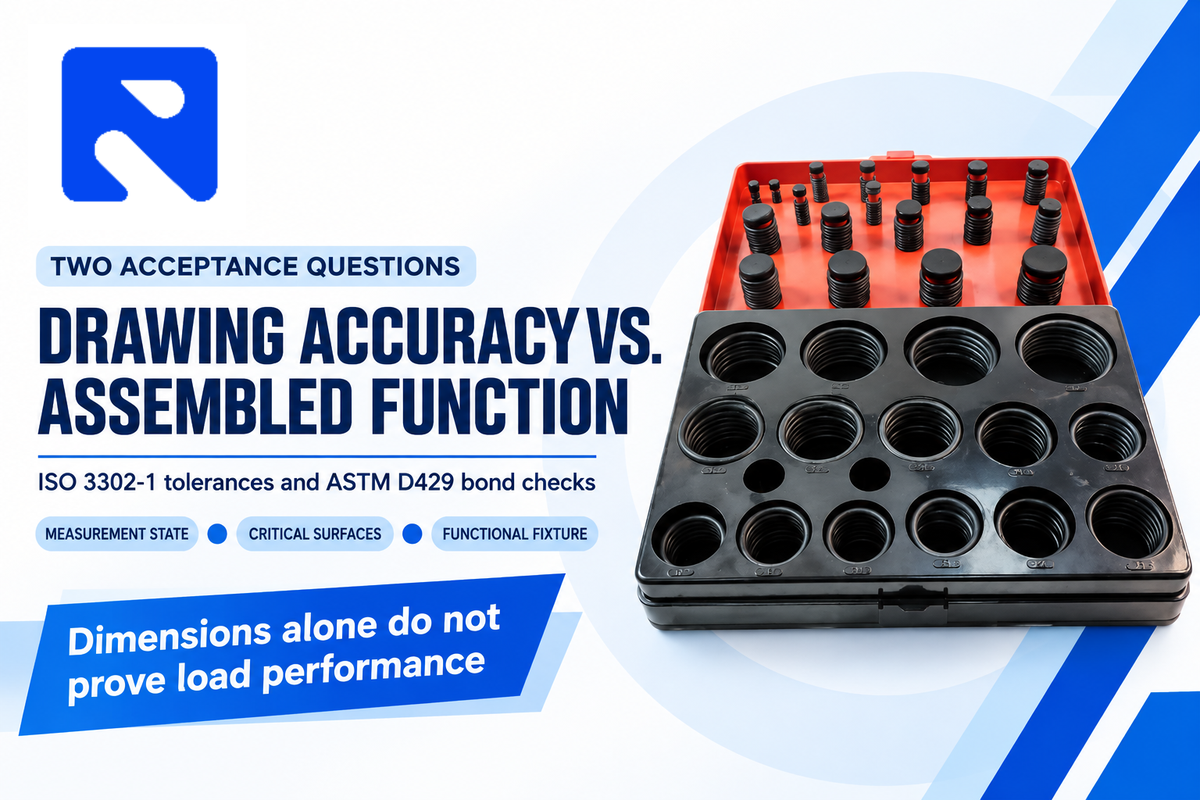
Judge conformity to drawing and the functioning of the device as different acceptance criteria. For precision rubber parts, a stated measurement condition, along with an explanation of the dimensions affecting the assembly, is required. The rubber mold, material, and inspection method are also part of the discussion. The functional test determines if the assembly meets the requirement.
The inspection scope must go beyond a first off sample to the intended production condition for high-volume precision rubber molding. For custom-molded rubber parts made in smaller batches, it’s acceptable to agree on the same critical features and measurement basis, before comparing the results.
ISO 3302-1 provides dimensional tolerance classes for specified solid rubber products, with precision toroidal sealing rings excluded from its scope. Choose the applicable drawing requirements before comparing suppliers’ inspection results; a general claim of precision rubber molding leaves that work unfinished.
- Measurement state: identify conditioning, support and the features being measured.
- Critical surfaces: locate the sealing edge, groove or mounting face on the drawing.
- Functional fixture: include the mating parts and installation condition that create the load.
Hypothetical bonded-mount example: the sample meets the overall dimensions and the insert is in the specified position. The buyer is ready to accept the rubber to metal part, but the intended assembly loads the joint at an angle that the dimensional inspection never exercises. The team adds that loading arrangement to the trial fixture and states the observation needed for acceptance.
If a problem is indicated during the trial, the subsequent discussions are concerned with the load path, the substrate, the geometry of the rubber and the bonding process. Tightening the dimensional tolerance of the rubber alone wouldn’t solve that problem. The drawing report has value; it serves to distinguish a problem of positioning from an assembly performance problem.
For rubber to metal bonding, multiple adhesion-test configurations are available in ASTM D429. Specify the configuration and specimen in the test plan and show the results on the joint you are designing.
A company that specializes in rubber components may subcontract a specialized rubber test. If it offers rubber molding while another laboratory performs the test, identify who prepares the specimens and who interprets the report. The same identity of the drawing and sample should accompany that work.
Use the rubber molding tolerance guide for drawing dimensional requirements.
Use the Same-Duty Sample Comparison before choosing a molder
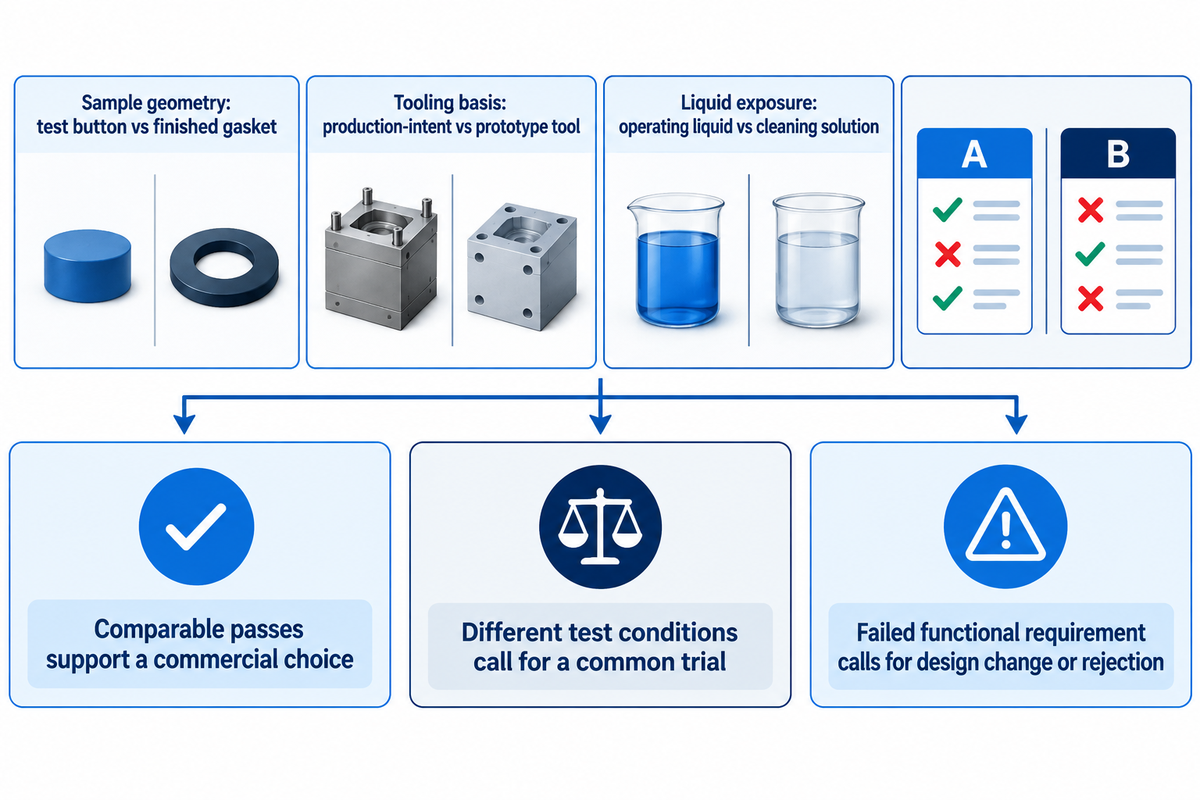
Each supplier’s sample should be evaluated on an equal basis before a determination is made regarding the proposal. Record what was tested, how it was prepared, what exposure it received and the acceptance criteria. Discrepancies in those areas become the basis for specific questions when resolving discrepant results.
The Same-Duty Sample Comparison below is an editorial purchasing tool. Its filled table develops the hypothetical enclosure-gasket example above; the descriptions are illustrative, and the acceptance limits belong to the buyer’s application.
| Comparison field | Proposal A | Proposal B | Buyer action |
|---|---|---|---|
| Compound identity | Supplier compound code recorded | Polymer family only | Identify the actual candidate compound |
| Sample geometry | Molded test button | Finished gasket | Separate material screening from part evidence |
| Tooling basis | Production-intent tool | Prototype tool | Identify which critical features are representative |
| Conditioning | Preparation recorded | Preparation not stated | Complete the missing test record |
| Liquid exposure | Operating liquid | Cleaning solution | Cover both relevant exposures on a common basis |
| Exposure temperature | Specified service condition | Laboratory ambient condition | Resolve the duty mismatch |
| Reported property | Material volume change | Visual surface condition | Compare the required property, retaining both observations |
| Assembly evidence | No enclosure fixture used | Fit check in a reference enclosure | Plan the required leakage assessment |
| Acceptance basis | Buyer’s draft criterion | Supplier’s general criterion | Agree the project criterion before deciding |
Nominally the same test methods may vary because of differences in test equipment, personnel, and material processing. In Rubber World, Paul Tuckner describes testing variations and identifies where adjustments may be required to reconcile preparation details to improve report utility.
Key takeaway
Comparable passes support a commercial choice. Different test conditions call for clarification or a common trial. A failed functional requirement calls for a design change or rejection of that proposal.
Quality owns the comparison record; engineering determines whether a difference matters to function. Then purchasing compares the cost and schedule of closing the difference.
Finance can distinguish a complete proposal from a partial one. They look for costs associated with testing and/or fixtures that remain to be priced.
The rubber molding experts reviewing the project can focus on the disputed condition, rather than defend two reports that test different things.
Budget for tooling, testing and a realistic launch date
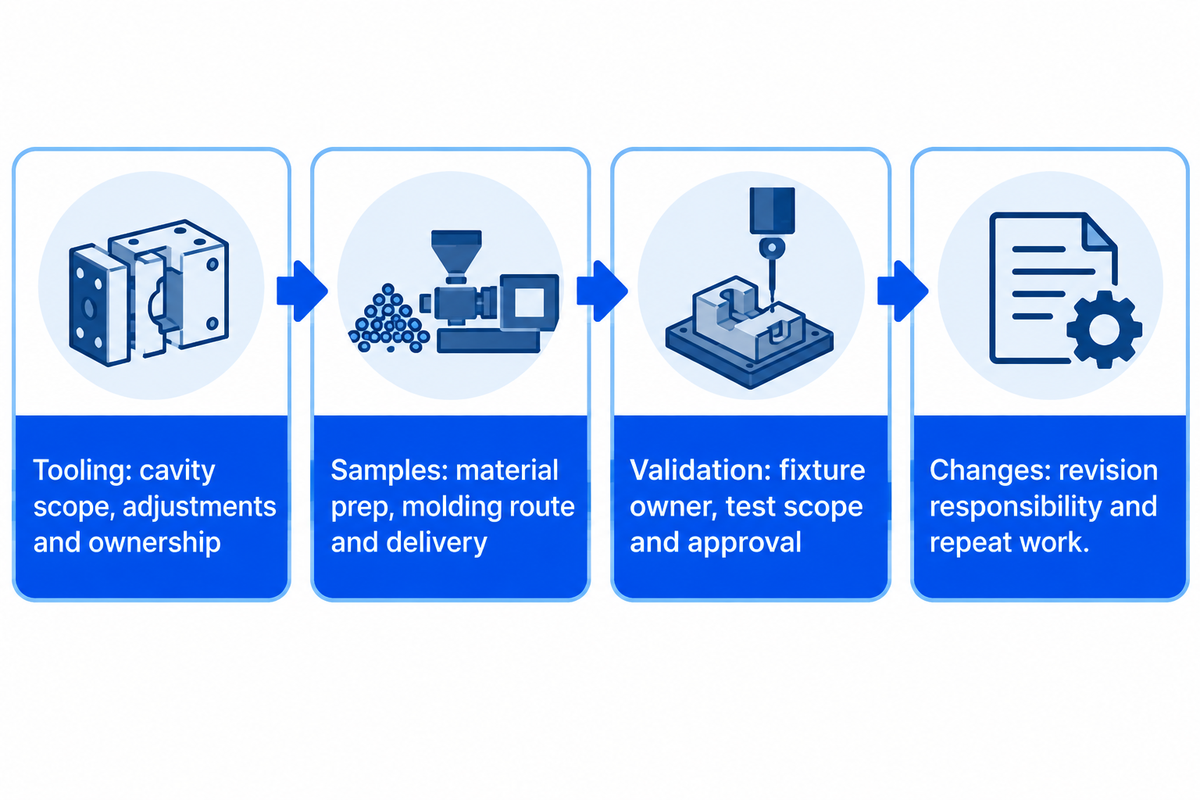
Compare the complete development scope: tooling, material preparation, samples, fixtures, testing and the buyer’s approval work. The best quote indicates what the payment/milestone delivers, and how this affects the launch plan.
Cost drivers identified in Custom Rubber Corp’s cost discussion include material, tooling complexity, volume, setups, quality work, and logistics. Use these as scope headings to compare custom rubber molding services rather than utilizing an unrelated mold price.
How Long Does It Take a Rubber Molds Manufacturer to Deliver an Order?
The commitment of custom molded rubber components states when tooling and a mold are ready for a functional trial. Separate dates are given for samples, testing and approval, and release for production. The commitment states what drawings are approved, and what assumptions are made about the material to be supplied.
A practical schedule also shows what mating parts are supplied and when the test fixture is available. If a sample is changed after a test, identify which tests are still relevant and which ones no longer apply. If an existing piece of evidence still applies, this can answer a question without needing to perform a new test.
- Tooling: cavity scope, planned adjustments and ownership terms.
- Samples: material preparation, molding route and delivery contents.
- Validation: fixture responsibility, test scope and approval owner.
- Changes: responsibility for revisions and any necessary repeat work.
For a wider commercial comparison, refer to the custom rubber molding cost estimate. Make sure the selected test basis is with the quote so the price and the proof provide the same information.
Make a conditional supplier choice and define the next trial
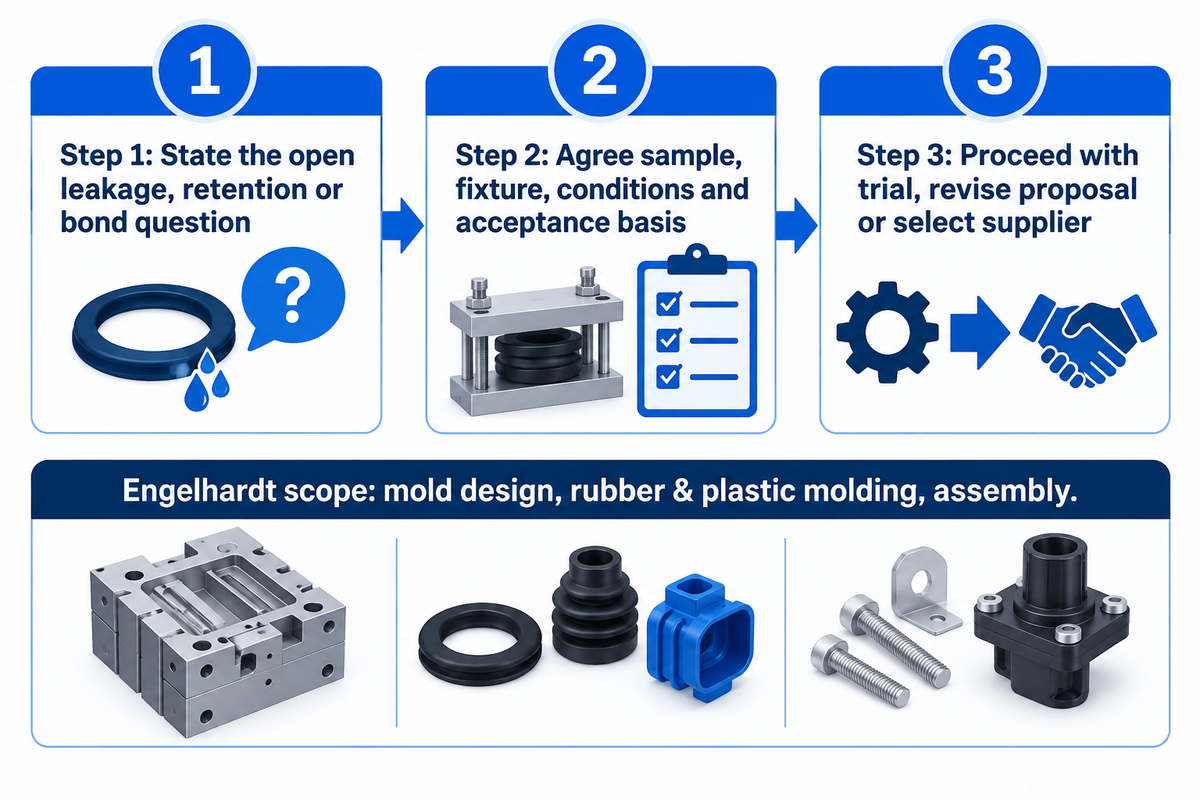
Select the company that has demonstrated the required function, or commission a clearly scoped next trial when the remaining question is still open. The next commitment should name the unresolved requirement, the evidence required to address it and who will accept it. This allows progress to be made without treating every unknown as a reason for a complete restart.
- State the open decision. Identify the leakage, retention, bond or other functional question that remains.
- Agree the next evidence. Define the sample, fixture, conditions and acceptance basis with the molder.
- Commit to the appropriate scope. Proceed with the trial, revise the proposal or move to commercial selection when the evidence is sufficient.
For starting conversations, Custom Rubber Corp. offers custom rubber molding services including transfer, injection and compression molding services. Apple Rubber offers design engineering support from concept through seal validation, including computer-aided design and prototype creation.
Relevant examples for different projects are provided in the sample comparison. Engelhardt’s manufacturing capabilities include in house mold design and fabrication, as well as rubber and plastic molding, and hardware and assembly work. Its custom plastic injection scope may be relevant when mating parts belong to the same development discussion.
Use the OEM rubber components handoff guide to take the accepted design and sample basis for production repetition.
Frequently Asked Questions
What is a rubber company?
A rubber company develops, processes, manufactures or supplies rubber materials and products. Businesses in the rubber molding industry may provide custom parts, standard seals or compound development. For rubber molded goods, identify who designs the mold, makes the parts and owns the technical response before evaluating the proposal; a distributor and a factory can have different responsibilities.
What are the different types of molding methods?
Common routes for molded rubber products include compression, transfer and injection molding. They differ in how uncured rubber enters the mold and how the process is organized. Liquid silicone rubber uses a liquid-material injection route. Choose among the available processes using the compound, geometry, critical features and production requirements, then evaluate representative samples from the proposed route.
What is the price of rubber mold?
Rubber mold pricing is specific to the tool’s geometry, cavity arrangement, material, production route and development work, so compare quotations covering the same tool and sample scope. Put the inclusions side by side: trial material, sample quantities, inspection reports and tool revisions, with tooling costs separated from recurring charges that belong in the piece price. Then establish whether each quote buys a production tool or only the next prototype; the price of another product’s mold doesn’t establish the cost of yours.
How can I minimize flash on my rubber molded parts?
Control flash through parting-line position, tooling condition, molding conditions and suitable deflashing, focusing on the surfaces where it affects fit or function. Put the acceptance requirement on the drawing. Inspect the critical location on samples instead of relying on a general promise of clean edges.
How do you choose a company for bonding rubber to metal?
Choose a company that can explain how it will join rubber with metal, prepare the substrate and evaluate the joint. Provide the substrate specification, geometry, load direction and exposure conditions. Compare relevant adhesion evidence alongside the assembled function, including how the result will be assessed.
State whether the approval concerns the bond, the molded geometry or the mount’s assembled behavior. A specimen-level result and a load test on the final assembly answer different questions, so keep both tied to the same joint configuration. Compare the failure location as well as the reported result when evaluating the proposed bond.
Can You Combine Extrusion and Molding?
Yes, a continuous rubber extrusion can be combined with molded corners or joining features. When custom extrusions become part of a molded assembly, define the interface, material compatibility and joining method. Assess extruded rubber products against the assembled requirement before treating the two processes as one finished-part solution.
Does every custom rubber part need the same laboratory test package?
No. Existing evidence may already cover an unchanged application. Select additional work around unresolved exposure, geometry or loading requirements, and agree the necessary test with the responsible engineering team.
Discuss your custom rubber molding project
Bring your drawing, service conditions, mating part details, and the functional question that you still need to answer. Discuss custom rubber molding with Engelhardt to identify the manufacturing scope of interest, define the required information for a proposal and agree on the next sample for your project.
Related articles
References & Sources
- ISO 23529:2016, preparation and conditioning of rubber test pieces
- ASTM D2240-15(2021), durometer hardness
- A Comparison of Type A and Type M Hardness Measurements, Journal of Testing and Evaluation
- ASTM D471-16a(2021), effect of liquids
- ASTM D395-18(2025), compression set
- Traintinger and colleagues, compression-set modeling for molded SBR, Polymers, 2024
- ISO 3302-1:2014, dimensional tolerances for rubber products
- ASTM D429-14(2023), rubber adhesion to rigid substrates
- Paul Tuckner, compression stress relaxation testing considerations, Rubber World, 2021