Get in Touch with Engelhardt


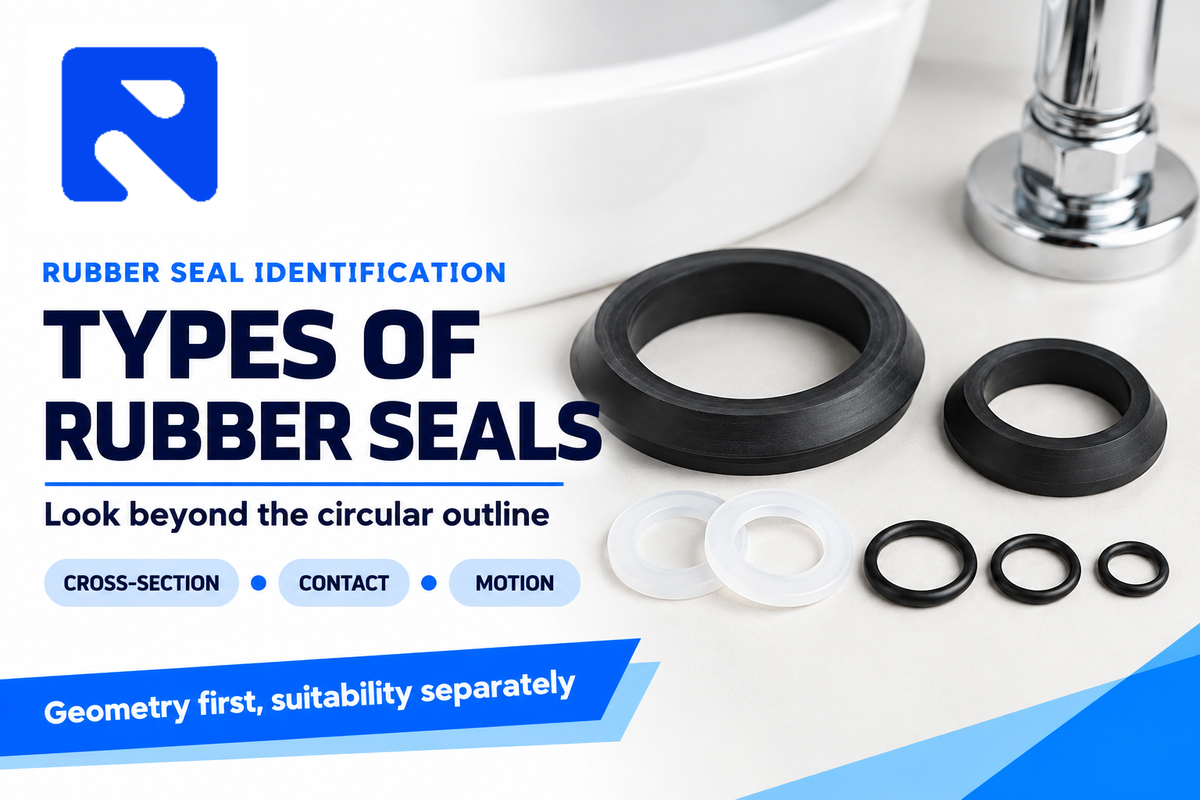
Types of rubber seals include flat gaskets, O-rings, X-rings, shaft lip seals, U-cups, wipers, and building weatherstrips. Identifying parts requires knowing their cross-sections and how they touch mating surfaces. A circular outline doesn’t distinguish an O-ring from a flat washer, and a rubber material name doesn’t describe either shape.
Updated October 2026
Types of rubber seals are grouped by cross-section, contact surface and motion. Flat gaskets seal faces; O-rings fit grooves; lips contact shafts or rods; bulbs and glazing profiles close building gaps. Match the profile to the joint before choosing the compound.
Quick identification facts
- A gasket can be a building weatherstrip; the word doesn’t always mean a stationary flange seal.
- An O-ring has a round cross-section, while a flat ring gasket has a broad, flat sealing face.
- A trim carrier holds an edge; its attached bulb or lip makes the separate sealing contact.
- The two comparison tables below distinguish 12 profile families and 10 joint situations.
Identify rubber seals by cross-section and contact surface
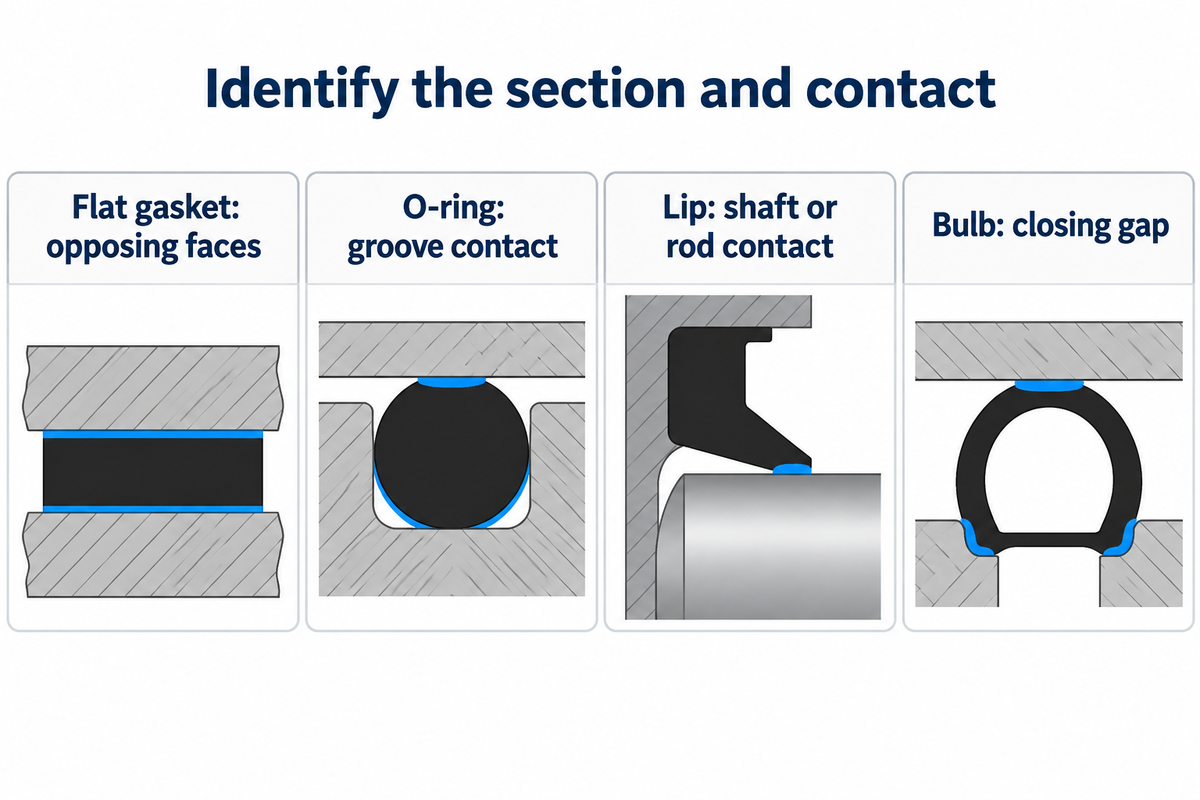
Identifying rubber seals begins with a cross-section of the part and its contact with mating hardware. Note if the contact closes a flat face, surrounds a shaft, sits in a groove, or spans a gap. Then, indicate which component moves during normal use, or only during assembly.
What is a rubber seal?
A rubber seal is a flexible elastomer component that stops the passage of fluids, air, or contaminants. Seal applications include stationary joints and assemblies with relative movement. Reliable sealing depends on the contact arrangement, the compound, and the joint design.
- View the section. Sketch the cut profile as well as the complete part.
- Mark the contact. Identify the face, shaft, rod, glass or frame that the rubber touches.
- Mark the movement. Separate installation movement from rotation, reciprocation or repeated door closure.
- Record the retention. Note the groove, flange, adhesive base or edge-grip carrier that holds the part.
Seal Shape Finder
The Seal Shape Finder groups 12 common profile families by cross-section and contact.
| Family | Section or outline clue | Main contact | Usual motion |
|---|---|---|---|
| Flat ring or washer gasket | Rectangular section; open center | Opposing faces | Static after tightening |
| Full-face gasket | Broad outline with bolt holes | Flange face | Static |
| Profiled molded gasket | Raised bead, step or shaped perimeter | Matching housing or cover | Usually static |
| O-ring | Round section; closed ring | Groove and mating face or bore | Static or designed dynamic use |
| X-ring | Four-lobed section | Matching gland surfaces | Static or designed dynamic use |
| Rotary lip seal | Flexible sealing lip; often a supporting body | Shaft surface; axial V-ring variants contact a counterface | Rotation |
| U-cup seal | Open cup section with sealing lips | Rod or cylinder bore | Commonly reciprocating |
| Wiper or scraper | Scraping edge facing the exposed rod | Rod surface | Reciprocating |
| Bulb seal, including D/P profiles | Compressible bulb with a base or carrier | Closing door, lid or panel | Repeated closure |
| Flap or lip weatherstrip | Thin projecting flexible blade | Opposing edge or face | Flexing or wiping contact |
| Locking glazing gasket | Glass/frame channels and locking feature | Glass and surrounding frame | Normally static in service |
| Channel with a sealing lip | U-shaped carrier plus a contact projection | Carrier on edge; lip on mating surface | Closure or limited movement |
Names overlap between catalogs. A P-profile bulb and a trim-mounted bulb belong to the same contact family here, while a plain protective U-channel sits outside the table unless it includes a sealing interface. Mechanical seals with engineered face pairs are another family; having a rubber secondary ring doesn’t make an assembly an O-ring seal.
Rubber gasket types for stationary faces
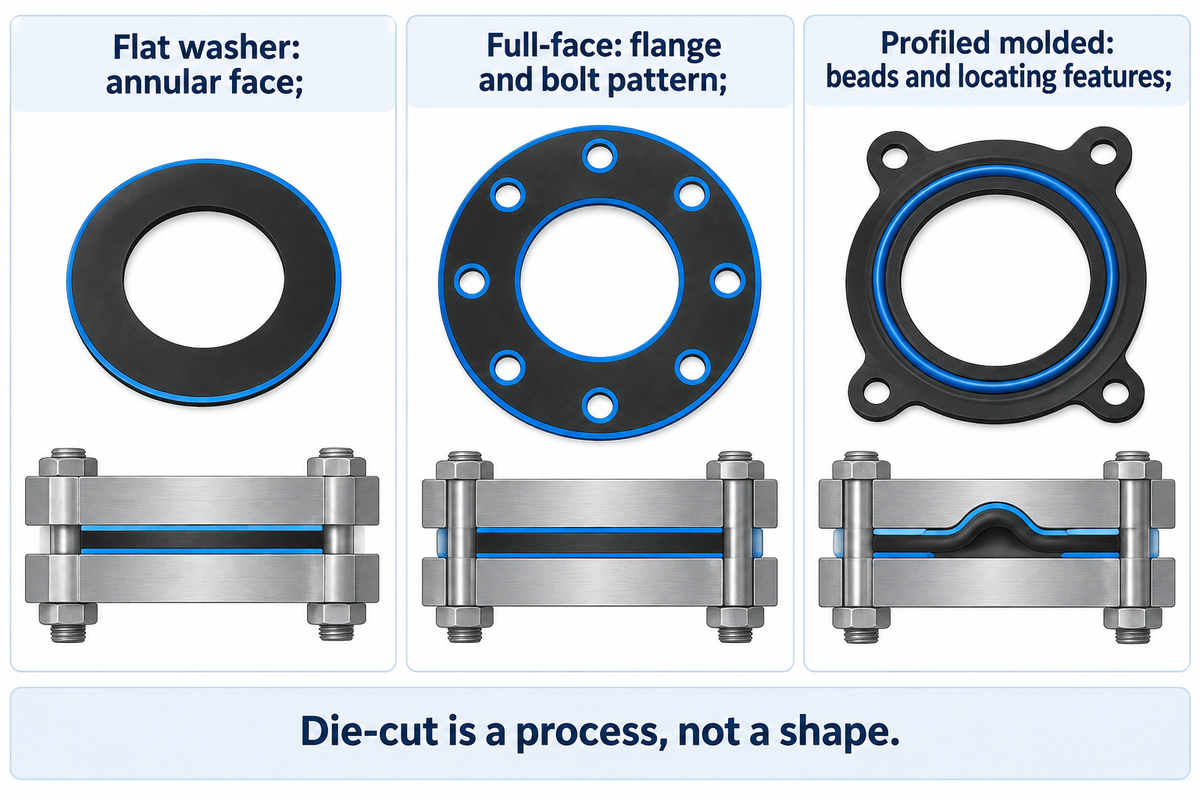
Common rubber gasket types for joints that remain closed in use are flat rings, full-face, and profiled molded gaskets. Contact in a flat part is distributed across opposing faces. A molded bead confines contact along a path. Bolt holes and locating tabs control placement, but the continuous sealing path must still surround the opening.
What is a rubber gasket?
A rubber gasket is a shaped elastomer part compressed or retained between mating components to close a leakage path. Flat flange gaskets normally work in stationary joints. Building terminology is broader: ISO 3934 calls door and window weatherstripping dynamic gaskets, so the word gasket alone does not identify the joint’s movement.
ISO 3934:2021’s building-gasket classification distinguishes weatherstripping from static glazing gaskets. In this building context, dynamic means the weatherstrip works around an opening door or window.
These types of rubber gaskets differ in section and coverage. A washer gasket is a flat annular part. A full-face gasket extends across the flange face and includes the bolt pattern. Die-cut describes how a part is made, rather than a separate sealing function. A profiled molded gasket can include corners, beads or retaining features that a plain sheet-cut outline lacks.
Consider a hypothetical request to replace a seal in a fixture coupling. The procurement team is provided a picture of a black ring and requests an O-ring of the same outside diameter. The part removed from the coupling has a rectangular section and fits between two flat surfaces. An O-ring would place a much narrower contact band in that space, and the joint has no matching O-ring groove. The correct interpretation is that the part is a flat washer gasket and its inside diameter, outside diameter and thickness should be provided from the part drawing. At this point, quality control should compare the sample to the provided dimensions and engineering should check the flat surfaces. The picture provides a starting point for identification, and the section drawing resolves the interpretation.
For squeeze, joint loading and inspection once the seal family is identified, use the rubber gasket and seal selection guide.
O-rings and other groove-mounted rubber seals
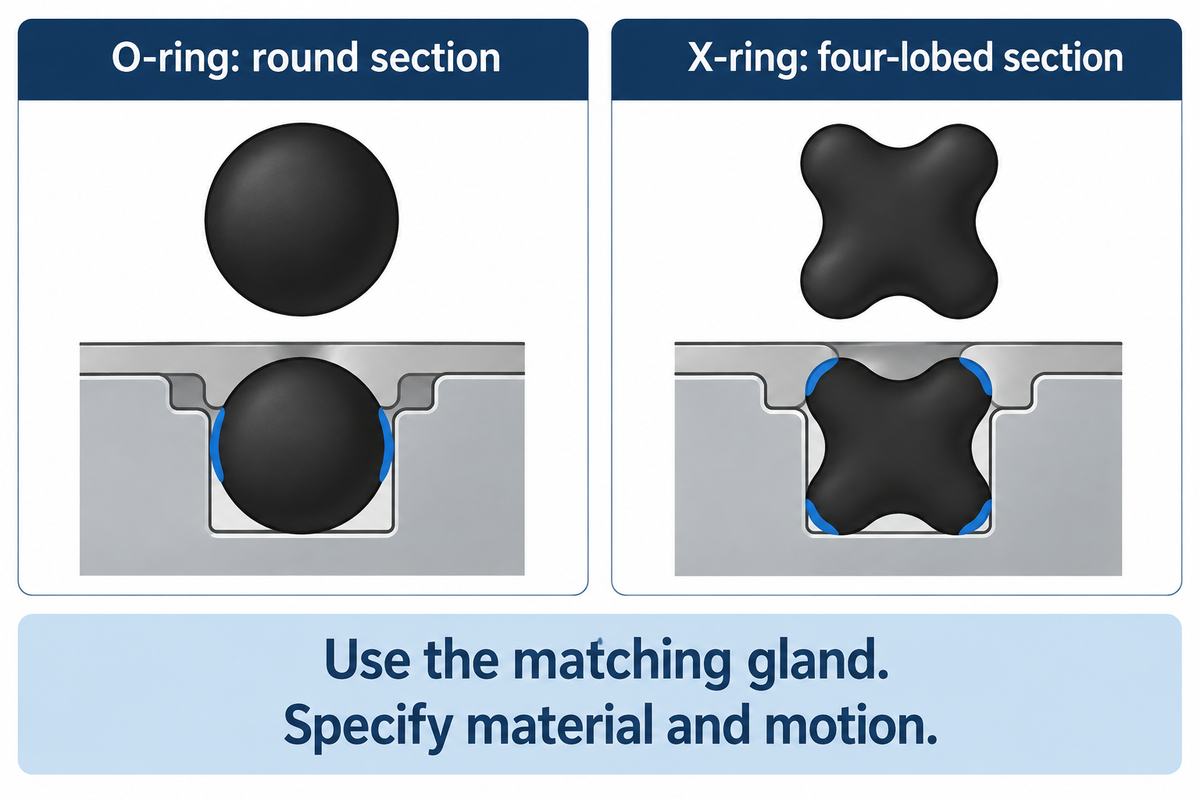
An O-ring has a circular section. An X-ring has a four lobed section and is closed. Both require a ring gland appropriate to the section to be compressed. The groove and the opposing surface determine where the elastomer is compressed, how it’s retained, and whether it’s designed to move.
A ring should be named from a side view. A round section O-ring, a rectangular section square ring and a flat washer can all look circular when viewed from the top, but their contact geometry can be different. A square ring is a seal variant and isn’t synonymous with a sheet washer.
Round-section O-ring
- Identify ring diameter and section diameter.
- Locate the actual groove and compressed interface.
- Distinguish static assembly from sliding operation.
Four-lobed X-ring
- Identify the lobed section and specified size.
- Use the gland intended for that profile.
- Keep material and motion requirements on the drawing.
Static face seals compress the O-ring between faces. In a reciprocating arrangement, a rod or piston moves along the sealing interface. That difference is important with respect to friction and wear, even when the rubber ring initially appears identical. Complete sizing should be in the O-ring sizes and gland guide, and not in a photo-based substitution.
Lip seals, U-cups and wipers for moving parts
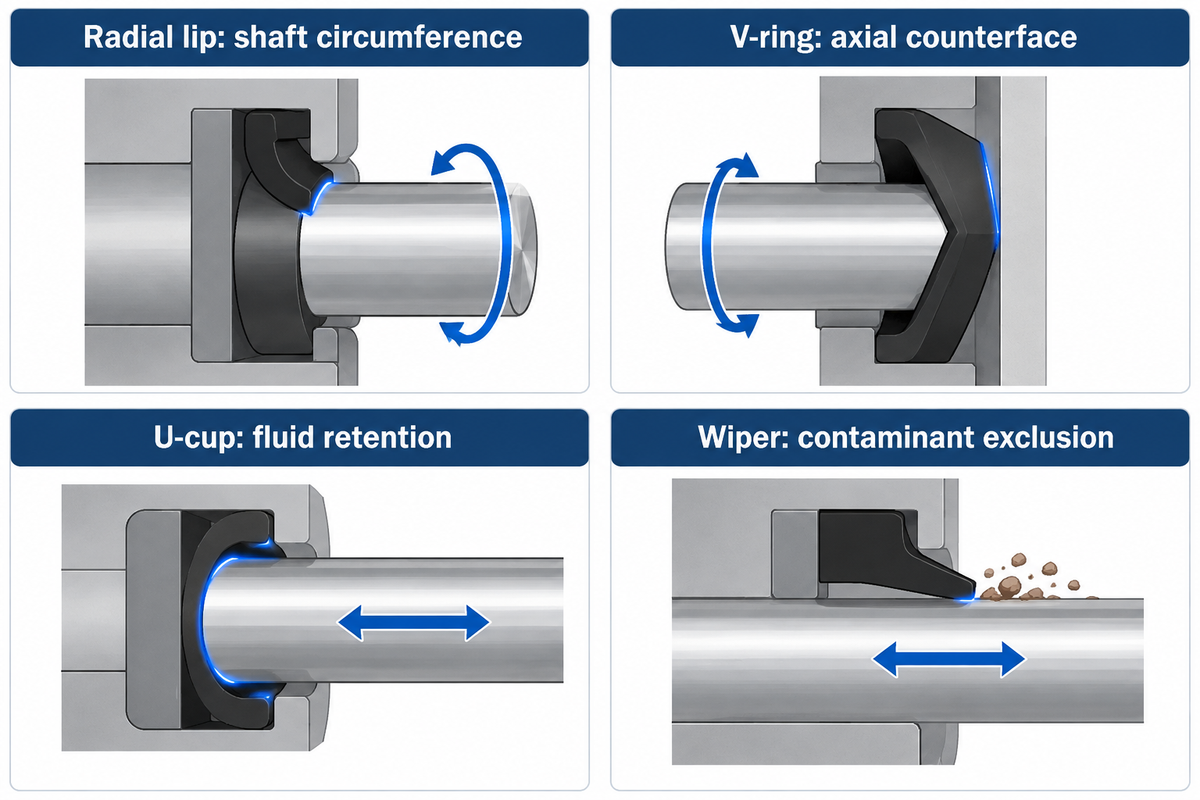
Rotary seals are used at turning interfaces, while rod and piston seals commonly occur with reciprocating movement. A radial shaft lip contacts the shaft circumference. An axial V-ring lip contacts a counterface. U-cups normally retain fluids at a rod or bore; wipers remove contaminants from an exposed rod prior to its entry into the assembly.
The ISO 6194-1 rotary shaft lip-seal scope addresses elastomeric sealing elements under low-pressure conditions. Its public adopted-standard preview distinguishes dynamic shaft contact from the static fit between the seal body and housing. A radial lip seal is not just a loose rubber seal around a shaft.
V rings provide a good contrast. In the Parker A-style V-ring design, the seal is located on the shaft and rotates with it while its flexible lip contacts an adjacent surface. This design has an exclusion role as well as a grease retention role. Neither lip nor a similar-looking element provides a pressure rating.
A U-cup, by contrast, has a cavity and lips of a fluid sealing profile. A U-shaped channel is usually used to hold a panel edge. The two profiles differ by the type of opening; the first is a pressure-facing cavity and the second a mechanical grip. Similarly, a wiper and a rod seal can exist in the same cylinder assembly, as their primary functions differ.
Automotive, aerospace and other industrial applications also use specialized sealing systems. A profile name is only the beginning of identifying the assembly’s application requirements; specify the family of part and installation orientation when comparing alternatives.
Extruded rubber seals for doors, panels and glazing
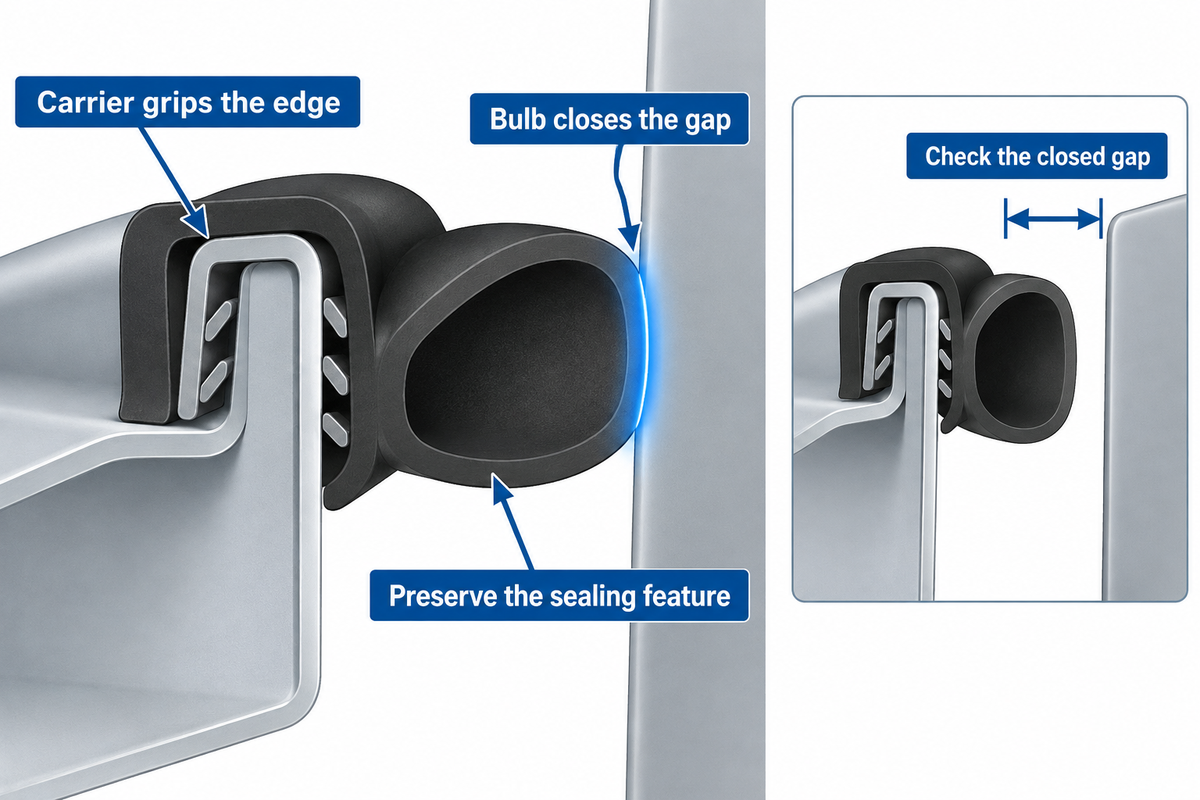
Various profiles meet similar functions, and their cross-section is repeated along their length. The base of an extruded rubber seal holds the profile in position, while the projecting portion makes contact as a door, panel or glazing assembly closes against it.
What are the different types of door rubber seals?
Rubber seals often incorporate bulb profiles, D and P sections, flexible flap seals and weatherstrips. Bulbs are squeezed between closing surfaces, and flaps contact an edge or face. Mounting bases can be attached in a groove, by an adhesive or by an edge grip. The mounting method and the portion that closes the gap have to be assessed separately.
The shape and construction of a bulb affect the way a door closes. Bulbs of sponge or dense rubber don’t necessarily compress with the same force. A larger bulb can obstruct closure, even if the carrier fits the edge. A cellular structure is also observed in closed cell foam strips. Thus, in order to determine how a door closes, it’s important to understand the construction and material of foam strips.
Consider an HVAC cabinet with a worn trim-mounted bulb seal. A maintenance buyer finds a replacement channel that grips the same edge of the sheet-metal, but it has no bulb on the outside. The channel covers the edge nicely; however, the closed door still leaves an open space on the side. A section view with the door open, followed by a view of the closed gap, helps make the closure path visible to procurement. Engineering can then compare the intended closure with the latch arrangement. Ordering only by channel width would omit the sealing feature that the cabinet needs.
Glazing raises another type of supporting function question. ISO 5892:2024 covers structural rubber gaskets used for sealing and supporting. Non-supporting gaskets have a different scope. For locking profiles, ASTM C542’s public scope addresses wall integrity and weather-tightness in the complete system’s design and installation. When replacing a glazing gasket, maintain the structural role defined for it.
Match a seal profile to a plumbing or building joint
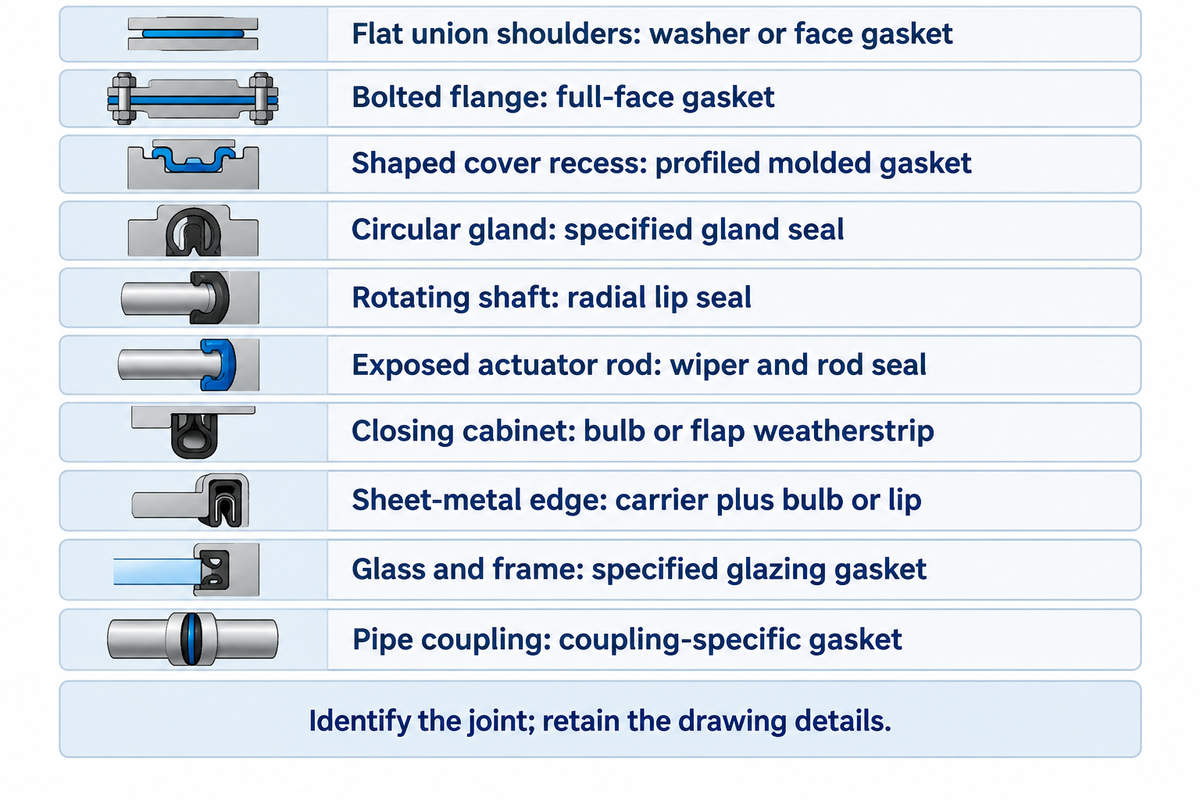
Compare suppliers after selecting the seal that best fits the contact surfaces of the joint. A union face, a grooved fixture body and a moving valve stem present different interfaces, even if each contains a black rubber ring. For building parts, differentiate an edge-retention feature from a closing bulb, flap or glazing contact that stops the leakage path.
Joint-to-Profile Match Table
The Joint-to-Profile Match Table turns a visible interface into a profile short list and the drawing details needed to compare candidate parts.
| Observed joint | Profile to investigate | Drawing detail to retain | Comparison question |
|---|---|---|---|
| Union with flat sealing shoulders | Flat washer or specified face gasket | Inside/outside diameters and thickness | Does the part sit on the intended shoulders? |
| Bolted flange with gasket bolt holes | Full-face gasket | Flange face and bolt pattern | Do the holes align without distorting the sealing path? |
| Cover with a shaped retaining recess | Profiled molded gasket | Beads, corners and locating features | Does the section match the recess? |
| Fixture body with a circular gland | Specified O-ring or other gland seal | Gland dimensions and ring section | Is the candidate the specified section, rather than just the same outside diameter? |
| Rotating shaft through a housing | Radial shaft lip seal | Shaft, housing and lip orientation | Which interface rotates and where does the lip contact? |
| Exposed reciprocating actuator rod | Wiper plus the specified rod-seal arrangement | Separate scraper and pressure-seal locations | Is the part excluding dirt or retaining fluid? |
| Closing cabinet door | Bulb or flap weatherstrip | Mounting base and closed gap | Does the contact feature reach the opposing face? |
| Sheet-metal edge with a sealing projection | Trim carrier plus bulb or lip | Edge grip and projection position | Are retention and sealing both preserved? |
| Glass held by a locking profile | Specified locking glazing gasket | Glass/frame channels and locking arrangement | Is structural support part of the specified system? |
| Pipe coupling with internal guiding lips | Coupling-specific molded gasket | Pipe contact and coupling-retention geometry | Does the proposed part belong to that coupling design? |
Drinking-water contact adds a product-suitability check after identification. NSF/ANSI 61 covers chemical health effects from relevant materials and components, including gaskets. Keep that evidence separate from the joint’s leakage and mechanical-performance requirements.
“This standard does not establish performance, taste and odor, or microbial growth support requirements”
A complete purchase description pairs the profile drawing with the defined compound and application. Define the sealing solution as that combination, so that quality staff receive a part definition that’s measurable and procurement compares quotes for the same part.
Separate seal shape from rubber material
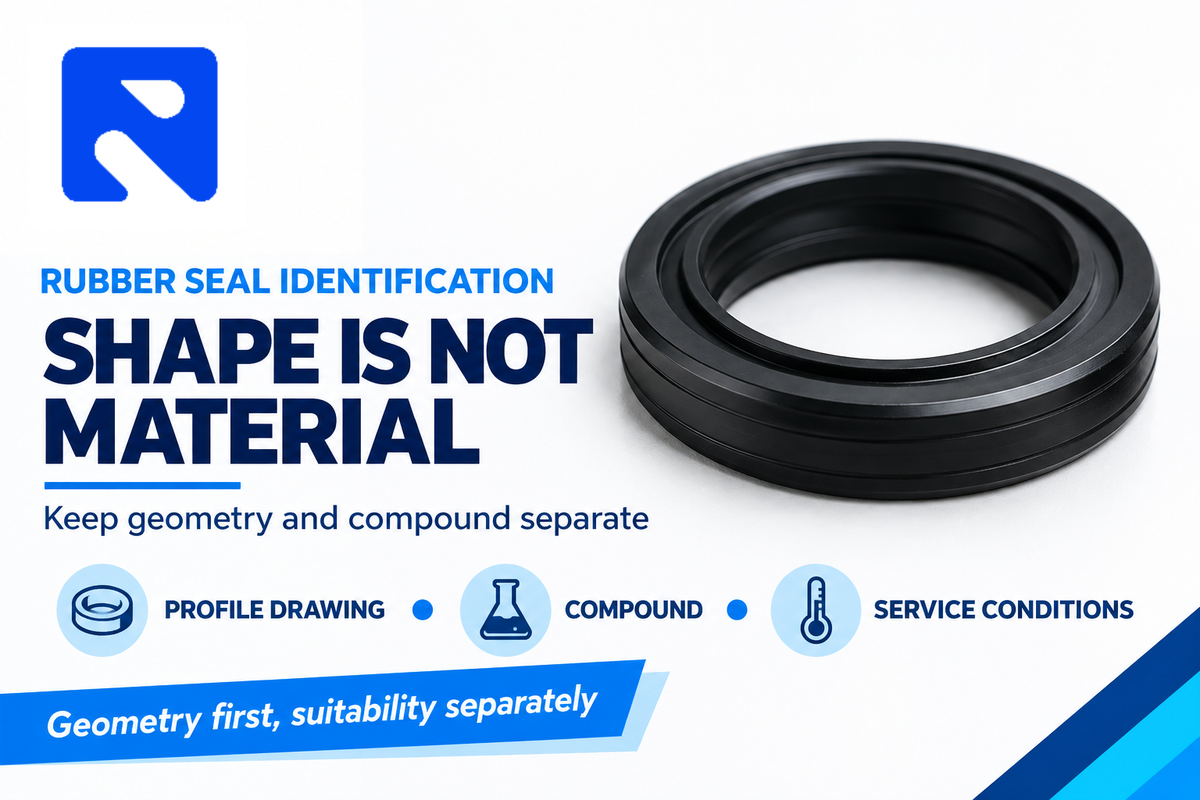
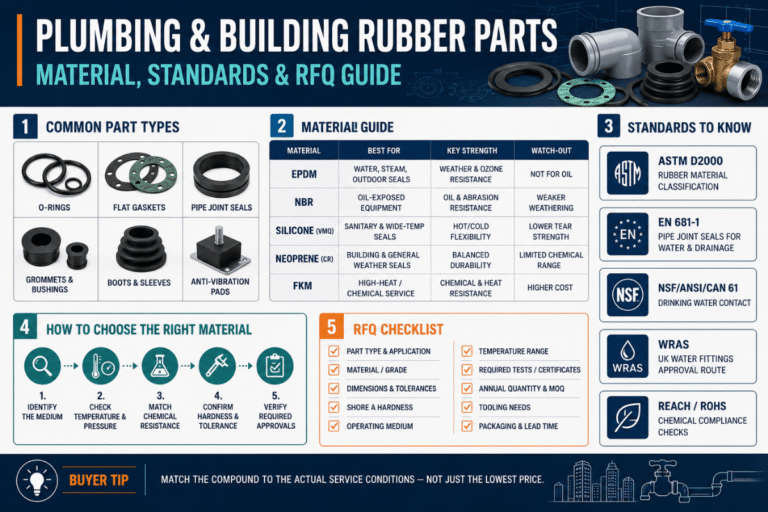
Seal shape describes geometry; rubber material describes the elastomer formulation. An O-ring can use different rubber compounds, and one compound can be made into different types of seals. Keep the profile name and material specification in separate drawing fields so a supplier can match both without treating either as a substitute for the other.
EPDM rubber, nitrile, silicone, neoprene, natural rubber and fluoroelastomer are different types of rubber, rather than gasket shapes. These different materials can be made into similar profiles. Natural and synthetic rubber compounds can have different mechanical properties and sealing properties within the same family. Black color doesn’t identify the formulation.
Describe the fluid or gas, temperature range and movement on the specification. Chemical resistance to harsh chemicals, heat resistance, low-temperature flexibility, compression set and electrical conductivity are distinct requirements. Temperature fluctuations and chemical attack can alter contact behavior in demanding environments; the label “suitable for extreme temperatures” is too general for a purchase drawing.
ASTM D2000 covers classification of vulcanized rubber properties, while ASTM D1056 addresses flexible cellular rubber. Use the rubber compound selection guide for comparisons after the contact geometry is clear.
Choose stock, cut, extruded or molded rubber parts
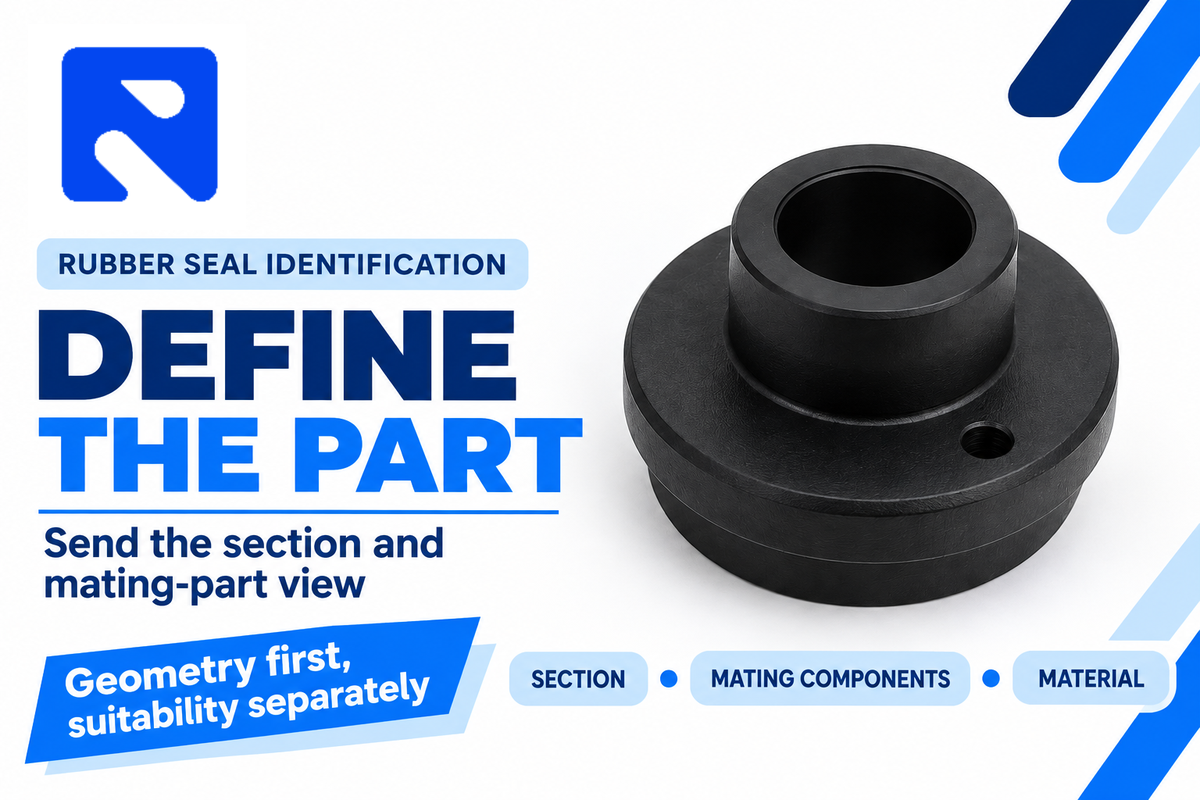
Select the most appropriate manufacturing process around the part geometry. Flat shapes can be cut from sheet, and constant-section profiles can be extruded along their length. Three-dimensional features can be molded. Stock availability is a separate purchasing question: a standard-looking shape still needs the specified dimensions, material and contact arrangement.
UNSW’s polymer-forming tutorial explains the continuous, constant-section geometry of extrusion. This explains why suppliers extrude long profiles. Corner pieces, joined ends and molded additions introduce further construction details beyond a straight, continuous, constant-section profile.
Consider a buyer comparing a sheet-cut gasket to a molded gasket for a removable equipment cover. If the cover has a flat edge, the buyer can describe a sheet-style gasket in the first drawing without adding a bead. If the design changes to include a locating groove and a raised sealing feature, copying only the original outside contour wouldn’t include those changes. Engineering would have to release that changed section before procurement could compare the two offers. At that point, finance could compare tooling, repeat orders and assembly work against the same geometry rather than assume a lower piece price buys the same part. Quality control should receive that same revision, so the inspection sample and the purchase order describe one construction.
A sheet-gasket example is included in the 2022 UIC camera housing project: the team describes laser-cut rubber sheets, compressed by a bolt assembly. The example provides construction detail; it doesn’t provide a general depth rating or a comparison in terms of production cost.
Send a section drawing, the mating part view and the specified material with the quotation request. Include whether the part is open ended, joined or a closed-loop molded part. For an adapted plumbing or building interface, Engelhardt’s custom plumbing and building rubber parts service is the relevant route for discussing molded washers, gaskets and profiles.
Questions about rubber seals and gaskets
Is rubber waterproof?
Many rubber compounds resist liquid water, but the joint needs continuous sealing contact.
A rubber part can resist water while an open path remains beside it. The distinction matters for porous sponge, open profile ends, corners and mating surfaces. In plumbing, the part’s water-contact suitability also belongs on the specification. Identify the complete contact path and the compound separately; a material description alone leaves the assembled joint’s leakage behavior unresolved.
Can you reuse a rubber gasket?
Replace a damaged or permanently distorted gasket; reuse requires an assembly designed to permit it.
Follow the assembly’s replacement instruction and inspect the sealing surfaces before reassembly. Before requesting a replacement, record the old gasket’s cross-section, contact surfaces, mating hardware and any permanent distortion. Those observations help identify the specified profile; they do not show that the removed gasket is reusable. Shape identification is not permission to return a used gasket to service.
How long do rubber seals last?
Rubber seals have no single service life shared by every compound and joint.
Heat, media, movement and sustained deformation affect service life. Compression set describes residual deformation after unloading, while stress relaxation is declining force at a fixed deformation. ASTM D6147’s public explanation describes that force decay. A seal can therefore keep its installed shape while its contact force changes over time. Base replacement intervals on the assembly’s service guidance and observed condition.
What is the rubber around a car door called?
It is usually called a door weatherstrip or door seal.
The name describes its location. Identify the bulb or lip section and its mounting base when ordering a replacement.
What can you seal rubber with?
Use the adhesive or sealant specified for the rubber compound and joint.
A joining adhesive, a gap-filling sealant and a replacement gasket perform different jobs. A damaged pressure-retaining seal normally needs the specified replacement part.
Have a profile to identify or adapt?
Send Engelhardt a clear cross-section, a view of the mating components and the service description. Start with the contact geometry so the discussion can move directly to the required rubber part.
The scenarios shown are sample cases; they aren’t representative of actual customer cases. The profile families combine public technical descriptions and standards scopes. For company background, see about Engelhardt.
References & Sources
- ISO 3934:2021: preformed building-gasket classification
- ISO 5892:2024: structural rubber-gasket materials
- ASTM C542-05(2024): lock-strip gasket scope
- ISO 6194-1:2007: rotary shaft lip seals
- GSO ISO 6194-1:2015: public adopted-standard preview
- NSF: NSF/ANSI 61 health-effects scope
- ASTM D2000: rubber-property classification
- ASTM D1056-20: flexible cellular rubber
- ASTM D6147-97(2026): stress relaxation in compression
- UNSW: polymer-forming methods
- UIC Engineering Expo: camera-housing gasket project