Get in Touch with Engelhardt

How Is Rubber Made: From Raw Latex and Monomers to Finished Elastomer Parts

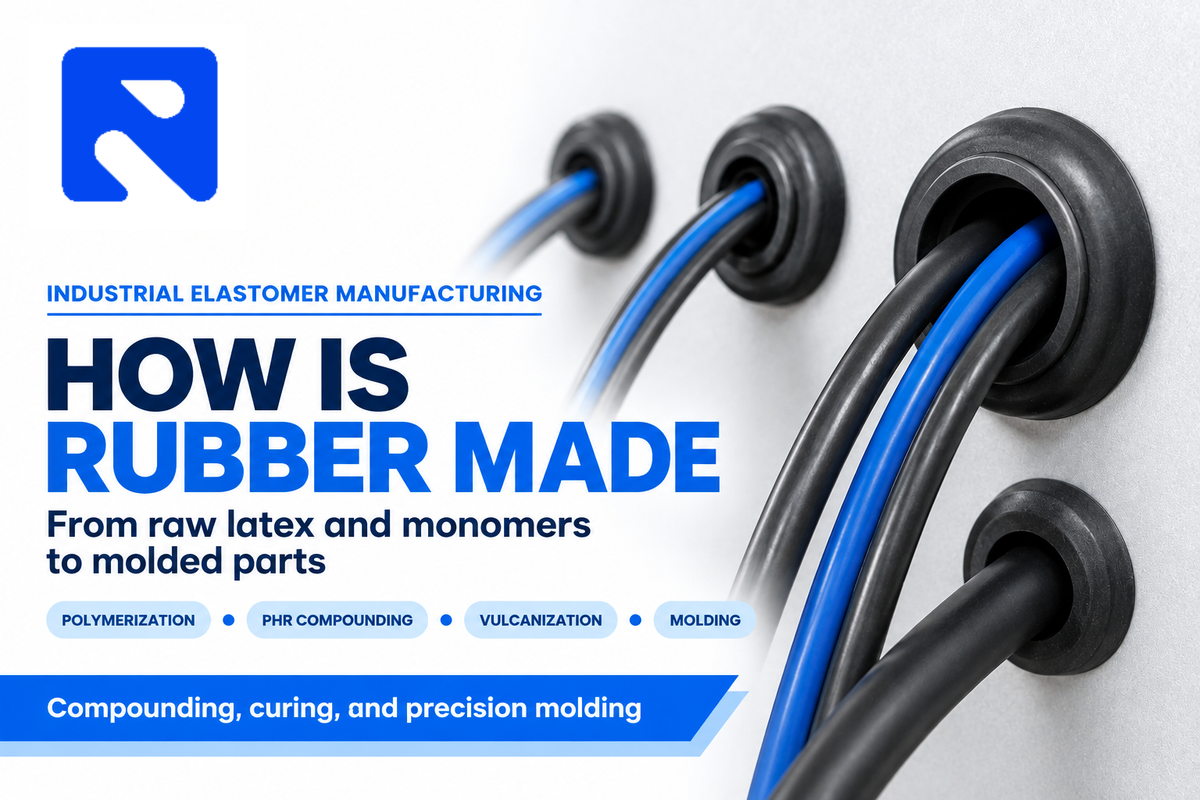
Understanding how rubber is made requires an upstream split. Each industrial rubber product begins on one of two material paths. In one path, liquid latex is tapped from Hevea brasiliensis rubber trees, and in the other, polymer components are derived from petrochemical monomers in a chemical reactor. The two polymer paths then unite into four downstream, factory paths: compounding in parts per hundred rubber (phr), internal mixing, shaping, and vulcanization.
According to the American Chemical Society (ACS) National Historic Chemical Landmark, approximately 70 percent of the manufacture of rubber is synthetic. The rest of the world’s supply comes from Natural rubber. Whether an elastomer is natural or synthetic, raw gum polymer alone can’t hold a mechanical seal. It stays soft and temperature-sensitive until compounders disperse fillers and cure the polymer chains. This guide covers the entire process from raw latex and monomer gas to finished molded parts.
How is rubber made from raw latex and monomers to finished parts
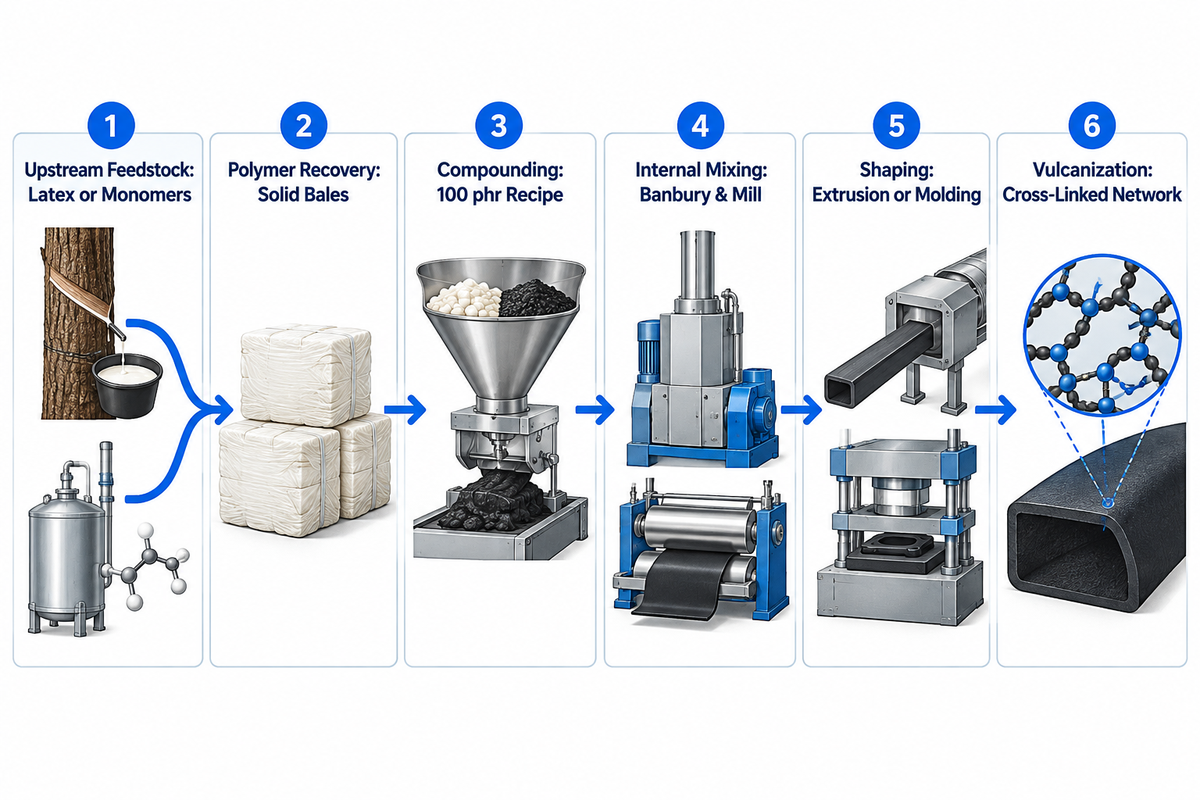
As Alpha Technologies’ rubber manufacturing guide notes, rubber manufacturing moves through six stages. Prior to downstream integration, there are upstream separations. U.S. EPA Source Assessment Document No. 24 on Rubber Processing elaborates on the unit operations in the main factory: compounding, mixing, forming, and building as well as vulcanization.
Pairing upstream polymer recovery with those factory steps creates a complete six-stage production pipeline. Currently, manufacturing sector uses this pipeline to manufacture precision seals and hoses and mounts from versatile material. During World War II, the U.S. Synthetic Rubber Program ramped up the production of general-purpose synthetic materials from 231 tons in 1941 to 70,000 tons per month in 1945. That effort standardized the reactor and mill workflows still used when rubber is manufactured today.
Framework 1: 6-Stage Industrial Rubber Production Map
Trace the divergence and convergence of natural and synthetic feedstocks during polymer recovery and part production respectively.
| Stage | Track A: Natural Rubber Route | Track B: Synthetic Rubber Route | Primary Control Variable | Downstream Handoff Output |
|---|---|---|---|---|
| Stage 1: Upstream Feedstock | Bark tapping of Hevea brasiliensis trees for liquid field latex (latex coagulation biopolymer) | Catalytic cracking of petroleum hydrocarbons into butadiene, styrene, acrylonitrile, or siloxanes | Latex ammonia stabilization vs. monomer purity | Stabilized field latex or purified monomer |
| Stage 2: Polymer Recovery | Acid coagulation, coagula maturation, roller sheeting, smoking (RSS), or crumb drying (TSR) | Emulsion or solution polymerization (about 70% emulsion conversion), steam stripping, crumb drying | Coagula maturation, conversion rate, and Mooney viscosity (ML1+4) | Standard solid bales or concentrated liquid latex |
| Stage 3: Mastication & phr Compounding | Mechanical chain shearing to reduce molecular weight, then weighing additives against ASTM D3182-21a(2025) | Direct weighing of synthetic bale at 100 phr with fillers, plasticizers, activators, and curatives | Formulation weight accuracy and filler dispersion index | Weighed batch recipe ready for internal mixer |
| Stage 4: Multi-Stage Internal Mixing | Non-productive Banbury masterbatch pass followed by cooler two-roll mill curative pass | Two Stages Mixing or Three Stages Mixing in internal kneaders and open mills | Silane coupling window (140–160 °C) vs. scorch window (t10) | Tested uncured sheeted compound or strip feed |
| Stage 5: Preform & Shaping | Extrusion, calendering, compression, transfer, or injection molding into cavity geometry | Extrusion, calendering, HCR molding, or cold-runner LSR injection molding | Cavity pressure (2000 psi/mold rule of thumb) and die swell | Shaped elastomer inside mold cavity or continuous line |
| Stage 6: Vulcanization & Finishing | Sulfur or peroxide cross-linking to t90 optimal cure, deflashing, and inspection | Sulfur, peroxide, or platinum addition cure (150–200 °C for LSR in 25 seconds or less), post-cure, and QC | Rheometer torque (ML, MH, t10, t90) and ASTM D2000 callout | Finished, dimensional-verified elastomer component |
Process Scope Note: Published process benchmarks describe general industrial rubber unit operations. Exact cycle times and viscosity windows depend on specific compound formulations and part cross-sections.
How is rubber made step by step?
Rubber is made in six sequential steps. First, producers harvest natural latex from rubber trees or synthesize monomers from petroleum. Second, they coagulate and dry the raw polymer into solid bales. Third, compounders weigh fillers, oils, and curatives in parts per hundred rubber. In the fourth step, the mix is further refined through internal Banbury mixers and two-roll mills. In the fifth step, uncured stock is shaped through extruders or molding presses. Finally, a permanent elastic network of polymer is vulcanized through heat and pressure.
How natural rubber is harvested, coagulated, and graded
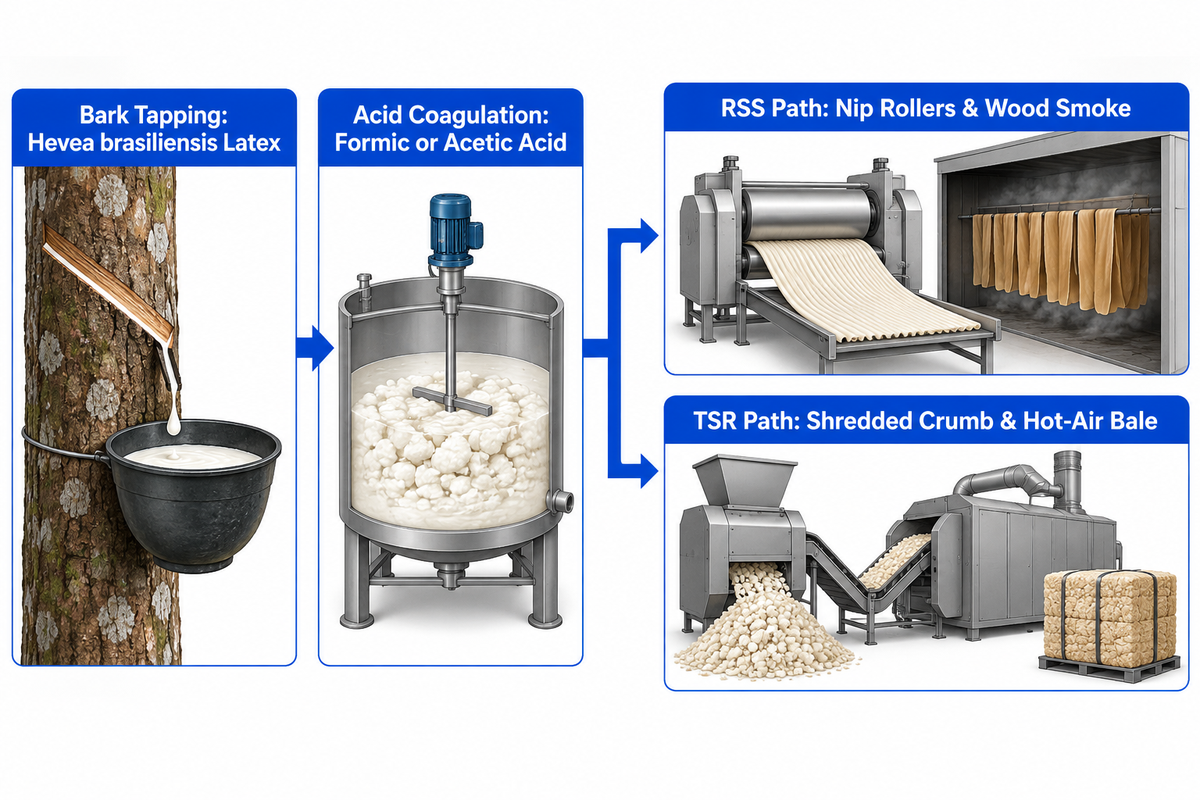
The production of natural rubber begins from plantations in the tropics. Workers harvest milky latex from trees of Hevea brasiliensis by tapping the bark. The American Chemical Society notes that Michael Faraday showed in 1829 that natural rubber had the empirical formula C5H8. By 1910, Asian plantations grown from Amazonian seeds had become the primary global supply source. Currently, growers focus on balancing land use and sustainable practices to curb deforestation, while maintaining the levels of latex.
Tappers score a thin diagonal cut into the outer bark of a mature natural tree at dawn. Pressurized laticifer vessels then exude liquid latex into a collection cup. Many readers call this fluid tree sap, but true sap flows in deeper xylem tissue. Latex comes from a different bark duct system adjacent to the phloem. Freshly collected field latex is an aqueous colloidal dispersion of cis-1,4-polyisoprene particles surrounded by water, proteins, phospholipids, and salts. It may also contain various mineral ions.
Once latex is collected from rubber trees, processors must stabilize or coagulate it promptly. As documented in a PubMed microbiological review on Hevea brasiliensis latex coagulation natural rubber is produced by coagulation of latex and the time between tree tapping and coagula processing is called maturation. To prevent natural latex from solidifying, workers add ammonia as a preservative. Conversely, solid raw rubber production uses formic or acetic acid to coagulate the rubber into slabs.
Acid addition neutralizes the negative protein-phospholipid charge on the suspended rubber particles. The particles coalesce into a soft, wet coagulum. Solid natural rubber then follows one of two commercial grading paths:
- In Ribbed Smoked Sheets (RSS) pathway, coagulum slabs, which contain high moisture and serum, are passed through a pair of nip rollers. Each roller presses out some of the moisture and serum from the slabs and embosses ribs. The sheets are hung in a smokehouse, where they’re smoked with wood, which provides antiseptic creosote and dries the sheets. The sheets are finally graded by visual experts.
- In Technically Specified Rubber (TSR), more modern mills, use rotary knives and hammermills to grind the coagulum slabs or matured field cup lumps. The moist slurry is then passed through a hot air tunnel to remove moisture, and pressed into dense bales in a press. Bales are graded by a laboratory to determine dirt, ash and plasticity limits.
Feedstock Variability Note: Field latex coagulation and maturation behavior (PMID 24891014) vary with Hevea clone genetics, tapping season, and plantation stabilization practices.
How is natural rubber made from rubber trees?
Natural rubber begins with rubber trees where a thin diagonal bark strip is shaved from a mature Hevea brasiliensis trunk. Liquid latex is collected from the bark ducts. Processors filter the latex and add formic or acetic acid to neutralize particle charges so the rubber coagulates into soft slabs. The coagulum is allowed to mature and dry over a hot-air tunnel to create commercial bales.
How synthetic rubber is polymerized from petrochemical monomers
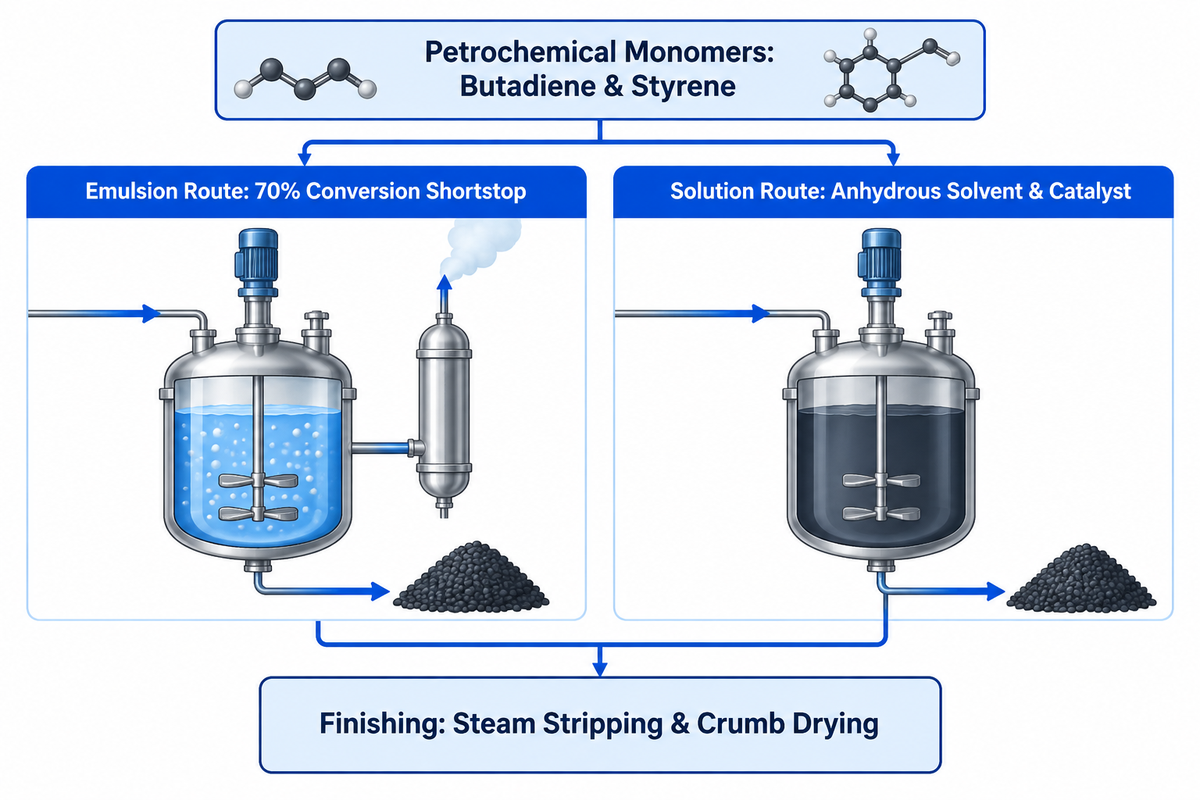
By contrast, synthetic rubber begins at petrochemical refineries. Chemical plants crack petroleum fractions or natural gas liquids to produce purified monomers like 1,3-butadiene, styrene, acrylonitrile, ethylene, propylene, chloroprene, or siloxanes.
According to the International Institute of Synthetic Rubber Producers (IISRP), plants synthesize man-made elastomers through two main reactor routes. Understanding which reactor method is used by a plant, allows molders to anticipate challenges like filler wetting and viscosity.
- In emulsion polymerization, a free-radical initiator and a chain transfer modifier are added to disperse monomers in an aqueous medium. In Emulsion Styrene-Butadiene Rubber (E-SBR), only about 70% of the monomers are converted into polymers before a shortstop chemical halts the reaction. Stopping at 70% prevents excessive chain branching and gelation. A steam stripping unit is used to recover the unreacted monomers and an acid-salt bath is used to coagulate the synthetic crumb.
- Solution polymerization entails dissolving monomers in anhydrous solvents, e.g., cyclohexane or n-hexane, in the presence of alkyl-lithium initiators or transition metal catalysts. As the IISRP Solution SBR technical guide explains, living anionic solution polymerization achieves near-complete monomer conversion. It allows control over the copolymer with 25% styrene while the vinyl content varies from 10 to 60% by using a Lewis acid randomizer.
When polymerizing monomers like styrene and butadiene into a random copolymer, butadiene inserts via 1,4 and 1,2 additions. The chain contains four monomer Units: styrene, 1,2-vinyl, cis-1,4, and trans-1,4 stereoisomers. That microstructural ratio determines the glass transition temperature (Tg) and wet grip of the cured rubber. After polymerization, steam strippers remove the solvent, expellers dewater the crumb, and hot-air dryers bale the crumb.
| Elastomer Type & Category (ASTM D1418 Class) | Primary Monomer Feedstocks | Typical Polymerization Method | Backbone Saturation & Key Trait |
|---|---|---|---|
| NR (Natural Polyisoprene, R Class) | Biological isoprene (C5H8) in Hevea brasiliensis latex | Enzymatic biosynthesis + acid latex coagulation | Unsaturated cis-1,4 chain; high green tack and strain crystallization |
| IR (Synthetic Polyisoprene, R Class) | Purified petroleum isoprene monomer | Anionic or Ziegler-Natta solution polymerization | Unsaturated cis-1,4 chain; high purity without natural proteins |
| SBR (Styrene-Butadiene, R Class) | 1,3-Butadiene (75%) + Styrene (25% styrene) | Continuous Emulsion (~70% conversion) or Solution (S-SBR) | Unsaturated main chain; balanced abrasion resistance and tread wear |
| BR (Polybutadiene, R Class) | 1,3-Butadiene monomer | Stereospecific solution polymerization (Nd, Co, Ni, or Li catalyst) | Unsaturated chain; low glass transition temperature and high rebound |
| NBR (Nitrile-Butadiene, R Class) | 1,3-Butadiene + Acrylonitrile | Cold or hot free-radical emulsion polymerization | Unsaturated backbone with polar nitrile groups; strong petroleum oil resistance |
| HNBR (Hydrogenated Nitrile, R/M Bridge) | Emulsion NBR subjected to catalytic hydrogenation | Emulsion polymerization + solution hydrogenation of C=C bonds | Highly saturated backbone; combined hot oil, ozone, and mechanical strength |
| EPDM (Ethylene-Propylene-Diene, M Class) | Ethylene + Propylene + Diene termonomer (ENB/DCPD) | Solution or suspension polymerization (Ziegler-Natta / metallocene) | Saturated main chain with pendant diene; superior ozone and steam weathering |
| CR (Polychloroprene / Neoprene, R Class) | 2-Chloro-1,3-butadiene (chloroprene) | Free-radical aqueous emulsion polymerization | Chlorine-deactivated double bond; flame, weather, and moderate oil resistance |
| FKM (Fluoroelastomer, M Class) | Vinylidene fluoride (VDF) + Hexafluoropropylene (HFP) / TFE | High-pressure free-radical emulsion polymerization | Fluorinated saturated polymethylene backbone; extreme heat and fuel resistance |
| VMQ / LSR (Silicone Rubber, Q Class) | Dimethyldichlorosilane hydrolyzed to cyclic siloxanes | Ring-opening equilibrium polymerization into siloxane chains | Inorganic Si–O–Si backbone; -50 °C to +250 °C thermal stability |
Natural vs. synthetic rubber manufacturing and molecular limits
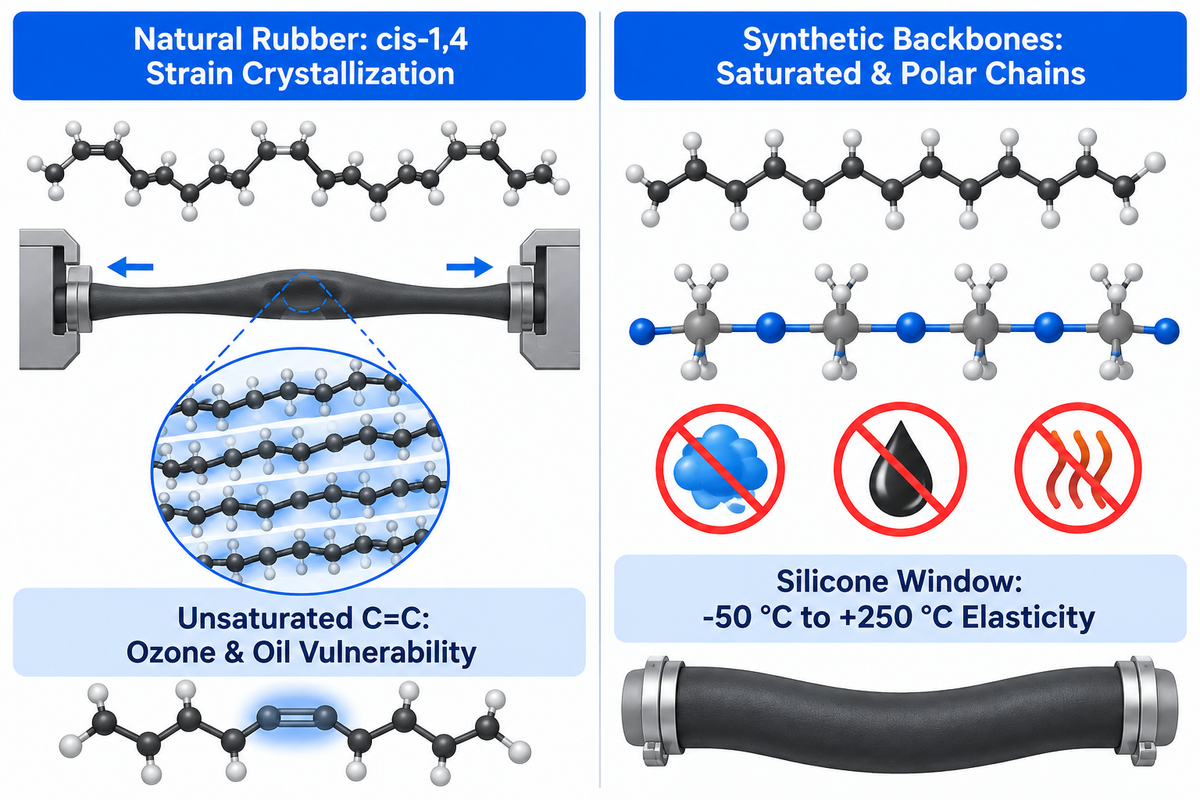
Studying how natural and synthetic rubbers are made shows why both materials can’t replace each other. Natural rubber has cis-1,4 stereoregular polyisoprene chains of relatively high molecular weight. Residual non-rubber proteins and lipids surround these long chains. Under tension, the uniform polyisoprene chains align and undergo strain-induced crystallization. This provides the rubber domain with unmatched green tack and dynamic tear resistance. Crystalline domains obstruct crack propagation.
Like all isoprenes, 1,4-isoprene features unsaturated carbon-carbon double bonds which results in an oxidative weakness. As mentioned in the IISRP, oxidation begins with the addition of oxygen to a double bond. When a double bond is in the main chain as in 1,4 units, oxidation leads to direct scission of the chain. Non-polar polyisoprene swells rapidly in petroleum oils and fuels.
Synthetic processes overcome this shortcoming. Main chains can be made saturated or polar groups such as nitriles and fluorine can be attached to the main chain. Saturated backbones in EPDM or inorganic siloxane chains in silicone give strong resistance to extreme ozone, UV light, and heat. Liquid silicone rubber maintains elasticity between -50 °C to +250 °C. Dow’s silicone curing guide shows that silicone exhibits outstanding and unique stability in the presence of peroxide catalysts and in other thermal curing systems. Thermal stability allows for seals in the aerospace and automotive industries to remain firm where natural rubber would soften and crack.
The two polymer classes also behave differently on the mixing mill. Natural rubber bales arrive with a high, variable viscosity. Operators must mechanically shear (masticate) natural rubber to shorten its long chains, before fillers can disperse. Synthetic rubbers are polymerized to a controlled molecular weight, and therefore rarely require a separate mastication pass.
When your team is prepared to choose a rubber family for a particular fluid or temperature range, please refer to our rubber compound selection guide, or our EPDM vs. NBR rubber comparison.
| Manufacturing & Molecular Dimension | Natural Rubber (NR, Hevea cis-1,4-polyisoprene) | Synthetic Rubbers (SBR, NBR, EPDM, FKM, Silicone) |
|---|---|---|
| Upstream Origin | Agricultural bark tapping, latex coagulation, and maturation | Petrochemical monomer cracking and emulsion/solution reactor synthesis |
| Pre-Mixing Mastication | Mandatory mechanical shearing to lower initial Mooney viscosity (ML1+4) | Rarely required; reactor chain-transfer agents pre-set molecular weight |
| Strain Crystallization & Green Tack | High (high-cis stereoregularity self-reinforces under tension) | Low in random copolymers (requires reinforcing filler loading) |
| Main-Chain Oxidation & Oil Limit | Susceptible to 1,4 main-chain oxidative scission and hydrocarbon swell | Tailorable for petroleum oil (NBR/FKM) or -50 °C to +250 °C heat (LSR) |
Rubber compounding, phr recipes, and internal mixing stages
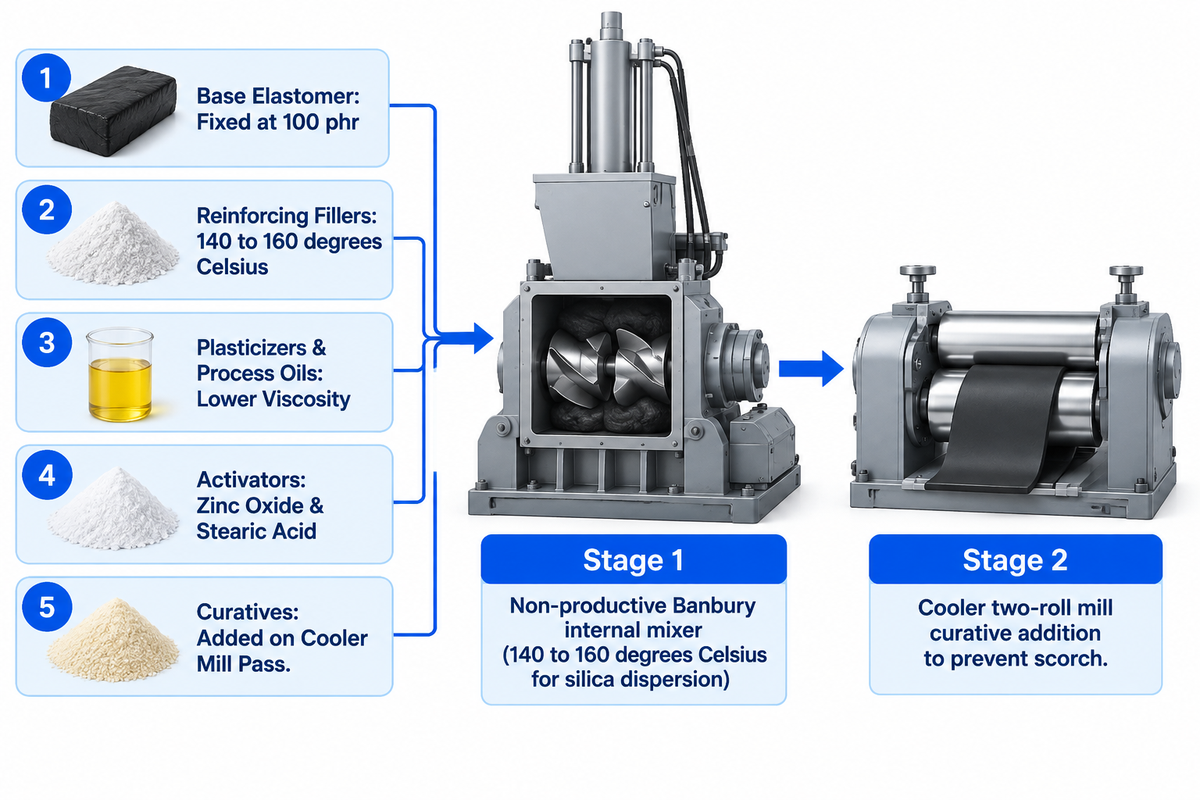
Raw gum rubber is almost never molded without compounding. To reach target hardness, modulus and abrasion resistance, chemists design a multi-component formulation around the base polymer. Each industrial rubber recipe uses phr (parts per hundred rubber) by weight under frameworks, for example, ASTM D3182-21a(2025) . The base elastomer (or blend) constantly equals 100 phr. Each additive is gauged relative to those 100 parts of rubber.
A standard industrial rubber compound contains five functional ingredient groups as follows:
- First, the base elastomer (fixed at 100 phr per ASTM D3182) sets baseline fluid compatibility and glass transition temperature.
- Second, reinforcing fillers such as carbon black or precipitated silica bind to polymer chains to increase tear strength and provide better abrasion resistance. EPA HERO Reference 6608902 on Silica-Filled Natural Rubber mentions that (unmodified) silica increases compound Mooney viscosity (ML1+4), which increases with time and storage. Moreover, Alpha Technologies mentions that the silane coupling agents link to silica at a temperature range of 140 to 160 degrees Celsius.
- Third, plasticizers and process oils lower uncured viscosity, aid in the dispersion of fillers, and improve cold flexibility.
- Fourth, activators (zinc oxide and stearic acid) and antidegradants activate sulfur cure kinetics and protect cured chains from ozone and heat.
- Fifth, curatives-sulfur with organic accelerators, organic peroxides, or platinum catalysts- cross-link the polymer during molding.
The production of a rubber compound requires carefully controlling the temperature of the rubber during processing. Inside an internal Banbury mixer, high-shear rotors create friction and break down agglomerates of filler. If sulfur-based accelerators or peroxides are added during that hot dispersion pass, the batch would start to cure in the mixer. Compounders call this premature curing scorch.
To prevent scorch, factories split mixing into Two Stages Mixing or Three Stages Mixing, as documented in EPA HERO Reference 6608902 and mixer control patent US20250250424A1. In Stage 1 (the non-productive masterbatch pass), the Banbury mixer blends the 100 phr polymer, filler, plasticizers, and activators under high shear. The hot masterbatch drops onto a mill to sheet out and cool. In Stage 2 (the productive pass), operators fold sulfur, accelerator, or peroxide curatives into the cooled stock on a two-roll mill below the scorch threshold. Alpha Technologies’ rubber troubleshooting guide shows that most press-side scorch and modulus rejects actually originate upstream in mixing dispersion and thermal history.
Thermal Mixing Gate Note: Internal mixer dump temperatures and silane coupling windows (140 to 160 °C) must be calibrated against each compound’s ASTM D5289 scorch onset time.
What is rubber compounding in phr?
Ratio compounding in phr (parts per hundred rubber) is the weight based recipe structure documented in ASTM D3182. The base elastomer is fixed at 100 parts by weight, and every additive is scaled against this 100 part reference. For example, 100 phr rubber mixed with carbon black, plasticizer oil, activators, and curatives gives compounders a consistent ratio regardless of mixer batch size.
Vulcanization chemistry: sulfur, peroxide, and platinum curing
Prior to vulcanization, a mixed compound, remains a plastic mass of separate polymer chains. Under heat and pressure, those chains slide past one another permanently. Vulcanization chemically bridges the chains and creates a three-dimensional thermoset network. This cross-linked network gives rubber permanent elasticity and durability across extreme temperatures. The American Chemical Society notes that Charles Goodyear discovered sulfur vulcanization in 1839 on a kitchen stove. From this point onward, vulcanized rubber revolutionized mechanical sealing and vibration control.
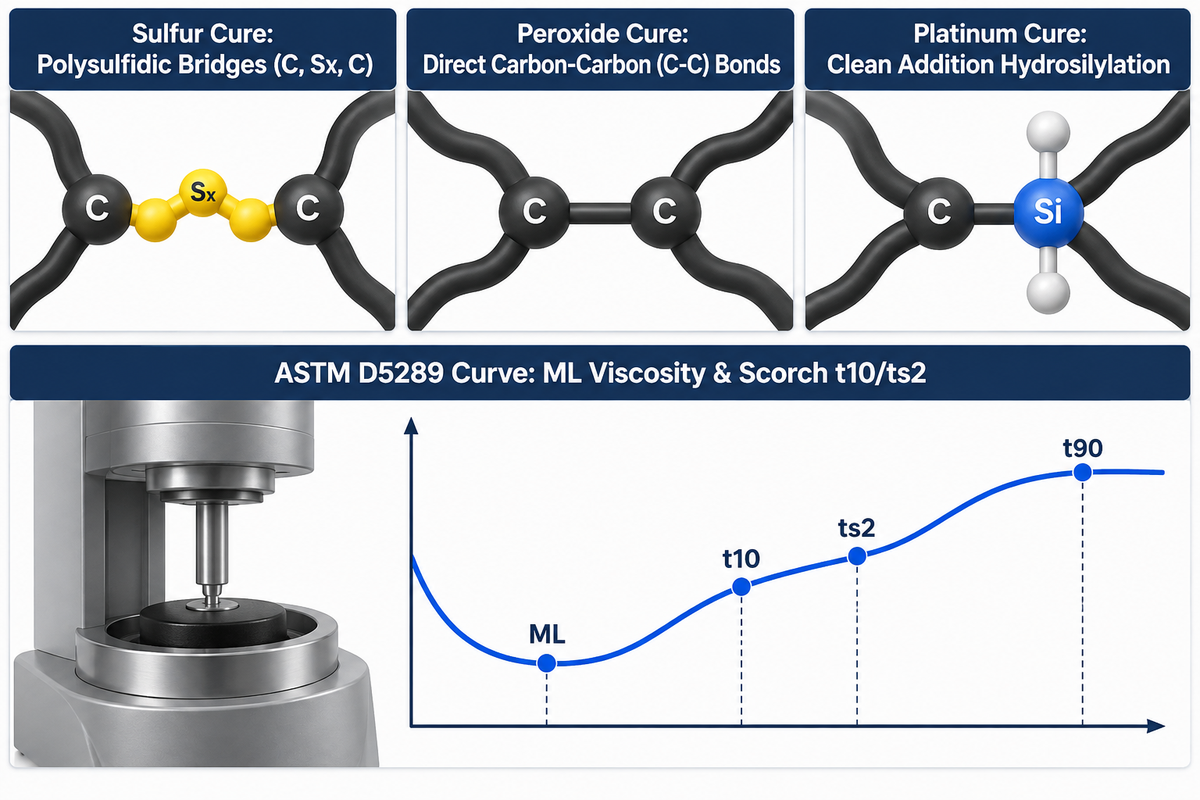
Modern compounders choose from three main cross-linking systems based on polymer backbone saturation, tensile strength, and compression set targets. As explained in Plas-Fab’s rubber vulcanization guide, two 70 Shore A compounds can display very different compression set and service life because crosslink density, filler loading and cure chemistry are different.
- With sulfur vulcanization, unsaturated carbon-carbon double bonds (C=C) in the backbone (such as NR, SBR, NBR, or EPDM diene units) react with sulfur, zinc oxide, and organic accelerators to form polysulfidic bridges (C, Sx, C) between allylic carbons. Polysulfidic bridges can yield and reform under cyclic strain, giving sulfur-cured parts high tear strength and flex-fatigue life.
- With organic peroxide curing, heated peroxides split into free radicals that abstract hydrogen atoms from polymer chains to couple them directly (C-C). As Plas-Fab and devulcanization patent US5258413A note, C-C bonds exhibit greater thermal stability compared to sulfidic bridges. Peroxide curing works on saturated backbones (like EPDM, FKM, HNBR and silicones) and gives lower high-temperature compression set.
- With platinum-catalyzed addition curing (hydrosilylation), liquid and high-consistency silicones cure cleanly without volatile byproducts. Dow’s silicone curing technical guide explains how addition-cure platinum systems differ from benzoyl peroxide systems. Because sulfur, tin, and amines poison platinum catalysts, platinum-cured silicones require segregated mixing and molding lines.
Technicians test a sample from a mixed batch in a rotorless cure meter, known as a cure meter, prior to releasing it to the molding floor, as described in ASTM D5289-19a(2026). As described by Alpha Technologies, a complete cure curve reflects the torque evolution over time at four distinct stages:
- Minimum torque (ML) measures uncured compound viscosity at the start of cure and predicts cavity fill behavior.
- The scorch safety window (t10 or ts2) delineates the induction time before cross-linking ceases mold flow.
- Maximum torque (MH) correlates with final cross-link density and cured compound stiffness.
- The optimal cure time (t90) defines the time it takes to complete 90% of the cure process and signals the end of the press cycle.
vulcanization refers to the primary chemical cross-linking within the mold or curing line. If your team is assessing post-molding joining methods for finished profiles, take a look at our article on vulcanization vs. adhesive bonding vs. mechanical fastening.
What does vulcanization do to rubber?
In raw rubber, Vulcanization causes the cross-linking of discrete polymer chains, permanently changing the viscoelastic state of the material, which no longer flows or recovers its shape once the force is removed.
How rubber parts are shaped: molding, extrusion, and calendering
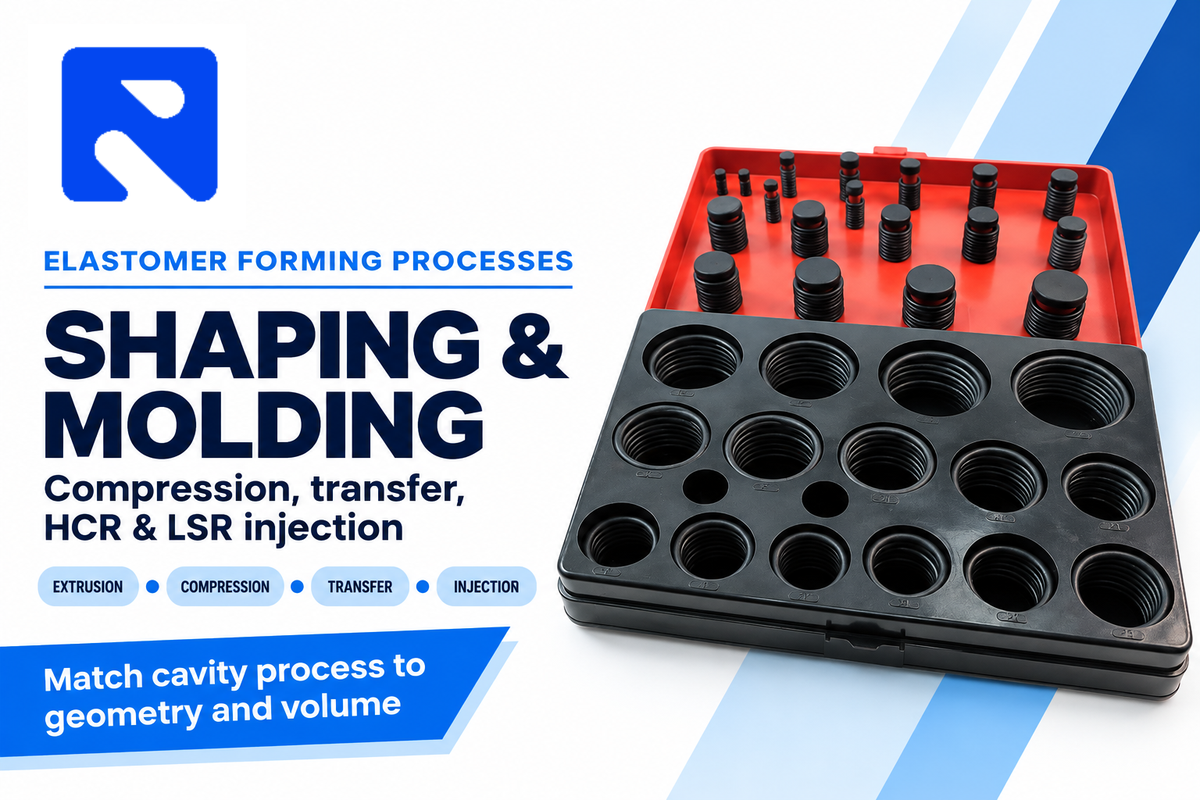
Once thermoset rubber is vulcanized, it can’t be remelted. Consequently, rubber manufacturing processes must shape the uncured compound before or during cross-linking. Factories use different methods to produce various geometries. Operations can be categorized as either continuous (extrusion and calendering) or discontinuous (compression, transfer, and injection molding).
In continuous extrusion, a rotating screw pushes uncured rubber through a profiled die to form continuous products like tubing, cord, and hose cores. Because rubber is viscoelastic and swells as it exits the die, the orifice of the die is made smaller than the final profile. The extruded profile is cured by a continuous microwave, hot-air, salt-bath, or steam autoclave. In calendering, rubber is pressed between two heated steel rolls to a final profile sheeting or an elastomer covering is applied to a fabric or steel cord to make a belt or diaphragm.
For discrete 3D parts (molded gasket, O-rings, diaphragms or boots) four molding processes are used. Each of these processes is also governed by the scorch safety window of compound:
- In compression molding, operators place a pre-weighed uncured preform into an open heated cavity. Closing the hydraulic press forces the rubber to fill the cavity while heat cures the part to t90. As practitioners explain in Eng-Tips compression molding pressure discussions, an elastomer compound pressure of 2000 psi/mold is a classic rule of thumb for sizing press tonnage on a mold-set (while ISO 2393 test sheets require at least 3.5 MPa / 500 psi). In addition, Eng-Tips mold bumping guidelines note that bumping (cracking the mold with a small opening gap of up to 0.5 mm max to vent trapped gases) must occur before the onset of cure. Bumping after cure starts distorts the part.
- In transfer molding, a measured preform is located in an upper transfer pot. A plunger, acting similar to a piston in an engine, pushes the warm rubber through sprues, and fills closed cavities below. Transfer molding holds better axial tolerances on metal-bonded inserts.
- In High-Consistency Rubber (HCR) injection molding, a screw barrel warms strip-fed gum rubber and injects it at high pressure into closed hot cavities. This method speeds up cycle times of high-volume automotive parts, made of rubber.
- As explained in Engelhardt’s LSR injection molding guide and LSR vs. HCR comparison, metering pumps dose liquid Part A (platinum catalyst) and Part B (cross-linker) at a 1:1 ratio. The mixed liquid flows through a cold-runner block (15-25 °C) which is cooled with water, into a hot cavity (150-200 °C), and cures to its desired durometer (Shore A 5-80) in 25 seconds or less.
If you’re matching seal cross-sections (i.e. O-rings, Lip seals, gaskets, etc.) before selecting tooling, see our guide on types of rubber seals.
Framework 2: Cure-to-Shaping Compatibility & Defect Matrix
To minimize the occurrence of molding and extrusion defects, correctly align compound’s curing chemistry and rheometer benchmark window with the shaping operation.
| Shaping Operation & Reference Benchmark | Uncured Feed Stock | Compatible Cure Systems | Critical Specification Range & Process Gate | Primary Defect if Gate Is Violated |
|---|---|---|---|---|
| Compression Molding | Pre-weighed cut preform / slug | Sulfur, Peroxide, or HCR Platinum | 2000 psi/mold pressure rule of thumb; bump gap 0.5 mm max before cure onset | Thick parting-line flash, trapped air blisters, or bump-induced distortion |
| Transfer Molding | Single pot charge preform | Sulfur, Peroxide, or HCR Platinum | Low initial ML viscosity and t10 scorch window long enough to clear sprues | Runner freeze-off (short shots) or flow-line delamination around metal inserts |
| HCR Injection Molding | Continuous strip feed (25 kg bale stock) | Fast-accelerator Sulfur or Peroxide | Barrel temperature held below scorch onset; rapid shear heating inside nozzle | Barrel/runner scorch lockup or back-rinding at cavity gates |
| LSR Injection Molding | Pumped liquid Part A + Part B (1:1 dosing) | Platinum-catalyzed addition cure (hydrosilylation) | Cold runner held at 15–25 °C; cavity heated to 150–200 °C (cures in 25 s or less) | Premature runner gelation or localized tacky surface cure inhibition |
| Hot-Air / Microwave Extrusion | Warm strip or cold-feed granulate | Peroxide (specialty peroxide or platinum) | Stable Mooney viscosity (ML1+4); oxygen exclusion for peroxide surface cure | Die-swell dimensional drift, surface tackiness, or internal porosity |
| Steam Autoclave Extrusion | Extruded green hose, tubing, or mandrels | Sulfur or Peroxide steam batch cure | Sufficient uncured green strength to prevent profile sag before steam cross-linking | Ovality collapse, water-spot surface marks, or under-cured thick walls |
| Multi-Roll Calendering | Warm mill-fed ribbon onto steel rolls | Sulfur or Peroxide rotocure / autoclave | Roll nip temperature below t10 scorch onset; uniform bank feed across roll width | Crowding gauge variation, trapped air blisters, or fabric skim delamination |
| Thick-Section Step Molding | Preheated slug (sections >10–15 mm) | Reversion-resistant Sulfur or Peroxide | Extended or stepped thermal cure schedule so core reaches t90 without surface reversion | Over-cured brittle skin over a spongy, under-cured interior core |
Molding Pressure Note: Compression molding cavity pressures (2000 psi/mold rule of thumb) and bump gaps (0.5 mm max) depend on projected land area, filler loading, and flash groove geometry.
Specify ASTM D2000 callouts, rheometer curves, and supplier checks
Three finishing and quality control steps turn a raw molding into an assembly-ready component that satisfies industrial requirements:
- During cryogenic deflashing, moldings enter a liquid nitrogen tumbling chamber, where the parting-line flash, which is normally thin and doesn’t obstruct the flow of the part, brittles and snaps off due to impact of the media.
- During secondary post-cure baking, high-performance peroxide-cured elastomers (FKM, EPDM, HCR silicone) and platinum silicones bake in forced-air ovens. As Plas-Fab’s vulcanization guide states, skipping secondary post-cure baking can lead to higher compression set, odor, and/or unstable long-term performance.
- During batch release verification, buyers avoid ordering “70 Shore A black rubber” alone on a print because a bare hardness callout invites batch inconsistency. Standard durometer testing carries a ±5 Shore A tolerance per Parker O-Ring Handbook ORD 5700, and two 70 Shore A compounds can have very different compression set (measured per ASTM D395-18(2025)).
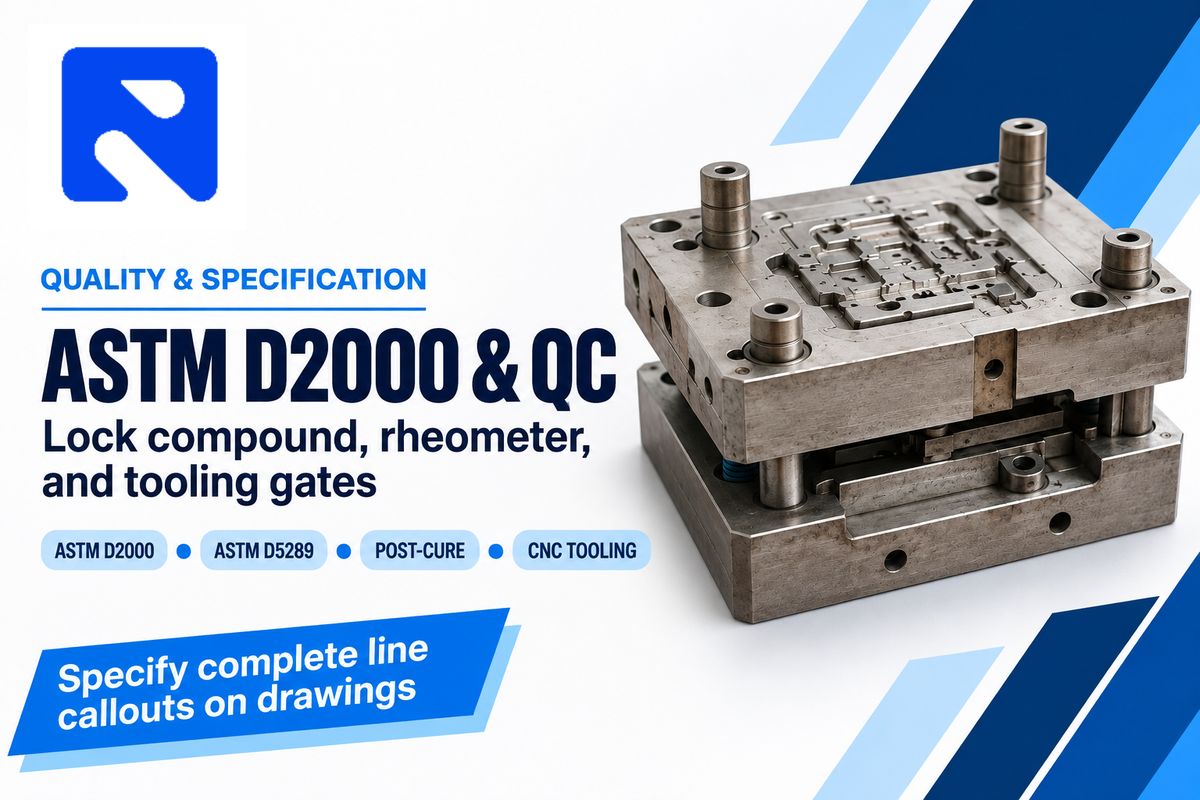
To ensure superior quality and performance for specific applications, drawings should carry a complete ASTM D2000-18(2024)e1 line callout. That callout locks hardness, tensile strength, and suffix tests. Buyers should pair it with chemical verification under ASTM D297-21(2026) and batch ASTM D5289 rheometer curves.
Framework 3: Manufacturing Release Verification Checklist
Place these four verification gates on your drawings and RFQs to ensure compound is held during production.
| Release Gate | Governing Standard | What to Specify on Drawing / PO | Supplier Batch Evidence Required |
|---|---|---|---|
| 1. Material Line Callout | ASTM D2000-18(2024)e1 | Polymer code + full D2000 Grade, Type (heat aging), Class (oil swell), hardness (±5 Shore A), and suffix codes | Compound data sheet + ASTM D297-21(2026) polymer identification certificate |
| 2. Mixing & Cure Kinetics | ASTM D3182-21a(2025) / ASTM D5289-19a(2026) | Locked cure system (sulfur vs. peroxide vs. platinum) and batch rheometer acceptance window | Lot-traceable cure curve reporting ML, MH, t10, and t90 |
| 3. Elastic Recovery & Post-Cure | ASTM D395-18(2025) (Compression Set) | Maximum compression set percentage (e.g., ≤15% to ≤30% per Plas-Fab) + mandatory post-cure bake schedule | Post-cure oven chart log + ASTM D395 Method B test report |
| 4. Tooling & Flash Control | ISO 3302-1 (Molding Tolerances) | Molding tolerance class, parting-line location, and 2–3% LSR mold shrinkage allowance | First-article dimensional inspection report + cryogenic deflashing sign-off |
Specification Verification Note: An ASTM D2000 line callout establishes baseline material heat and oil classes. Critical dynamic seals still require part-level validation on production tooling.
As published on the Guangdong Engelhardt Rubber & Plastic Technology Co., Ltd. company profile, Engelhardt integrates in-house rubber compounding, CNC mold fabrication, HCR compression and transfer molding, and cold-runner LSR injection molding under ISO 9001 and IATF 16949 quality systems. Keeping mixing, tooling, and molding under one roof lets engineers match ASTM D5289 cure curves directly to cavity runner design. For supplier audit criteria, see our guides on how to choose a custom rubber molding company and IATF 16949 vs. ISO 9001 in rubber molding. You can also send 2D/3D drawings through our custom rubber molding service page.
Frequently asked questions about how rubber is made
Is rubber still made from rubber trees?
Yes, natural rubber is still harvested commercially from the bark of Hevea brasiliensis trees in tropical plantations. Even though ACS historical production data indicates that synthetic elastomers make up about 70 percent of worldwide requirements, natural rubber is irreplaceable for heavy truck and aircraft tires, bridge bearings, and anti-vibration mounts. Its stereoregular cis-1,4-polyisoprene chains undergo strain-induced crystallization to resist cut growth.
Can natural rubber be mixed with synthetic rubber?
Yes, compounders typically integrate natural rubber with synthetic elastomers like styrene-butadiene rubber (SBR) or polybutadiene rubber (BR) during multi-stage internal mixing. This merges the green tack, tensile strength, and tear resistance of natural cis-1,4-polyisoprene with the abrasion resistance and thermal stability of synthetic diene rubbers. Chemists adjust the accelerator-to-sulfur ratio in both phases such that they cure at the same t90 cure rates.
Can synthetic rubber totally replace natural rubber?
Synthetic elastomers like EPDM, NBR, FKM, and silicone (-50 °C to +250 °C) outperform natural rubber in petroleum oils, solvents, ozone, and extreme heat. However, synthetic polyisoprene still lacks the natural protein-phospholipid network and near-100% cis-1,4 stereoregularity of Hevea rubber that prevent crack propagation and hysteresis heat buildup in thick dynamic sections.
How was rubber accidentally invented?
According to the American Chemical Society, Charles Goodyear discovered vulcanization in 1839 by heating natural rubber mixed with sulfur and white lead on a stove. That reaction cross-linked the sticky gum to a stable elastic network.
Are plastics also made from rubber?
No. Both are polymers, but vulcanized rubber is a cross-linked thermoset elastomer that snaps back after stretching. Standard thermoplastics lack covalent cross-links (US5258413A) and remelt when heated.
References & Sources
- American Chemical Society (ACS) – U.S. Synthetic Rubber Program: National Historic Chemical Landmark (Goodyear 1839 vulcanization, C5H8 empirical formula, and 70% synthetic rubber share).
- U.S. Environmental Protection Agency (EPA NEPIS) – Source Assessment Document No. 24: Rubber Processing (EPA-950-R-75-044),
Core Industrial rubber processing unit operations: compounding, mixing, forming, building, and vulcanization.
- U.S. Environmental Protection Agency (EPA HERO ID 6608902) – Influence of Mixing Procedure on Properties of Silica Filled Epoxidised Natural Rubber Compounds (Two Stages Mixing and Three Stages Mixing orders, Mooney viscosity ML1+4, and filler dispersion).
- International Institute of Synthetic Rubber Producers (IISRP) Solution & Emulsion Styrene Butadiene Rubber Manufacturing & Microstructure (Emulsion ~70% monomer conversion, solution anionic polymerization, 25% styrene / 10-60% vinyl control and strain induced crystallization).
- PubMed/National Library of Medicine (PMID 24891014) Microbial Communities in Hevea brasiliensis Latex and Natural Rubber Coagula Maturation (Biopolymer latex coagulation and coagula maturation processing).
- ASTM International (Committee D11 on Rubber) ASTM Rubber Standards Catalog: ASTM D2000-18(2024)e1, ASTM D3182-21a(2025), ASTM D297-21(2026), ASTM D5289-19a(2026), and ASTM D395-18(2025).
- Alpha Technologies Rubber Manufacturing Troubleshooting & Rheometer Diagnostics (Six-stage manufacturing process, 140-160 °C silane coupling window, and ML, MH, t10, t90 cure curves).
- Dow Chemical Company Silicone Coating and Curing Considerations (Platinum addition curing vs. benzoyl peroxide radical curing).
- Parker Hannifin O-Ring Division Parker O-Ring Handbook ORD 5700 (Standard ±5 Shore A durometer tolerance and compression set guidelines).
- Plas-Fab Rubber Vulcanization Guide for Custom Parts (70 Shore A cure chemistry comparison, ≤15% to ≤30% compression set targets, and 10–15 mm thick-section curing).
- Google Patents/USPTO US20250250424A1: Automated Elastomer Compounding and Vulcanization Control & US5258413A: Devulcanization of Cross-Linked Elastomers.
- Rubber World Magazine ACS Rubber Division 2026 Technical Courses on Compounding, Mixing, and Vulcanization.
Trending now