Get in Touch with Engelhardt

How to Evaluate a Rubber Manufacturer for Custom Parts

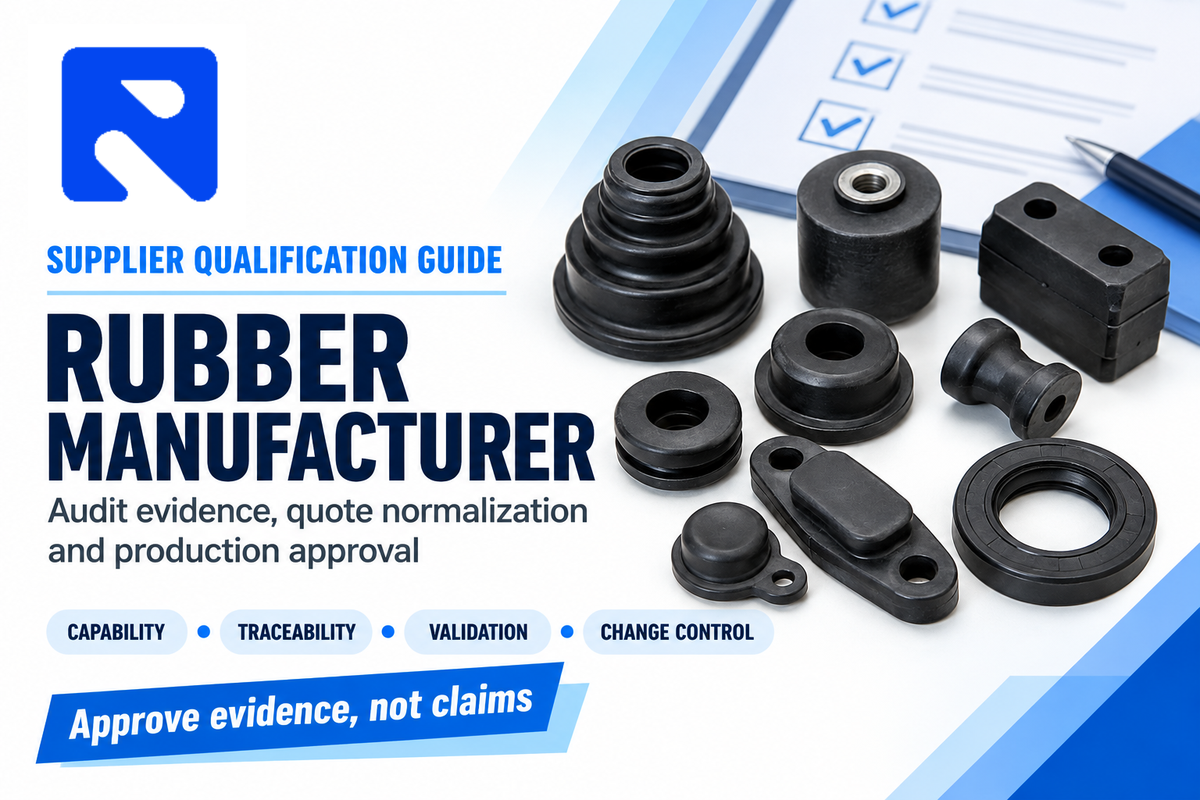
Choosing a rubber manufacturer isn’t about finding the most complete capability list. The true challenge is determining whether one supplier can coordinate your material, tooling, processes, inspections, and delivery to produce parts that consistently meet the functional requirements demonstrated by the approved sample.
This handbook provides practical methods to qualify manufacturers, compare sourcing alternatives, and bring consistency to quote comparisons and expedite the transition from one-off prototype work to repeat production. It doesn’t replace a product catalog, compound selection handbook or molding process manual.
What a Full-Service Rubber Manufacturer Should Actually Control
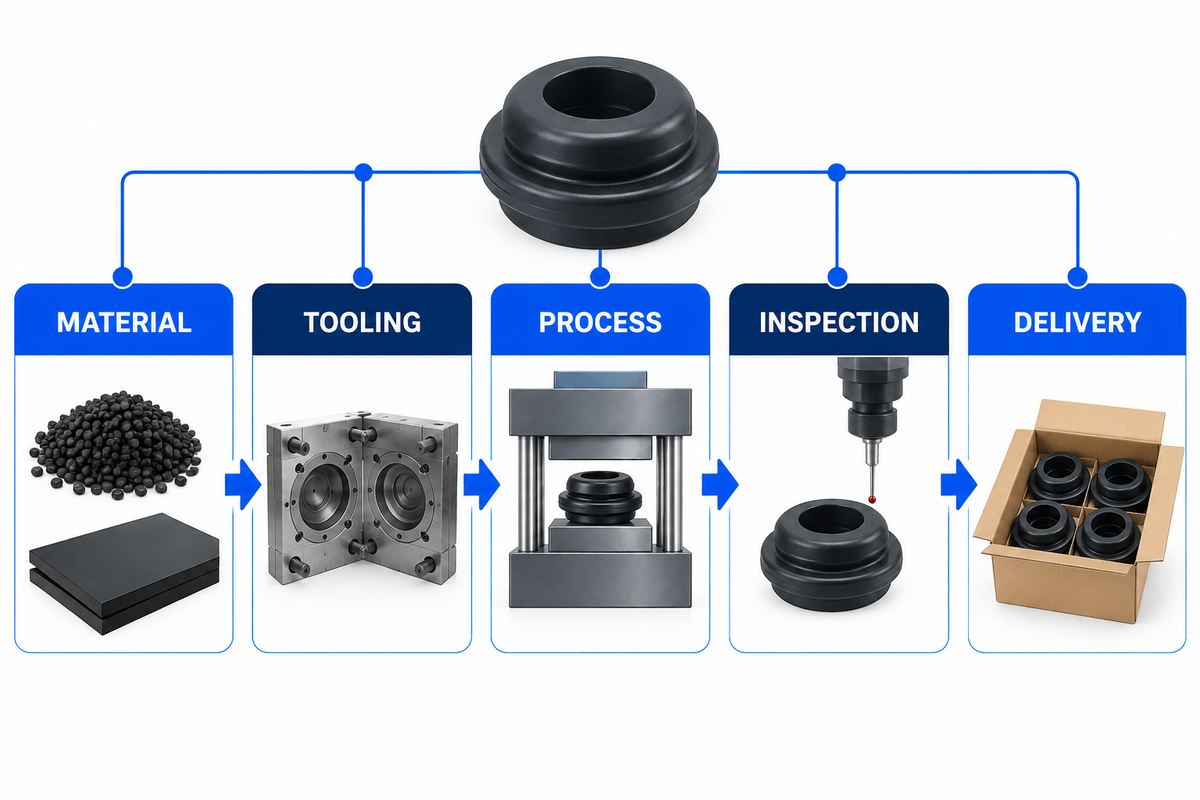
What capabilities should a full-service rubber manufacturer provide from material development through production?
A competent manufacturing company supporting natural rubber manufacturing and synthetic rubber programs should be able to explain how its rubber manufacturing system converts a polymer specification into a repeatable rubber component. This explanation should delineate natural and synthetic options, including silicone rubber alternatives, without turning supplier qualification into a material selection process.
A full-service supplier should connect application requirements with compound selection, tooling, molding, testing, release and delivery. It should identify the work it owns and controls, the work it subcontracts, and the evidence that proves each step met the specification.
| Capability category | Evidence to request | What the evidence should answer |
|---|---|---|
| Material expertise | Compound specification, batch identity, test method, certificate of analysis | Was the approved formulation used and tested? |
| Material traceability | Receiving record, batch genealogy, expiry or retest status | Can each production lot be tied to approved material? |
| Tooling control | Tool drawing, ownership terms, cavity identification, maintenance history | Which tool made the sample and who controls later changes? |
| Process capability | Process flow, work instructions, parameter controls, subcontractor list | Which steps occur at the quoted factory? |
| Outside-process control | Approved-provider list, specifications, receiving verification | How are subcontracted steps controlled and accepted? |
| Inspection | Control plan, calibrated-gauge list, dimensional and physical-property reports | How is conformity checked and recorded? |
| Packaging and identity | Label format, packaging specification, shipment-lot link | Will identity and condition survive storage and transport? |
| Change control | Notification procedure, approval matrix, requalification plan | Which changes require buyer approval before use? |
| Production continuity | First-article approval, pilot-lot record, change-notification procedure | Will repeat production match the approved state? |
This is important because a supplier can own a broad, interconnected system without controlling each individual process in that system. This can work, but for specification, traceability, and corrective action, responsibility shouldn’t be obfuscated. The ISO 9001 Auditing Practices Group guidance on external providers supports evaluating the controls applied to outsourced processes instead of relying on the supplier’s capability list alone.
Define the Part and Supplier Requirements Before You Search
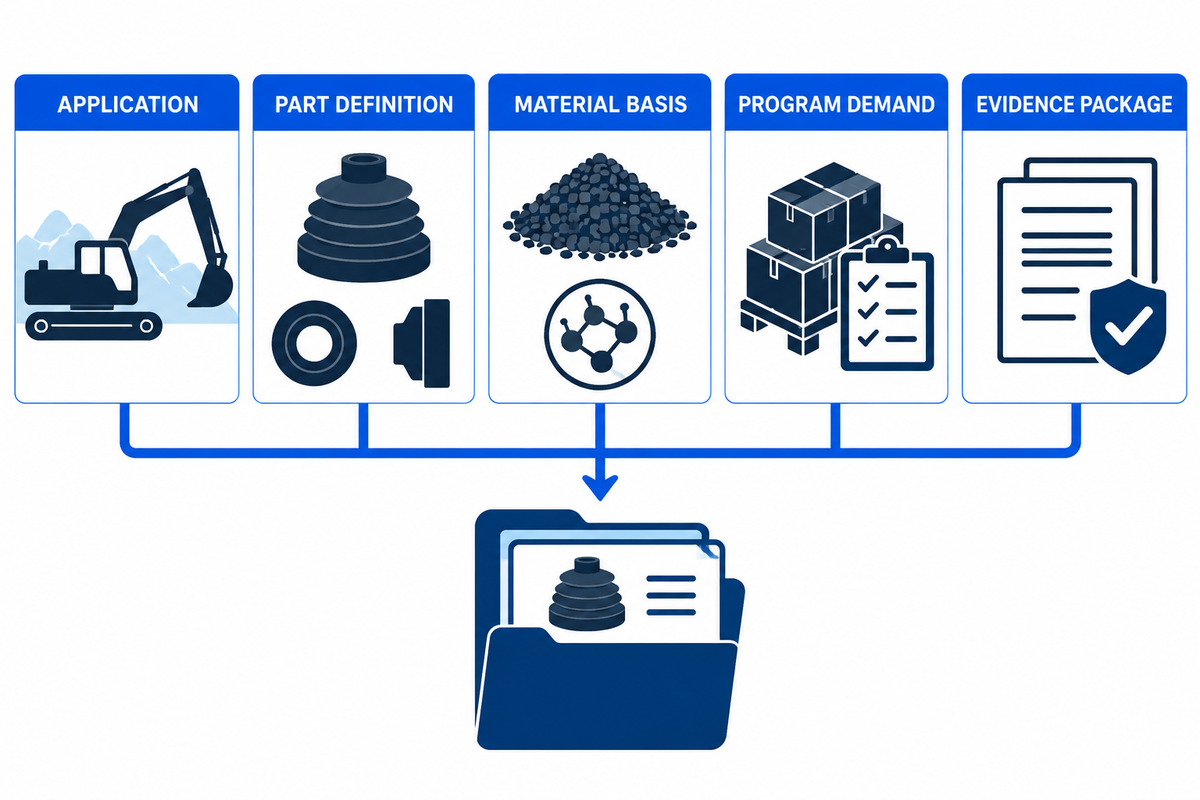
Give rubber companies a project brief covering the drawing, application, demand, validation, packaging, logistics and schedule; don’t just provide a list of requirements. A seal, gasket, automotive rubber isolator, or other high-performance part may need additional evidence even with a simple-looking drawing. Is the evidence required to support custom molded rubber, rubber injection molding, another molding of rubber route, or secondary bonding and finishing?
An RFQ with insufficient detail leaves open-ended possibilities for answers. Begin with the current version of the drawing, application conditions, required performance, annual demand, order quantities, validation, packaging, logistics, and schedule. If a compound hasn’t been fixed, state the operating conditions and measurable performance instead of naming a surrogate material. The official ASTM rubber standards catalog illustrates why the request should identify the applicable test method and acceptance rule rather than merely ask for a generic rubber grade.
- Application conditions: temperature, fluids, pressure, weathering, motion, abrasion, and expected service life.
- Part definition: dimensions, tolerances, flash limits, surface condition, inserts, color, and critical characteristics.
- Material basis: compound callout or required hardness, tensile, elongation, compression set, aging, and regulatory status.
- Program demand: prototype quantity, annual volume, forecast variability, target launch, and delivery pattern.
- Evidence package: first article, material certificate, dimensional report, test results, traceability, and change approval.
ASTM publishes numerous rubber standards covering classification, physical testing, processability, sampling, and statistical methods. This does not create a universal test package. The buyer must still determine the required methods and acceptance criteria.
How to Qualify a Rubber Manufacturer Before Production
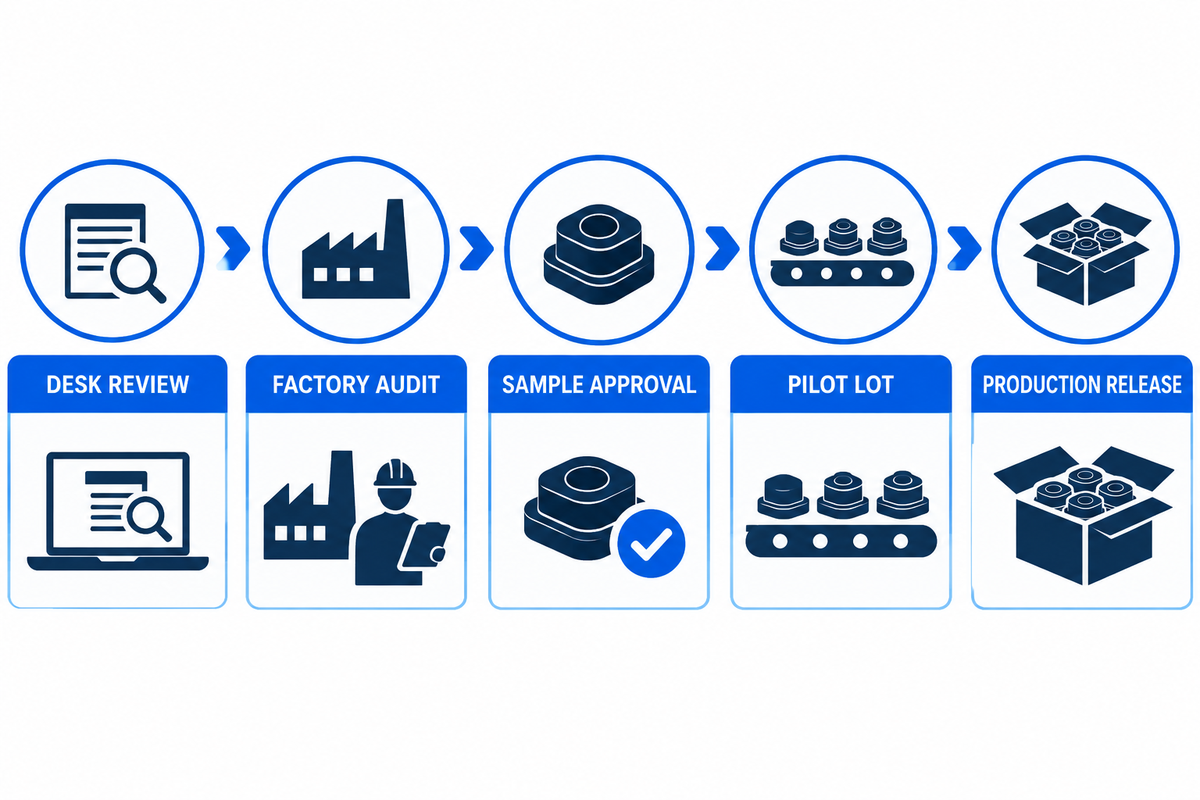
How can I evaluate a custom rubber supplier before approving it for production?
Require a staged approval. A quotation demonstrates commercial interest. A sample shows only that a part was made once. A passing sample or accepted batch doesn’t, by itself, provide an estimate of process capability and control over the long-term; the National Institute of Standards and Technology acceptance-sampling guidance distinguishes lot acceptance from estimation of lot quality. Approving a batch of parts for production requires progressively stronger evidence that the supplier can consistently repeat the approved result under normal conditions.
The Five-Gate Supplier Approval Path
- Begin with a desk review: confirm the legal entity, factory location, QMS scope, relevant processes, subcontractors, capacity, and technical contact.
- Factory audit: trace a representative order through material receipt, production, inspection, nonconformance control, and shipment.
- Sample approval: link samples to the compound batch, tool revision, cavity, test methods, and drawing revision.
- Pilot lot: run the intended production route and inspect enough parts to expose cavity, setup, handling, and batch variation.
- Production release: approve the control plan, records, packaging, change rules, and escalation path before recurring orders.
ISO auditing guidance addresses defined purchasing criteria, controls for approved providers, and evaluations based on performance and risk. The ISO also indicates that the certification of a quality management system provides confidence in the system, but QMS conformance should not be considered as a means of declaring product conformity. Verifying the controls that affect your part is important, and reviewing the scope statement of the certificate should be done as well.
Factory Audit Evidence That Matters
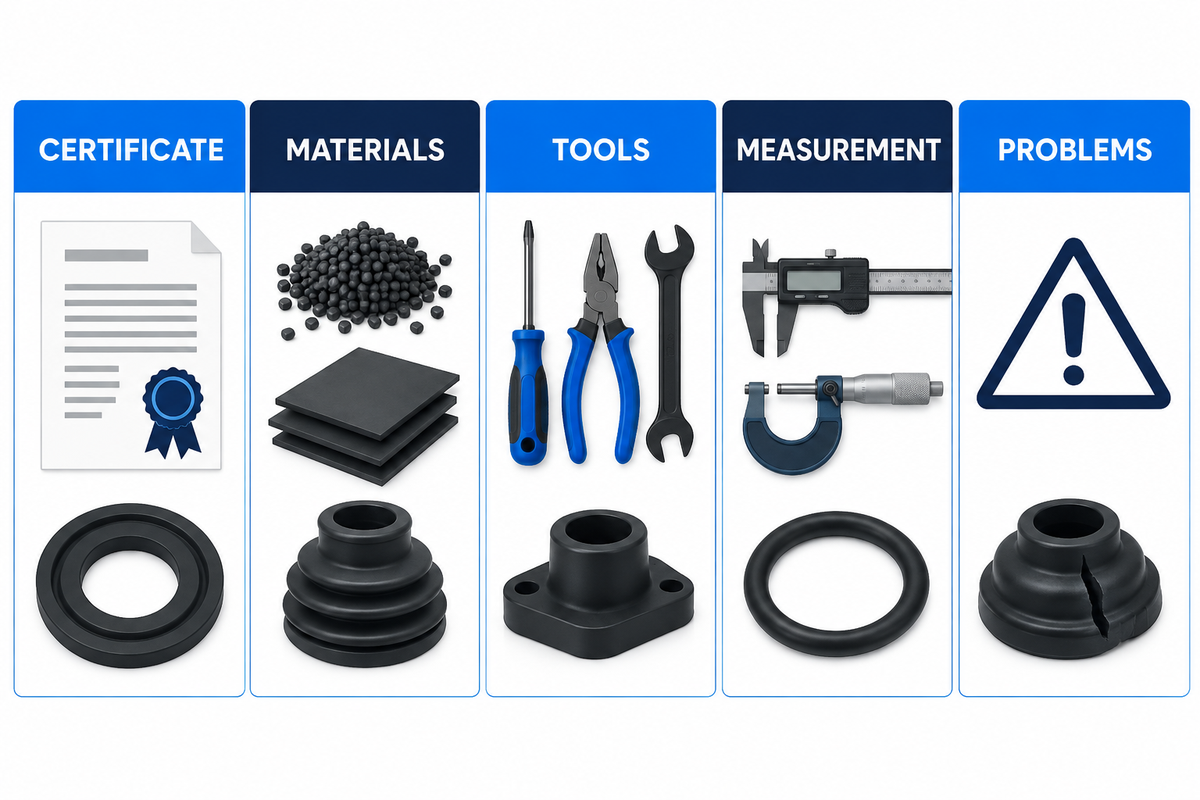
Manufacturing processes should be audited for the quoted part. Many industrial rubber products or rubber and plastic services may be offered by a manufacturer and supplier, but for the controlled route of this project, only a relevant capability is required. For customized rubber or specialized rubber, confirm which operations will be performed in-house and which will be outsourced.
Follow the evidence, not the showroom route. Pick a recent or representative job and have the supplier show evidence of control for revision, material, tool, process, inspections, deviations and release. Redacted records may be sufficient to demonstrate the system and maintain customer confidentiality. The ISO external-provider auditing guidance likewise emphasizes evidence of defined controls, monitoring, and re-evaluation rather than certificate possession by itself.
| Audit area | Useful proof | Red flag |
|---|---|---|
| Certificate | Current certificate, accredited body, relevant site and scope | Scope excludes the quoted process or factory |
| Materials | Incoming checks, lot identity, storage controls, batch genealogy | Material substitutions can occur without approval |
| Tools | Asset ID, maintenance, revision, cavity history | Ownership or custody is unclear |
| Measurement | Method, gauge ID, calibration status, sampling rationale | Reports cannot be tied to equipment or lot |
| Problems | Containment, root cause, corrective action, effectiveness check | Closed actions lack verification |
It’s common to troubleshoot where a defect appears instead of tracing where variation was introduced upstream. A useful supplier audit may incorporate preparation and condition of compounds and tooling, control of curing, handling, and measurement.
Manufacturer vs Distributor vs Trading Company
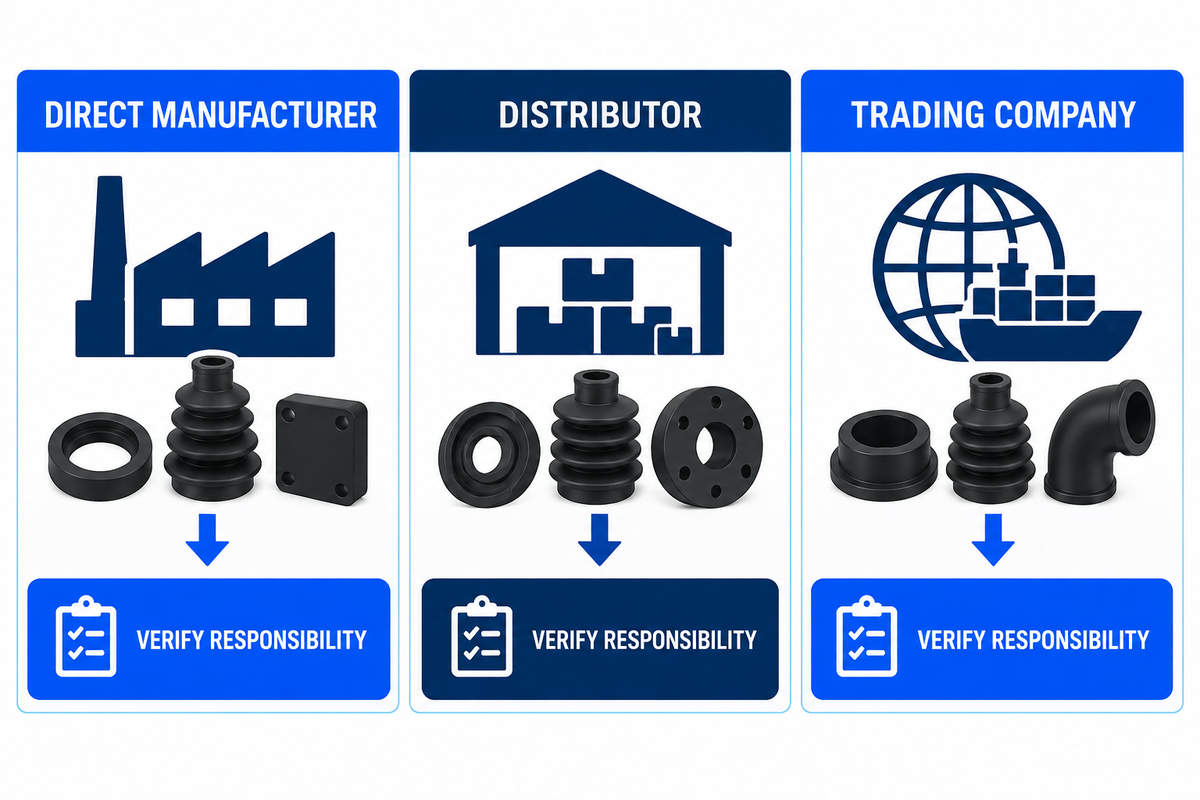
For natural rubber products, polymer products, sealing products, and other industrial products, source type affects who controls engineering, inventory, traceability, and change notification. A manufacturer of rubber parts is usually easier to audit for custom production; for stocked consumer products or rubber goods, a distributor may be adequate. The commercial label should be of less concern, as long as the technical responsibility is clear. Under the ISO guidance for externally provided processes and products, the practical issue is whether selection, control, monitoring, and re-evaluation responsibilities are defined across the supply chain.
Should I buy molded parts from a manufacturer, a distributor, or a trading company?
For an engineered, recurring, traceability-sensitive part, direct purchasing can offer stronger technical control when the manufacturer can provide the required evidence. Use a distributor for standard items stocked by the distributor, where availability is of greater importance than customization. An intermediary can be beneficial for mixed low-volume orders and for cross-border order fulfillment, as long as the contract identifies the real factory, and technical and quality responsibilities are assigned. For stocked rubber products, extend traceability through packaging, storage, inspection records, and lot identity. Factory release doesn’t prove how the inventory was controlled after that.
| Source | Strong fit | Verify before award |
|---|---|---|
| Direct manufacturer | Custom geometry, repeat demand, engineering changes | Actual factory control, MOQ, capacity, tooling, continuity |
| Distributor | Catalog parts, small quantities, urgent replacement | Stock, authorization, lot traceability, obsolescence |
| Trading company | Mixed orders, supplier coordination, export support | Factory disclosure, margin, warranty, change notification, audit access |
Compare landed risk, not just unit price. An anonymous manufacturing-forum example illustrates the trap: the quotation with the lowest tooling charge carried the highest charge for each molded part. Take into consideration tool cost, piece cost, logistics, inventory, inspection, and the risks involved, and then make a decision.
How to Compare Quotes, Tooling, MOQ, and Lead Time
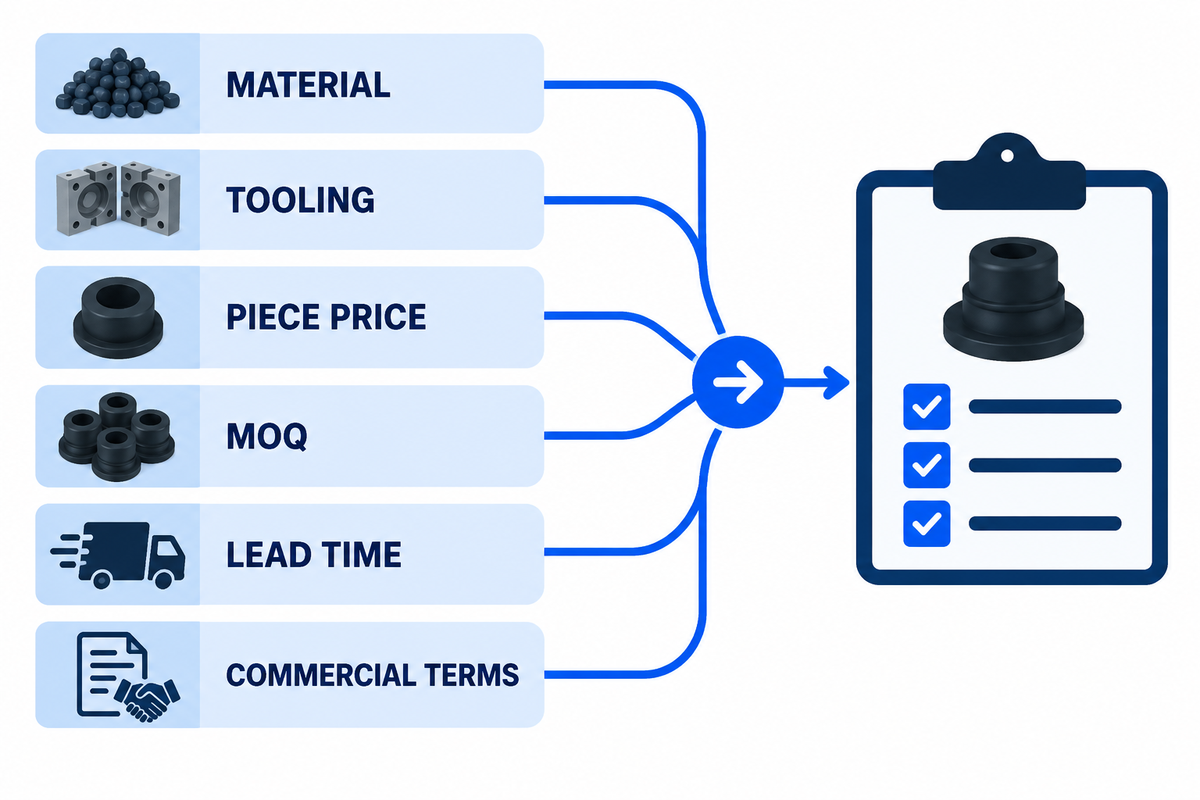
What affects custom rubber part pricing, tooling cost, minimum order quantity, and lead time?
Compound, mass, geometry, tolerance, process, cavity count, cycle time, secondary operations, inspection, volume, current capacity, and many other factors impact the answer. Allowable ranges are helpful when formulating questions. They aren’t helpful when judging a quotation unless its underlying assumptions match.
| Quote line | Normalize this basis |
|---|---|
| Material | Compound designation, color, certification, test requirements, material minimum |
| Tooling | Tool material, cavities, ownership, maintenance, expected life, modifications, storage |
| Piece price | Order tier, annual volume, scrap assumption, secondary operations, inspection |
| MOQ | Compound batch, setup economics, packaging, release schedule |
| Lead time | Clock start, DFM, tool build, sample iterations, approvals, production, transit |
| Commercial terms | Incoterm, payment, freight, duties, quote validity, warranty, exclusions |
For a deeper explanation of cost drivers, see Engelhardt’s custom rubber molding cost factors. In the case that process flexibility is allowed, evaluate the existing rubber molding process options rather than expanding this supplier-selection guide into a process tutorial.
Use one RFQ comparison sheet for every supplier
Create a controlled comparison chart for each of the quotations. Don’t make side-by-side comparisons of the supplier PDFs and assume the same label means the same thing. Record drawing revision, compound type, quoted volume tier, tooling, cavities, sample quantity, inspection, packaging, freight, and everything that has been excluded. If a field is unknown, mark it as an open action rather than making an assumption.
Separate one-time costs and recurring costs. Tooling, molds and fixtures, gauges, first article, and testing are one-time costs. Molding, trim, post-cure, inspection, packaging and freight are recurring costs. The tool price can be low while the piece price can be high, or vice versa, and a low piece price can hide customer-funded inspection and logistics costs.
Compare definition of milestones. Lead time can start at the purchase order, drawing approval, material receipt, tool approval, or deposit. It can also end at samples, factory release, port departure or delivery. Convert each quotation to the same start event, approval assumptions, and delivery endpoint before evaluating schedule performance.
Validate the Prototype-to-Production Transfer
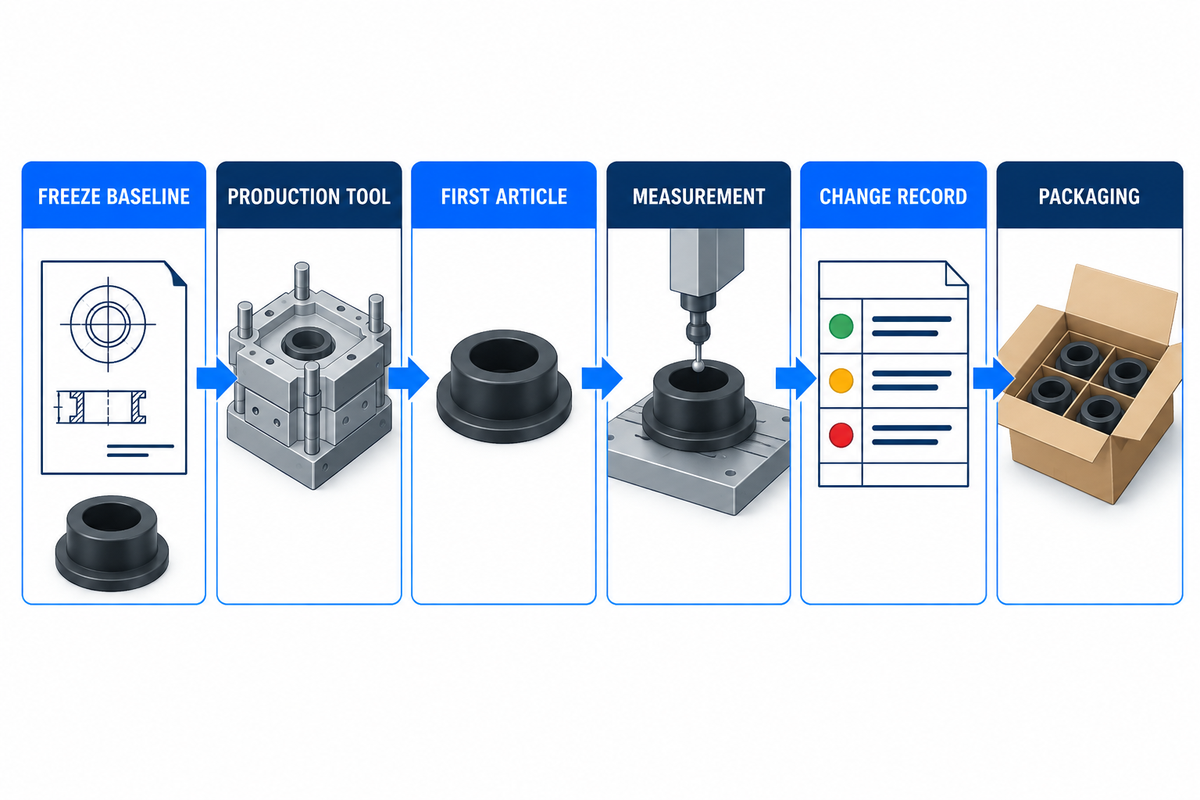
What differences are there between a prototype and production? Differences in tooling, cavity arrangement, trimming, compounding, or other aspects of processing can occur in a prototype. Those differences do not invalidate the sample, but they must be declared and revalidated where they affect performance.
- Freeze the drawing, material specification, approved deviations, and visual standard.
- Identify the production tool, cavity, equipment, and subcontracted operations.
- Define first-article and pilot-lot records before the run.
- Use the same measurement definitions and test methods at approval and release.
- Record every change between the sample route and the production route.
- Approve packaging and labeling so lot identity survives shipment.
If resolution of material selection is deferred, continue the work in the existing rubber compound selection guide. The supplier guide should ensure the required material is controlled and not compare alternative materials.
A Weighted Rubber Manufacturer Scorecard
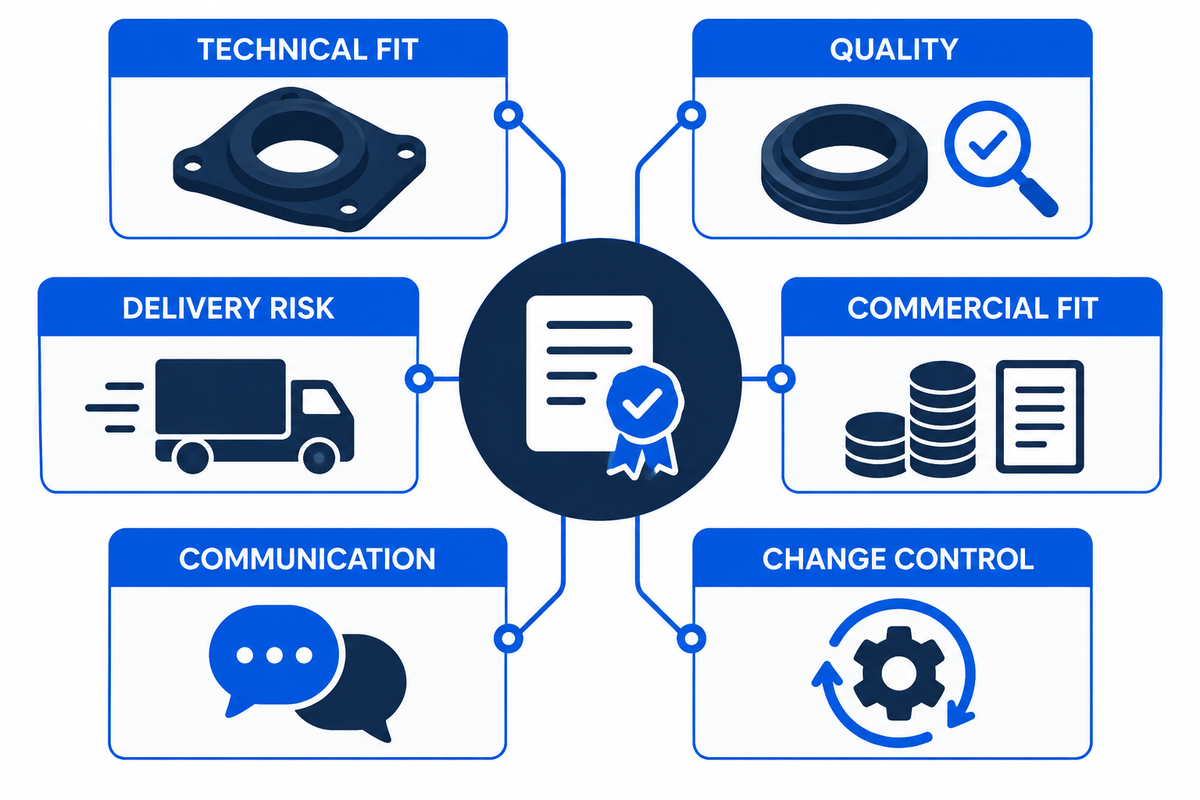
Which rubber manufacturer is best for custom molded industrial parts and how should I compare shortlisted suppliers?
The best manufacturer isn’t the same for each project. The best rubber supplier is the one that supports your compound, geometry, process, volume, evidence requirements, and supply risk. Use the same scorecard for all finalists and to evaluate disqualifying red flags.
The 100-Point Rubber Supplier Proof Scorecard
| Area | Weight | What earns points |
|---|---|---|
| Technical and process fit | 25 | Relevant compound, geometry, process, tooling, and DFM evidence |
| Quality and traceability | 25 | Applicable scope, records, measurement control, CAPA, lot genealogy |
| Production and delivery risk | 20 | Capacity evidence, maintenance, continuity, realistic milestones |
| Commercial fit | 15 | Comparable quote, transparent tooling, workable MOQ and terms |
| Engineering communication | 10 | Named technical owner, revision discipline, clear response path |
| Change and continuity control | 5 | Notification, requalification, tooling custody, second-source readiness |
Change the weights before the bid is made. Don’t change them after the bid is made. A high total score, in the absence of material traceability or when a factory is concealed, a substitution is unauthorized, or production changes are undisclosed, should result in a bid hold. The scorecard should therefore preserve evidence-based selection and re-evaluation fields consistent with the ISO external-provider guidance, while project-specific weights remain the buyer’s decision.
Change Control, Continuity, and Second-Source Readiness
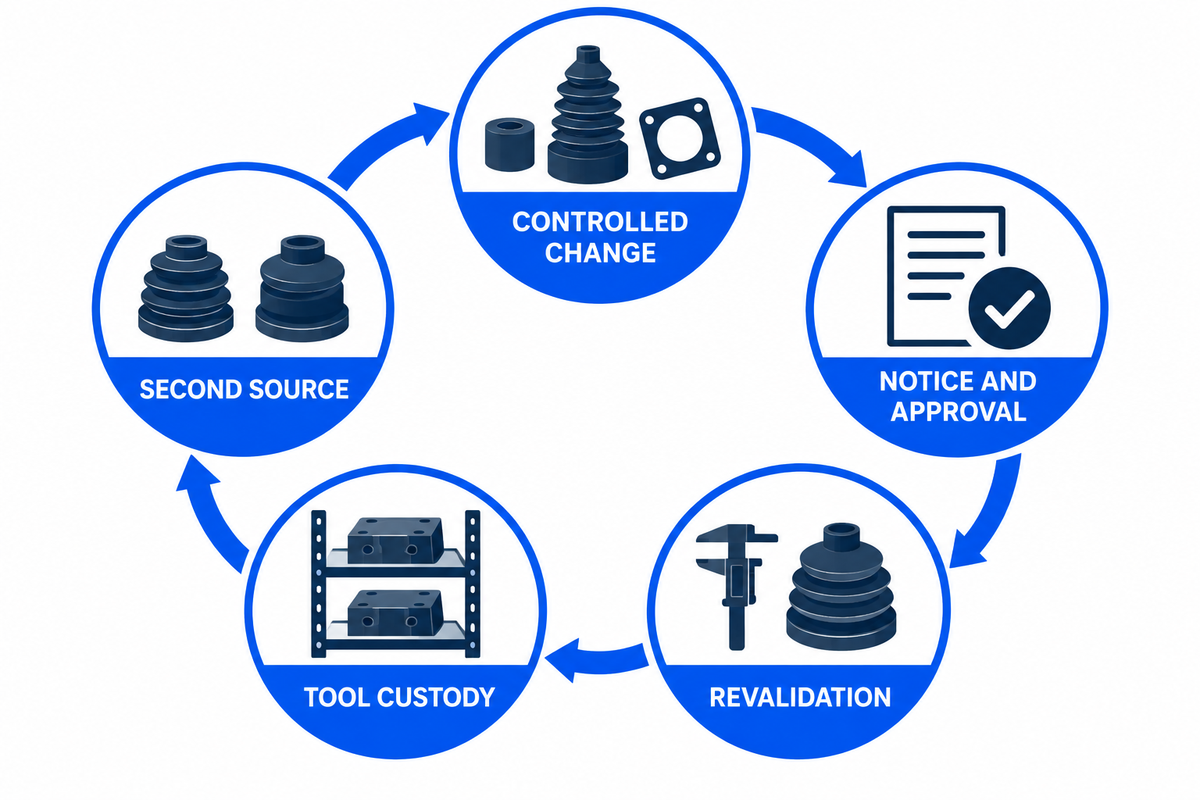
Supplier approval is not permanent. Define which changes require notice and approval, including changes to material source, manufacturing site, tooling, process, inspection, subcontracting, packaging, or labeling. For each change, specify the evidence and level of revalidation. The ISO external-provider auditing guidance provides a useful basis for keeping supplier controls and performance monitoring tied to the risk of the supplied process or product.
Document tooling ownership, storage, maintenance, access, and transfer conditions. For critical parts, maintain current drawings, material requirements, inspection methods, and approved reference samples so a second source can be qualified without copying confidential supplier know-how.
When Engelhardt Is a Fit for Molded Rubber Products
According to its published capability page, Engelhardt is a manufacturer specializing in molded rubber and plastic components for buyer-defined projects. Unlike equipment manufacturers, a molded-parts supplier must prove material, tool, process and lot control at the component level. Its published capabilities cover custom rubber molding and related production support. Buyers should still assess the evidence and validation packages and examine change controls, as defined in this guide, for the specific part.
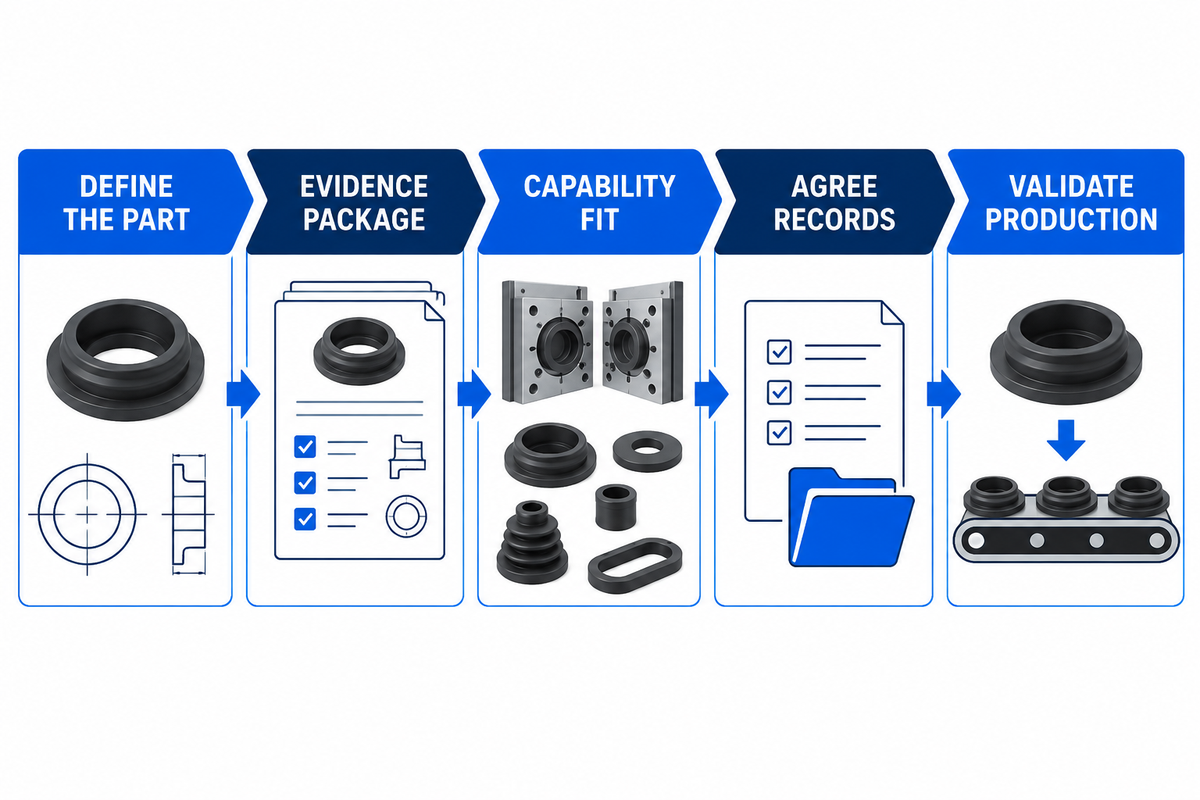
After defining the part, evidence package and approving the route, buyers may review Engelhardt’s molded rubber product capabilities. The same questions in this guide apply. Confirm process and material fit, agree on the required records, normalize the quotation, and define sample-to-production validation before award.
Company background and manufacturing context are available on the Engelhardt manufacturing background page. A project review should still be based on the drawing, application, volume, evidence, and delivery requirements of the individual part.
Frequently Asked Questions
What information should I send a rubber manufacturer for a quote?
Send a controlled drawing revision, application conditions, required compound or performance targets, tolerances, annual and order volumes, testing and documentation needs, packaging, destination, and timing. Separate mandatory acceptance criteria from preferences. Ask every supplier to identify tooling scope, cavity count, material basis, inspection level, MOQ, delivery assumptions, sample stage, commercial exclusions, and which operations will be subcontracted.
How do I verify whether a supplier is a factory or a trading company?
Verify the legal entity and manufacturing address, then connect the quoted process to equipment, production records, operators, tooling control, and inspection at that site. Trace one representative order from material receipt through production and final release. An intermediary can be legitimate, but the agreement should identify who controls engineering changes, traceability, tooling, warranty, audit access, and corrective action.
Which quality records should accompany a rubber production lot?
The package depends on part risk and contract terms. Common records include the purchase-order and drawing revision, batch or lot identity, material certificate or certificate of analysis, inspection results, test-method references, nonconformance disposition, and shipment identity. Critical programs may also require cavity-level data, first-article or PPAP documents, process-control evidence, and written approval for material or process deviations.
Who owns a custom rubber mold after the tooling invoice is paid?
Ownership depends on the purchase agreement. Define legal ownership, custody, maintenance, storage, modification approval, access, and transfer terms before ordering.
When should a buyer require PPAP or first-article inspection?
Use the evidence level required by customer, industry, regulation, and part risk. First-article inspection is useful when dimensions or the production route must be verified. PPAP is appropriate when the program requires a structured demonstration that design records, process controls, measurement, materials, and production evidence support repeatable output.
How should material or process changes be approved?
List controlled changes in the quality agreement, set a notification and approval route, and define the evidence needed for each risk level. Don’t accept a substitution merely because the supplier considers it equivalent; compare the new material, source, process, test results, and application risk against the approved baseline.
Is a local rubber manufacturer always lower risk than an overseas supplier?
No. Distance affects communication, freight, and recovery time, but process control, technical fit, traceability, capacity, and change discipline determine manufacturing risk. Compare the complete operating model and landed consequences rather than treating geography as a substitute for evidence.