Get in Touch with Engelhardt

EPDM vs NBR Rubber: How to Choose the Right Material

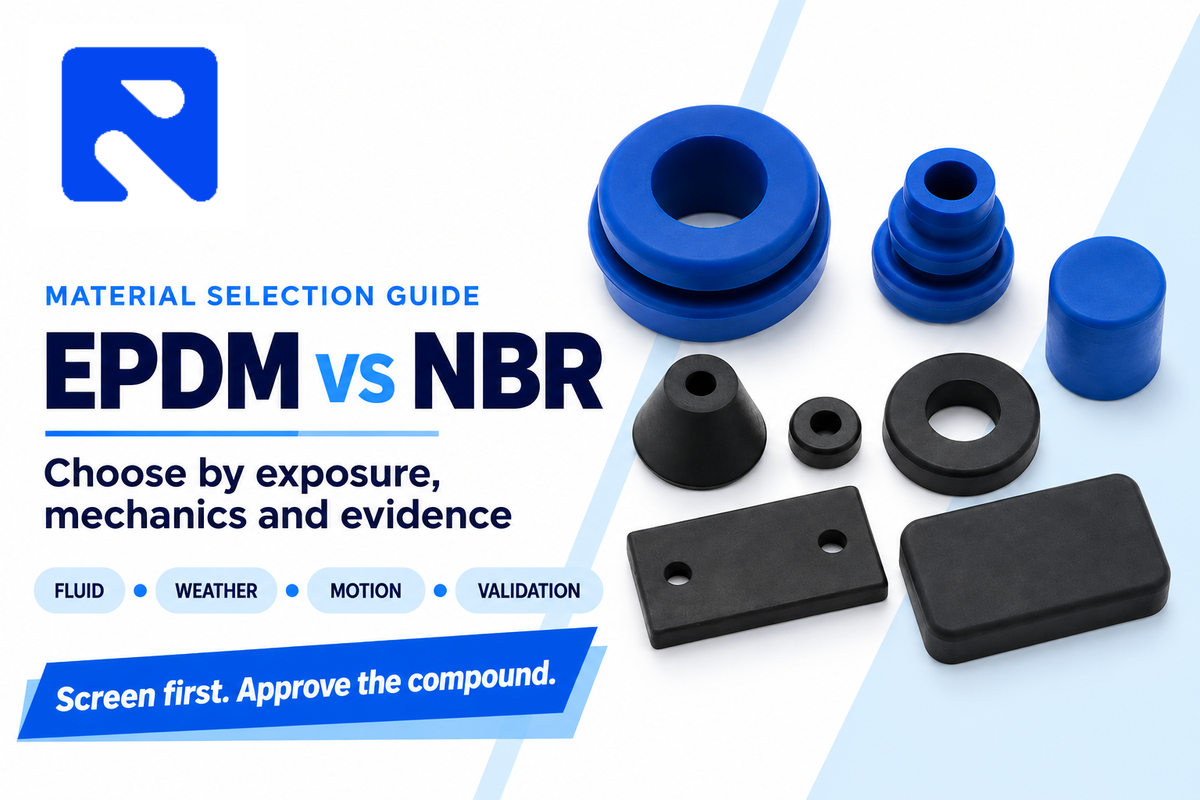
EPDM vs NBR rubber isn’t a competition with a clear, universal winner. EPDM rubber is a better starting point for water, weather, and outdoor service resistance as well as for resistance against ozone. NBR, also called nitrile rubber or Buna-N, is a better starting point for greases, fuels and oil, and mineral-oil hydraulic fluids. In various industrial and sealing applications, the final choice is determined by the exact compound, fluid formulation, temperature, motion, and pressure, and the type of test performed.
The goal of this guide is to help engineers and buyers quickly make an EPDM versus NBR rubber selection. For other rubber families including neoprene, natural and FKM rubber, see our more general rubber compound selection guide. Our custom rubber parts page describes our capabilities for customers that know the service needs.
Why EPDM and NBR Behave Differently
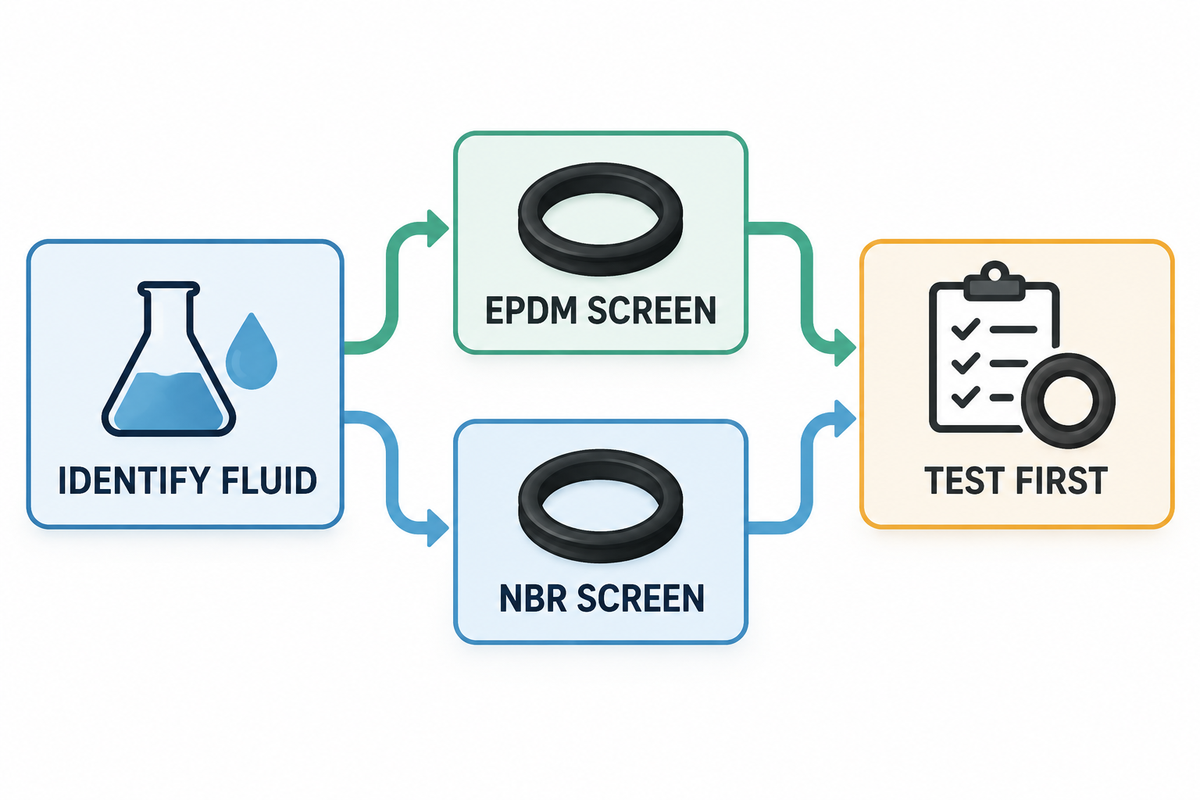
EPDM and NBR belong to the class of synthetic rubbers, but their polymer structures lead to different affinities for different fluids and aging behaviors. The public scope of ASTM D471 provides the testing context for comparing how liquids affect rubber compounds. EPDM is short for ethylene propylene diene monomer, and it has a saturated backbone, giving it good ozone, weather and ultraviolet light resistance. Because of the polarity of EPDM, it’s compatible with water, glycol and other media, and is therefore screened for water and glycol seals.
NBR means nitrile butadiene rubber. It’s a copolymer of butadiene and acrylonitrile. It’s also described as butadiene rubber modified for oil service. It has good resistance to petroleum-based fluids and other hydrocarbon media. The amount of acrylonitrile in the copolymer determines resistance to petroleum products. There can be considerable differences in the performance of NBR compounds, depending on the choices made in the formulation. These can also affect the useful temperature range.
The practical lesson is simple: Base polymer names do describe families, but not finished performance specifications. A compound can contain several chemicals in addition to the base polymer. The choice of chemicals in the compound can affect hardness, compression set, tensile behavior, low temperature behavior, extraction, and aging.
Choose by the Fluid, Not by the Part Name
Either EPDM or NBR can be used to manufacture a molded seal, O-ring, gasket, diaphragm or boot. The name of the part doesn’t define the material it’s made from. The first thing to define is the fluid that the part will contact while it’s being manufactured, including fluids that it may come in contact with during storage, transport and normal use.
| Exposure | Usual screening choice | What can overturn the shortcut |
|---|---|---|
| Petroleum oil, mineral grease, diesel, gasoline | NBR | Fuel blend, oxygenates, additives, heat, sour service, or unusually long immersion |
| Water, outdoor weather, ozone, UV | EPDM | Oil contamination, water treatment chemistry, pressure cycling, or grade-specific temperature limits |
| Hot water or steam | EPDM candidate | Steam pressure, continuous versus intermittent exposure, condensate chemistry, cure system, and exact compound rating |
| Hydraulic fluid | Depends on fluid chemistry | Mineral-oil and phosphate-ester fluids can require opposite material choices |
| Cleaning chemicals plus process fluid | No automatic winner | Cleaner concentration, rinse quality, temperature, exposure time, and residues |
| Brake fluid | Identify the fluid type first | Glycol-based and petroleum-based formulations require different screens |
| Glycol coolant | EPDM candidate | Additives, concentration, temperature, and oil contamination |
| Outdoor oil-contact seal | No automatic winner | Oil contact points to NBR while ozone and weather point to EPDM |
| Unknown or proprietary blend | Test before approval | Obtain the supplier identity, formulation data, and representative sample |
This fluid-first approach aligns with the scope of ASTM D471, which evaluates the comparative effect of liquids on rubber. The public ASTM description also notes an important caveat: Controlled accelerated testing may not correlate directly with actual part performance because service conditions vary. In other words, an immersion test is evidence, not a guarantee.
Why “hydraulic fluid” is not specific enough
Many users of hydraulic fluids may associate NBR because of the historical use of mineral-oil based hydraulic fluids. In fact, fluid service type does vary. Fire-resistant phosphate-esters, water/glycol fluids, and biodegradable fluids may create a different compatibility problem. Provide a material brief with product name, supplier, formulation, and safety data sheet (SDS) if available.
Why fuel age and blend ratio matter
Fuel chemistries can vary by blending, oxidation, contamination, and storage. A compound that screens well against a known fuel category may react adversely to an oxidized or degraded fuel. It’s also important to consider fuel formulation, blend ratio, conditions, duration, and temperature. The correct question to ask may not be “Does it touch diesel” but “Which fuel formulation, at what blend ratio, in what conditions, for how long, at what temperature?”
Is EPDM or NBR better for oil and fuel?
NBR is the elastomer Trelleborg commonly uses for oils including hydraulic and fuel oils, as stated in Trelleborg factsheets. Use that information as a screen, not as an approval to use with all types of petroleum oils, fuels, greases and mineral-oiled based hydraulic fluids. Long and high temperature service may affect swelling and property retention.
Is EPDM or NBR better for water and steam?
For water and outdoor moisture service, EPDM is usually the better first material candidate, along with hot-water or steam services. Approval is dependent on the steam pressure, temperature, condensate chemistry, exposure duration, and the cure system. A generic EPDM label doesn’t take the place of a compound-specific steam rating.
What about brake fluid, coolant and cleaning chemicals?
Identify the chemistry, rather than choosing from the fluid category name. Glycol-based brake fluid and coolant may suggest EPDM. However, petroleum contamination may suggest NBR. Cleaning chemicals, concentration, rinse quality, and residue must be evaluated as separate exposures.
Compare Temperature, Weathering, and Aging
EPDM typically is the better material option for industrial applications where a part must withstand outdoor weather resistance, temperature resistance, ozone and UV exposure. Trelleborg’s public EPDM or NBR comparison gives application context for this family-level screen. NBR typically requires more protection for these aging mechanisms. This often determines the material choice for weather seals and boots, outdoor enclosures, and water system gaskets.
Temperature is more difficult to interpret. Online comparison charts simplify things by giving ranges for the entire family, but there may be trade secrets, hardness, test methods, exposure time, fluid, and the allowable change in property. One EPDM may be designed for heat and steam, while another may be for a different balance. NBR compounds also vary with acrylonitrile content and formulation.
Aging isn’t just due to exposure to air. Heat can promote fluid extraction, hardening, softening, swelling, or loss of strength. A quick check at room temperature can’t account for all possible combined effects. Ask what changes are acceptable for the time the fluid is exposed: volume, mass, hardness, tensile strength, elongation, compression set, sealing force, and leakage.
Compare Compression Set, Abrasion, and Dynamic Service
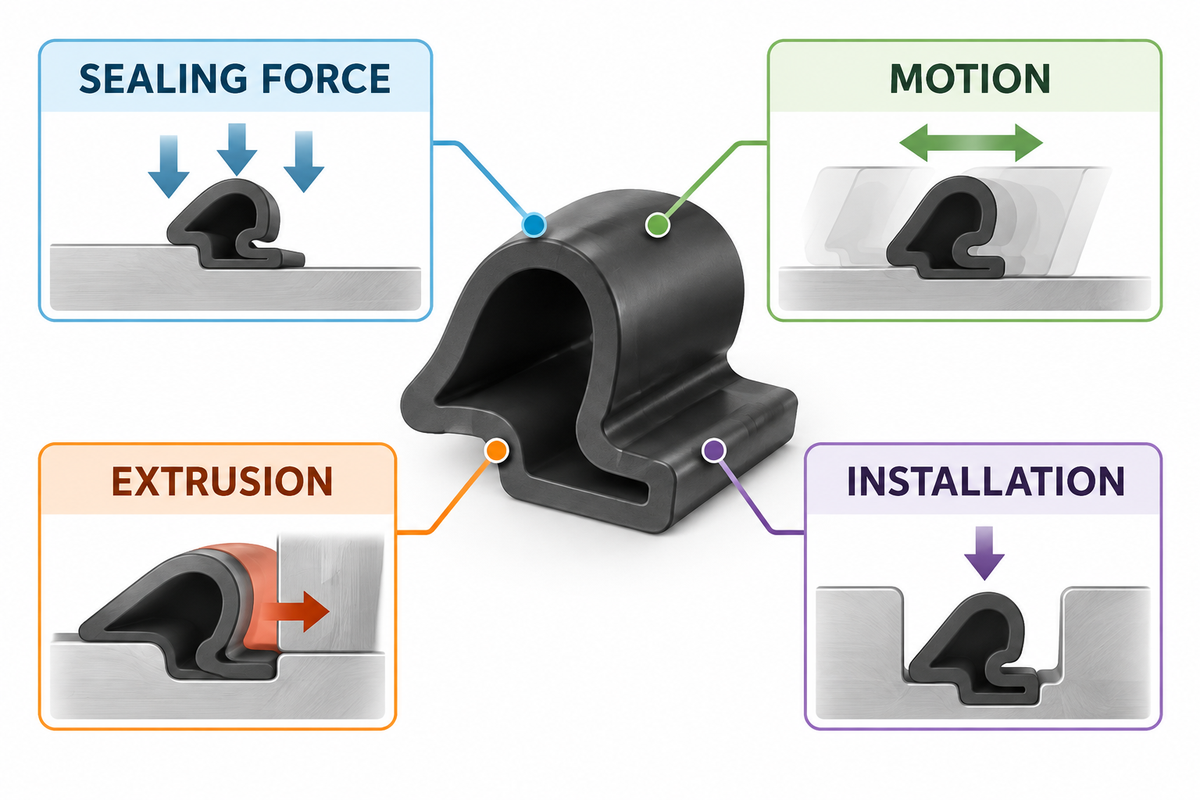
Fluid compatibility is very important, but it isn’t the only consideration in seal design. A compound can resist the fluid and still fail because it cannot maintain sealing force, tolerate motion, resist extrusion, or survive installation.
ASTM D395 examines compression set and describes it as the ability of rubber compounds to retain their elastic properties after the rubber is subjected to an extended period of constant compressive stress. Its public scope notes state that compression-set tests are mainly applicable to static stress service. Therefore, when assessing a static flange gasket versus a reciprocating hydraulic seal, the same number does not mean the same thing. The same number does not necessarily predict dynamic friction or wear, or leakage.
For a fair comparison, keep the method and conditioning constant. Deflection, time, temperature, specimen geometry and the recovery procedure can affect the reported results. Don’t compare one supplier’s EPDM with another supplier’s NBR, where the data are generated using different methodologies.
- Look for the compatibility of the process fluid, flange conditions and the compression set (over the long-term heat exposure) for a static gasket.
- Look for friction, lubrication, abrasion, surface finish, pressure, velocity and clearance for a rotary/reciprocating seal.
- Look for flex fatigue and pressure cycling for a diaphragm.
- Look for ozone, weathering and low-temperature movement for an outdoor boot/bellow.
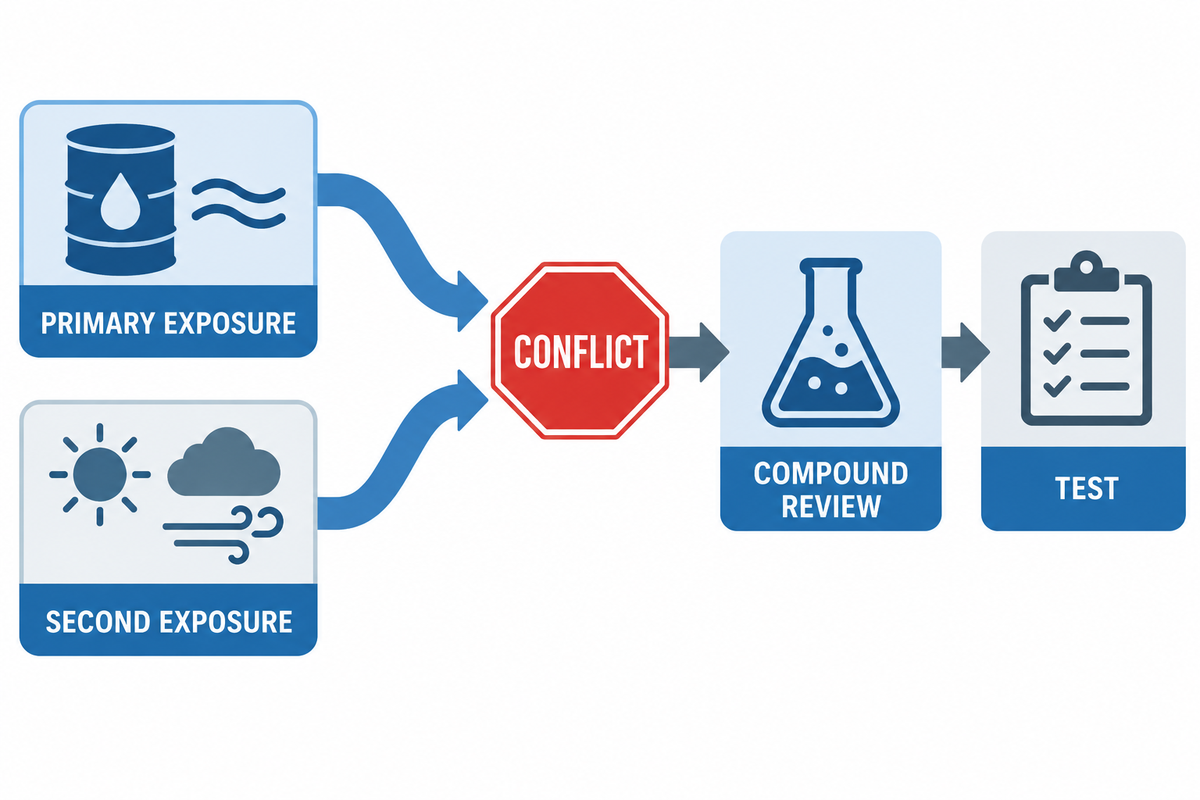
Use the Two-Exposure Veto
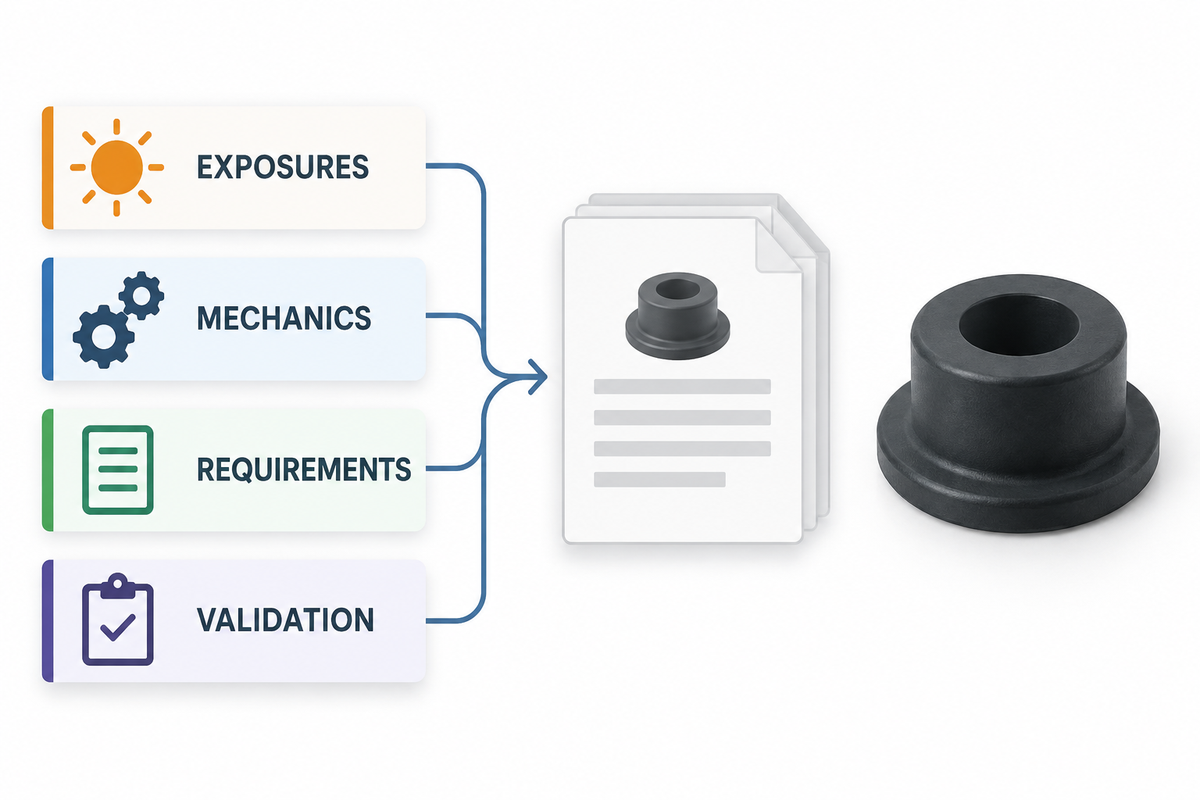
The Two Exposure Veto is a screening stop rule. The public scope of ASTM D471 reinforces why liquid exposure must be evaluated under defined test conditions. If important exposures pull in the direction of EPDM and NBR, respectively, don’t use a general comparison chart. Move the application into compound review and testing.
- List important exposures, starting with the process fluid or environment.
- List the next important exposure. Lubricants and cleaning agents can be important exposures.
- Check if the exposures pull in opposite directions. Petroleum oil and outdoor ozone is a classic example. Mineral oil service and steam cleaning is another.
- Stop the binary choice if they conflict. Review a tailored EPDM or NBR compound, or compare a different family, i.e. HNBR or FKM, if appropriate.
- Validate with representative conditions: Consider representative conditions of the actual fluid formulation, blend ratio, age, additives, temperature, time, and mechanical load.
The simple family rule reaching its limit doesn’t mean EPDM and NBR are unusable in more complicated service. It means the simple family rule has reached its evidence limit. Compounding can strengthen a weakness, but it can also introduce new tradeoffs. The new compound should be supported with its own evidence.
When should you compare HNBR or FKM?
HNBR can be a good candidate when the required performance is beyond the capability of nitrile with respect to heat, aging and mechanical performance, as well as affinity to oil. FKM can be a candidate when the service requires exposure to fuels, oils and/or heat and chemicals that are beyond the capability of standard NBR. Of course, they have their tradeoffs, like cold flexibility, steam and polar fluids, cost and variability. Treat them as new candidates, and don’t assume they’re an automatic upgrade.
EPDM vs NBR by Part Type
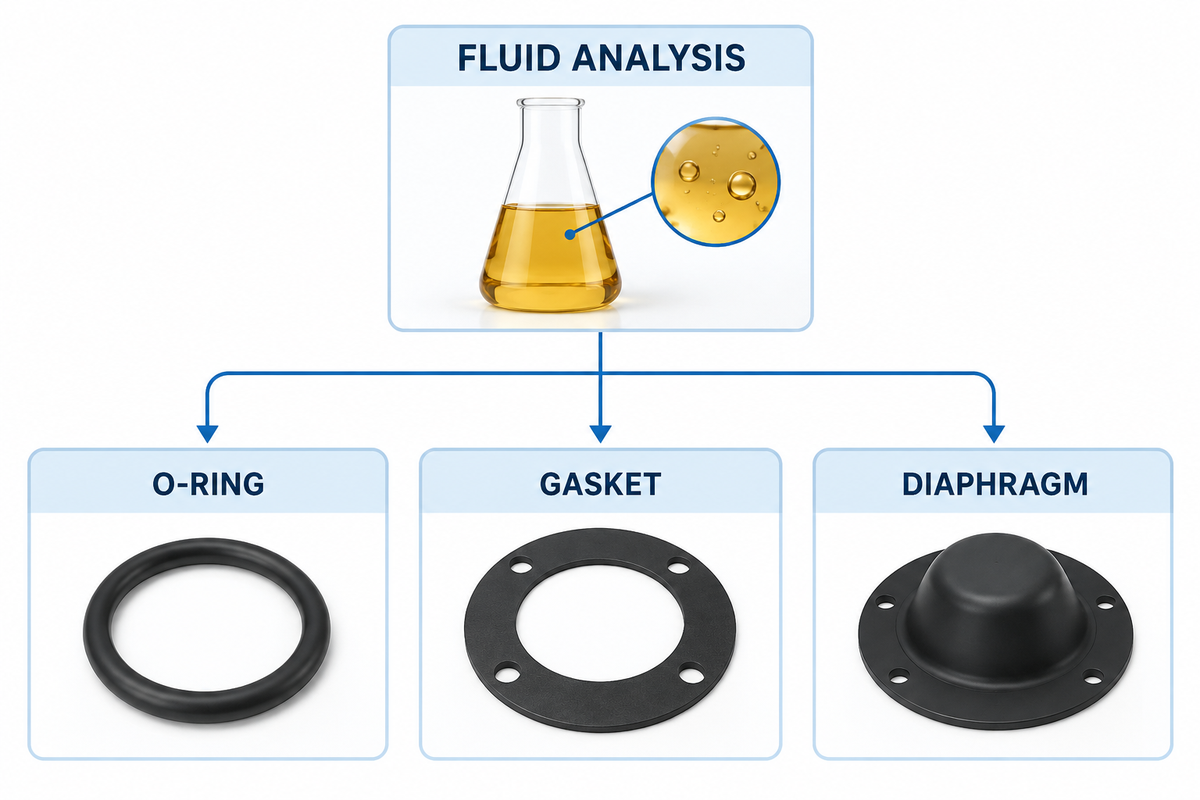
Changes in part type alter the type of questions you ask, but it doesn’t replace fluid analysis.
O-rings
For an O-ring, check the fluid, temperature cycle, pressure, motion, squeeze, stretch, gland fill, clearance, surface finish, and installation lubricant. For water valves or outdoor enclosures, EPDM may be the best choice. For lubricated pneumatic or mineral-oil hydraulic systems, NBR may be a better choice. Either choice may still fail in a poor groove or in an incompatible secondary fluid.
Gaskets
For a gasket, check flange finish, bolt load, joint movement, thickness, the compression target, and relaxation. EPDM and NBR may both be logical choices for water and oil gaskets, respectively, but sealing of the joint depends on the assembly.
Custom molded seals and diaphragms
Thin flex zones may be realized through custom part geometry. These may be used in conjunction with knit lines and bonded inserts. Sharp transitions may also be realized, as well as high strain areas, and material selection should take process design and tooling into account. Engelhardt creates custom molded rubber parts with material, mold and production integration.
Validate the Actual Compound Before Production
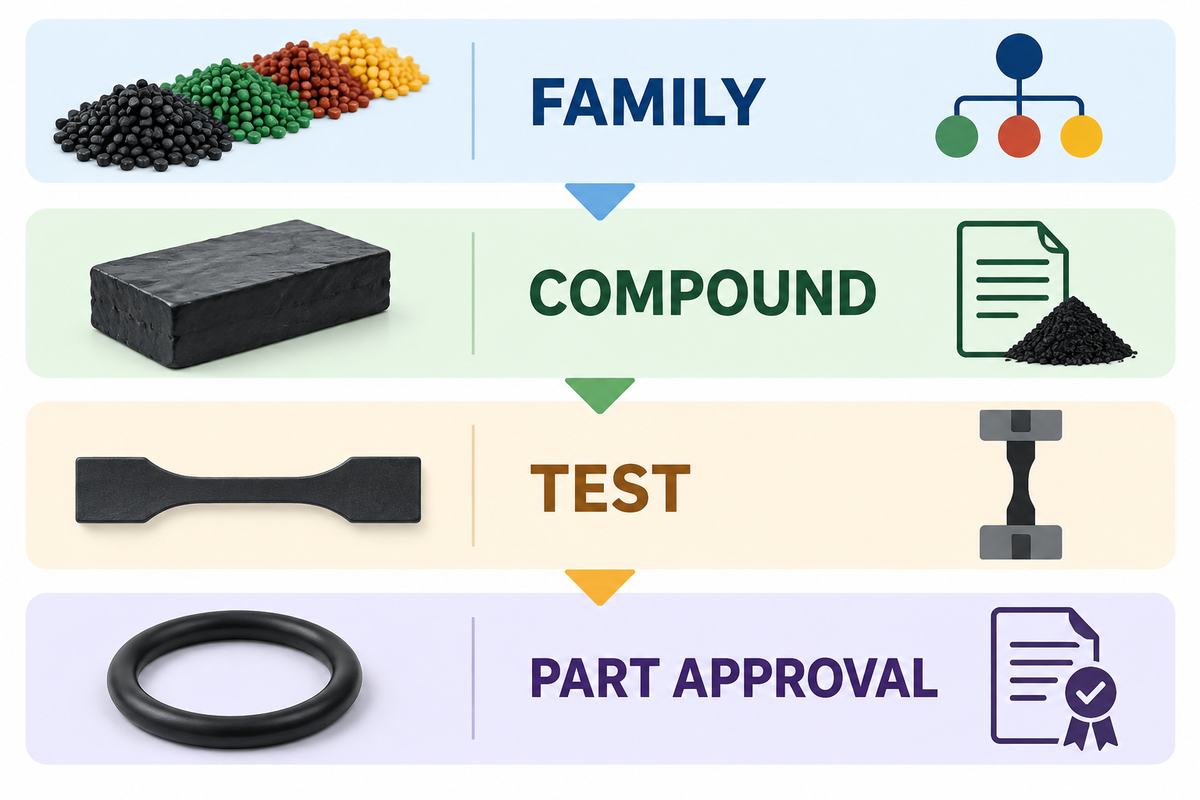
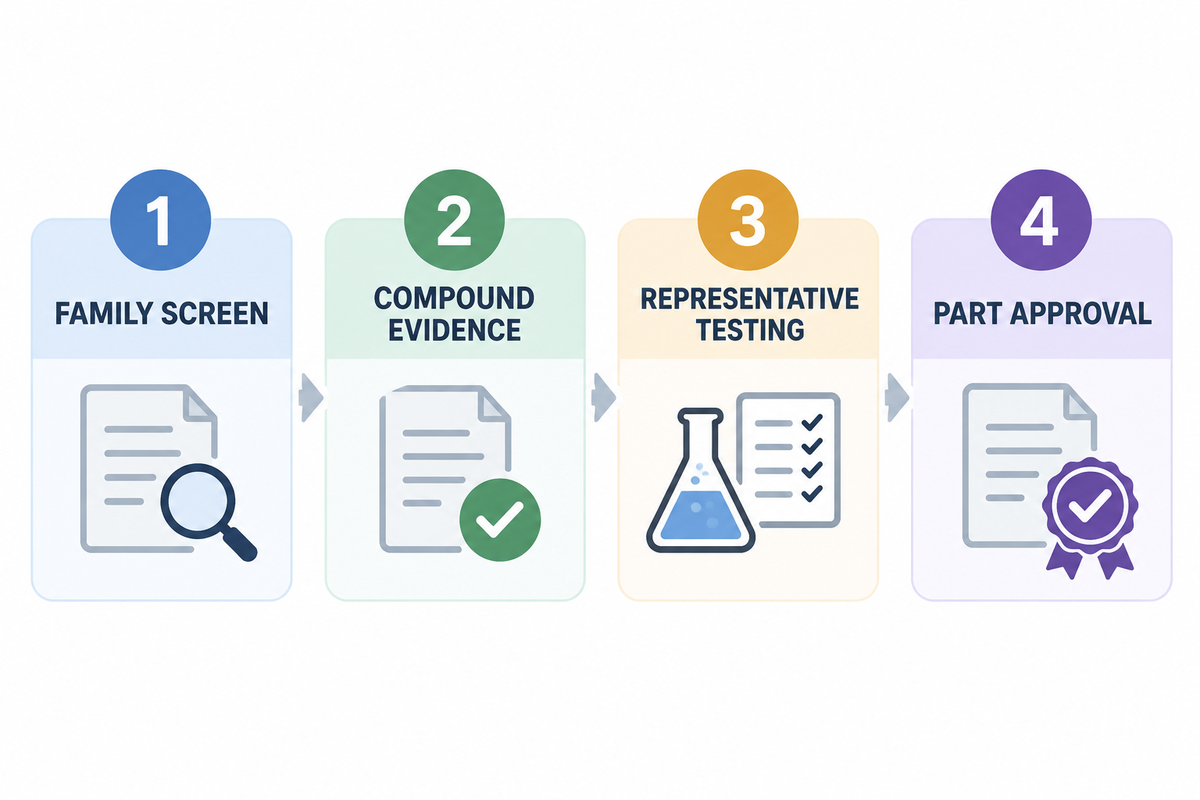
A realistic approval process has four layers. Each layer asks a different question and skipping a layer creates a false sense of security.
1. Family screen
Does EPDM, NBR, or another elastomer family broadly fit the fluid and environment?
2. Compound evidence
Does the exact compound datasheet cover hardness, cure, physical properties, aging, and relevant approvals?
3. Representative testing
Does testing use the actual fluid or a justified simulant at the relevant concentration, temperature, duration, and mechanical condition?
4. Part and process approval
Does the molded part meet dimensional, visual, functional, and traceability requirements after production?
Establish acceptance criteria before testing. The public scopes of ASTM D471 and ASTM D395 show why fluid effects and compression set need defined methods and acceptance limits. A report that says “compatible” without specified limits is practically useless. Acceptable criteria for the material can be limits on changes in volume, mass, hardness, tensile strength, compression set, sealing force, leakage, dimension, appearance, etc.
Also, retain the identity of the approved material in the manufacturing process. Include the supplier, compound code, revision, color if any, cure system if any, and certificates. Merely stating “Black EPDM 70 Shore A” won’t assure that the next batch is the same.
Send a Quote-Ready Material Brief
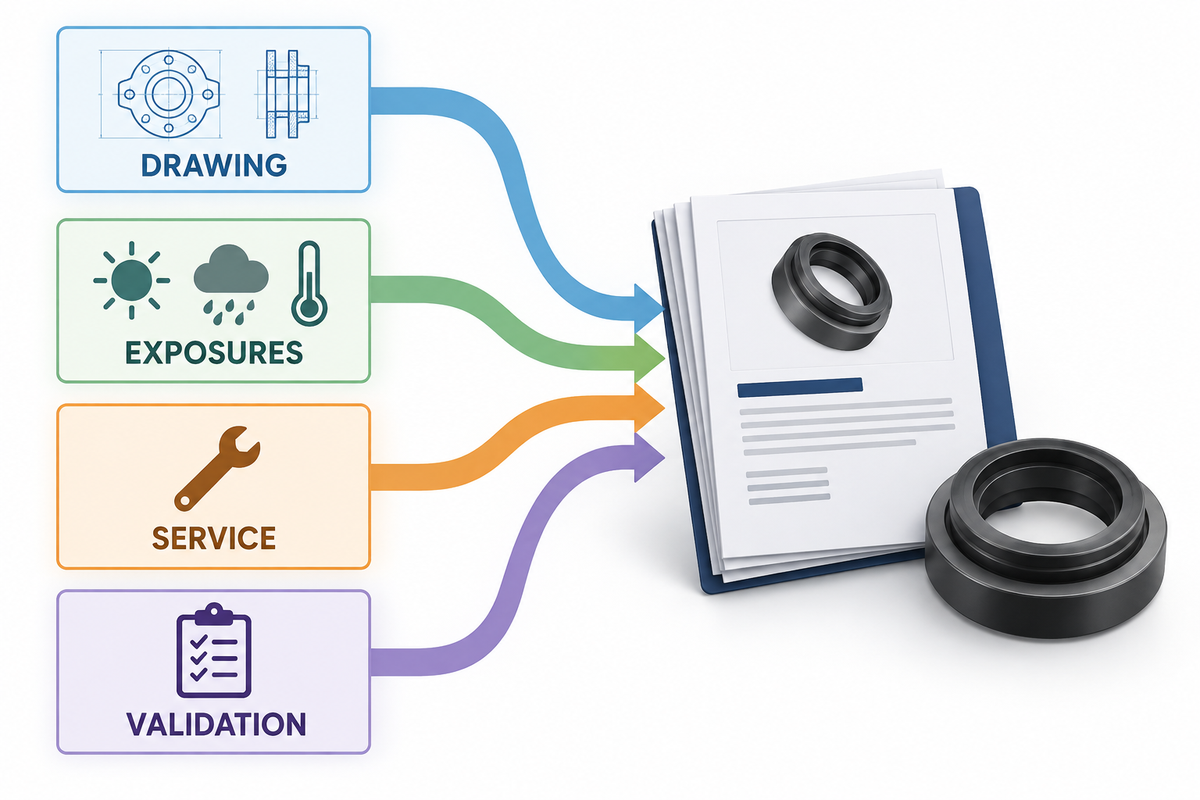
A clear brief allows a molder to compare suitable compounds rather than guess from the part name. Use the same service envelope in all quotations. Referencing the applicable ASTM D471 fluid-test conditions can make that envelope more specific.
- Paper drawing and 3D models including critical dimensions and sealing surfaces.
- Part function and consequence of failure
- Describe each process, cleaning, maintenance and all incidental fluids including products and their concentrations.
- Minimum, normal, maximum continuous, and short peak temperatures
- Static, reciprocating, rotary, flexing, or vibration service
- Cite the expected service life, maximum and minimum service conditions, and normal and peak service conditions.
- Outdoor, ozone, UV, humidity, or storage exposure
- Hardness target and the rationale if any, defined earlier.
- Applicable ASTM, SAE, FDA, drinking-water, automotive, or customer-specific requirements
- Validation tests, acceptance limits, sample quantity, and documentation required
- Define the volume to be produced, lot size, prototypes, insert bonding requirements, color and marking requirements, and traceability.
Common EPDM vs NBR Selection Mistakes
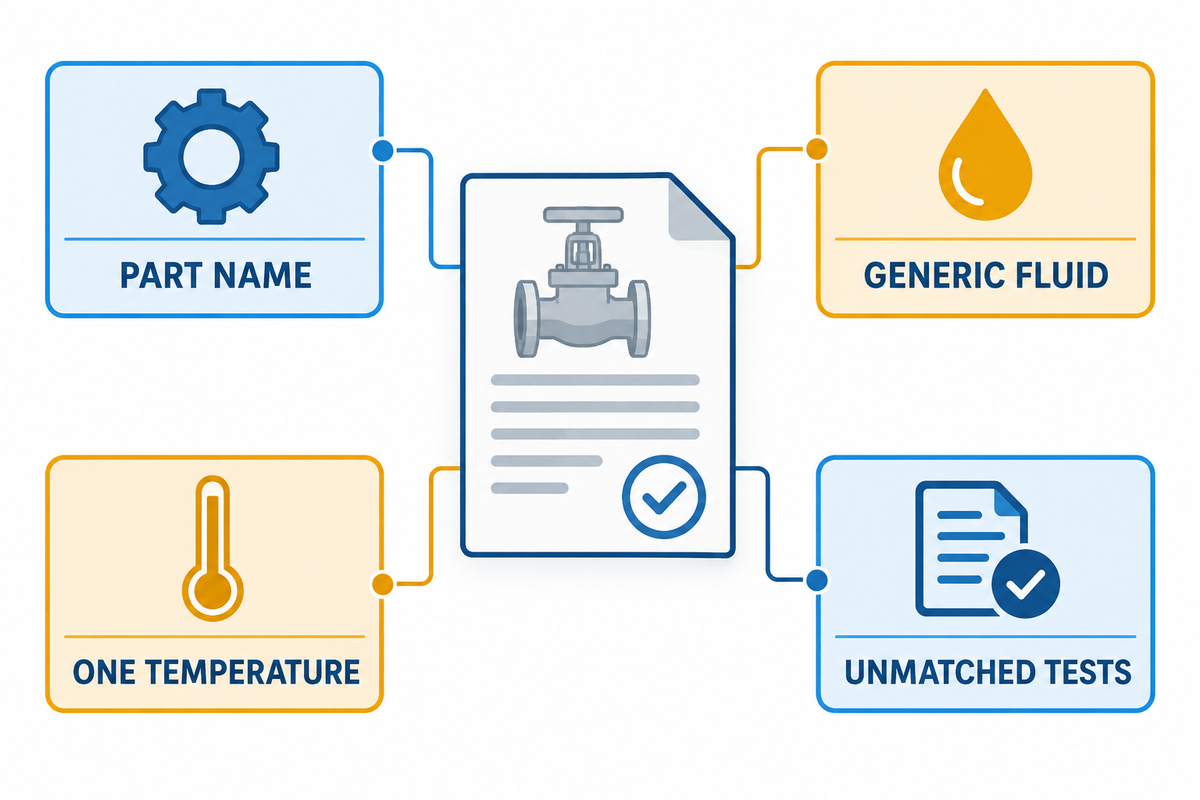
- Choosing from the part name: “O-ring” or “gasket” doesn’t identify the exposure. Trelleborg’s public EPDM or NBR comparison is one application-based reference that avoids this part-name shortcut.
- Writing “hydraulic fluid” doesn’t identify the base chemistry and additive package of hydraulic fluids.
- Using one maximum temperature: continuous, peak, fluid, and aging conditions must stay connected.
- Ignoring cleaners and lubricants: secondary fluids can become the limiting exposure.
- Comparing unmatched test results: Different test methods and recovery conditions can lead to misleading results.
- Using a polymer family instead of a single compound: Formulation changes performance.
- Assuming an expensive elastomer is a safer choice: HNBR and FKM elastomers have some advantages and some failures.
Frequently Asked Questions
Is EPDM better than NBR?
EPDM is generally better for weather, ozone, and outdoor use. NBR is generally better for fuel and oil. Neither is generally better for all applications.
Can EPDM be used with oil?
As stated in Trelleborg’s report, EPDM with hydrocarbon, mineral, and vegetable oil products should be avoided because of oil absorption, which weakens the properties of EPDM. Don’t generalize from the word “oil” here. Silicone oils, process oils, and additive packages can behave differently. You should check the type of oil and compound.
Is NBR suitable for outdoor use?
NBR is generally less resistant than EPDM to ozone and weathering. A specially formulated NBR compound may be of help in some outdoor applications.
Which is better for steam, EPDM or NBR?
Usually EPDM is the better choice; however, steam pressure, steam chemistry, temperature and duration, as well as the cure system, can affect the choice. Request a compound-specific steam rating and validate the intended steam cycle.
Which is better for hydraulic seals?
It depends on the hydraulic fluid. NBR is generally screened for mineral oils. Water glycol and phosphate-ester fluids can point elsewhere. Other factors, including wear and heat, must also be evaluated.
Can I specify only EPDM or NBR on a drawing?
That’s usually too broad for a critical application. Add an approved compound code or performance specification, hardness, required tests, acceptance limits, regulatory needs, and change control.
Final Decision
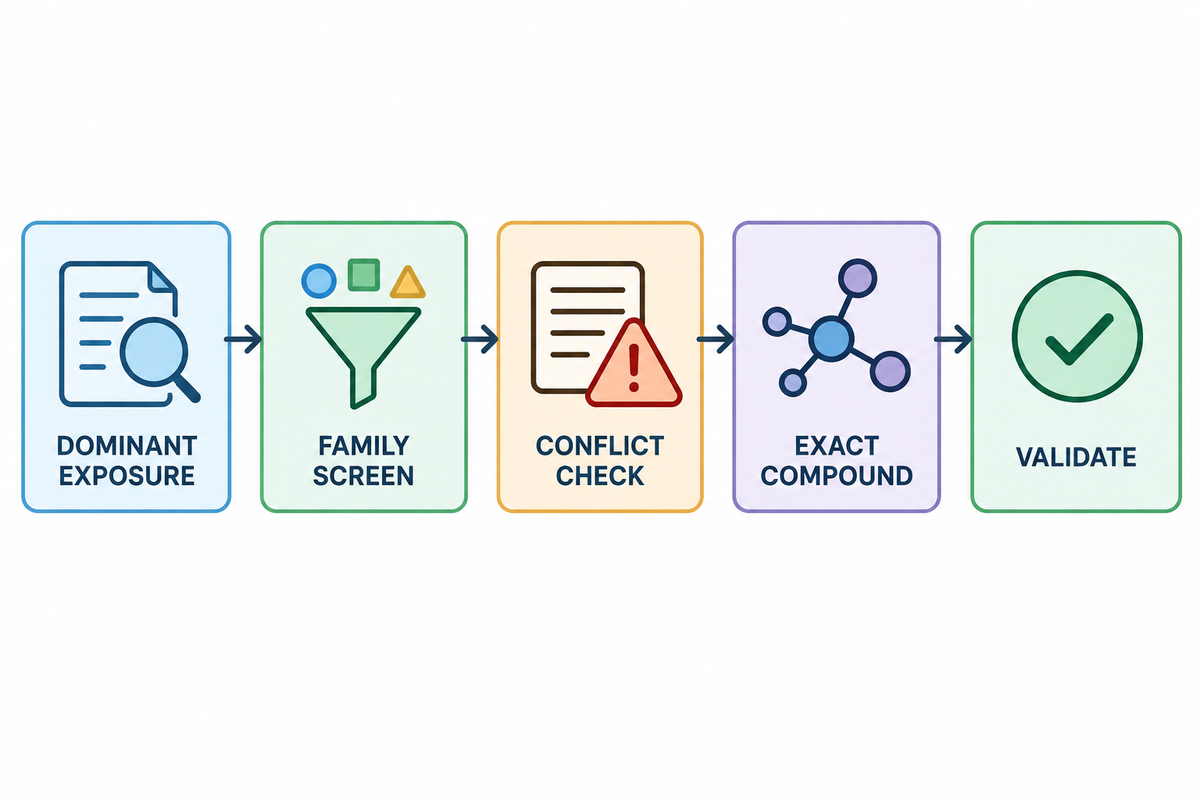
For a quick choice of EPDM vs NBR rubber, follow the predominate exposure. Water, weather and ozone exposures normally favor EPDM, and petroleum and fuel exposures usually favor NBR. Check for a second exposure that negates the shortcut. If the environment is different, the fluid changes over time, or the service is mechanically demanding, stop the binary choice and determine the exact compound. To find out more on Engelhardt, check out our manufacturing site, or contact our team with a quote-ready brief.
With this method we can turn a basic comparison of materials into an engineering and purchasing decision. To find out more on the material, the geometry, the tooling and the production requirements, contact Engelhardt about your custom rubber part.
References & Sources
- ASTM D471: Standard Test Method for Rubber Property – Effect of Liquids
- ASTM D395: Standard Test Methods for Rubber Property – Compression Set
- Trelleborg Fluid Handling Solutions: EPDM or NBR?
- Apple Rubber: Understanding ASTM D2000
- Oak Ridge National Laboratory: Elastomer compatibility with POMDME and diesel blends