Get in Touch with Engelhardt


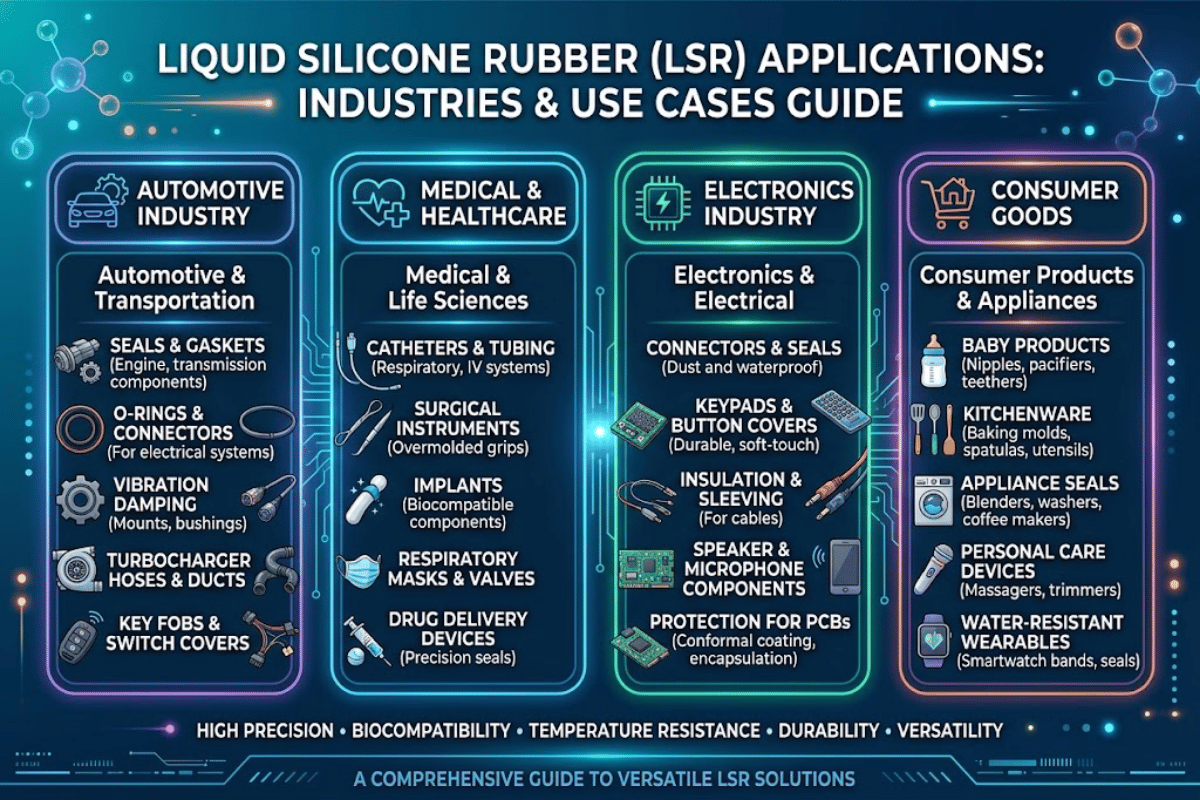
Liquid silicone rubber applications span almost every serious manufacturing sector — from implantable medical devices to EV battery seals to baby-bottle nipples to dielectric encapsulation in smartphones. This guide maps where liquid silicone rubber wins, why it wins there, and how to decide if LSR is the right material of choice for a given part. Focus throughout is on concrete product examples, the material properties that drive adoption in each industry, and the decision criteria that separate LSR from its closest alternatives.
Quick Specs: Liquid Silicone Rubber at a Glance
| Continuous service temperature | −55 °C to +200 °C typical; high-temp grades to +250 °C |
| Hardness range | Shore A 5 – 80 (per grade) |
| Cure system | Two-part (A + B, 1:1), platinum catalyst, heat-activated |
| Tensile strength | 6 – 11 MPa typical (medical grade) |
| Compression set (22 h / 150 °C) | 10 – 25 % (ASTM D395 Method B) |
| Biocompatibility | ISO 10993-5/-10 and USP Class VI grades available |
| Molding method | Liquid injection molding (LIM), fully automated |
What Is Liquid Silicone Rubber, Really?
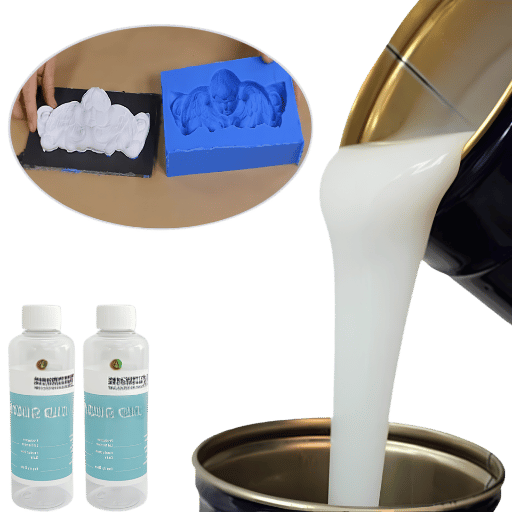
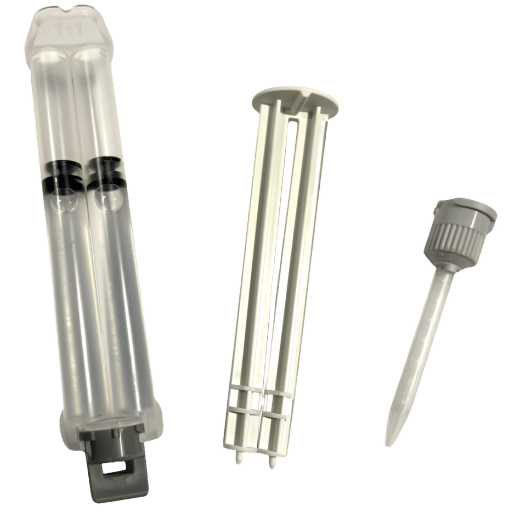
Liquid silicone rubber is a two-part, platinum-cured elastomer with a silicone–oxygen (siloxane) backbone. Compound A carries the base polymer with vinyl end groups; Compound B carries the platinum catalyst and hydride cross-linker. These two compounds mix 1:1 in a metering unit and cure inside a heated mold. This curing process cross-links the vinyl end groups under heat, converting the viscous liquid into a solid elastomer in seconds. Unlike a thermoplastic, cured LSR does not remelt when reheated — it is a thermoset.
This is what is relevant when talking about the product – not the chemistry lecture. 4 properties matter for the industry application:
- ✔Biocompatibility. The siloxane backbone does not provoke an immune response, so it suits long-term tissue contact and qualifies under ISO 10993.
- ✔Thermal stability. The Si–O bond is stronger than the C–C bond in organic rubbers, so LSR keeps its mechanical properties at temperatures that soften nitrile or EPDM.
- ✔Electrical insulation. Volume resistivity above 10¹⁴ Ω·cm and dielectric strength around 20–25 kV/mm place LSR among the best elastomeric insulators.
- ✔Chemical inertness. LSR resists water, most acids and alkalis, and holds up under steam, ethylene-oxide, gamma and e-beam sterilization.
Every one of the application examples needs to be seen as a consequence of one or more of these four properties pushing cheaper alternatives into the background. I challenge you to look for the application examples below and not see this model explicitly used in the Industry Property Matrix below.
Medical and Healthcare Applications
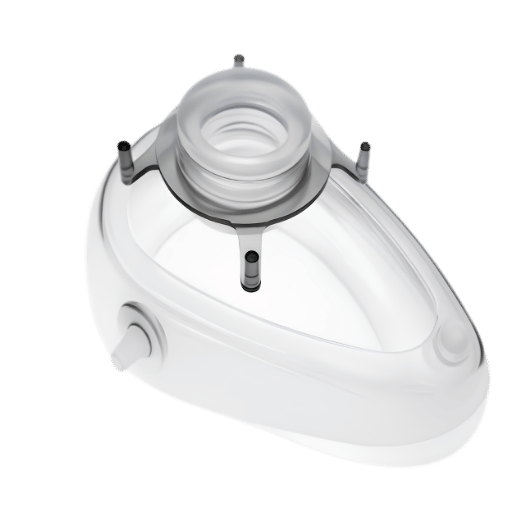
The application space with the most – and the most stringent – applications for liquid silicone rubber elastomer is Medical. Full compliance with ISO 10993 biocompatibility alone can be enough to justify the switch from other elastomeric material solutions. The reason will be familiar: silicone rubbers is one of the few elastomers that will pass all ISO 10993 biocompatibility testing without additives that would compromise sterilizability. According to Grand View Research (cited by several industry reports), the premium (medical-grade) silicone market from which LSR is a central player was expected to be worth circa USD 1.84 billion in 2025.
Typical product families molded from medical-grade LSR include:
- Optic and other implant components: contact lenses, cochlear implant housings, drug-delivery seals, shunt and pacemaker accessories, tissue contact components on orthopedic instruments.
- Catheters, infusion-pump membranes, and one-way valves for fluid handling.
- Respiratory masks, mask cushions, and CPAP components.
- Wearable medical devices- skin contact biosensor housings, insulin pump seals, continuous-glucose-monitor gaskets.
- Surgical tools: suction-bulb handles, sterilizable keypads, disposable valve diaphragms.
What makes LSR biocompatible for medical implants?
biocompatibility isn’t one property. It is a battery of tests defined by the ISO 10993 family. The FDA guidance document on the use of ISO 10993-1 is the de facto reference for how US device submissions handle biological evaluation. ISO 10993-5 covers in-vitro cytotoxicity, ISO 10993-10 covers irritation and skin sensitization, and ISO 10993-11 covers systemic toxicity. A medical-grade LSR grade from a reputable supplier will come with test reports against the specific sub-parts relevant to the device’s contact duration/contact type.
USP Class VI is relevant but not equivalent. USP Class VI is a six-day rabbit-implantation screen originally developed for plastic packaging. Specifying ‘USP Class VI’ for a long-term implantation is common shorthand in RFQs – but it is technically insufficient. A peer-reviewed review of biocompatibility testing in PMC (PMC10647244) reinforces that long-term implantation selection requires the full ISO 10993 battery, not a Class VI shortcut. This is one of the most common specification errors we see in medical LSR sourcing.
⚠️ Common Mistake
Specifying “biocompatible silicone” in an RFQ without naming the ISO 10993 sub-tests (5 cytotoxicity, 10 irritation, 11 systemic toxicity) routinely delays FDA 510(k) submissions. Require the material supplier to deliver test reports against the sub-parts matched to your device’s contact duration and tissue type.
Automotive and Electric-Vehicle Applications
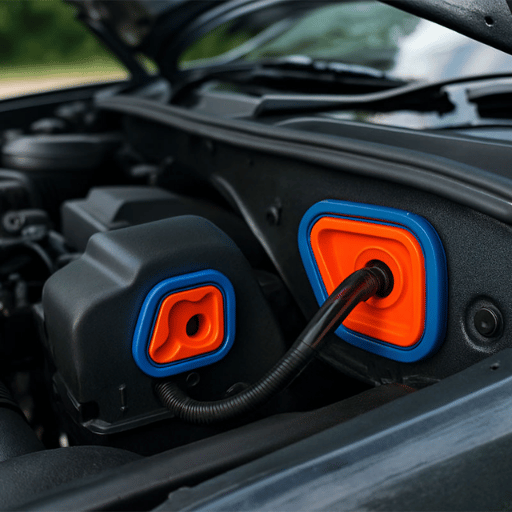
The automotive sector is the second largest consumer of liquid silicone rubber and the fastest growing one. According to Global Market Insights, the global LSR market was valued at USD 3.8 billion in 2024 and is expected to grow at a CAGR of over 6.5% through 2034, with automotive lightweighting and EV electrification specifically cited as the primary demand drivers.
USD 3.8 B
LSR market, 2024
>6.5 %
CAGR, 2025–2034
−40 to +150 °C
EV battery-pack service envelope
Typical automotive LSR parts include connector seals, wire-loom seals, spark-plug boots, turbocharger and coolant-line gaskets, ADAS sensor housings, headlight bellows, and – most visibly in EVs – battery-pack seals, cable glands, and cell-module gaskets. LSR displaces EPDM or FKM in these locations for one reason: extreme temperatures (heat spikes above +150 °C and cold-soak service at low temperature down to −40 °C), vibration, and chemical resistance against coolants and thermal-management fluids, all in the same part.
Why are automotive OEMs moving from HCR to LSR?
High-consistency silicone rubber (HCR) can equal LSR on temperature and chemical resistance, but it can’t equal LSR on part-to-part consistency at automotive production volumes. LSR is injected under tight process control – shot-size, temperature, and cycle time are all closed-loop. HCR is compression-molded or extruded, and its tolerance band is wider. For safety-critical seals in battery packs where IP67 water ingress is non-negotiable, the LSR tolerance advantage is more important than raw material cost. That trade-off reverses at roughly 20,000 parts per year, where HCR tooling amortizes better – a threshold that appears again later in the decision framework.
“For EV battery-pack sealing and cable-gland applications, LSR is specified when the part must hold a gas-tight seal across the full battery thermal-cycling envelope of −40 °C to +85 °C continuous, with IP67 ingress protection, for the vehicle’s 10-to-15-year service life. That combination of service envelope and tolerance is what LSR does better than any other elastomer.”
— Synthesized from Parker Hannifin’s LSR/LIM and HCR Silicone for EV Electrification brochure
Electrical and Electronics Applications
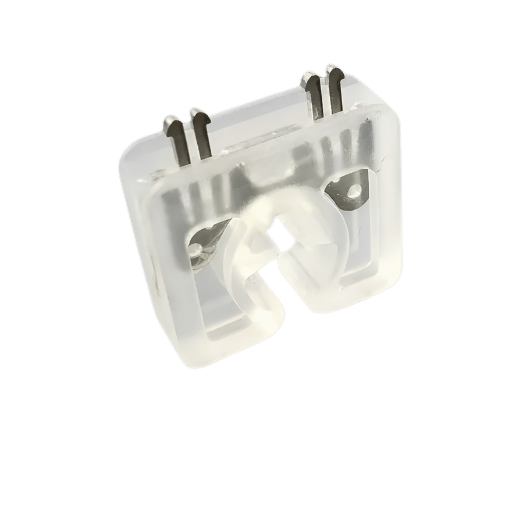
Electrical applications exploit LSR’s dielectric properties and its ability to be over-molded onto substrates without damaging delicate electronic assemblies. Typical parts include LED and lidar lens encapsulation, waterproof cable seals, smartphone keypads and buttons, hearing-aid tips, IoT-sensor potting compounds, and wearable-electronics housings where skin contact meets sealing.
Dielectric strength, tested per ASTM D149, is the primary electrical specification. Typical medical- and industrial-grade LSR measures 20–25 kV/mm, with volume resistivity above 10¹⁴ Ω·cm and dissipation factor below 0.001 at 1 MHz. Those numbers are closer to rigid thermosets than to most filled elastomers — which is why LSR becomes the material of choice when a part must flex, cycle, and insulate simultaneously.
LED and lidar encapsulation specifically benefits from LSR’s optical clarity. Unlike most elastomers, LSR is naturally translucent, and optical-grade formulations retain high transmission in the visible and near-infrared bands. Combined with excellent UV stability, that makes LSR a default for automotive headlight primary optics, horticulture-LED encapsulation, and the emerging lidar lens market in autonomous vehicles.
💡 Pro Tip
If a part must insulate and flex across a wide temperature band, start your material shortlist with LSR rather than with a filled thermoplastic. LSR holds its dielectric number across the full operating range; most filled thermoplastics lose insulation strength above 100 °C.
Consumer, Baby Products, and Food-Contact Applications
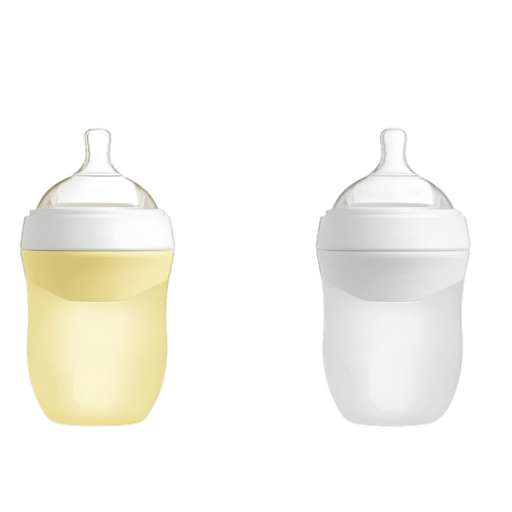
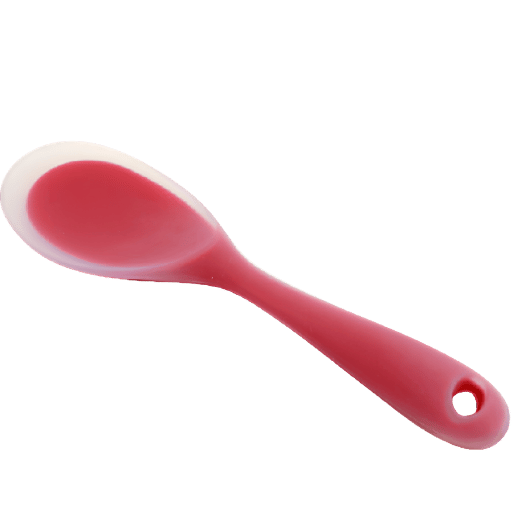
Consumer applications for liquid silicone rubber span kitchenware (spatulas, baking mats, ice trays, reusable food covers), baby products (bottle nipples, pacifiers, teethers), personal-care items (menstrual cups, electric-toothbrush seals, shaver and hearing-aid ear tips), pet products, and fitness-wearable bands. Common thread across every one of these products: either the part contacts food or it contacts skin, and often both.
Food-contact LSR in the United States is governed by FDA 21 CFR 177.2600, which defines the permitted composition of rubber articles intended for repeated food contact. In Europe, the equivalent framework is the LFGB / BfR XV recommendation. For childcare articles specifically, EU standard EN 14350 covers drinking equipment and imposes migration limits on volatile extractives. A reputable medical- or consumer-grade LSR supplier will certify against these standards by default; “food-grade silicone” without a specific standard citation is a red flag in a bill of materials.
⚠️ Misconception to retire
A persistent internet claim holds that silicone rubbers leach at oven temperatures. LSR is thermally stable to +200 °C continuous and +250 °C for short excursions; typical oven applications at 180–220 °C are well inside the envelope, provided the specific grade is rated for food contact. This myth confuses LSR with low-grade silicone compounds that include untested plasticizers.
Industrial Seals, Gaskets, and O-Rings
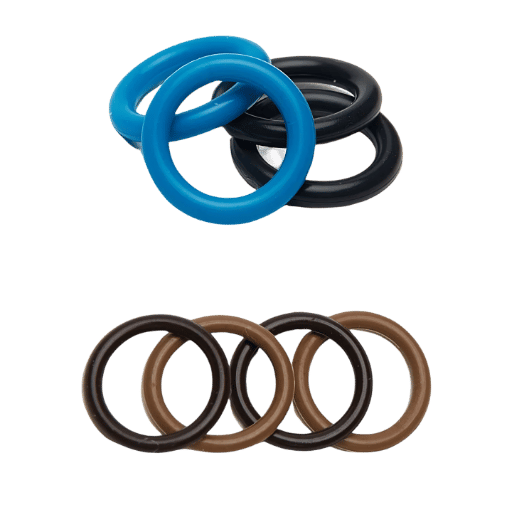
Industrial sealing is where liquid silicone rubber competes head-to-head with FKM (fluorocarbon) and EPDM. These three dominate different parts of the elastomer seal design space, and for a part that must span a wide thermal range with low compression set, LSR frequently wins.
Typical industrial LSR seal applications include food-processing gaskets that must survive CIP/SIP cleaning cycles, semiconductor wafer-handling vacuum seals, aerospace fuel-line O-rings in cold-soak conditions, smoke-detector and gas-detector diaphragms, and steam-table service seals. Compression set — the seal’s tendency to take a permanent set under long-term stress — is measured per ASTM D395-18, with Method B (constant deflection) the standard protocol for LSR seals. Broader elastomer classification for industrial seals falls under ASTM D2000.
How do LSR O-rings compare with FKM or EPDM at extreme temperatures?
| Property | LSR (platinum-cured) | FKM (Viton-type) | EPDM |
|---|---|---|---|
| Continuous temp range (°C) | −55 to +200 | −20 to +205 | −50 to +150 |
| Compression set, 22 h / 150 °C (%) | 10 – 25 | 15 – 30 | 20 – 40 |
| Tear strength (kN/m) | 20 – 40 (filled 2C grade) | 25 – 55 | 30 – 55 |
| Fuel / hydrocarbon resistance | Poor | Excellent | Poor |
| Cost index (EPDM = 1.0) | 3 – 5 | 8 – 15 | 1.0 |
Read the table as a decision tool, not as a ranking. LSR dominates the wide-temperature low-compression-set niche. FKM wins when the seal contacts fuels or aggressive hydrocarbons. EPDM wins on price when the service envelope is modest and ozone resistance is the main concern.
📐 Engineering Note — Tear Strength Reality CheckOne-component (1C) LSR grades exhibit tear strength near the low end of the 20 kN/m range. Two-component (2C) lsrs with fumed-silica reinforcement reach the upper end of 40 kN/m, still below natural rubber’s 50–100 kN/m. For thin-section LSR parts under cyclic load, specify a 2C-filled grade and reinforce stress-concentrator corners with a minimum 0.5 mm radius. A real shop-floor tip: cured LSR scrap is notoriously hard to machine because the material deflects under the tool — production machinists freeze the chunk in dry ice and bandsaw it into fixture-able pieces.
The Industry × Property Matrix — How Four Properties Drive Every LSR Application
The section above each industry was self – contained. That is how most LSR material write-ups organize themselves, and it obscures a pattern: those same four material properties turn LSR into a versatile material and decide its adoption in every sector, just in different weightings. What follows makes the weighting visible:
| Property → / Industry ↓ | Biocompatibility | Thermal stability | Electrical insulation | Chemical inertness |
|---|---|---|---|---|
| Medical / healthcare | Critical (ISO 10993) | Important (autoclave 134 °C) | Nice-to-have | Critical (EtO/gamma) |
| Automotive / EV | N/A | Critical (−40 to +150 °C) | Important (HV isolation) | Important (coolants, fluids) |
| Electrical / electronics | Nice (wearables) | Important | Critical (ASTM D149) | Nice-to-have |
| Consumer / baby / food | Critical (21 CFR 177.2600) | Important (oven / dishwasher) | N/A | Important (cleaning agents) |
| Industrial seals / gaskets | N/A | Critical (CIP/SIP) | Nice-to-have | Critical (process fluids) |
Read down a column to see where a single property lands a “Critical” rating. Read across a row to see the property mix that a given industry actually pays for. In short, this is the fastest way to answer the question “why LSR here?” without writing a separate explanation per industry.
A practical use for the matrix: when evaluating whether a new application fits LSR, place it in the row with the closest service profile, and check whether at least two of the four property columns are rated “Critical.” That is the same intuition that underpins the 4-Condition Decision Rule in the next section.
How to Decide If LSR Is the Right Material for Your Application
For any part, LSR’s nearest competitors are high-consistency rubber (HCR), thermoplastic elastomer (TPE), or room-temperature-vulcanizing silicone (RTV). Each wins in at least one combination of volume, tolerance, and property set. This next matrix compresses a lot of sourcing experience into a quick triage.
| Criterion | LSR (LIM) | HCR (compression) | TPE (injection) | RTV silicone |
|---|---|---|---|---|
| Min. volume for cost efficiency | ~20 – 50 k parts / yr | 1 – 20 k parts / yr | 10 k+ parts / yr | 1 – 500 (prototypes) |
| Dimensional tolerance | ±0.02 – 0.05 mm | ±0.10 – 0.30 mm | ±0.05 – 0.10 mm | ±0.5 mm+ |
| Service temperature ceiling | +200 / +250 °C | +200 / +300 °C | +80 / +130 °C | +150 / +200 °C |
| Biocompatibility | ISO 10993, USP Class VI | ISO 10993, USP Class VI | Grade-dependent | Grade-dependent |
| Tooling cost (complex part) | High (hardened steel, cold runner) | Low-to-moderate | Moderate | Very low (RTV or 3D-printed mold) |
The 4-Condition LSR Decision Rule
Pick LSR when at least three of these four conditions apply to your part:
- Biocompatibility or food-contact compliance is required (ISO 10993, USP Class VI, 21 CFR 177.2600, or EN 14350).
- Continuous service temperature exceeds +150 °C or drops below −40 °C.
- Annual production volume exceeds roughly 20–50 thousand parts, so LIM tooling amortizes.
- Dimensional tolerance needs to stay within ±0.05 mm, or the part has thin walls or microfeatures that need repeatable fill.
Fewer than three? HCR, TPE, or RTV usually delivers the same function for less tooling capital and less material cost.
Blunt note: the volume thresholds listed above are compiled from different industry information — public supplier guidance, published comparison tables, and process experience. Your specific breakeven point depends on part geometry, secondary finishing steps, and supplier relationships. Ask for competitive process quotes from both LSR and HCR molders for your particular part rather than treating any single number as the whole answer.
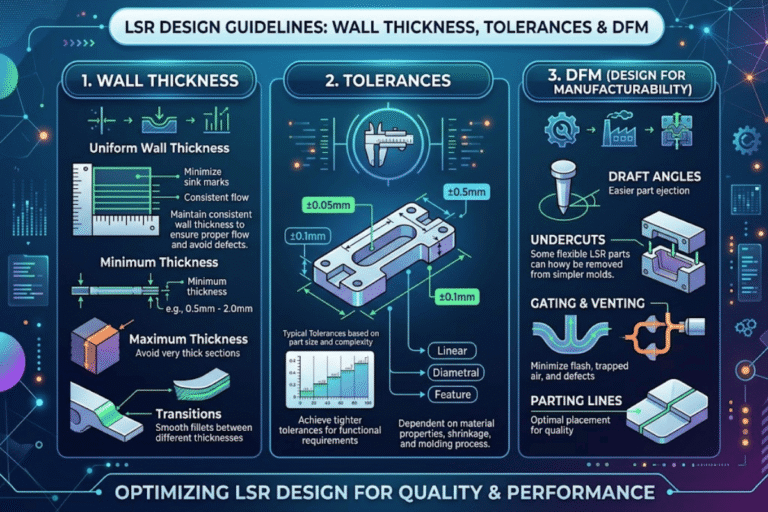
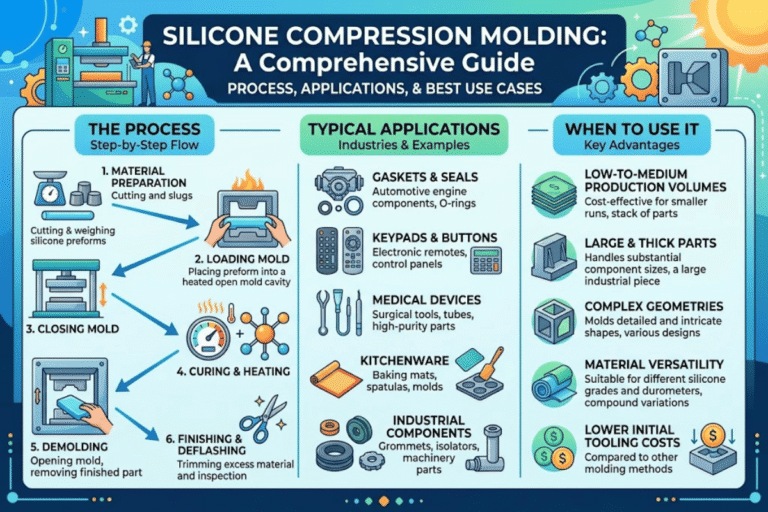
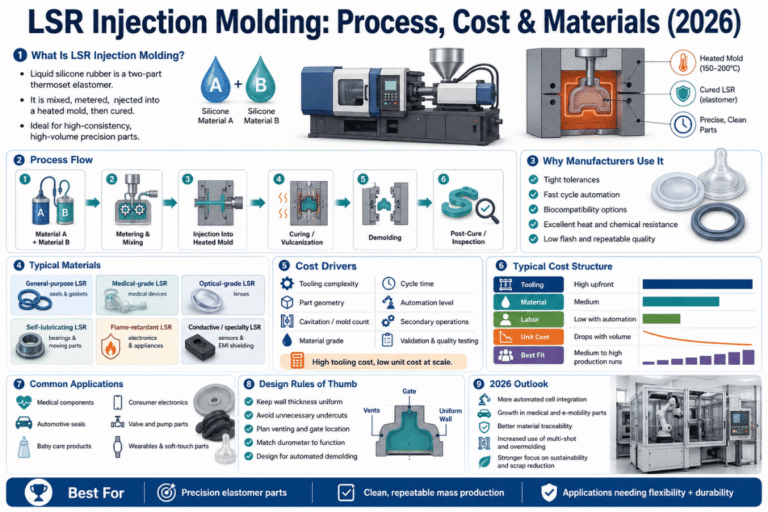
Once LSR is the right resin choice for your part, the molding process itself drives design decisions on cold-runner vs hot-runner layout, gate placement, venting, and cure profile. For tooling, tolerances, and cycle-time details, see our LSR injection molding guide that covers the production side of the story.
Frequently Asked Questions
Q: What is liquid silicone rubber used for?
View Answer
Liquid silicone rubber is used in medical implants, catheters, respiratory masks, automotive connector and EV battery seals, LED and lidar encapsulation, smartphone keypads, baby-bottle nipples, menstrual cups, and industrial seals that face extreme temperatures or aggressive process fluids. It is selected wherever biocompatibility, thermal stability, dielectric strength, or chemical inertness outranks raw material cost.
Q: What are the disadvantages of LSR?
View Answer
The drawback is tear strength – one component LSR runs about 20 kN/m, far below rubber’s 50 – 100 kN/m; two component filled LSR runs about 40 kN/m but still cannot compete with rubbers. Additional issues include poor hydrocarbon and fuel resistance (FKM), very high tooling costs that only amortize to volume levels above 20-50 K annually, and longer cure cycles than thermoplastics. These certainly are not game changers, but they do mean LSR is not the default material – just the specific choice for a particular property envelope.
Q: What will liquid silicone not stick to?
View Answer
cured liquid silicone rubber does not naturally stick to most thermoplastics (polyethylene, polypropylene, PTFE), stainless steels, or glass without a primer. When over-mold to plastics, some self-adherent LSR grades or a chemical primer layer are required. This non-stick behavior is also why LSR is used for release surfaces such as baking mats and pharmaceutical-tablet tooling liners.
Q: Is LSR safe for baby products and direct food contact?
View Answer
Yes, when the specific grade is certified. Repeated-contact food parts in the U.S. must meet FDA 21 CFR 177.2600; childcare articles in the EU must meet EN 14350 and the LFGB / BfR XV recommendation. Require the supplier to certify against the specific standard for your market. “Food-grade silicone” without a standard number is not a meaningful specification.
Q: What is the typical liquid silicone rubber manufacturing process?
View Answer
LSR is produced by liquid injection molding (LIM). Compound A and Compound B meter at 1:1 ratio through a cold runner into a heated mold cavity at roughly 180–220 °C. The platinum catalyst cross-links the siloxane chains in seconds to minutes depending on part thickness, and the finished parts demold automatically. Secondary operations such as post-cure or printing follow in-line.
Q: Does silicone rubber absorb water?
View Answer
LSR is very low in water intake, generally less than 1 % by weight after twenty-four hours immersion. This accounts for its excellent behavior in humid service and when subjected to many autoclave steam courses.
About This Analysis
This guide consolidates liquid silicone rubber application data from FDA ISO 10993-1 guidance, ASTM D149 and ASTM D395 test standards, Global Market Insights’ 2024 LSR market report, the Parker Hannifin EV LSR specification brochure, Saint-Gobain Medical’s HCR-versus-LSR comparison, and peer-reviewed LSR injection molding literature. Specific numerical claims have been cross-checked against multiple sources; where supplier datasheets disagree on service temperature ranges, the conservative continuous range is reported with the high-temp grade noted separately. Reviewed for technical accuracy by the meitu-engelhardt.com LSR engineering team.
References & Sources
- Use of International Standard ISO 10993-1, Biological Evaluation of Medical Devices (Guidance PDF) — U.S. Food and Drug Administration
- Biocompatibility Testing for Implants: A Novel Tool for Selection and Evaluation — National Library of Medicine (PMC)
- ASTM D395-18: Standard Test Methods for Rubber Property — Compression Set — American National Standards Institute
- Liquid Silicone Rubber Market Size & Share, Growth Trends 2034 — Global Market Insights
- Liquid Silicone Rubber Market Size Report, 2030 — Grand View Research
- A Review of Liquid Silicone Rubber Injection Molding: Process, Material Modeling, and Simulation — Society of Plastics Engineers (Wiley)
- Silicone Rubber — Wikipedia (general chemistry reference)
Related Articles
- LSR injection molding process guide — tooling, cycle times, and design rules for liquid injection molding
![Silicone Overmolding: Multi-Material LSR Design Guide [2026]](https://meitu-engelhardt.com/wp-content/uploads/2026/04/0-8-768x512.png)