Get in Touch with Engelhardt

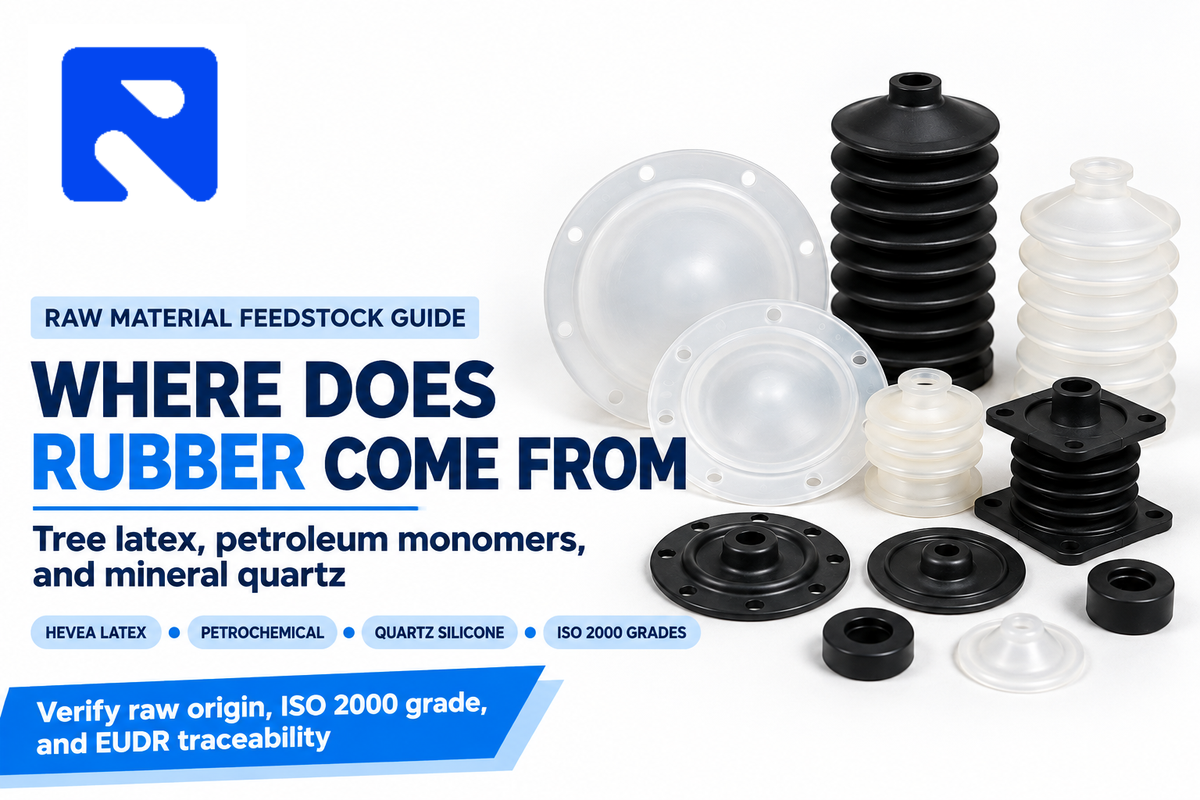
Where Does Rubber Come From? How Natural Rubber Latex Is Harvested From Rubber Trees vs. Synthetic Rubber Origins

Updated November 2026 | Raw Material Feedstocks, ISO 2000 Grading & Supply-Chain Traceability Guide
‘Where does rubber come from’ refers to three raw material streams in modern manufacturing. Commercial elastomers start as milky latex sap in tropical trees, petroleum hydrocarbon monomers, or mineral quartz sand. Natural rubber comes from Hevea brasiliensis bark vessels, while synthetic rubber comes from cracked crude oil and natural gas. For details on the downstream factory mixing, molding, and curing processes, please see our guide on how raw rubber is compounded, mixed, and vulcanized in factory production.
Global elastomer supply splits between agriculture and forestry, and industrial chemical synthesis. According to the Association of Natural Rubber Producing Countries (ANRPC), worldwide natural rubber production reached 14.9 million metric tons in 2025. Meanwhile, 2025 Reuters commodity data shows the global total at 15.6 million metric tons. Petrochemical and mineral-based elastomers fill the remaining industrial demands for automotive, medical, and sealing applications.
Where Does Rubber Come From? Natural Rubber, Synthetic Rubber, and Silicone Feedstocks
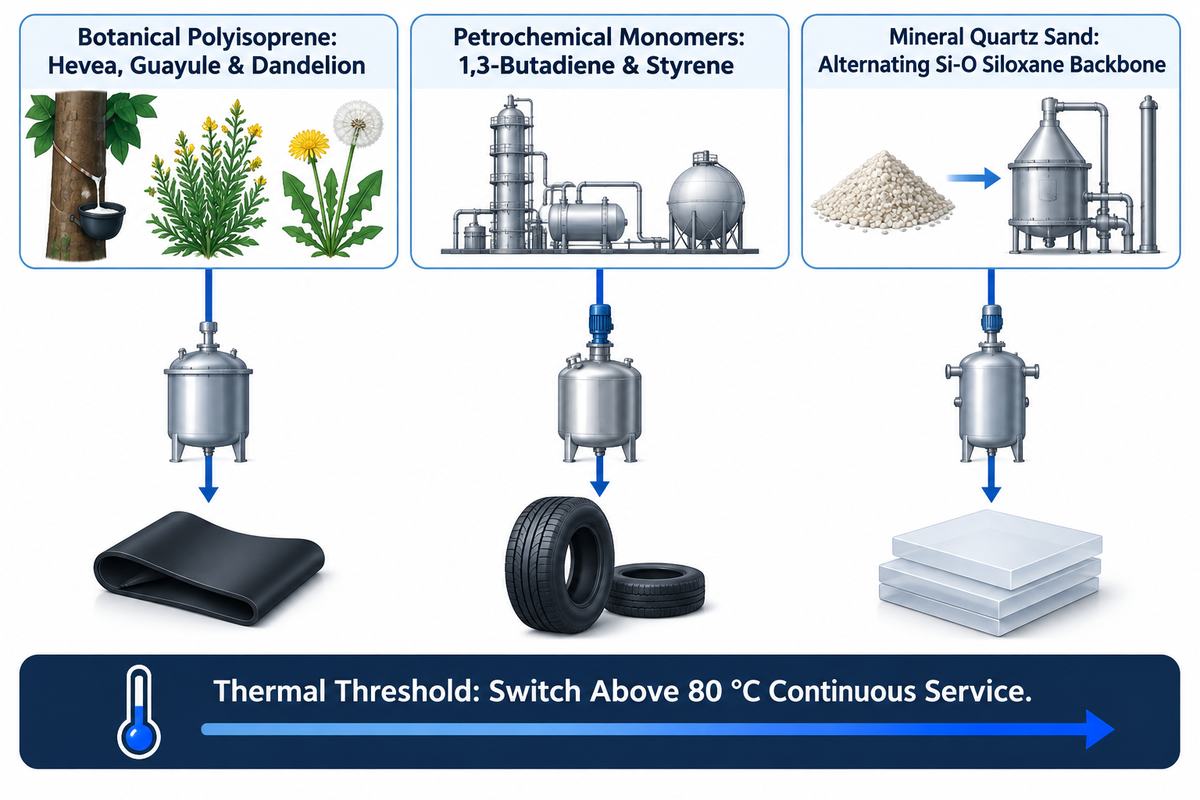
Industrial rubber is derived from three molecular feedstocks: biological plant polyisoprene, petrochemical carbon monomers, and inorganic silica. Over 2,500 plant species produce natural rubber, while petrochemical plants crack naphtha into butadiene and styrene. Switch from natural tree rubber to synthetic or silicone elastomers when continuous temperatures exceed 80 °C.
Where did rubber originate?
Natural rubber began with the Amazon region and Mesoamerica, where ancient peoples harvested latex from Hevea brasiliensis and Castilla elastica trees in the South American rain forest. Christopher Columbus and later European explorers noted bouncing rubber balls in Brazil and Ecuador. In 1770, English chemist Joseph Priestley noticed the dried gum rubbed out pencil marks and named the substance an eraser or rubber.
South America monopolized raw tree sap until 1876, when Englishman Henry Wickham collected 70,000 seeds from Brazil and shipped them to Kew Gardens in London. Germinated seedlings were sent to Sri Lanka, Singapore, and Malaysia, establishing the modern plantation belt across Southeast Asia.
What is the difference between how natural tree rubber, petroleum synthetic rubber, and quartz-derived silicone rubber originate?
Natural tree rubber, petroleum synthetic rubber, and quartz-derived silicone rubber originate from three different raw materials and polymerization pathways. Natural rubber is made inside living tree bark cells through enzymatic assembly of isoprene units into cis-1,4-polyisoprene. Synthetic rubber is made by linking polymer molecules in chemical reactors from petroleum by-products such as 1,3-butadiene, styrene, and acrylonitrile.
Silicone rubber replaces the carbon chain with an alternating silicon-oxygen siloxane backbone. The 3-Stream Elastomer Origin Matrix below classifies the nine primary raw elastomer types based on their upstream sources, monomer synthesis methods, and service temperature ranges.
| Material Category & Elastomer Type | Primary Raw Feedstock Origin | Synthesis Method & Monomer | Backbone & Key Metric | Service Temperature Range |
|---|---|---|---|---|
| Natural Hevea Rubber (NR) | Hevea brasiliensis tree bark sap | Enzymatic biosynthesis of isopentenyl diphosphate | cis-1,4-polyisoprene (1,310 kg/mol) | -50 °C to +80 °C |
| Guayule Natural Rubber | Parthenium argentatum desert shrub bark | Cortical parenchyma synthesis & homogenizing | cis-1,4-polyisoprene (1,280 kg/mol) | -50 °C to +80 °C |
| Dandelion Root Rubber (TKS) | Taraxacum kok-saghyz root vessels | Root laticifer biosynthesis & wet milling | cis-1,4-polyisoprene (2,180 kg/mol) | -50 °C to +80 °C |
| Gutta-Percha Bio-Isomer | Palaquium gutta tropical tree latex | Botanical trans-isomer polymerization | trans-1,4-polyisoprene crystalline | -20 °C to +60 °C |
| Styrene-Butadiene (SBR) | Crude oil naphtha & natural gas liquids | Emulsion or solution copolymerization (C4 + C8) | Carbon C-C chain (346 kJ/mol) | -40 °C to +100 °C |
| Nitrile Butadiene (NBR) | Petroleum naphtha steam-cracked fractions | Copolymerization of butadiene & acrylonitrile | Polar C-C chain with nitrile groups | -35 °C to +120 °C |
| EPDM Elastomer | Natural gas ethane/propane & naphtha | Ziegler-Natta terpolymerization (ethylene/propylene/diene) | Saturated C-C main backbone | -50 °C to +150 °C |
| High-Consistency Silicone (VMQ) | Mineral quartz sand (SiO2) & methanol | 2,000 °C reduction & Müller–Rochow direct synthesis | Inorganic Si-O chain (452 kJ/mol) | -55 °C to +230 °C |
| Liquid Silicone Rubber (LSR) | Refined quartz silicon & methylchlorosilane | Siloxane ring-opening & platinum addition cure | Vinyl-functional Si-O-Si network | -55 °C to +230 °C |
Botanical Origins: Harvesting Latex Sap From the Hevea Brasiliensis Rubber Tree
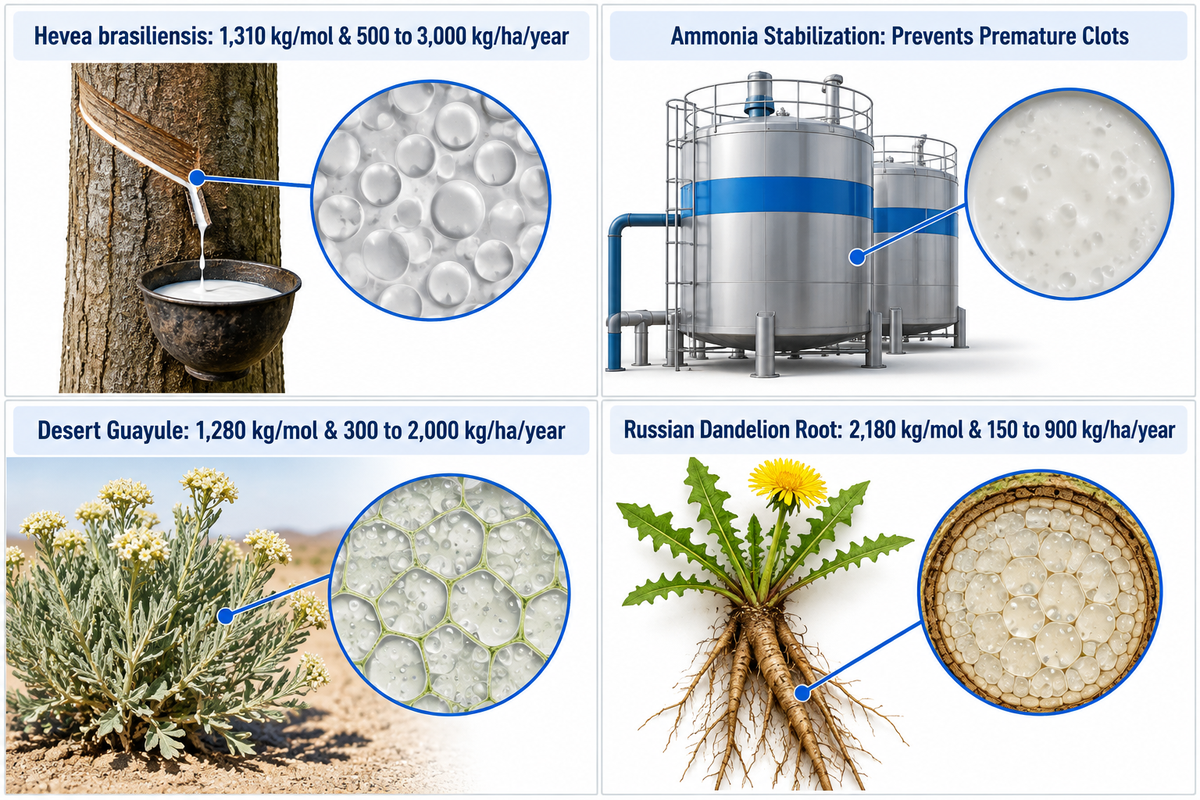
Commercial natural rubber contains almost all of its Para rubber tree (Hevea brasiliensis). Specialized bark laticifer vessels synthesize cis-1,4-polyisoprene at 1,310 kg/mol molecular weight within a 30-year plantation lifespan. Use guayule or synthetic polyisoprene for medical devices that need zero Hevea proteins.
Does rubber come from trees or synthetic chemicals?
Some engineering tasks can be fulfilled with natural rubber but some can only be done with synthetic. Natural Hevea rubber has chains that are almost 100% cis-1,4 stereoregular. Other components accompany the chains, such as proteins and phospholipids. Chains in natural rubber can be aligned into crystalline zones and, thus, can block the propagation of cracks.
On r/chemistry a user reports that about 80% of world natural rubber produced goes into tires, mixed with petroleum rubbers.
Heavy aircraft and truck tires need tree-derived hevea rubber because synthetic polyisoprene lacks equal green tack and tear strength.
Rubber tapping requires careful knife depth control to protect the tree’s vascular cambium. Rubber farmers begin work before dawn when internal turgor pressure peaks and cool air delays latex clotting. Using a hooked knife, the tapper shaves a thin bark ribbon along a 30° downward spiral without piercing the cambium. Milky latex sap drips into a collection cup, while wild trees reach 120 feet versus 80 feet on plantations with 0.5-micron latex particles.
Failure Mode Warning: Cutting into the cambium triggers permanent bark callusing and Tapping Panel Dryness (TPD), which stops latex flow on the damaged panel. In addition, microbial contamination in unpreserved field sap, in some cases, ferments sugar to volatile fatty acids in just a few hours. Farmers must add ammonia immediately to prevent the sap from solidifying into premature clots.
Which plants produce latex?
Over 2,500 plant species produce natural rubber, yet only three botanical sources synthesize high-molecular-weight polymer suitable for industrial rubber products. In transcriptome studies comparing Hevea and guayule, Hevea brasiliensis stores latex in connected bark laticifer tubes that bleed from a single cut, yielding 500 to 3,000 kg/ha/year at 1,310 kg/mol.
By contrast, desert guayule (Parthenium argentatum) traps rubber inside isolated bark parenchyma cells at 1,280 kg/mol and 300 to 2,000 kg/ha/year. Recovering guayule requires grinding the shrub via US Patent US8815965B2 homogenizing processes or WO2017103769A1 solvent extraction. Russian dandelion (Taraxacum kok-saghyz) stores rubber in bred roots at 2,180 kg/mol and 150 to 900 kg/ha/year. Note one scope limit: the 1,280 kg/mol guayule and 2,180 kg/mol dandelion figures come from plant biotechnology trials (PMC6790360), while bulk sourcing still relies on Hevea plantations.
| Botanical Species | Storage Tissue & Harvest Method | Dry Rubber Content (% w/w) | Molecular Weight (Mw) | Annual Yield & Allergen Profile |
|---|---|---|---|---|
| Hevea brasiliensis (Para Tree) | Bark laticifers; knife ‘tapping’ harvest | 30% field sap to 60% concentrate (Walker) | 1,310 kg/mol | 500–3,000 kg/ha/y; contains Hev b allergens |
| Parthenium argentatum (Guayule) | Bark parenchymal cells; shrub homogenizing | Cortical bark parenchyma (PMC6790360) | 1,280 kg/mol | 300–2,000 kg/ha/y; zero Hevea allergens |
| Taraxacum kok-saghyz (Dandelion) | Root laticifers; annual root harvest & milling | Bred root laticifer tissue (PMC6790360) | 2,180 kg/mol | 150–900 kg/ha/y; temperate climate crop |
| Ficus elastica & Helianthus | Stem or leaf latex; non-commercial extraction | Low-yield botanical trace latex | 1–279 kg/mol (PMC6790360) | Not applicable; chain too short for structural tyres |
Global Rubber Geography: Where Natural Rubber Is Grown and Why Supply Shifts
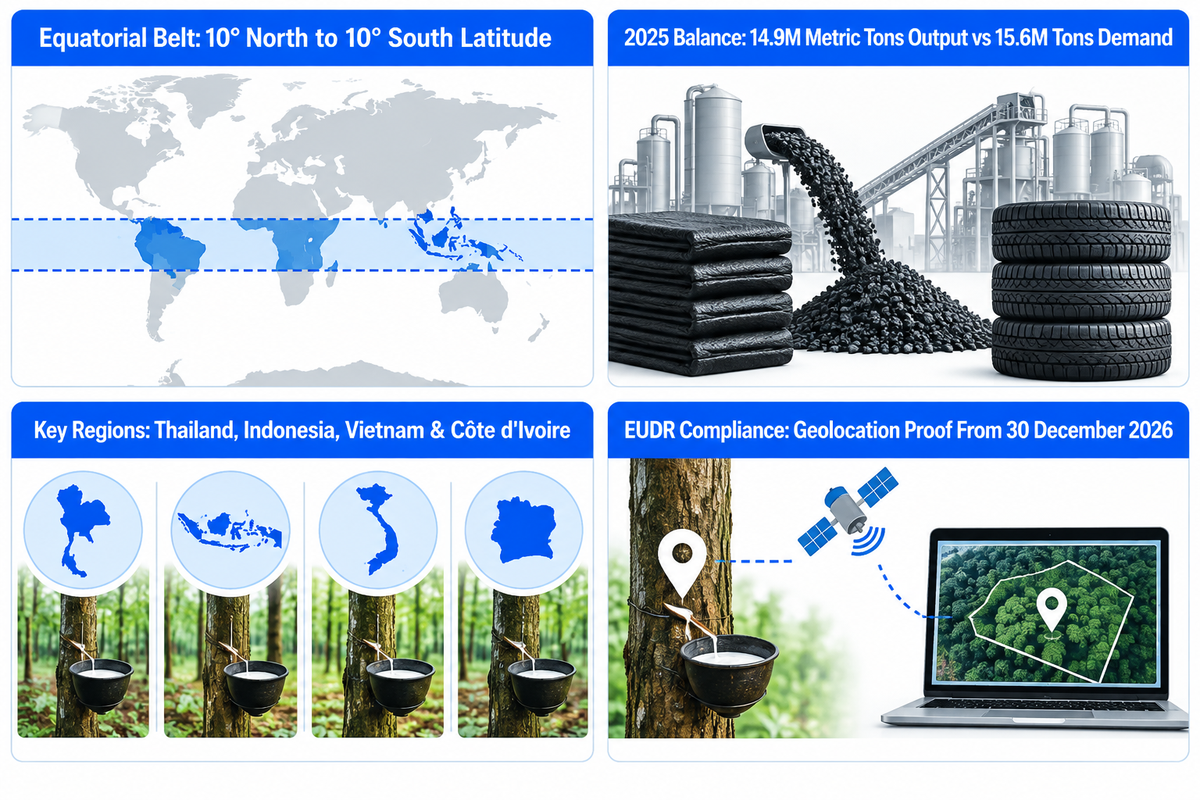
Southeast Asia leads world natural rubber output through Thailand, Indonesia, and Vietnam, while West Africa’s Côte d’Ivoire has climbed to third place globally. Although Hevea trees are native to Brazil, commercial plantations cannot operate in South America because endemic leaf blight destroys dense monocultures. Dual-source raw bales across regions for 2026 supply security.
The EU Deforestation Regulation (EUDR) states that from December 30, 2026, products placed on, sold within, or exported from the EU must be deforestation-free.
Where are rubber trees found in the world today?
Commercial rubber trees grow within the equatorial belt between 10° North and 10° South latitude where tropical rainfall and warm temperatures prevail year-round. According to ANRPC figures reported by Reuters, Thailand remains the largest producer with a 1.2% output gain in 2025, while Vietnam holds third place in Asia at 1.28 million tons.
Conversely, Indonesia’s natural rubber production fell 9.8% in 2025 to 2.04 million tons as smallholders switched to oil palm and fought fungal leaf disease. Meanwhile, Côte d’Ivoire expanded output in West Africa, reshaping global rubber industry trade routes.
Will we run out of natural rubber?
Global manufacturing will not run out of natural rubber entirely, but world consumption is outpacing plantation harvesting. According to Reuters and ANRPC 2025 data, global production rose 0.3% to 14.9 million metric tons in 2025 while demand grew 1.8% to 15.6 million tons, leaving an annual supply shortfall.
Three factors could affect supply availability in 2026. First, smallholder trees across Southeast Asia are aging. Second, the EU Deforestation Regulation (EUDR) will come into effect from 30 December 2026. Third, tire manufacturers are funding research and development into alternative sources like guayule and dandelion. Now, European importers of rubber products require geolocation records proving that raw latex was harvested from trees on deforestation-free land.
Petrochemical and Mineral Origins: How Synthetic Rubber and Silicone Rubber Are Made
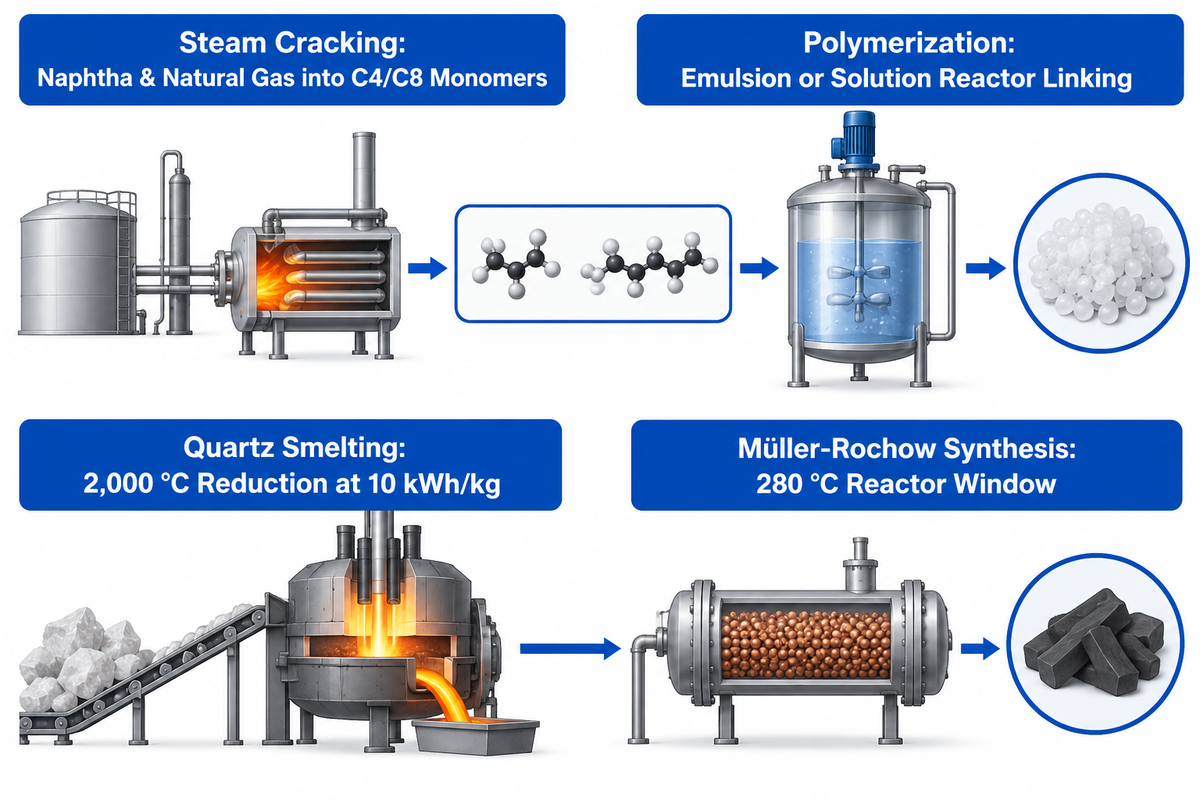
Synthetic carbon-chain rubbers come from steam-cracking petroleum naphtha and natural gas liquids into C4 and C8 hydrocarbon monomers. On the other hand, silicone elastomers come from smelting mineral quartz sand at 2,000 °C into elemental silicon and reacting it at 280 °C. Always specify quartz-derived silicone when seals face extreme temperatures or outdoor ozone.
Where does synthetic rubber come from in petroleum refining?
Synthetic rubber is made comes from light hydrocarbon fractions separated during crude oil refining and natural gas processing. Refineries crack liquid naphtha or ethane-propane streams into unsaturated monomers, 1,3-butadiene, styrene, acrylonitrile, isobutylene, ethylene and propylene. Chemical plants then turn these gases into artificial rubber by linking polymer molecules together through emulsion or solution polymerization.
Chemical Engineering describes a 3,500 metric ton/year NBR latex plant that copolymerizes butadiene and acrylonitrile to produce 230 million exam gloves per year. For high-wear mechanical goods, see our guide on styrene-butadiene rubber (SBR) mechanical properties and custom parts.
Where does silicone rubber come from compared to carbon-chain rubbers?
Silicone rubber originates from inorganic quartz sand (SiO2) and methanol-derived methyl chloride rather than crude oil. Silicon accounts for 26.9% by mass of the Earth’s crust. As documented in an AppliedChem review of the Müller–Rochow direct synthesis, carbothermic reduction of quartz at 2,000 °C consumes about 10 kWh per kilogram of metallurgical silicon.
Next, organosilicon monomers are synthesized over a copper catalyst at 280 °C in a fixed-bed reactor, as discussed in the DTU Orbit polymer research. Hydrolyzing dimethyldichlorosilane yields polydimethylsiloxane gum. The 280 °C reactor window and 10 kWh/kg smelting energy apply only to upstream monomer synthesis; final tear strength in molded silicone seals is governed by downstream platinum or peroxide curing. Engineers should read the engineering differences between quartz-derived silicone and carbon-chain rubber before finalizing part drawings.
Processing Rubber Into Raw Trade Grades: Field Latex, Ribbed Smoked Sheets, and TSR Bales
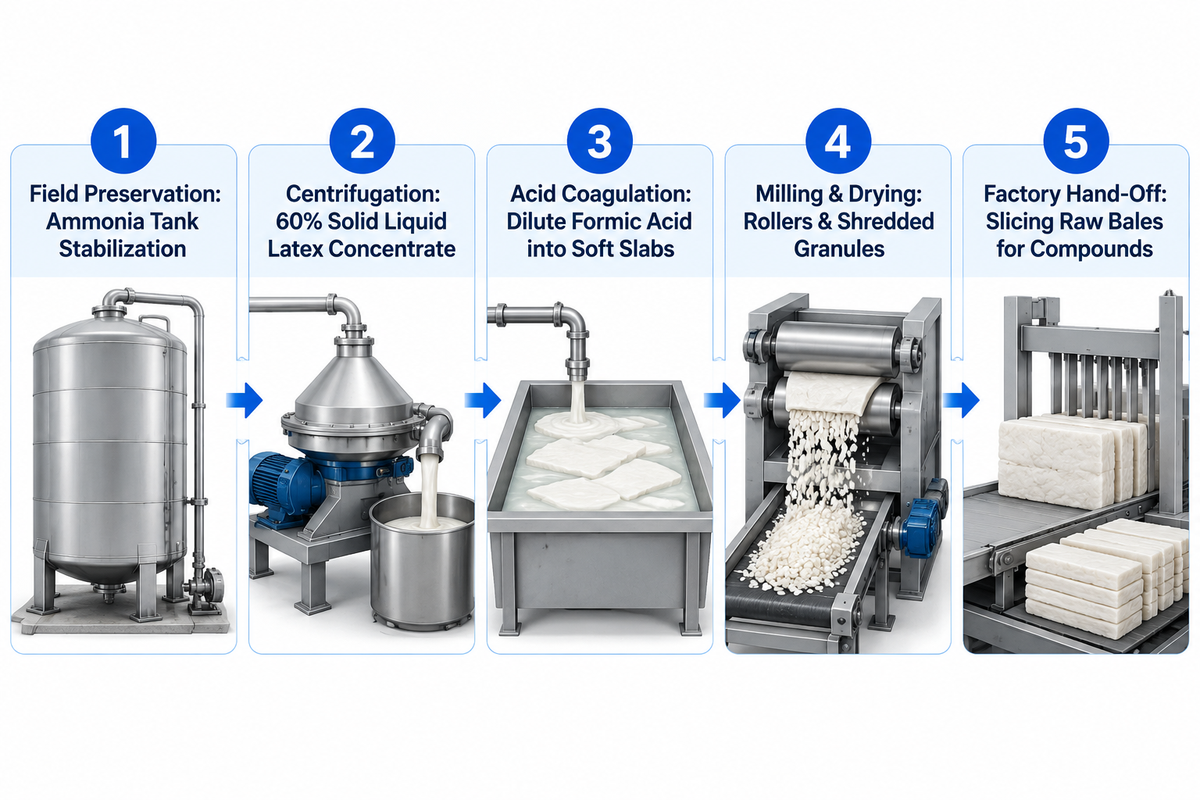
Upstream plantation factories convert raw tree latex into three commercial forms under ISO 2000:2014 specifications: 60% solid centrifuged liquid latex, Ribbed Smoked Sheets (RSS), and Technically Specified Rubber (TSR) bales. Order TSR 20 block bales for molded industrial parts, and reserve 60% liquid latex for thin dipped goods.
How does raw rubber move from plantation coagulation to factory vulcanisation?
Processing rubber from liquid tree exudate into shippable solid bales follows a five-step field stabilization and coagulation sequence. First, after rubber is extracted at the plantation, ammonia is mixed into collection tanks to prevent bacterial clotting. Second, for dipped catheter and glove lines, centrifugal force spins water out of the sap to concentrate the latex to 60% solid rubber.
Third, for solid rubber, dilute formic acid is added to the rubber latex to trigger controlled latex coagulation into soft slabs. Fourth, coagulated slabs are passed through rollers to remove serum water and shredded into granules. Washing ensures dirt and bark imperfections are removed from the rubber before hot-air drying into blocks.
Fifth, downstream factories slice those raw bales of rubber to make industrial compounds and make rubber parts. During downstream mixing, reinforcing fillers and curing chemicals are added to the rubber. Charles Goodyear accidentally discovered sulfur curing in 1839, and Thomas Hancock patented the process in Britain. When raw gum is heated with sulphur, the compound goes through a heat-treatment phase known as vulcanisation. This vulcanization reaction forms cross-links between the rubber molecules. Those sulfur bridges create extra bonds or cross-links that make the rubber strong and durable once shaped or moulded. Note one boundary condition: the 0.16% wt dirt cap and 40% PRI minimum in TSR 20 only govern raw bale purity, so molders still test cure rheometry on every mixed batch. See our dedicated factory guide for how raw rubber is compounded, mixed, and vulcanized in factory production.
| Specification Parameter | STR 20 / SMR 20 / SVR 20 | Indonesian SIR 20 | RSS 3 Smoked Sheet & 60% Latex | Standard & Reference Source |
|---|---|---|---|---|
| Max Dirt on 44u Aperture | 0.16% wt maximum | 0.20% wt maximum | Visual inspection (RSS 3); centrifuged liquid (Latex) | Oriental Rubber TSR 20 TDS |
| Max Ash Content | 0.80% wt (STR/SVR); 1.00% wt (SMR) | 1.00% wt maximum | 0.80% wt maximum reference | Oriental Rubber TSR 20 Table |
| Max Nitrogen Content | 0.60% wt maximum | 0.60% wt maximum | 0.60% wt (residual Hevea protein) | ISO 2000 / TSR 20 Spec |
| Max Volatile Matter | 0.80% wt maximum | 0.80% wt maximum | 0.80% wt (RSS 3); 60% solid in Latex | Walker Rubber / TSR 20 |
| Min Wallace Plasticity (P0) | 30 minimum | 30 minimum | 30 minimum reference | Oriental Rubber TSR 20 TDS |
| Min Plasticity Retention (PRI) | 40% minimum | 50% minimum | 40% to 50% oxidation resistance baseline | ISO 2000 TSR 20 Spec |
| Dry Rubber Content (DRC) | Solid block crumb polymer | Solid block crumb polymer | 60% solid rubber (Centrifuged Latex) | Walker Rubber / ISO 2000 |
| Commercial Delivery Format | Polyethylene-wrapped TSR bale | Polyethylene-wrapped SIR bale | Smoked sheets (RSS 3); steel drums (Latex) | SGX SICOM Contract Spec |
| Global Market Share & Price | 46% share; 242.20 US cents/kg | Included in 46% TSR block share | Ribbed Smoked Sheet & Latex segments | Persistence Market Research / Trading Economics |
How Raw Origin Determines Rubber Pricing, Traceability, and Material Selection
Physical benchmark futures for natural rubber on the Singapore Exchange (SGX SICOM) traded at 242.20 US cents per kilogram in 2026 as Asian plantation supplies tightened. Solid block TSR accounts for 46% of the $33.2 billion global natural rubber market. Always convert liquid latex quotes to a dry-weight basis before comparing supplier bids.
How much does natural rubber sell for?
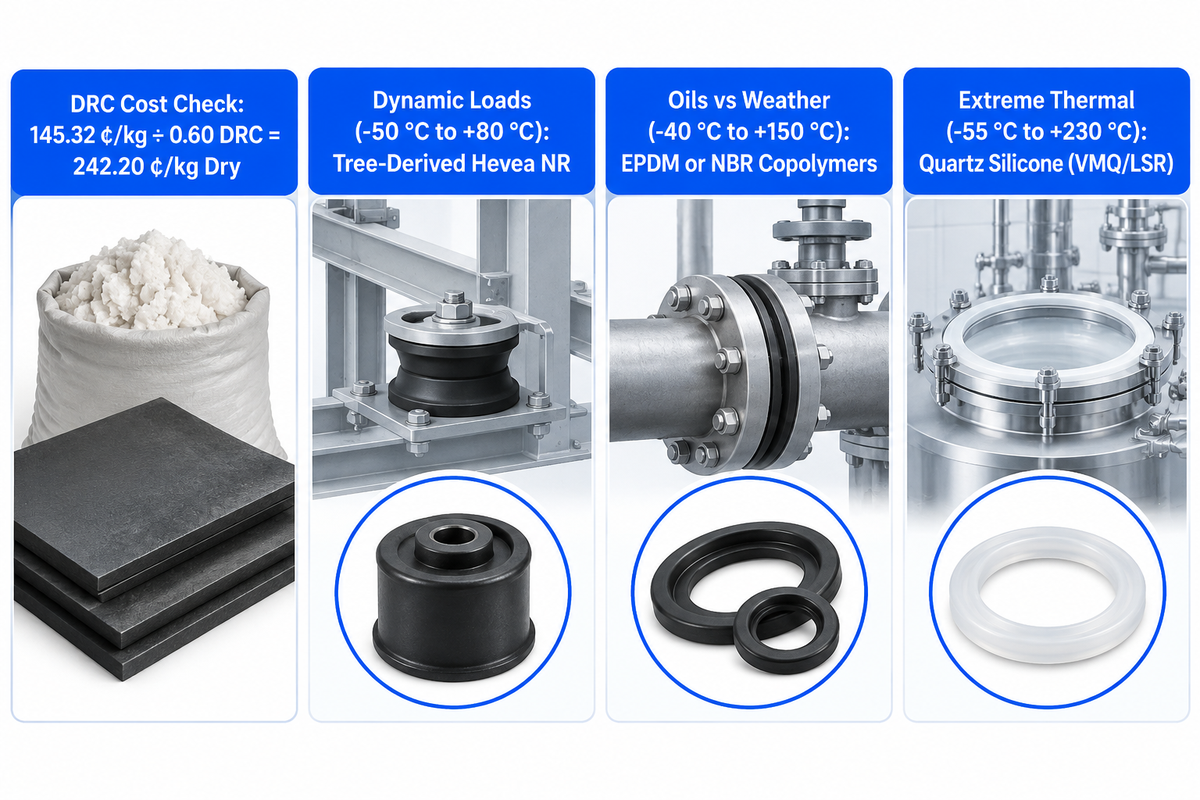
Natural rubber benchmark futures trade at 242.20 US cents per kilogram on 2026 commodity markets, while solid TSR 20 and SIR 20 block grades command 46% of the $33.2 billion global market. When comparing 60% solid centrifuged latex against solid TSR 20 bales, procurement teams apply The Dry-Rubber-Content (DRC) Landed Cost Check:
Effective Dry Polymer Price (US cents/kg) = Wet Latex Price (US cents/kg) ÷ Dry Rubber Content Fraction (DRC)
Worked Calculation Example: Take the 60% solid DRC concentration in the sample and the 242.20 US cents/kg benchmark. A wet latex drum at 145.32 US cents/kg divided by 0.60 DRC equals 242.20 US cents/kg of dry rubber. The effective dry polymer price (US cents/kg) equals the wet latex price (US cents/kg) divided by the dry rubber content fraction (DRC). Any wet quote above 145.32 US cents/kg carries a dry-polymer premium over solid bales. Keep in mind that this dry-weight calculation compares only upstream raw polymer prices and does not include sea freight of drums, winter freeze-protection transit, or factory mixing scrap.
Which countries and custom rubber manufacturers supply traceable industrial rubber and silicone parts today?
Bulk natural rubber bales come from Thailand, Indonesia, Cote d’Ivoire, Vietnam, and Malaysia, and custom molders in the US and China (as well as Germany and Japan) compound and mold traceable natural, synthetic, and silicone elastomers. Because natural and synthetic rubber are mainly polymers with very different chemical backbones, material selection follows the operating fluid and temperature:
- High-cycle dynamic loads (-50 °C to +80 °C): Choose tree-derived Hevea natural rubber (TSR 20 or RSS 3). Strain-induced crystallization reinforces the crack tip to make a durable material for heavy mounts and bushings.
- Hydrocarbon oils vs. outdoor weather (-40 °C to +150 °C): Choose petrochemical copolymers by comparing EPDM weather resistance against NBR oil resistance for automotive fuel hoses and weatherstripping.
- Extreme temperatures and medical/food purity (-55 °C to +230 °C): Choose quartz-derived silicone (VMQ or LSR), which acts as a versatile material for high-heat gaskets and biocompatible components.
At Guangdong Engelhardt Rubber & Plastic Technology Co., Ltd., our ISO 9001-certified Dongguan facility tracks every raw elastomer batch. We pair FDA, RoHS, REACH, and ISO 2000 lot certificates with compression molding, LSR injection molding, and extrusion. Review our guides on specifying custom silicone parts with batch validation checklists and custom molded rubber parts manufactured with full lot traceability. Always specify raw polymer origin, ASTM D2000 line callout, and cure rheometry on your purchase order.
Frequently Asked Questions About Where Rubber Comes From
Why is ammonia added to freshly tapped field sap before transport?
Alkaline ammonia solution is added immediately after tapping to raise field latex pH and stop bacteria from fermenting natural sugars into volatile fatty acids. Without ammonia preservation against microbial contamination, bacterial acid production clots the liquid sap inside collection tanks before it reaches the centrifuge or coagulation mill.
Why can South American estates not cultivate Para trees on an industrial scale?
Dense Hevea brasiliensis monocultures on South American estates are vulnerable to South American Leaf Blight (SALB) caused by the native fungus Microcyclus ulei. In the wild Amazon rain forest, natural rubber trees grow far apart, whereas tightly spaced plantation rows allow fungal spores to defoliate and kill entire estates.
How do STR 20 crumb bales compare against RSS 3 smoked sheets in dirt limits?
Under ISO 2000 TSR 20 technical specifications, STR 20 Technically Specified Rubber is graded by laboratory testing with a maximum 44u dirt limit of 0.16% wt and a minimum Plasticity Retention Index of 40%. By contrast, RSS 3 Ribbed Smoked Sheets are visually graded whole coagulated sheets cured in smoke houses.
Can desert guayule shrubs prevent Type I protein allergies in dipped medical gloves?
Yes, desert guayule (Parthenium argentatum) bark rubber contains zero Hevea allergenic proteins and reaches a molecular weight of 1,280 kg/mol. It provides a hypoallergenic botanical polyisoprene alternative for surgical gloves and catheters without relying on petroleum NBR.
What polygon geolocation records must European importers collect before December 30, 2026?
You must include the latitude and longitude of the source plantation plots for natural rubber, compounded rubber, or tyres with your shipment to the EU. The EU Deforestation Regulation (EUDR) 2023/1115 requires EU importers to demonstrate deforestation-free supply chains from 30 December 2026.
Why does polydimethylsiloxane remain flexible at minus 55 degrees Celsius while carbon elastomers stiffen?
Quartz-derived polydimethylsiloxane (silicone rubber) retains flexibility at -55 °C because its inorganic Si-O-Si siloxane backbone has a wide bond angle and a high bond dissociation energy of 452 kJ/mol. Flexibility in the molecular backbone prevents stiffening of the polymer chains and enables flexibility in extreme sub-zero conditions where hydrocarbon elastomers become brittle.
References & Sources
- Cherian S., Ryu S.B., Cornish K. (2019). Natural rubber biosynthesis in plants, the rubber transferase complex, and metabolic engineering progress and prospects. Plant Biotechnology Journal. NIH PMC. https://pmc.ncbi.nlm.nih.gov/articles/PMC6790360/
- National Library of Medicine / PubMed (2019). Transcriptome analysis of Hevea brasiliensis and Parthenium argentatum rubber biosynthesis. https://pubmed.ncbi.nlm.nih.gov/30755179/
- International Organization for Standardization (2014). ISO 2000:2014 Rubber, raw natural — Guidelines for the specification of technically specified rubber (TSR). https://www.iso.org/standard/51091.html
- Oriental Rubber Products / Thai Natural Rubber. TSR 20 (STR 20 / SVR 20 / SMR 20 / SIR 20) Technical Specifications. https://thainaturalrubber.com/solid-rubber/tsr-20/
- Association of Natural Rubber Producing Countries (ANRPC) (2025). Global Rubber Production Faces Continued Challenges in 2025. https://www.anrpc.org/news/global-rubber-production-faces-continued-challenges-in-2025
- Reuters (2025). Global rubber shortfall looms in 2025 as stagnant output trails demand, ANRPC says. https://www.reuters.com/markets/commodities/global-rubber-shortfall-looms-2025-stagnant-output-association-says-2025-03-05/
- European Commission Green Forum (2025). Implementing the EU Deforestation Regulation (EUDR — Regulation (EU) 2023/1115). https://green-forum.ec.europa.eu/nature-and-biodiversity/deforestation-regulation-implementation_en
- Pakuła D., Marciniec B., Przekop R.E. (2023). Direct Synthesis of Silicon Compounds—From the Beginning to Green Chemistry Revolution. AppliedChem 3(1), 89-109, MDPI. https://www.mdpi.com/2673-9623/3/1/7
- Chemical Engineering (2021). Sibur to begin producing synthetic NBR rubber in Krasnoyarsk. https://www.chemengonline.com/sibur-to-begin-producing-synthetic-nbr-rubber-in-krasnoyarsk?printmode=1
- Singapore Exchange (SGX). SICOM Rubber Futures – RSS 3 and TSR 20 Contracts. https://www.sgx.com/derivatives/products/sicom-rubber
- US Patent US8815965B2. Processes for recovering rubber from natural rubber latex (Guayule). https://patents.google.com/patent/US8815965B2/en
Trending now