Get in Touch with Engelhardt

Medical Grade Silicone Parts: An Evidence-Led Selection and Validation Guide

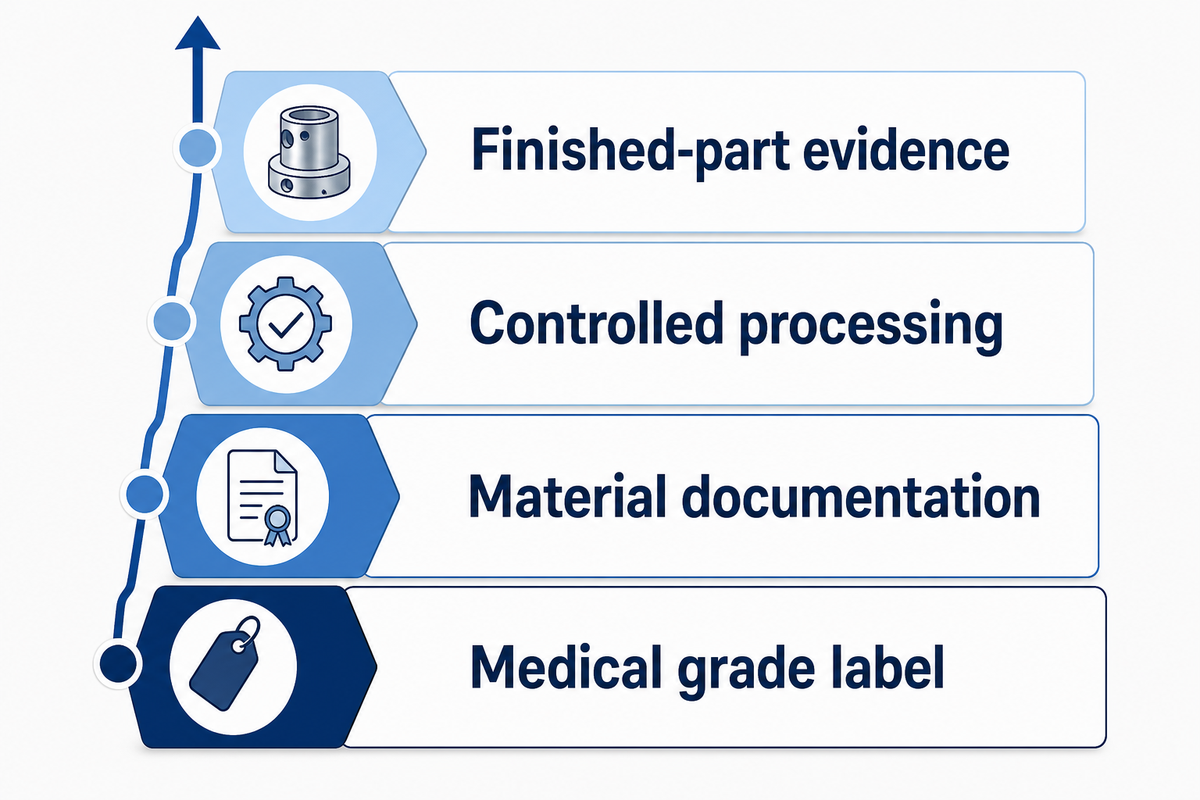
Medical grade silicone (parts) refers to molded components whose material, processing, intended use, patient-contact profile, sterilization route, and traceability are supported by evidence appropriate to the finished device. It’s a series of decisions relating to the intended use, patient contact, formulation, molding, downstream processing, sterilization, and traceability to the body of evidence available to support the finished device.
Buyers who search for “medical grade silicone (parts)” are usually trying to resolve that whole chain, not merely identify a polymer. The answer depends on the definition of the application and the scope of evidence each document provides.
This overview shows engineers, quality personnel, and sourcing personnel how to resolve the chain. It deliberately focuses on evidence and validation planning; molding capacity, tooling, and quotation details belong on the supplier capability page.
For medical device manufacturers, this holds true for a broad range of medical components from a soft silicone gasket to components in drug delivery. A medical-grade silicone molding project for the medical industry requires evidence traceable to a specific product design, and not an overarching claim directed to the healthcare industry.
Key takeaway: Treat “medical grade” as the start of an evidence review, not its conclusion. The safest purchase specification names the use, the required records, the representative test article, and the change controls.
What “Medical Grade Silicone” Does (and Does Not) Prove
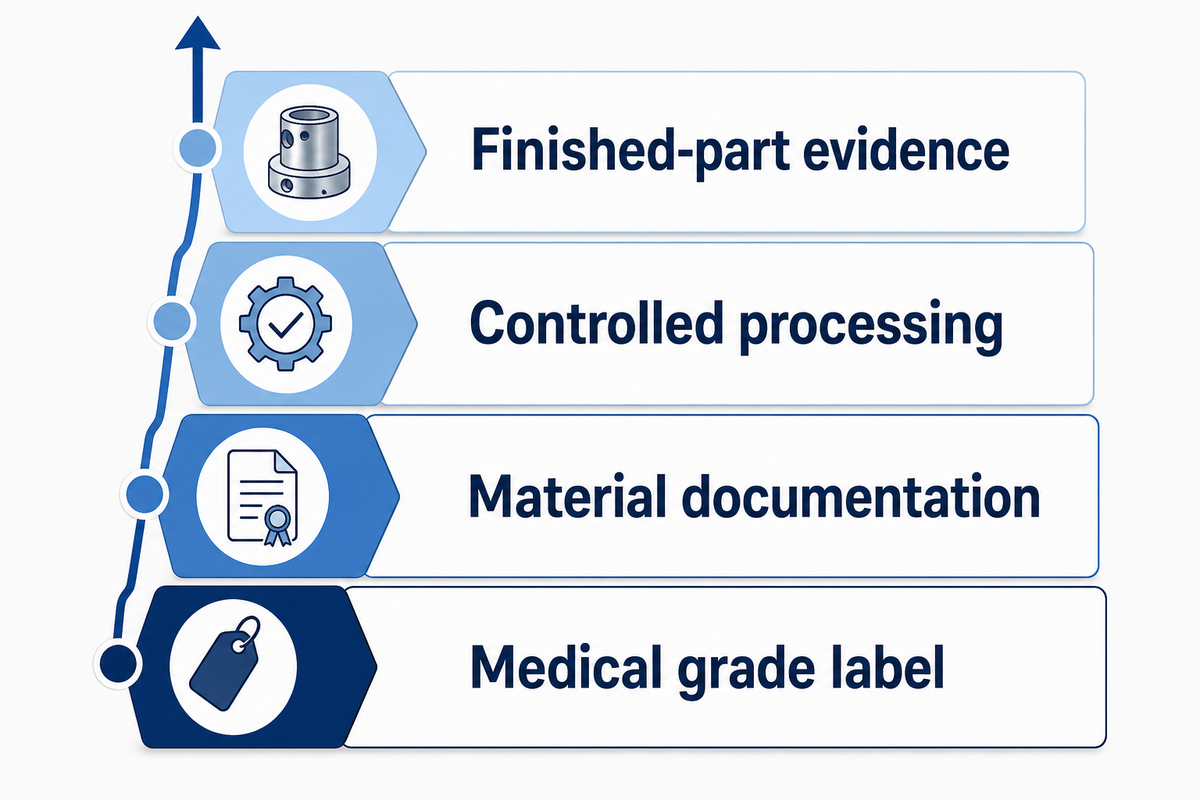
Medical grade silicone is a widely used market term. However, it isn’t a single universal certification for every molded component. The phrase may indicate that a silicone rubber formulation has controlled ingredients, supporting test data, or a history in healthcare applications. Medical grade silicone, however, doesn’t prove a medical device claim.
The distinction matters because the US Food and Drug Administration evaluates devices rather than approving individual materials used to fabricate them. Its biocompatibility resources address the device in its final finished form, including processing and sterilization where applicable. The practical question is therefore not “Is this silicone FDA approved?” but “Which evidence supports this formulation, this process, and this intended use?” FDA biocompatibility guidance
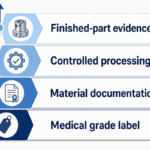
The Label-to-Evidence Ladder
| Level | What it can tell you | What remains open |
|---|---|---|
| 1. “Medical grade” label | The supplier positions the material for healthcare use. | Which grade, test scope, and intended use? |
| 2. Material documentation | Identity, composition controls, certificates, and selected test results. | Was the tested specimen representative of your part? |
| 3. Controlled processing | Molding, post-cure, cleaning, and lot records are defined. | The distinction matters because the US Food and Drug Administration evaluates devices rather than approving individual materials used to fabricate them. |
| 4. Finished-part evidence | The test article and validation plan represent the supplied configuration. | Does the device sponsor’s full risk assessment support the claimed use? |
ISO 10993 biological evaluation, USP Class VI testing, food-contact status, and platinum-cure chemistry sit on different rungs. They answer different questions. None should be silently substituted for another.
The same rule applies whether the type of silicone is an LSR, HCR, clear silicone, or platinum silicone rubber formulation. Medical silicone rubber may be used for different purposes, but the intended use in medical devices is the governing question.
Start With Intended Use, Contact Type, and Contact Duration
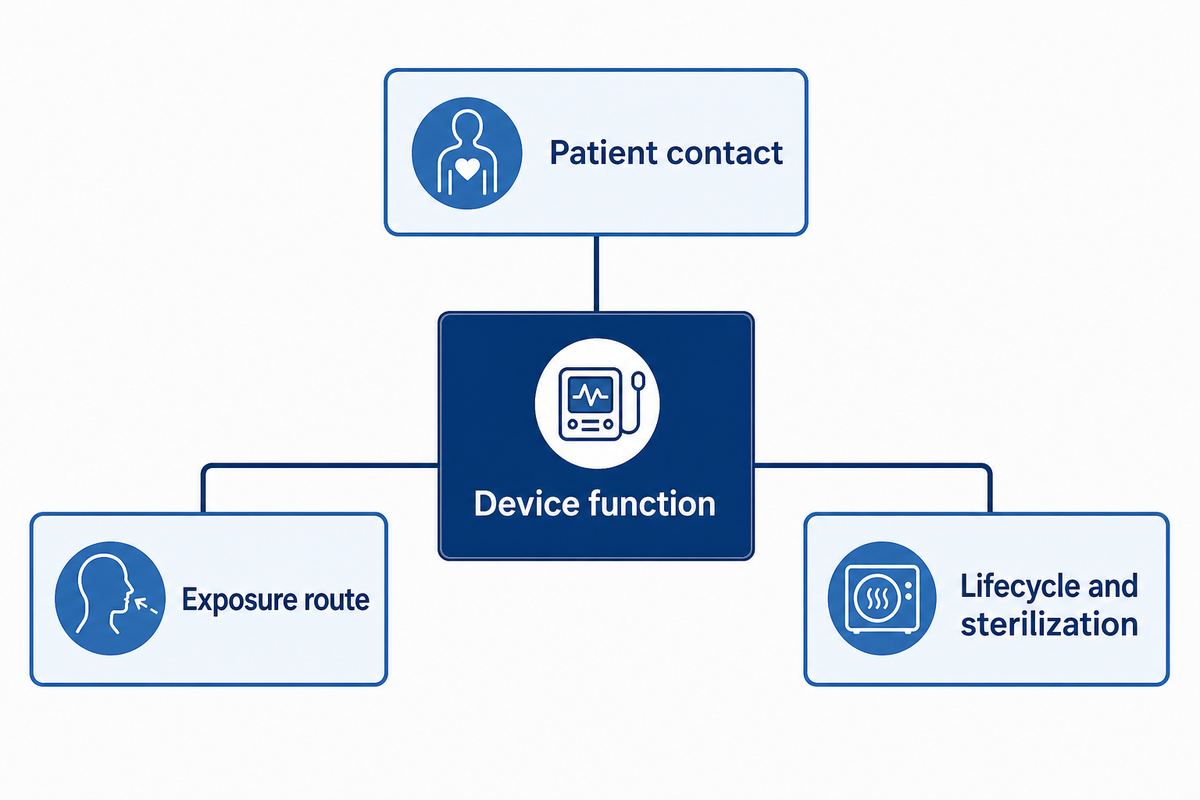
When providing evidence, the focus should be on the device and not the polymer. Describe the function of the component. State who’s potentially exposed to it. Is the exposure contact or non-contact? What’s the contacting tissue or fluid? How long and how often does contact occur? Is it a closed system? Is the component sterilized? Is it implantable? Is it part of the fluid path?
ISO 10993-1:2025 places biological evaluation within a risk-management process. This prevents a procurement error whereby a standard test list is blindly copied into an RFQ.
Intended-use input card
- Device function and market jurisdiction
- Direct or indirect patient contact
- Contacting tissue, fluid, or gas path
- Limited, prolonged, or long-term exposure
- Single-use or reusable lifecycle
- Sterilization method and maximum validated cycles
- Known patient population or use-related risks
The component supplier shouldn’t promise that one generic certificate of analysis meets all requirements because the finished device manufacturer owns the strategy for biological safety. A component supplier can provide material and process evidence for a material for medical applications, representative samples, and change-control support, but should not promise that one generic certificate makes every application compliant.
Risk management can also justify a narrower evidence path when an official framework explicitly permits it; “finished-device evaluation” does not mean every project needs the same new test program. Conversely, gas-path components can raise inhalation-exposure questions addressed by the ISO 18562 series, while directly contacting surfaces remain within the ISO 10993 framework. Confirm the current edition and its recognition or transition status in each target market. ISO 18562-1:2024 scope
The evidence package also needs to address durability needs, chemical resistance, extreme temperatures, and UV light. These material properties help screen candidates, but don’t take the place of biological evaluation or functional testing protocols.
Build a Four-Lane Evidence Package Before Selecting a Silicone
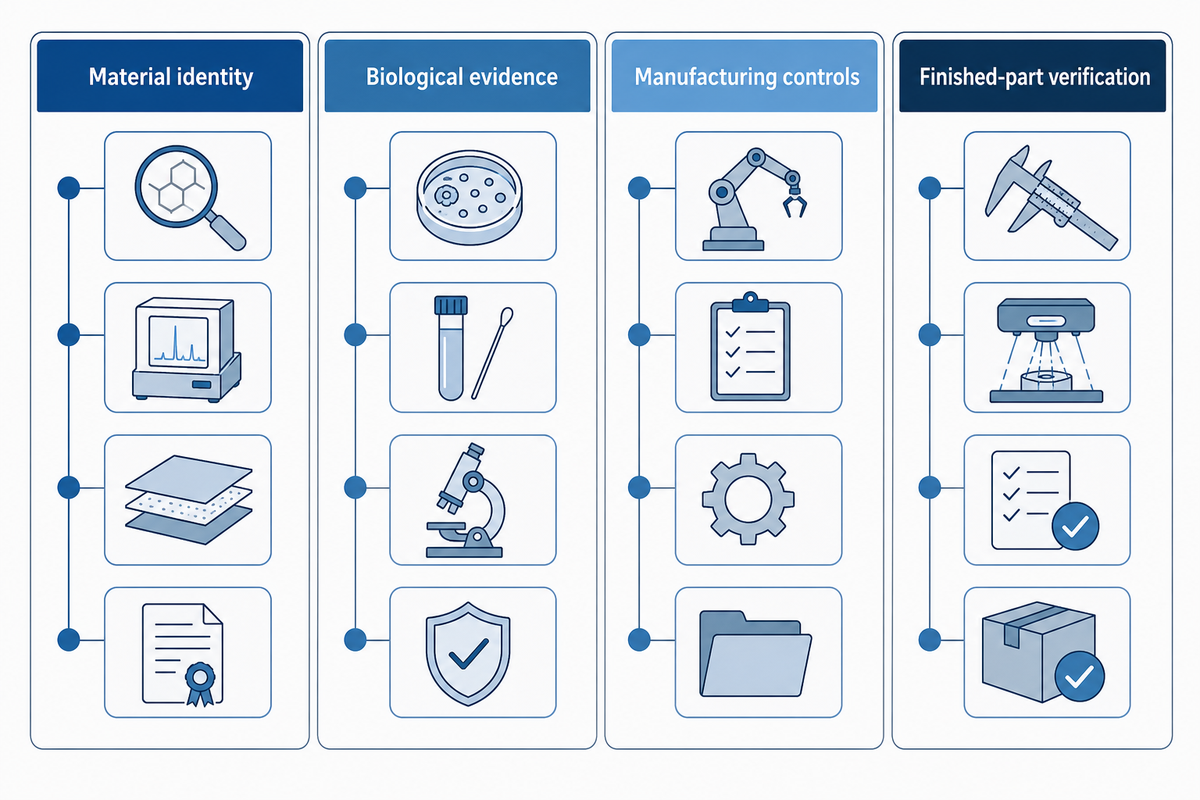
A good evidence package separates four lanes to provide what’s proven and what’s still an assumption. This structure helps discipline comparison of silicone suppliers.
| Evidence category | Records to review | Decision it supports |
|---|---|---|
| Material identity | Exact grade, supplier, cure system, pigment, additives, declaration, and lot certificate | Is the supplied compound the one that was assessed? |
| Biological evidence | Test standard, endpoints, sample preparation, extraction conditions, laboratory, and report date | Is the test scope relevant to the planned contact? |
| Manufacturing controls | Molding parameters, post-cure, cleaning, contamination controls, inspection, and packaging | Is the process controlled and reproducible? |
| Finished-part verification | Representative configuration, sterilization, aging, functional tests, and risk assessment | Does evidence follow the actual device configuration? |
| Material change control | Supplier notices, formulation revisions, pigments, additives, and substitution rules | Which changes require reassessment? |
| Process validation | Approved parameter window, equipment, tooling, and post-cure records | Can the molding route remain repeatable? |
| Cleanliness control | Handling environment, cleaning method, packaging, and acceptance criteria | Are contamination risks controlled to the defined level? |
| Lot release | Certificate, inspection result, deviation status, and shipment trace | Can each delivered lot be linked to its evidence? |
| Lifecycle verification | Sterilization cycles, aging, functional testing, and complaint feedback | Does performance remain acceptable through the claimed life? |
USP <88> describes biological reactivity tests for polymers and elastomers. A result can be valuable material evidence, but the chapter’s test scope is not identical to a device-specific evaluation under the ISO 10993 framework. The official USP chapter preview should be read for what the test actually covers.
A good supplier dossier makes scope visible. It names the formulation and color of the tested article, states whether specimens were molded or otherwise prepared, and describes the conditions of processing, extraction and sterilization. A certificate without that context is harder to connect to the finished component.
Adhesives, rigids, and fluid contact assemblies in silicone medical devices warrant a review of the complete interface. A silicone adhesive or silicone overmold may provide additional constituents or failure modes not addressed in the base silicone material report.
Match Material Form and Molding Process to the Part
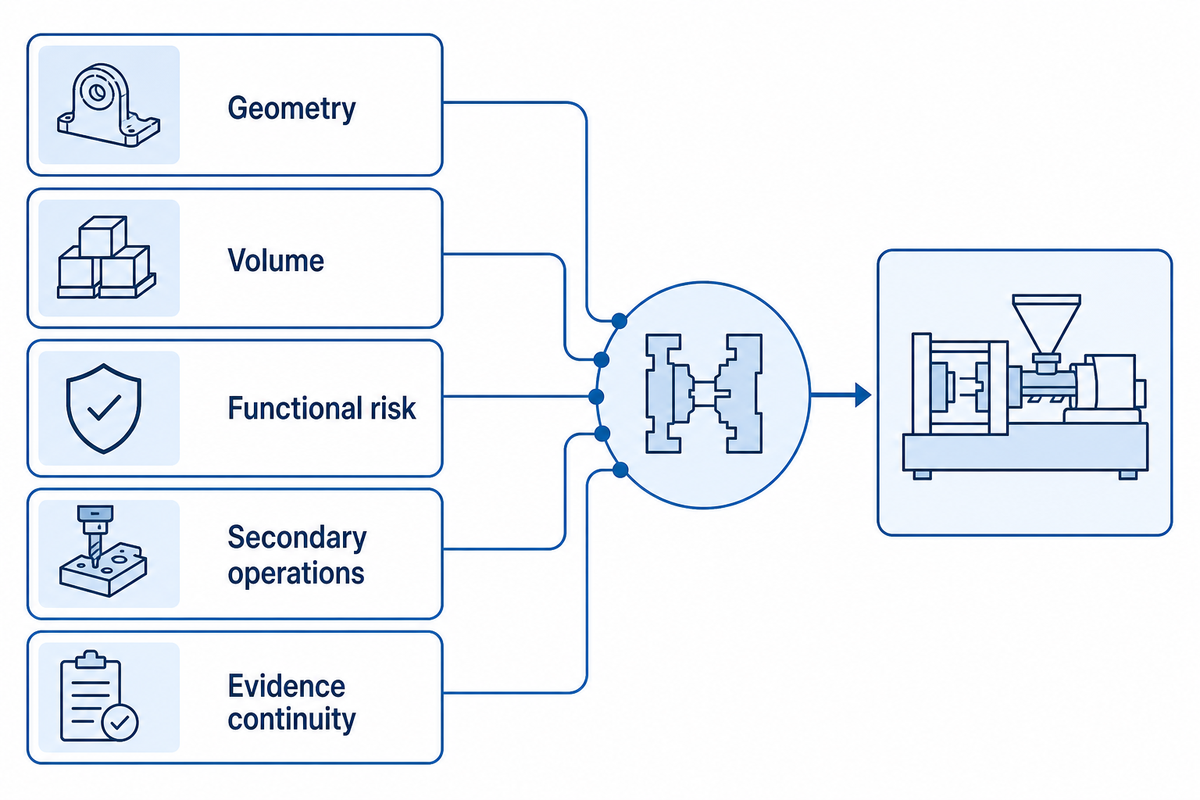
Evidence should direct the selection of material and processes. Liquid silicone rubber is commonly paired with LSR injection molding for repeatable high-volume parts, fine features, and automated handling. High-consistency rubber can suit silicone compression molding and other geometries. Overmolding can integrate silicone with a rigid insert, while also adding interface and adhesion risks that require verification.
In common terminology, LSR molding is liquid injection molding for a two-part thermoset, and HCR tends to use different molding techniques. Silicone injection molding can support complex molded parts, but silicone mold making, gate design, venting, and the curing process must be developed around the actual compound and geometry.
| Decision factor | Questions for the team |
|---|---|
| Geometry | Are there thin walls, undercuts, microfeatures, shutoffs, or sealing surfaces? |
| Volume | Does expected demand justify automated injection molding and dedicated tooling? |
| Functional risk | Which dimensions, surfaces, flash conditions, and mechanical properties are critical? |
| Secondary operations | Will the part be post-cured, cleaned, bonded, printed, assembled, or packaged? |
| Evidence continuity | Can the chosen process be represented in biological and functional test samples? |
Do not turn a supplier’s published capability into a universal design rule. Wall thickness, tolerance, hardness, and flash limits depend on the formulation, part geometry, tool concept, measurement method, and validated process window. Demonstrated sampling to design may address those needs.
Terms such as high-quality silicone injection or advanced molding capabilities are not measurable requirements. For custom silicone molded components, replace them with drawing features, inspection methods, surface criteria, and documented process controls. Document these requirements in drawings, process controls, and supporting evidence.
Plan Biological Evaluation Around the Finished Device
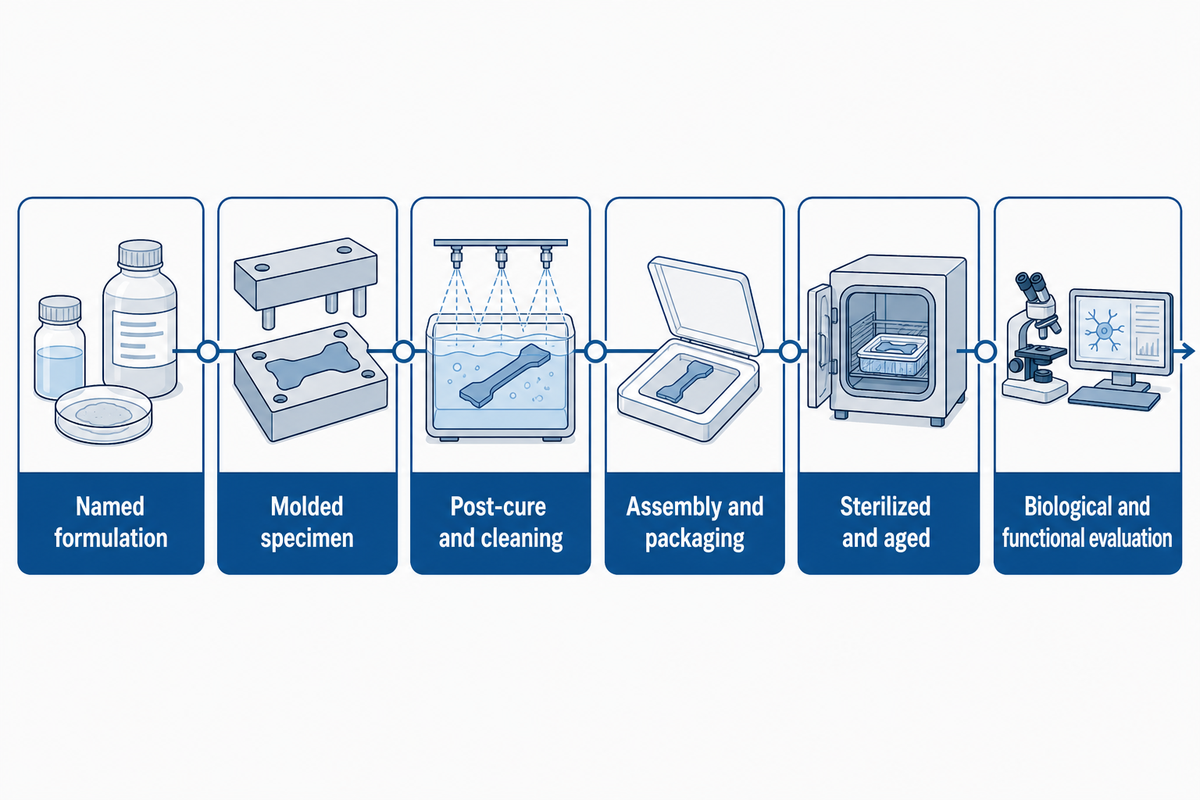
A raw material data sheet (RMDS) can support a biological evaluation, but it may not close the evaluation. Pigments and processing aids can change the composition. Residuals from molding and post-cure may remain on the part. Cleaning can alter or remove residues; bonding and assembly may add interfaces; packaging, aging and sterilization may alter what the patient encounters.
FDA guidance recommends that a test article be representative of the final device, including relevant chemical, physical, and surface properties and the same manufacturing and sterilization processes. This is the Material-to-Finished-Part Evidence Bridge: every transformation needs either evidence that it is covered or a documented rationale for why it does not change the assessment. FDA guidance on ISO 10993-1 and representative test articles
Material-to-Finished-Part Evidence Bridge
Named formulation → molded specimen → post-cure and cleaning → assembly and packaging → sterilized/aged configuration → biological and functional evaluation
Build a specimen matrix early. Identify worst-case colors and additive packages, and consider the maximum amount of relevant processing. Identify any surface that’s in contact with the patient or fluid path. If a coupon is used instead of a finished part, document why its composition, surface, manufacturing history, and extraction ratio are representative.
This is especially important when a material of choice is promoted for many applications. The test specimen must still represent the design and manufacture route, including additives, post-curing, cleaning, and any operation that changes the contact surface.
Verify Sterilization Compatibility on the Actual Configuration
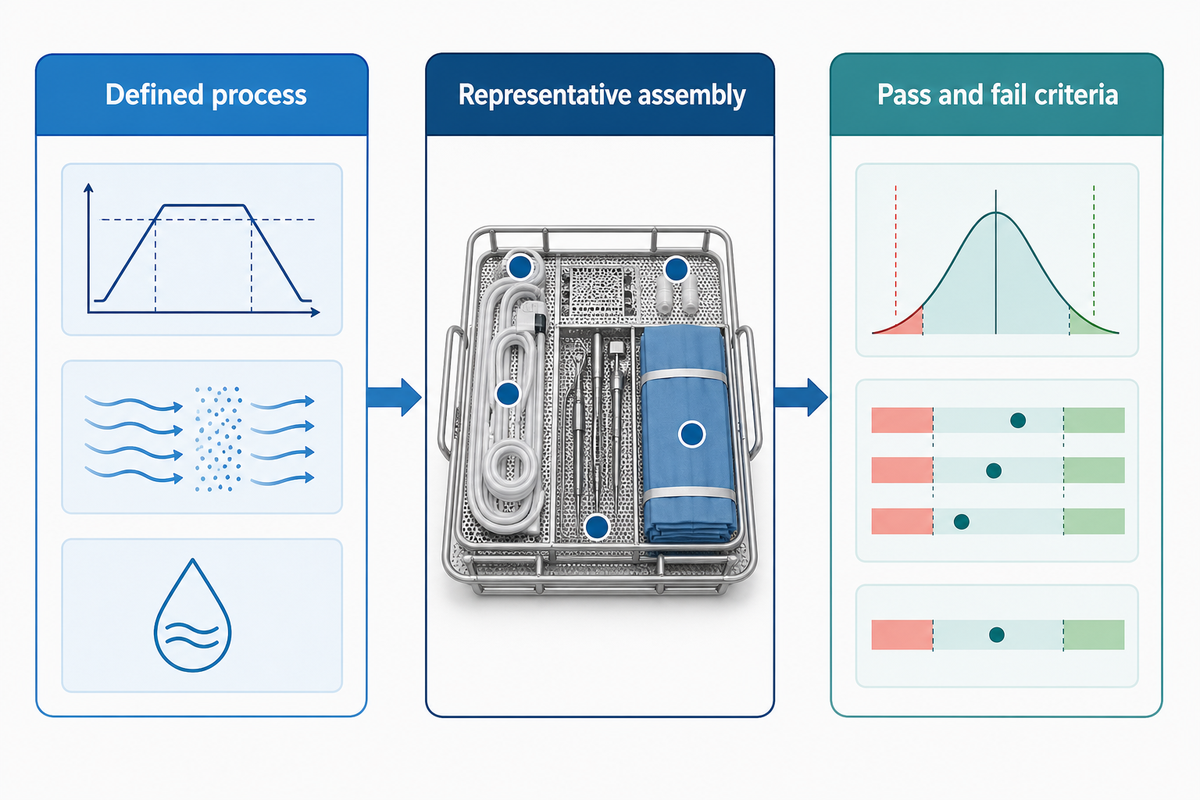
“Autoclavable” isn’t a complete engineering claim. Other elements, like the nature of the steam, cycles, dose, and the level of aging and use, affect the response of the component.
Acceptance criteria should be defined prior to testing for the method to be employed. Acceptance criteria may be dimensional, visual, hardness or tensile, sealing or compression, bond, condition, or function of the device. For a reusable product, a justification of the maximum number of cycles of cleaning and sterilization, or performance-based end-of-life criteria, is needed.
Exposure to Methods such as autoclave can’t be narrowed down to a chemical name. Even when silicone is known for stability, the preferred choice depends on the assembly, use condition, and verified performance after the specified cycle.
A peer-reviewed study of particular medical silicone specimens reported changes in measured surface and mechanical properties across repeated processing cycles. The repeated-cycle design is evidence that repeated exposure can be studied, not a hard and fast safe-cycle limit on every silicone part. (Repeated-cycle silicone study)
Avoid this specification: “Silicone must withstand autoclaving.”
Use this instead: Name the sterilization process, cycle parameters, maximum cycles, aging condition, representative assembly, measured properties, and pass/fail criteria.
Use this instead: Name the sterilization process, cycle parameters, maximum cycles, aging condition, representative assembly, measured properties, and pass/fail criteria.
Preserve an Evidence Continuity Chain From Lot to Released Part
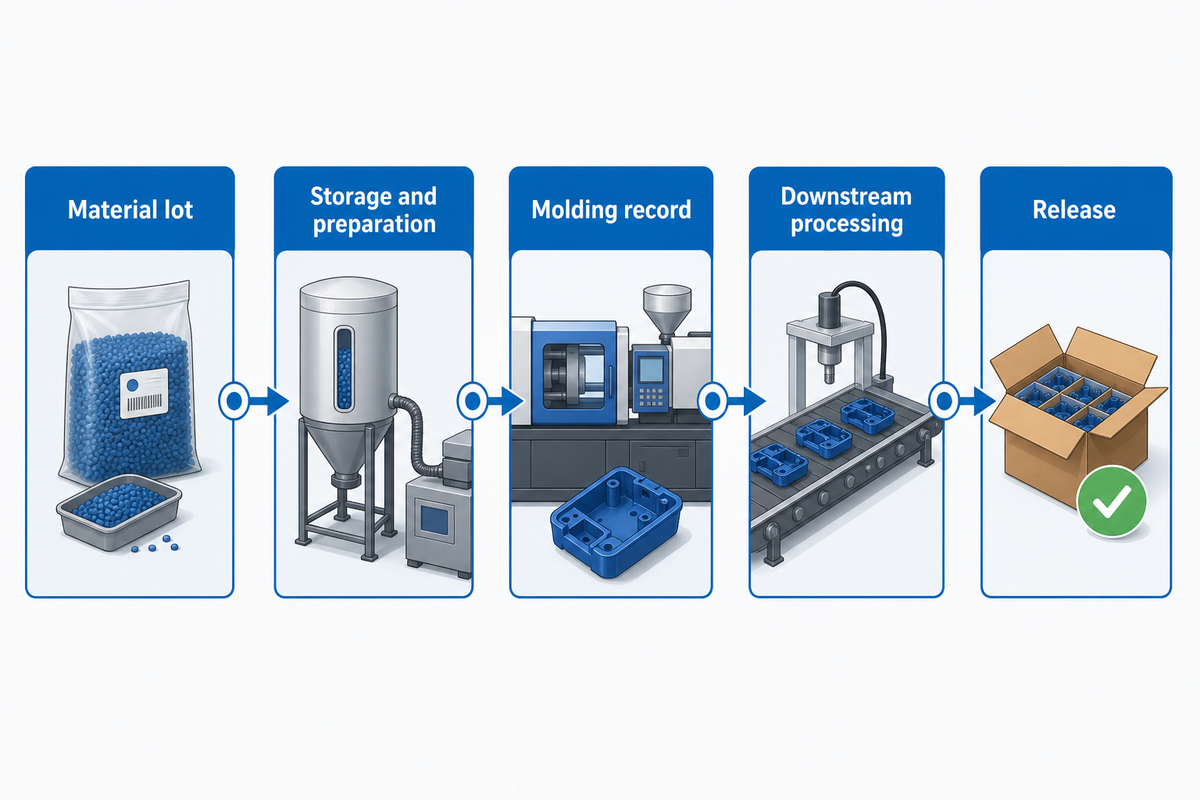
Traceability converts a set of documents into control of production. The chain should connect the material received to the part released, while showing which approved process and inspection records apply.
- Material lot: supplier, exact grade, lot or batch, certificate, pigment, and shelf-life status.
- Storage and preparation: storage conditions, mixing or metering controls, handling, and contamination prevention.
- Molding record: tool, machine or process identifier, approved parameter window, operator or system record, and nonconformances.
- Downstream processing: post-cure, cleaning, bonding, assembly, inspection, and packaging history.
- Release: inspection results, deviations, disposition, quantity, and shipment link.
Change control protects that continuity. Change can impact many aspects of the product from its formulation to packaging and even post-cure processing. The response may range from a record update to targeted requalification or a broader risk reassessment.
Therefore, a silicone manufacturer should understand that different types of silicone, including medical-grade silicone rubber and food-grade silicone, are distinguished by materials and evidence, not their family name.
For US device manufacturing, the FDA’s Quality Management System Regulation became effective on February 2, 2026 and aligns the framework more closely with ISO 13485. Duties depend on each organization’s regulatory role and jurisdiction, so a component molder should not be described as carrying every obligation of the legal manufacturer. The rule emphasizes the use of risk-based supplier and production controls. QMSR final rule
Qualify a Medical Silicone Parts Supplier
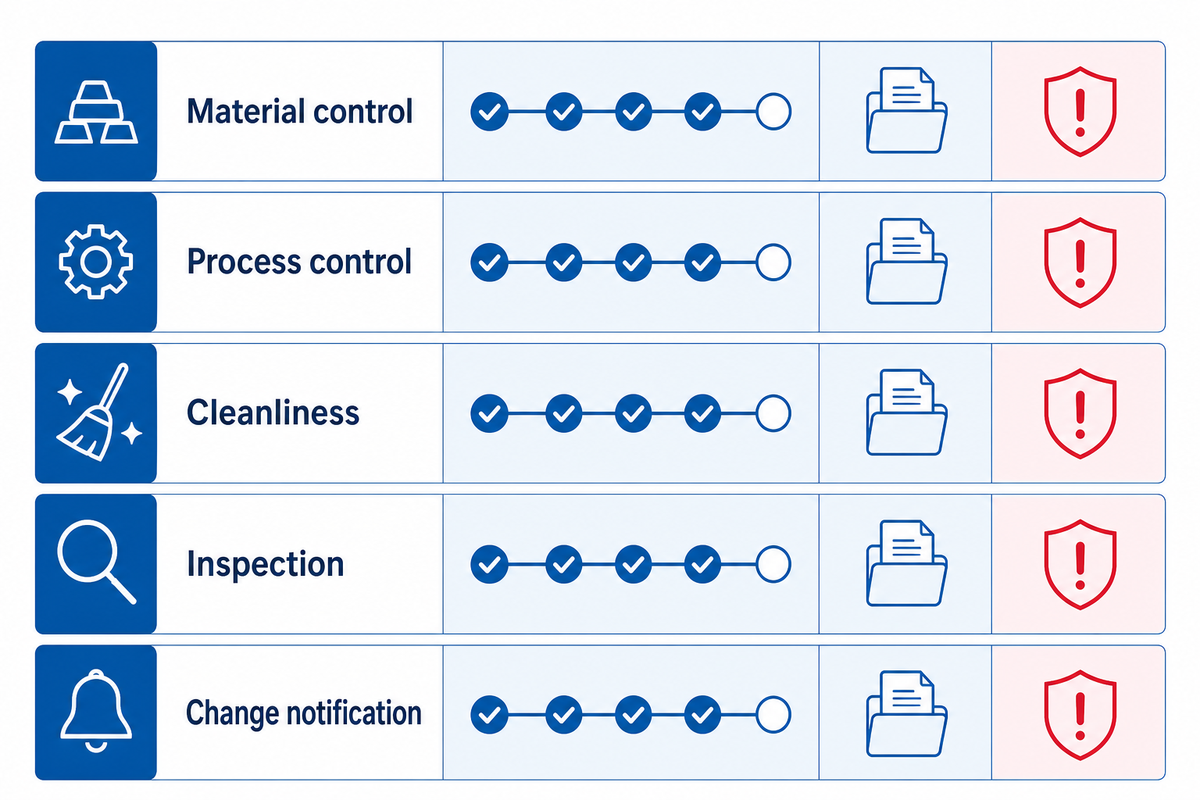
Supplier qualification should evaluate evidence access and process discipline, not the assurance of a sales claim. Candidates should be required to link their answers to the specific formulation, manufacturing route, and part configuration under examination.
For medical device manufacturing, the useful comparison is between documented controls rather than promotional breadth. Ask how the supplier maintains consistency from silicone mold making through inspection, and how it supports validation for the intended medical application.
| Review area | Evidence to request | Red flag |
|---|---|---|
| Material control | Approved grade, supplier, lot traceability, storage, and substitution policy | “Equivalent” material may be used without notice |
| Test scope | Full report or usable summary with sample and method details | Certificate title only, with no specimen context |
| Process control | Defined molding and post-cure controls, validation support, and records | Critical conditions are treated as operator preference |
| Cleanliness | Handling, environment, cleaning, and packaging controls appropriate to risk | “Clean” is stated without a method or acceptance criterion |
| Inspection | Measurement method, sampling plan, calibrated equipment, and disposition process | A tolerance is promised before the method and geometry are reviewed |
| Change notification | Defined triggers, notice period, review path, and record retention | Material or process changes can occur without customer review |
Once evidence and production requirements are defined, Engelhardt’s custom silicone parts capability can be assessed commercially next. This helps maintain the focus of the guide on the selection and validation of parts while the product page takes care of the discussions on manufacture and the project.
Turn Requirements Into an RFQ and Validation Plan
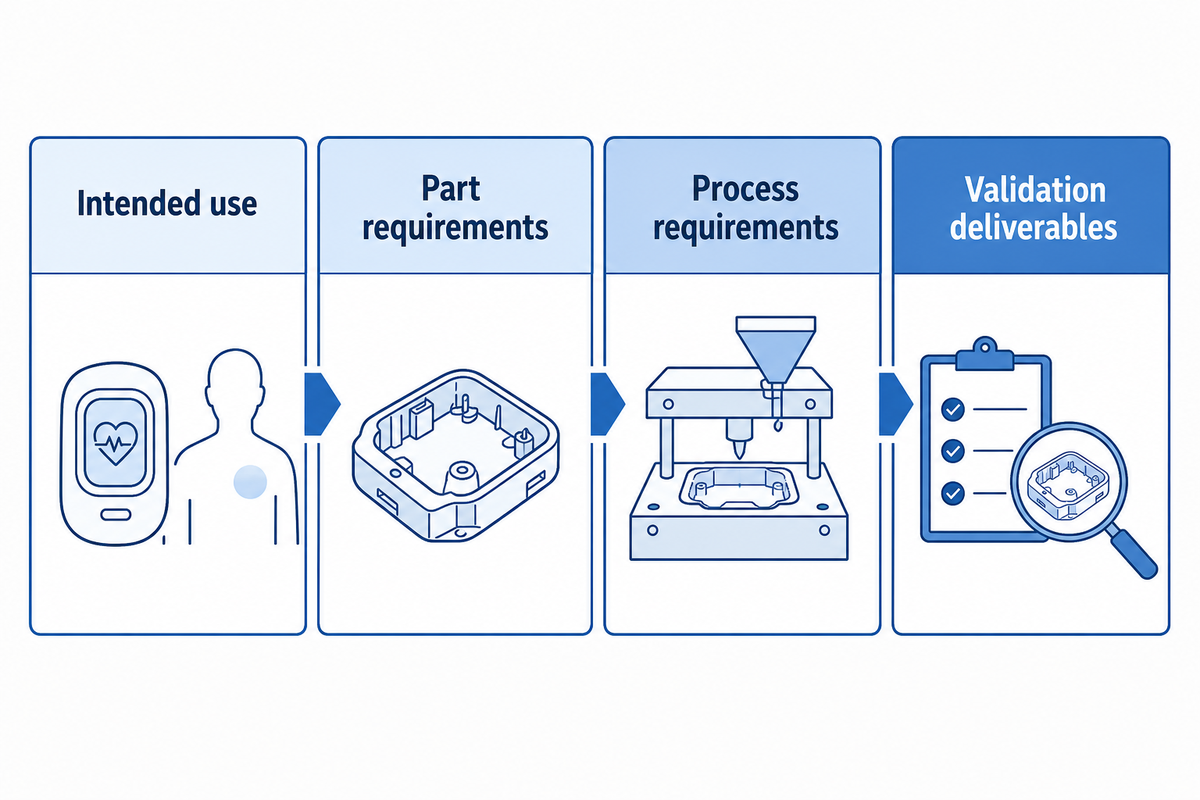
A well-crafted RFQ should state ownership. It provides the molder sufficient information to identify the material and process risks without requiring the supplier to make the finished device regulatory claims.
Use the site’s silicone parts RFQ readiness checklist to structure the commercial handoff after the evidence brief.
While the RFQ can capture the anticipated medical device market and a range of applications, it should limit them to the actual program. This prevents medical-grade silicone, soft silicone, or platinum silicone rubber from being used as undefined functional requirements.
Medical Silicone RFQ Evidence Checklist
- Device function, target markets, patient-contact route, and contact duration
- Drawing, critical dimensions, sealing surfaces, and inspection methods
- Specifications for hardness, silicone form, additives, prohibited substances and color.
- Molding route, inserts, bonding, post-cure, cleaning, and packaging needs
- Sterilization method, cycle definition, aging condition, and acceptance criteria
- Material Declarations, Test Reports, Certificates, Lot Records and Samples
- Validation deliverables, capability evidence, inspection records, and retention period
- Change-notification triggers and approval responsibilities
The device team owns the intended-use claims, biological evaluation plan, overall risk management, and market submissions, while the supplier is responsible for accurate material identity, controlled manufacturing, traceable component records, agreed inspection, and change notification.
The resulting validation plan should state what will be tested, which configuration represents worst case, when samples are made, who approves deviations, and what evidence is required before production release.
Frequently Asked Questions
What qualifies silicone as medical grade?
The phrase usually points to a controlled silicone formulation with documentation or testing relevant to healthcare use, but it is not a universal finished-part certification. Qualification relies on evidence linked to the specific grade, manufacturing history, intended use, contact with patients, and the duration of such contact. Be specific about what was tested, the test article, the test conditions, and how the evidence pertains to the supplied component.
Is medical grade silicone the same as food grade silicone?
No. Compliance of a product with the requirements for food contact and the medical device biological evaluation address different uses and regulatory situations. A food contact statement doesn’t automatically mean patient contact, and a medical material claim doesn’t automatically mean compliance with every food contact situation. Evaluate the jurisdiction, exposure, formulation, processing and finished product requirements separately.
Does USP Class VI replace ISO 10993 evaluation?
No. USP <88> and the ISO 10993 series have different scopes and frameworks. A USP Class VI result may be useful supporting material evidence, but it does not by itself complete the biological evaluation of a finished device. Intended use, contact type and duration, processing, sterilization, and the device risk assessment determine what further evidence is appropriate.
Is platinum-cured silicone always medical grade?
No. Platinum cure describes the chemistry used to crosslink the silicone, not a universal medical-grade status. Buyers still need documented evidence for the specific formulation, manufacturing controls, cleanliness, biological evaluation, traceability, sterilization route, and intended use of the finished part.
Can medical silicone parts be autoclaved?
Some silicone formulations and designs of parts can withstand steam sterilization, but this shouldn’t be assumed for all cases. Verify the actual formulation, design, assembly, packaging, cycle conditions, number of cycles, aging, dimensional and mechanical stability, and functional performance of the device. Supplier data can be useful in developing a plan; a representative configuration test should support the final decision.
What documents should a buyer request from a silicone molder?
Request material identity declarations and relevant test reports, lot certificates or traceability records, agreed cure controls, inspection results, cleanliness and packaging records, nonconformance controls, and change-notification terms. Then verify that every record identifies the formulation, color, process, production lot, and finished part it is meant to support.
Does a medical-grade raw material make the finished part compliant?
No. Molding, pigments or additives, post-cure, cleaning, assembly, packaging, sterilization, aging, and intended use can change the evidence needed, so the final configuration must be evaluated against its own risk and application requirements across the selected sterilization and packaging configuration.
A Practical Decision Framework
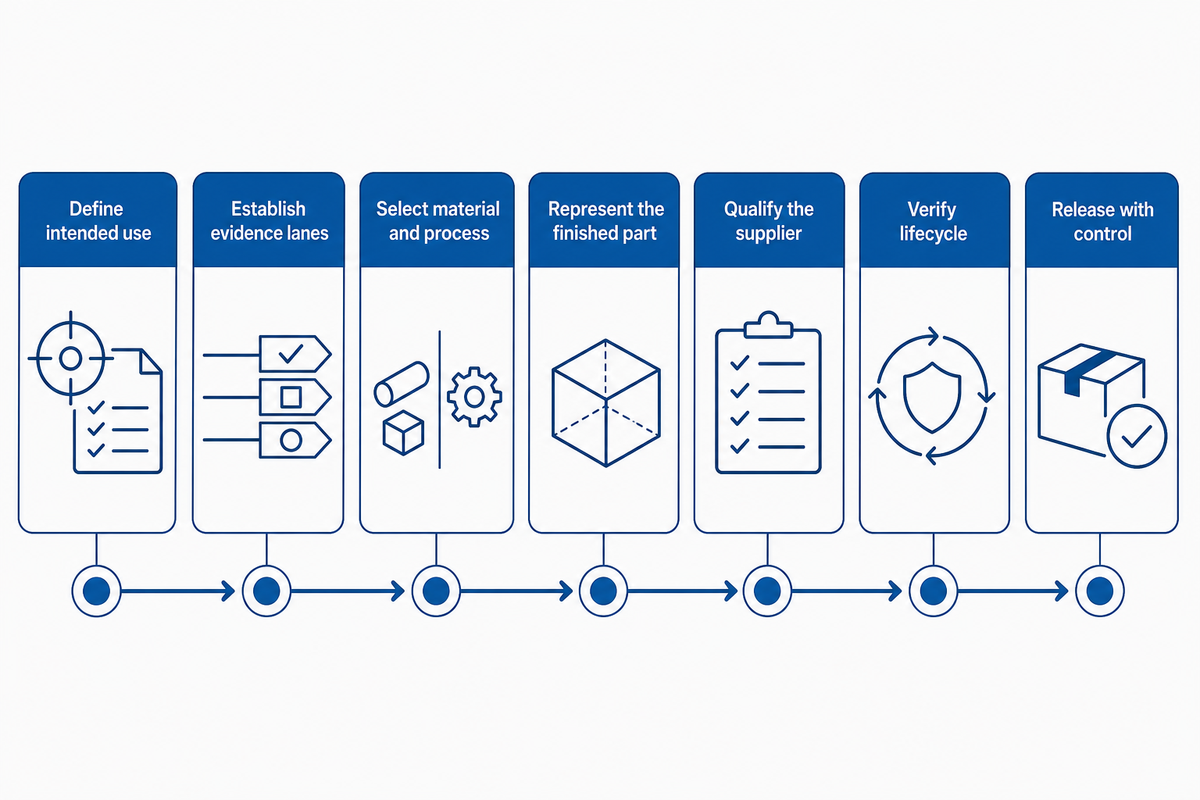
Proceed with the project as follows: define the intended use and contact; establish the four evidence lanes; shortlist potential materials and processes; determine what represents the finished part; qualify the supplier; verify sterilization and aging; and release for production control.
If a gap exists and hasn’t been resolved, don’t close it with a misleading label; the FDA’s biocompatibility framework evaluates the finished device rather than approving a material in isolation. Identify the missing decision and its owner; request evidence which covers the scope of the actual medical silicone component.
References & Sources
- US FDA: Basics of Biocompatibility
- ISO 10993-1:2025 official standard page
- USP <88> Biological Reactivity Tests, In Vivo
- US FDA guidance on ISO 10993-1 and biological evaluation
- Federal Register: Medical Devices; Quality System Regulation Amendments
- Peer-reviewed study of repeated processing cycles for medical silicone specimens