Get in Touch with Engelhardt


Medical injection molding requirements are the material, quality, validation, traceability, and documentation conditions needed for a molded plastic part’s intended medical use. In practice, the question is not “Which resin is medical grade?” It is “What evidence must this molded component carry for its contact type, risk, sterilization path, and buyer quality system?”
This guide is written for OEM engineers, sourcing teams, and quality managers who need to define a medical molding evidence package before requesting a quote. It is a buyer and manufacturing guide, not legal advice and not a substitute for device-specific regulatory review.
Direct answer
Core medical injection molding requirements are: define the product role and intended use, select resin and additives against the contact and sterilization profile, document supplier and quality-system controls, validate molding processes when later inspection cannot fully verify output, control contamination where the device needs it, prove inspection and metrology capability, preserve lot or cavity traceability where relevant, and lock change-notification rules before production.
What Requirements Actually Cover
Medical molding requirements start with product context. Intended use, indications for use, device classification, product code, patient or user contact, sterilization, packaging, and supply-chain role all change the evidence package. A component-only molder, a finished-device contract manufacturer, a contract sterilizer, a labeler, and an importer do not carry identical duties.
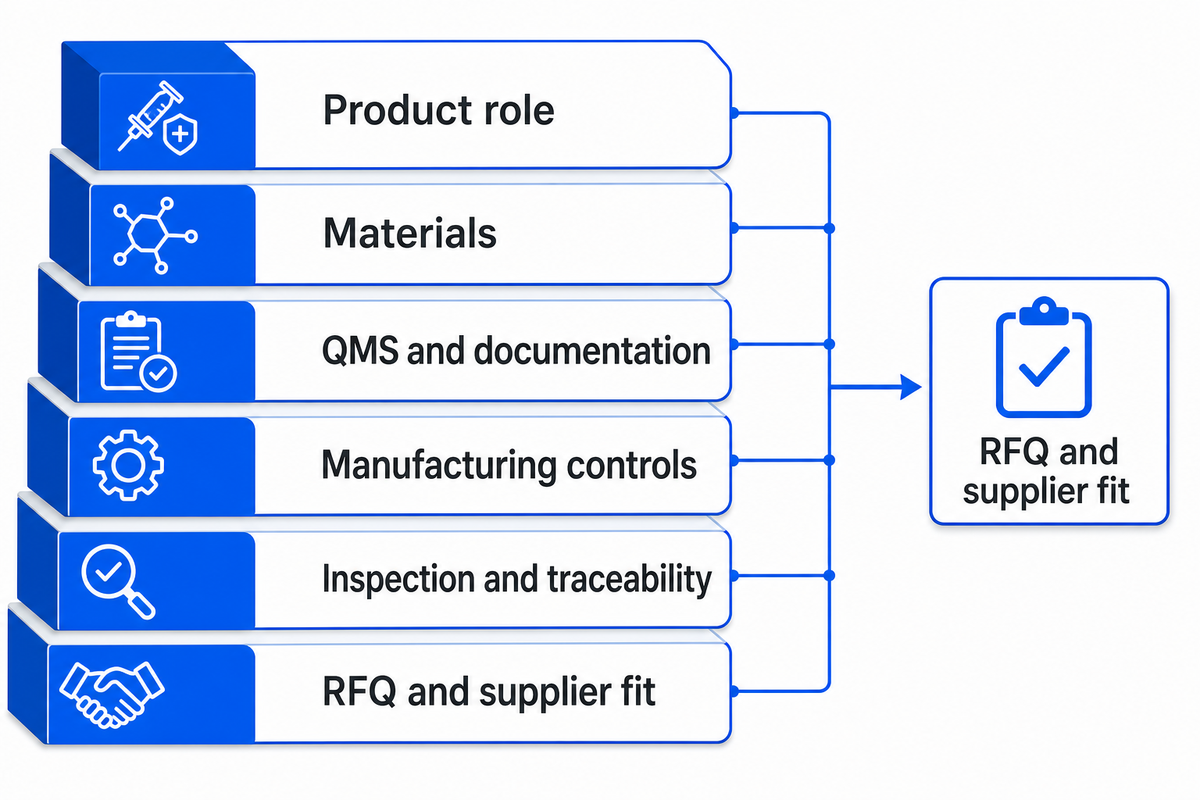
Use the hierarchy below before building an RFQ. It keeps baseline molding evidence separate from conditional device-law branches that only apply when the project trigger is present.
Medical device injection molding should be scoped as a manufacturing process, not as a generic plastic purchasing job. The injection molding process for medical products can include straight molding, and injection molding for medical assemblies may also involve insert molding, overmolding, assembly, and documentation-heavy molding services for the medical industry. Medical field regulatory requirements also depend on product role, contact path, and buyer flow-down.
Use related terms with care. Injection molding for medical devices is broader than a generic injection molding services order: a medical-grade plastic or medical plastic is suitable for medical applications only when its material grade, processing history, cleanroom manufacturing need, lot traceability, and design control evidence fit the product role. Materials for medical device manufacturing must be tied to medical device regulation, medical device industry expectations, the intended medical equipment or component function, and the buyer’s quality-system requirements. Medical components must meet ISO 13485 flow-down controls only when that QMS path applies; two-shot molding can support seals or soft-touch interfaces, but it inherits the same evidence boundaries.
6-Layer Medical Molding Requirement Map
| Layer | What To Define | Typical Evidence |
|---|---|---|
| Product role | Component, accessory, finished device, or supplier service | Drawing, intended-use statement, buyer quality agreement, role map |
| Materials | Resin grade, additives, colorants, contact type, sterilization exposure | Material certificates, traceability, chemical characterization, biocompatibility rationale |
| QMS and documentation | Supplier controls, records, purchasing requirements, change notification | Quality agreement, audit evidence, production records, batch records, training records |
| Manufacturing controls | Tooling, process window, drying, cleanroom need, validation depth | DFM records, molding parameters, IQ/OQ/PQ package where applicable, maintenance history |
| Inspection and traceability | Critical dimensions, sampling, measurement capability, lot or cavity identity | Inspection plan, calibrated results, Gage R&R or method capability, material and lot genealogy |
| RFQ and supplier fit | Evidence package, escalation path, buyer approvals, transfer rules | Medical molding RFQ checklist, quote assumptions, change-control matrix |
Applicability Hierarchy Matrix
| Branch | Use It When | Buyer Question |
|---|---|---|
| Baseline molded-component evidence | Any plastic part is supplied for a medical product. | Can the supplier prove material identity, process control, inspection, and change notification? |
| Finished-device or accessory duties | Molded output is usable as a device or accessory after final processing. | Who owns registration, listing, labeling, complaint handling, and submission evidence? |
| Buyer specification | OEM flow-down specifies ISO 13485, cleanroom, validation, or documentation requirements. | Which controls are contract requirements even if not universal regulations? |
| Voluntary consensus-standard route | A standard supports a submission or buyer specification. | Is the standard recognized, current, partially recognized, or only used as a technical method? |
| Submission-specific change pathway | Material, process, supplier, facility, or intended-use changes may affect a cleared or approved device. | Does the OEM need regulatory review before accepting the change? |
Material Requirements
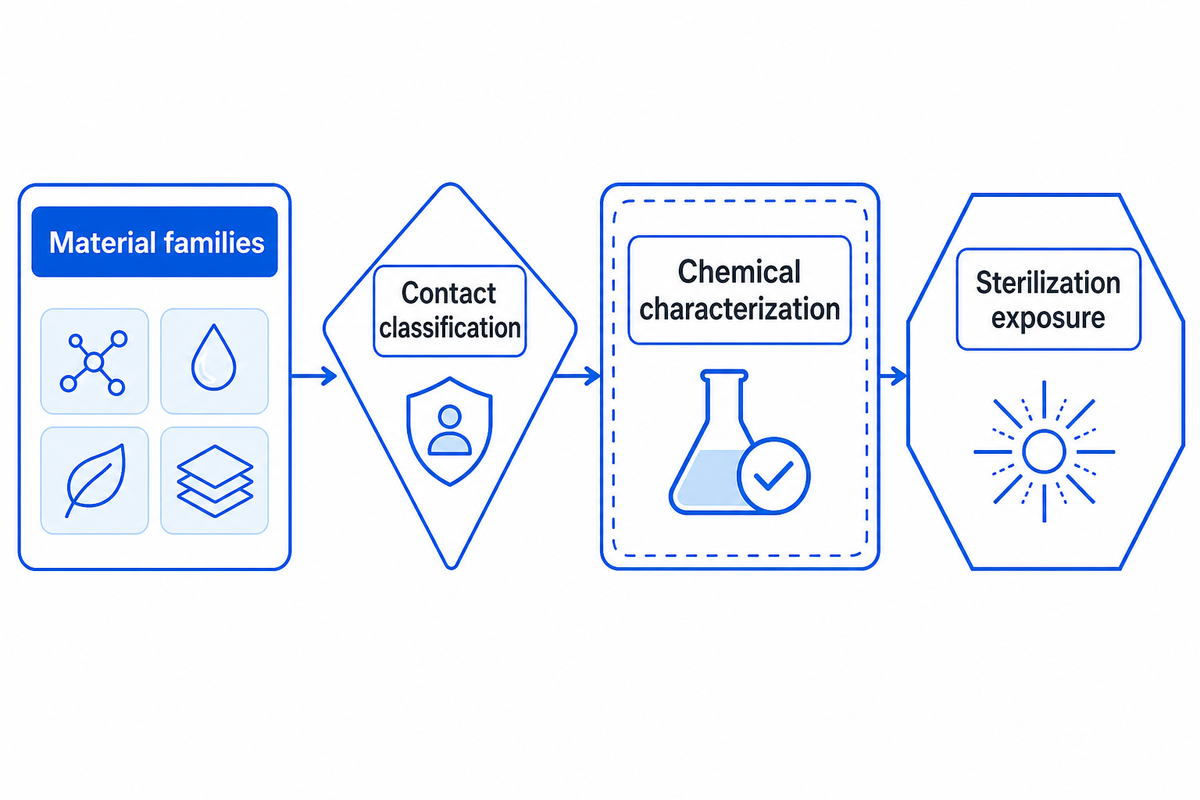
After the applicability matrix sets the branch, material selection can be narrowed without treating every conditional rule as universal. Common medical molding material families include polypropylene, polyethylene, polycarbonate, ABS, PEEK, TPE, and silicone. These families are only starting points. Exact grade, masterbatch, colorant, lubricant, mold-release residue, drying history, sterilization exposure, and final part geometry can change the biological and performance risk profile.
Start material selection with contact classification. Direct body contact, indirect patient contact through fluid or gas paths, user-only contact, and true non-contact housings should not be forced into the same biological-evaluation path. ISO 10993-1 is usually the main biological-evaluation framework, while chemical characterization under ISO 10993-18 may be needed to understand substances introduced by formulation, molding, cleaning, sterilization, or degradation.
Avoid the shortcut phrase “FDA-approved plastic” unless a specific regulatory source supports the exact use. FDA evaluates devices and evidence in context, not loose polymer family names. Color additives are their own branch: black, white, gray, and colored pigments may need use-specific evidence when they are part of a device with direct body contact. USP Class VI can also appear in procurement specifications, but it does not replace ISO 10993 or device-specific biological evaluation.
Sterilization compatibility also belongs in the material requirement package. Ethylene oxide, radiation, heat, vaporized hydrogen peroxide, and repeated reprocessing cycles can affect color, brittleness, dimensions, extractables, seal performance, or long-term strength. For reusable molded devices, ask whether the part retains material properties and function through the maximum validated cleaning, disinfection, or sterilization cycle count.
Injection molding adds latent material risks that cannot be solved by certificate review alone. Residual stress, molecular orientation, anisotropy, weld-line strength, creep, stress relaxation, warpage, environmental stress cracking, and delayed failure can matter for connectors, fluid seals, optical parts, clips, housings under load, and precision interfaces. These risks should be tied to mold design, gate location, packing and cooling strategy, process window, and performance tests that represent production parts.
Compliance and Documentation Requirements
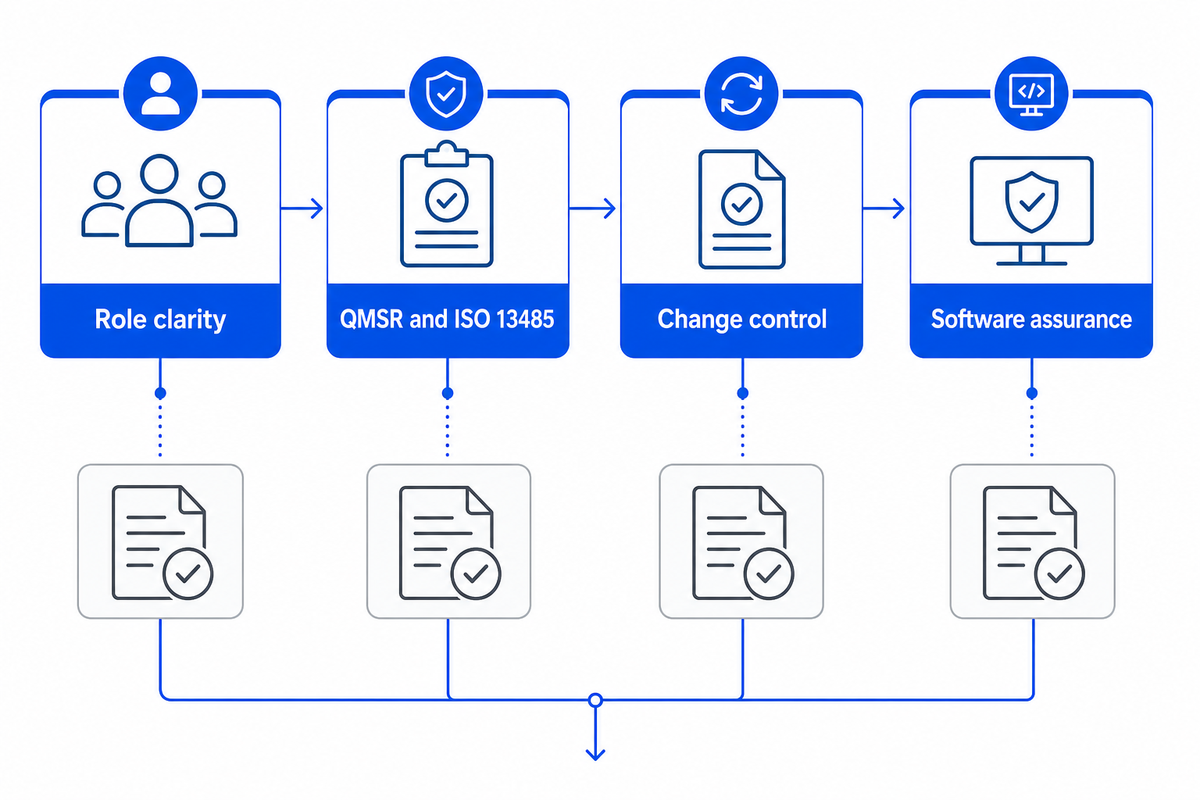
Those material and molding-risk choices must flow into controlled records instead of staying as engineering notes. For the U.S. market, FDA’s Quality Management System Regulation aligns device quality-system requirements with ISO 13485:2016 while keeping FDA supplemental provisions such as record controls and labeling and packaging controls. The key buyer point is role clarity. A component supplier may be controlled through purchasing requirements and a quality agreement, while a finished-device manufacturer or contract manufacturer can carry broader medical-device quality-system duties.
ISO 13485 certification is common in medical-device supply chains, but it should be specified accurately. Some buyers require a certified supplier. Others qualify a molder under the OEM’s quality system and flow down project controls for material traceability, validation support, production records, training, supplier notification, and document retention. Engelhardt-Meitu’s public pages list ISO 9001 and IATF 16949; this guide does not claim ISO 13485 certification for the company.
Documentation should be current and role-specific. Ask for medical-device records, batch records, production records, quality records, inspection records, nonconforming-product records, rework records, CAPA linkage where applicable, mold-maintenance records, training-effectiveness evidence for quality-impacting roles, and documented change review. Legacy terms such as DHR, DMR, DHF, and QSR should only be used when they are intentionally referring to older records or older rules.
Change control needs special attention. Resin supplier changes, formulation changes, new colorants, cavity changes, mold transfers, press transfers, facility transfers, process-window changes, sterilization changes, packaging changes, or supplier changes can affect device evidence. For devices subject to a 510(k), significant changes to design, components, method of manufacture, or intended use can trigger OEM regulatory review. PMA, HDE, IDE, and other pathways need their own review instead of a single 510(k)-only model.
Software should be scoped by its intended use. Molding-machine recipe control, automated inspection decisions, process-data capture, barcode traceability, electronic batch records, and QMS platforms can need risk-based computer software assurance when used for production or quality purposes. Part 11 electronic-record governance and ISO 13485 monitoring and measurement software validation are related checkpoints, but they are not identical.
Manufacturing Validation and Process Controls
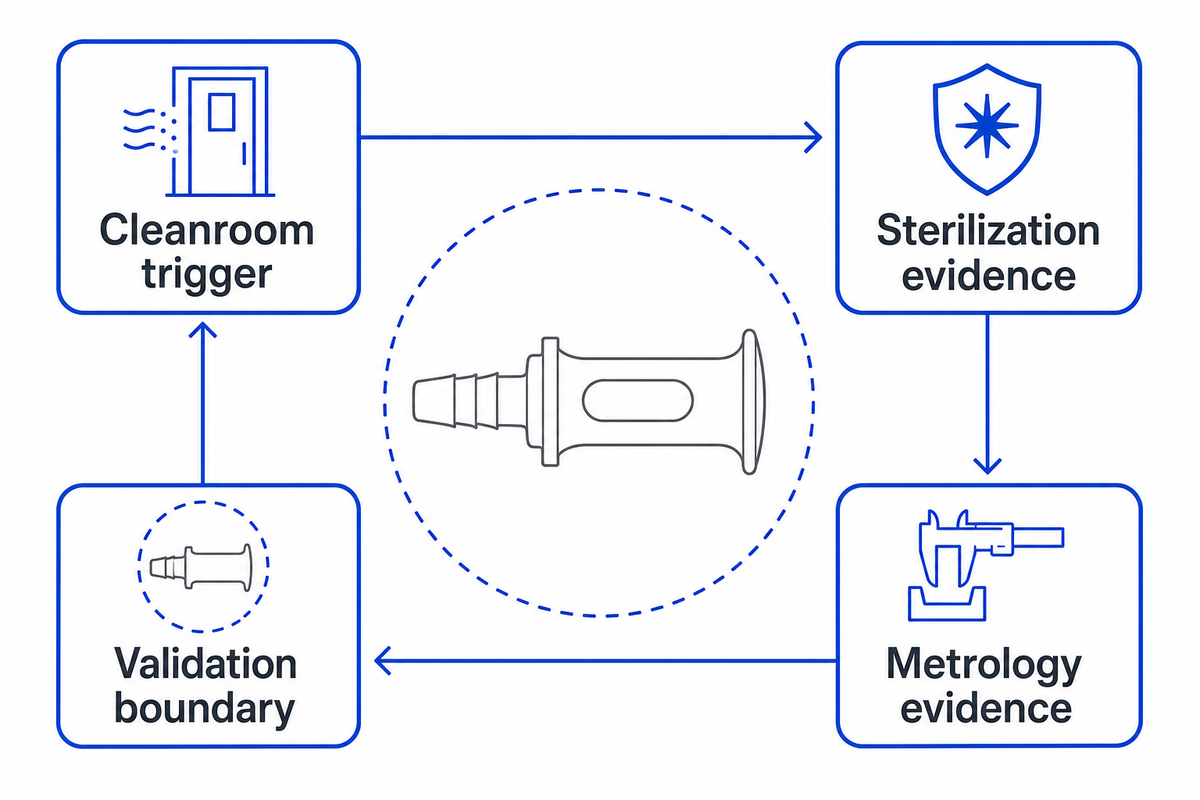
Cleanroom molding is not automatic for every molded medical component. It becomes relevant when contamination risk, sterile-device strategy, assembly route, packaging path, product cleanliness, buyer specification, or microbial-control strategy requires a controlled environment. If a cleanroom is required, define the ISO 14644 particle class, environmental monitoring, microbiological monitoring where applicable, gowning, material flow, packaging interface, and response to excursions.
Sterile devices need more than a clean manufacturing room. Buyers should separate cleanroom class from sterilization validation, sterility assurance level, sterilant residuals, product bioburden, endotoxin or pyrogen controls, sterile-barrier packaging, package integrity, simulated distribution, aging, and shelf-life evidence. Contract sterilizers can also have their own establishment role, which should be mapped separately from the molder’s role.
Process validation becomes important where later inspection and testing cannot fully verify finished output. A useful validation package should go beyond labels such as IQ, OQ, and PQ. It should show equipment qualification, process-window rationale, worst-case parameter challenge, failed-run handling, revised worst-case repeat runs where needed, and nominal production runs long enough to represent routine production duration.
A validated state is not a one-time event. Changes to mold condition, machine, auxiliary equipment, material drying, personnel, procedures, maintenance, software, deviations, trends, or CAPA can require documented review and partial or full revalidation. Startup purge, hot-runner residence time, restart rules, first-shot segregation, and degraded-resin containment also matter when black specks, flakes, or embedded contamination can appear after holds or stops.
Dimensional and functional risks should be tied to the actual part. For tight-tolerance molded medical parts, define critical dimensions, acceptance criteria, calibrated measurement equipment, measurement uncertainty where relevant, repeatability and reproducibility, operator effects, and method discrimination near limits. Calibration, sampling, process validation, and software validation are not substitutes for a measurement method that can reliably separate conforming from nonconforming parts.
Conditional Trigger Matrix
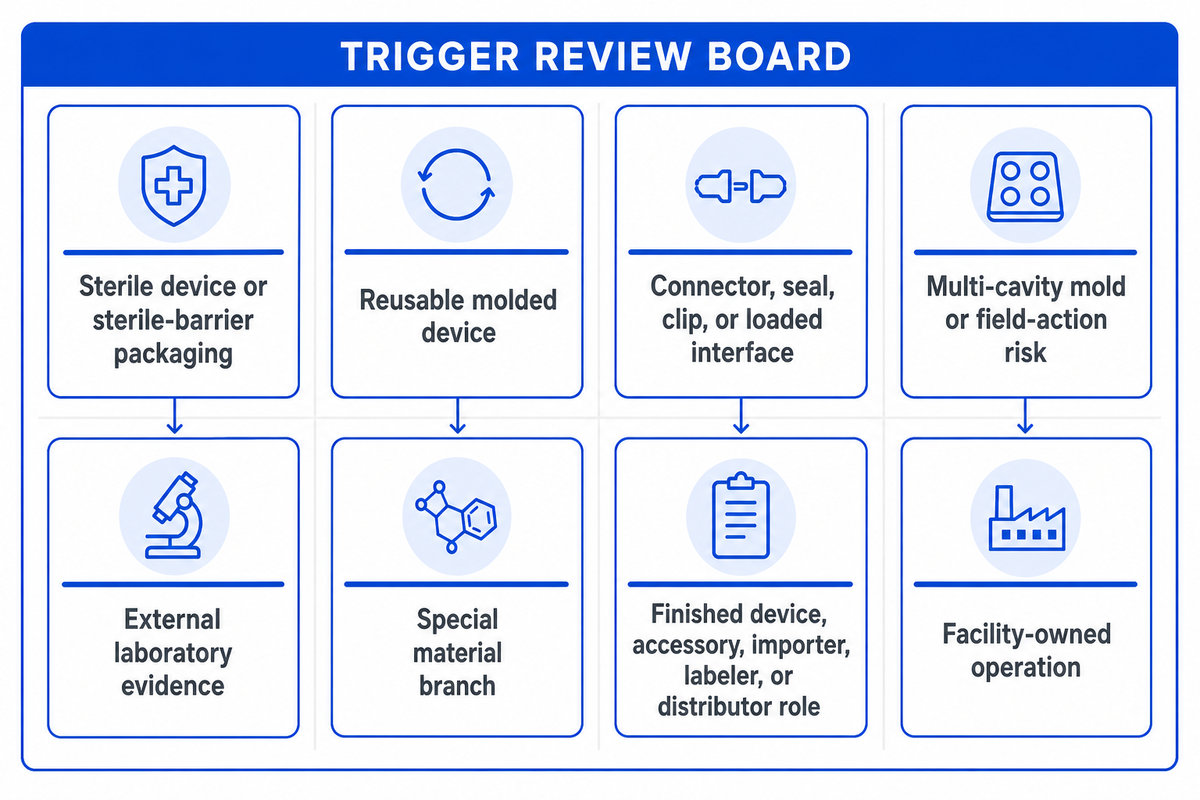
Once the manufacturing validation and metrology are drafted, the other process branches typically require engagement only if the project meets the relevant trigger. These separate branches remain in a combined matrix of risk assessment because they all relate back to manufacturing a finished part within specifications. Keeping them united as such helps keep the product-level objective in focus as the work moves from RFQ development to full production.
| Trigger | Review This Requirement |
|---|---|
| Sterile device or sterile-barrier packaging | Sterilization validation, product bioburden, endotoxin where applicable, packaging integrity, aging, residuals, and contract sterilizer role. |
| Reusable molded device | Cleanability, reprocessing instructions, marking durability, retained physical properties, and maximum validated reuse cycles. |
| Connector, seal, clip, or loaded interface | Weld-line location and strength, residual stress, creep, stress relaxation, mating tolerance, and misconnection risk where relevant. |
| Multi-cavity mold or field-action risk | Cavity identity, lot genealogy, sampling across cavities, defect localization, and containment records. |
| External laboratory evidence | Testing-facility qualification, data-integrity review, independent verification of submitted results, and GLP only for qualifying nonclinical studies. |
| Special material branch | Color-additive use restrictions, natural rubber latex labeling, animal-derived inputs, recycled or reprocessed resin, and shelf-life performance evidence. |
| Finished device, accessory, importer, labeler, or distributor role | Registration and listing, UDI or direct marking, GUDID, complaint handling, MDR routing, Part 806 correction/removal, and Part 821 tracking where ordered. |
| Facility-owned operation | State or local manufacturing licenses, EtO environmental controls, OSHA guarding, lockout/tagout, ventilation, heat or fume controls, and training records. |
Medical Molding RFQ Checklist
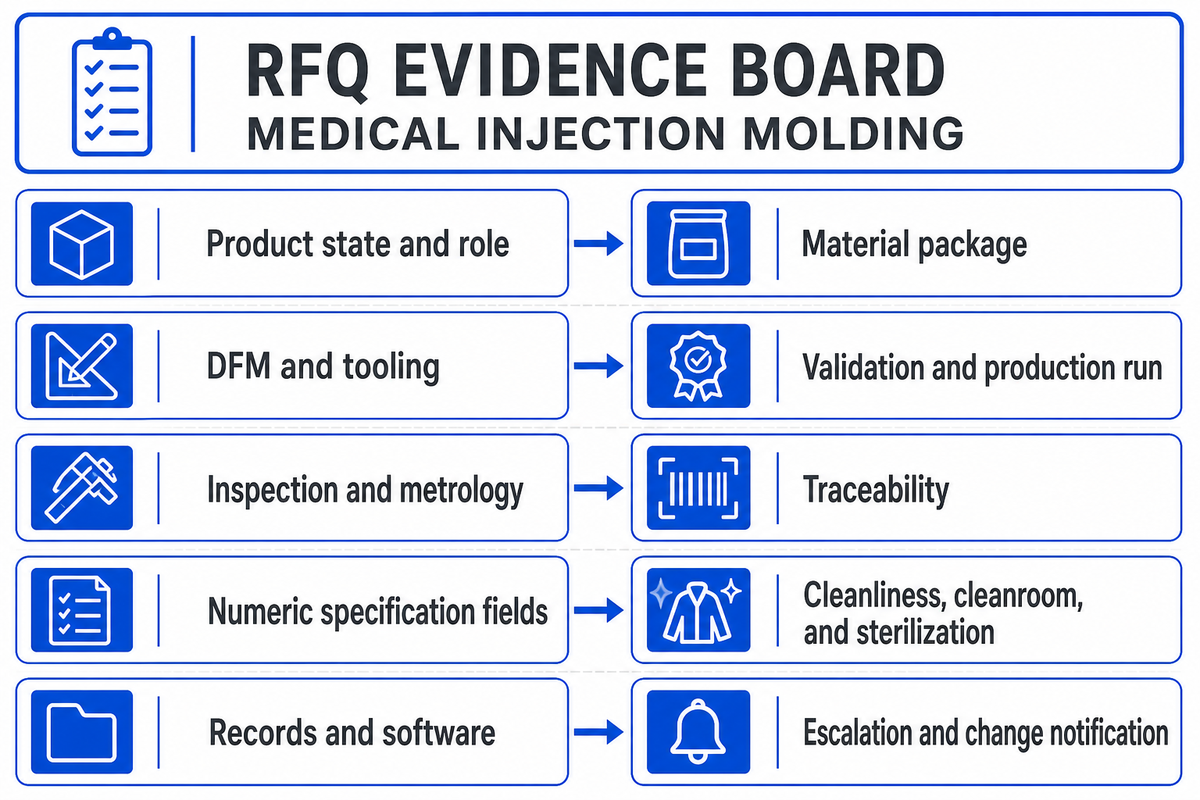
After the trigger matrix removes non-applicable branches, a strong RFQ can define evidence before price. If the buyer cannot state the contact type, sterilization route, inspection plan, and change-control expectations, the supplier is forced to quote assumptions instead of requirements.
When comparing medical injection molding companies, do not start with a generic medical injection molding requirements PDF. Start with a role-specific evidence map that separates baseline molding controls, buyer specifications, and regulatory-review triggers.
| Requirement Type | What To Ask For |
|---|---|
| Product state and role | Component, accessory, finished device, packaging or assembly interface, and each party’s quality-system responsibility. |
| Material package | Resin grade, additives, colorants, certificates, storage and drying controls, permitted regrind, and substitution rules. |
| DFM and tooling | Mold-flow concerns, gate location, weld-line risk, ejection, draft, tolerances, cavity plan, tool maintenance, and transfer controls. |
| Validation and production run | IQ/OQ/PQ expectation, process-window rationale, worst-case runs, nominal run duration, startup rules, and revalidation triggers. |
| Inspection and metrology | Critical dimensions, sampling plan, calibrated instruments, method capability, measurement uncertainty, and release criteria. |
| Traceability | Material lot, production batch, machine, operator, tool, cavity where needed, inspection data, and retention period. |
| Numeric specification fields | Use buyer-approved limits, not copied examples. RFQs often need units for tolerances such as 0.01 mm, 0.05 mm, or 0.10 mm; pin diameters such as 1 mm or 2 mm; particulate bins such as 10 um or 50 um; drying records such as 2 hours, 4 hours, 8 hours, or 24 hours; cycle records such as 30 sec; pressure such as 500 psi or 80 MPa; residence-time limits such as 10 min; regrind rules such as a buyer-approved percentage or no regrind; and aging such as 7 days, 180 days, 12 months, or 3 years. |
| Cleanliness, cleanroom, and sterilization | Cleanroom class if needed, product cleanliness limits, bioburden, endotoxin, packaging, sterilization method, and interface owner. |
| Records and software | Production records, batch records, electronic-record expectations, automated inspection logic, traceability systems, and CSA evidence where applicable. |
| Escalation and change notification | Nonconformance, rework, CAPA, complaint feedback, field-action support, supplier notification timing, and buyer approval requirements. |
How Engelhardt-Meitu Fits Plastic Injection Molding Projects
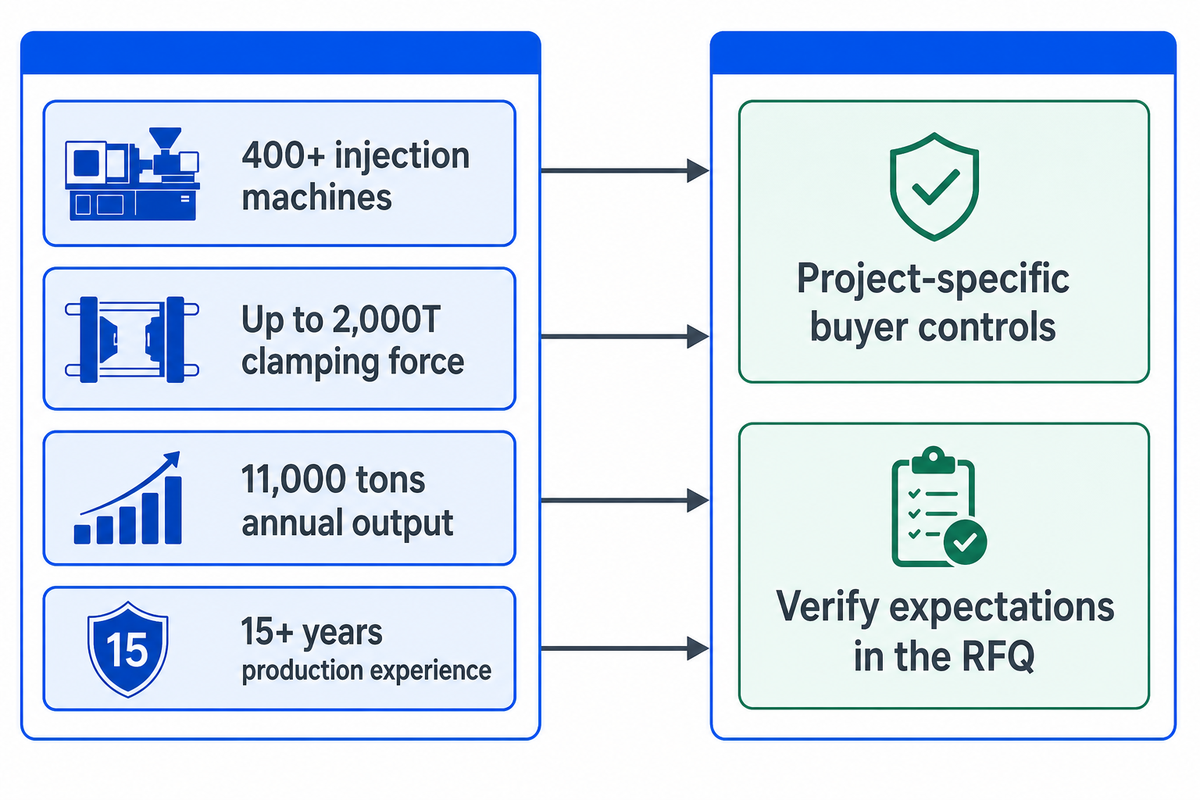
With that RFQ boundary in place, the checklist should be applied to the supplier’s real manufacturing surface, not to a generic vendor profile. Engelhardt-Meitu is positioned as a custom molding and multi-process manufacturing partner with plastic injection molding, rubber and silicone molding, precision hardware, in-house mold work, assembly, packaging, and quality-lab capabilities. Its public plastic molding page describes 400+ injection machines, up to 2,000T clamping force, 11,000 tons annual output, and 15+ years of production experience.
For medical projects, treat those capabilities as manufacturing context and pair them with project-specific buyer controls. Before launch, define the material evidence, DFM review, inspection method, traceability plan, cleanroom or packaging interface if required, and supplier change-notification rules. If the buyer needs ISO 13485 certification, sterile-device documentation, or FDA submission-supporting evidence, those expectations should be named in the RFQ and verified for the specific project.
Engelhardt-Meitu Capability Boundary
Use Engelhardt-Meitu’s custom plastic injection molding capabilities for DFM, tooling, molding, material selection support, secondary operations, and production planning. Use the buyer’s device-risk file, quality agreement, and regulatory strategy to decide which medical evidence is required.
FAQ
What are the main medical injection molding requirements?
Main requirements include material selection, biocompatibility or chemical-risk evidence where applicable, QMS and supplier controls, process validation where inspection is not enough, contamination control where needed, inspection and metrology capability, traceability, and documented change control.
Do medical injection molding suppliers need ISO 13485?
Some buyers require ISO 13485 certification. Others qualify a supplier under buyer-controlled purchasing requirements and quality agreements. Correct scoping depends on product role, risk, buyer policy, and whether the supplier performs covered finished-device work. A sourcing team should state the requirement before quoting, because it changes audit depth, record retention, validation support, complaint-feedback routing, software evidence, and change-notification language. If a supplier lists ISO 9001 or automotive certifications but not ISO 13485, treat that as capability context rather than medical-device QMS proof.
When is cleanroom injection molding required?
Cleanroom molding is required when contamination risk, sterile-device strategy, assembly route, packaging path, or buyer specification requires environmental control. It is not universal for every molded medical component.
Which materials are used in medical injection molding?
PP, PE, PC, ABS, PEEK, TPE, and silicone are common families. Material choice depends on contact type, mechanical load, chemical exposure, sterilization, aging, additives, colorants, and the evidence needed for the finished device.
What makes process validation representative?
Representative validation uses production-equivalent tooling, material, equipment, parameters, inspection methods, and run duration. It should address worst-case settings, nominal production duration, startup or restart behavior, cavity balance, and revalidation triggers.
References & Sources
- FDA: Quality Management System Regulation (QMSR)
- Federal Register: Medical Devices; Quality System Regulation Amendments
- eCFR: 21 CFR 820.1 Scope
- FDA: Use of International Standard ISO 10993-1
- FDA: Sterilization for Medical Devices
- FDA: Computer Software Assurance for Production and Quality System Software
- FDA: Deciding When to Submit a New 510(k) for a Change to an Existing Device
- FDA: Special Considerations for 510(k)s