Get in Touch with Engelhardt


Two shot molding is a plastic injection molding process to make one component with two materials, two colors or two functional surfaces, in a coordinated series of molding steps. It’s relevant if the design is well established, the annual volume is high enough, the bond can be tested and the additional tooling price can replace assembly, painting or other joining.
Process definition matters. Some suppliers use “two-shot”, “2K”, “dual-shot” and “multicomponent injection molding” with subtle distinctions. Buyers should clarify what the machines and mold do: rotary indexing, moving cores, multiple injection units, robot transfer between mold cavities or a subsequent secondary molding operation. Route choice is more important than the label on the quote.
Short Answer
Use two shot molding when the single molded component requires a rigid/soft interface, two colors, sealed surfaces or assembly removal for high volume production. Use standard plastic injection molding, insert molding, or a staged secondary molding route when the design is low volume, in flux or requires easier later separation of materials.
What Is Two-Shot Molding?
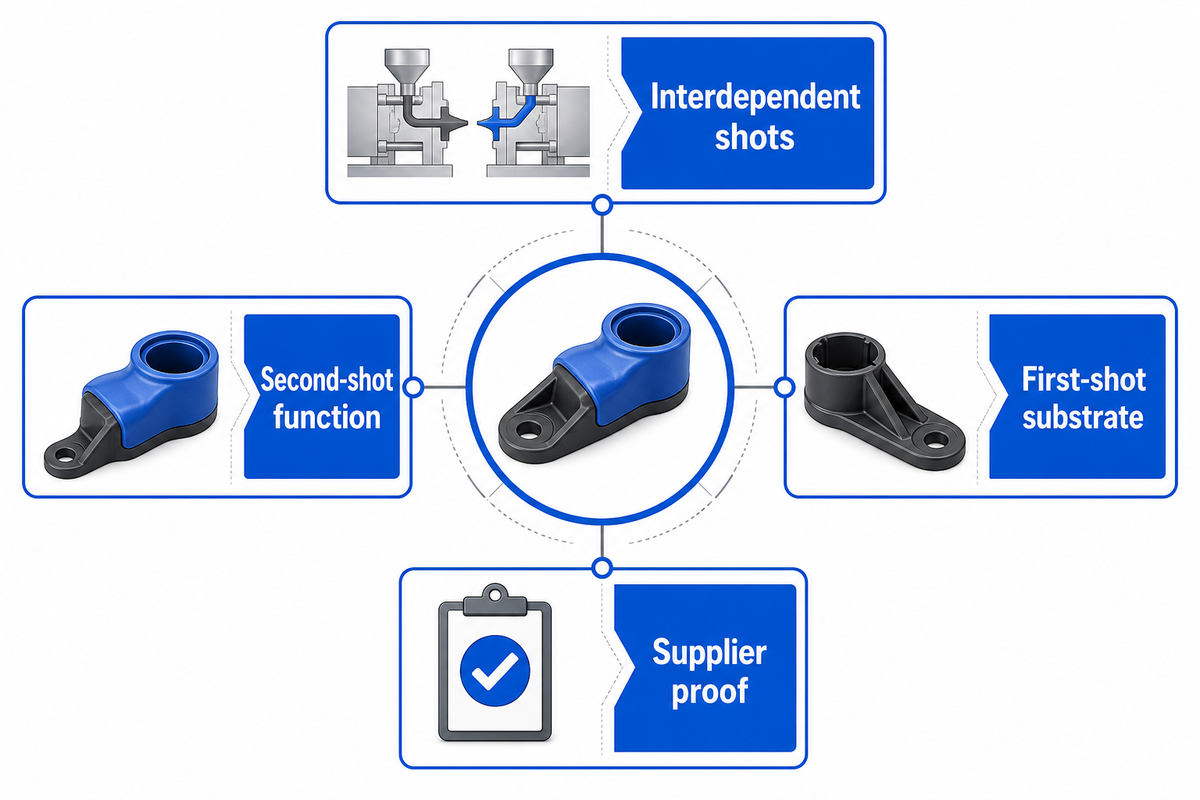
Two shot molding produces a multi-material or multi-color component in two interdependent shots of thermoplastic or elastomer. First-shot material prepares a substrate or basic feature. Second-shot material bonds, seals, colors or softens part of the initial shot geometry. Typical cases include a hard enclosure with a soft grip, a black and white control switch, a sealed connector or a two-shaded cosmetic cap.
In purchasing dialogs “two-shot molding” blurs with “two-shot injection molding”, “2K molding”, “dual-shot molding” and “two-component injection molding”. This paper uses those terms for decisions relating to plastics and rubber-plastic parts, not for the legends on keycaps or other unrelated consumer “double shot” products.
In academic manufacturing writings, multi-material injection molding is distinguished from standard single-material processes by the presence of a previously molded part in the second molding step. This adds process control checks on the sequence, mold motion, interface geometries and ejection forces, beyond resin choice.
Krauss-Maffei current guidance for multicomponent equipment divides the process routes into mold technologies like sliding split, turntable, index plate, sliding table or transfer. This supports a route-specific classification: the quote should specify how the first shot is handled prior to second-shot injection.
For buyer review, compare the academic definition of later molding stages with current multicomponent equipment routes. A credible factory answer should name the first-shot handling route, second injection unit, material pair, and validation samples from a similar project.
Treat two-shot molding as a process route to prove, not a label to accept. The RFQ should make the supplier show the cell architecture before the design moves to steel.
How The Two-Shot Injection Molding Process Works
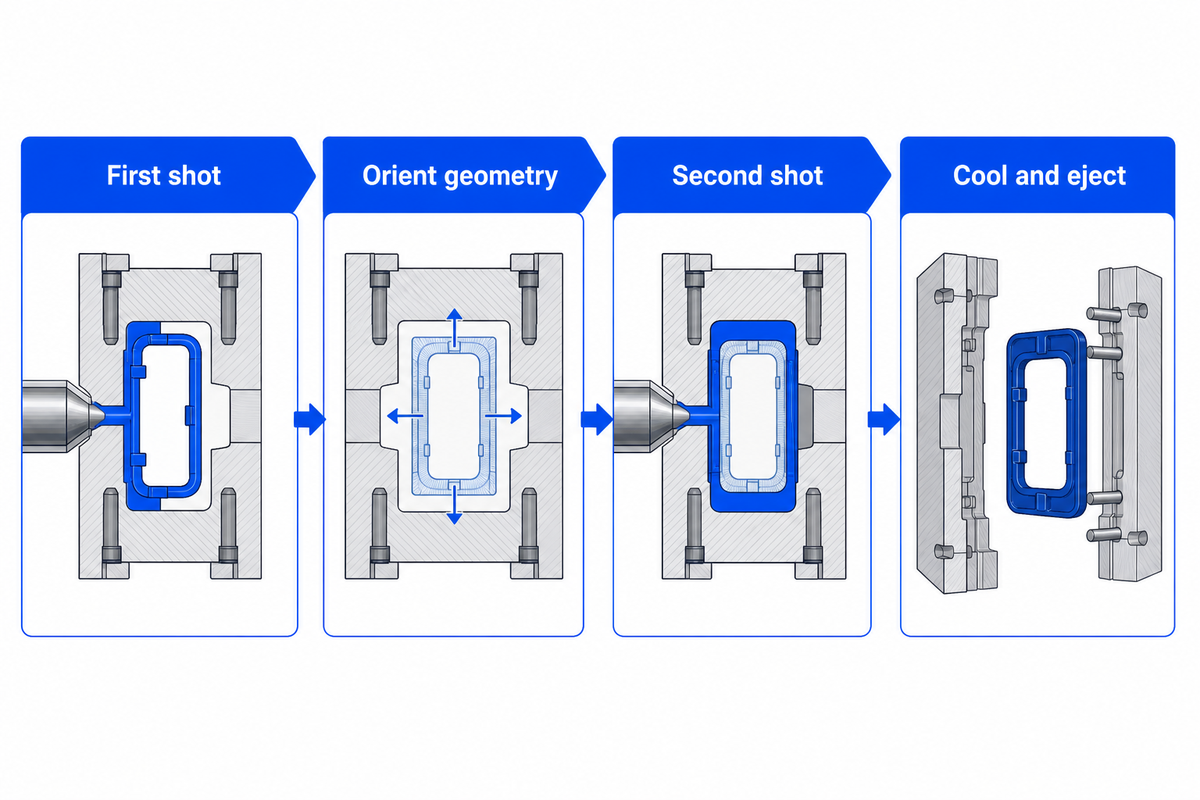
A typical route comprises four process steps: produce first shot, orient first-shot geometry for second shot, inject second shot, then cool and eject the formed component. In an injection molding process review, the orienting stage decides whether the quote describes one controlled multicomponent cell or a looser transfer operation.
| Step | What Happens | Engineering Risk |
|---|---|---|
| First shot | A rigid or base material fills the first cavity. | Shrinkage, datum stability, and surface temperature affect the second shot. |
| Index, rotate, move core, or transfer | The first-shot element is positioned for the second material. | Alignment, mold motion, robot controls, and shut-off faces decide flash and registration. |
| Second shot | A second material or color is injected against selected first-shot surfaces. | Pressure, gate direction, overlap area, melt temperature, and flow rate affect bond strength. |
| Cooling and ejection | The finished part cools and exits as a single component. | Different materials may shrink, grip, or deform at different rates. |
Route-specific terminology is necessary. A robot moving a component between mold halves can be present in advanced injection molding literature. At the same time, conventional molding over a preformed part often means re-molding in a second operation. When reviewing a quote, ask the supplier to describe the cell layout rather than use “two-shot” as a proxy.
In transfer-style 2K, the preform may be transferred out of the first cavity by robot, placed into another cavity, and then closed to make the second component. That’s why this guide considers robot transfer as a viable multicomponent architecture, though it remains to consider if the transfer occurs within a validated cell or outside it.
Two-Shot Molding vs Overmolding vs Insert Molding
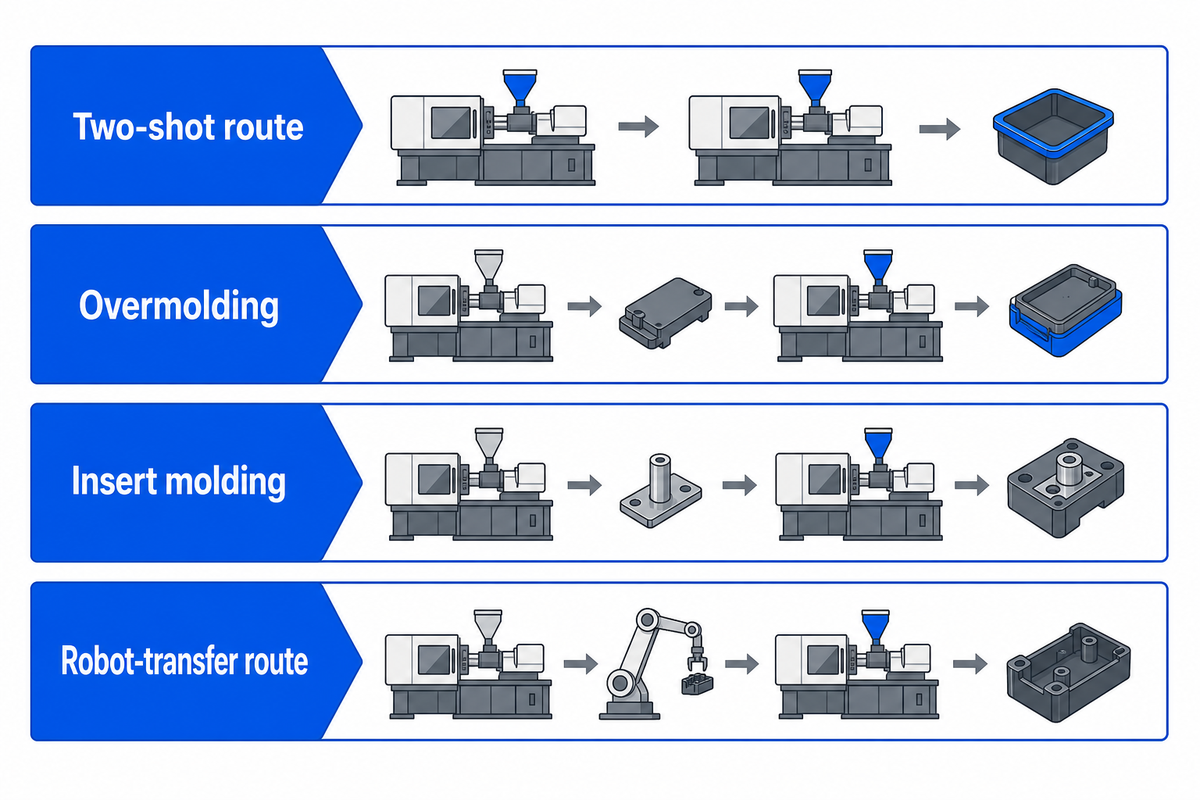
Route selection depends on volume, material behavior, assembly target, tolerance stack, and how much freedom the design still requires; multi-material manufacturability research treats those choices as design-stage constraints. A stable automotive button may use a two-shot tool. A low-volume handle with changing grip geometry may be better achieved as overmolding. A connector with metal contacts may need insert molding.
| Route | Best Fit | Ask Before Tooling |
|---|---|---|
| Two-shot / multicomponent molding | High-volume parts with stable geometry, repeatable color/material placement, and assembly reduction. | Which machine architecture, injection units, and validation history support the route? |
| Overmolding | Material flexibility, lower initial validation burden, or parts that can be molded over in a later step. | How will the preform be located, heated, cleaned, and bonded? |
| Insert molding | Metal threads, contacts, bushings, pins, terminals, or other placed inserts. | How are inserts loaded, retained, and protected from shift during injection? |
| Robot-transfer route | Can be part of a multicomponent cell or a separate secondary molding operation, depending on tooling and validation. | Is the transfer inside one controlled molding cell, or is it a separate operation with its own variation? |
Material And Process Risk Matrix
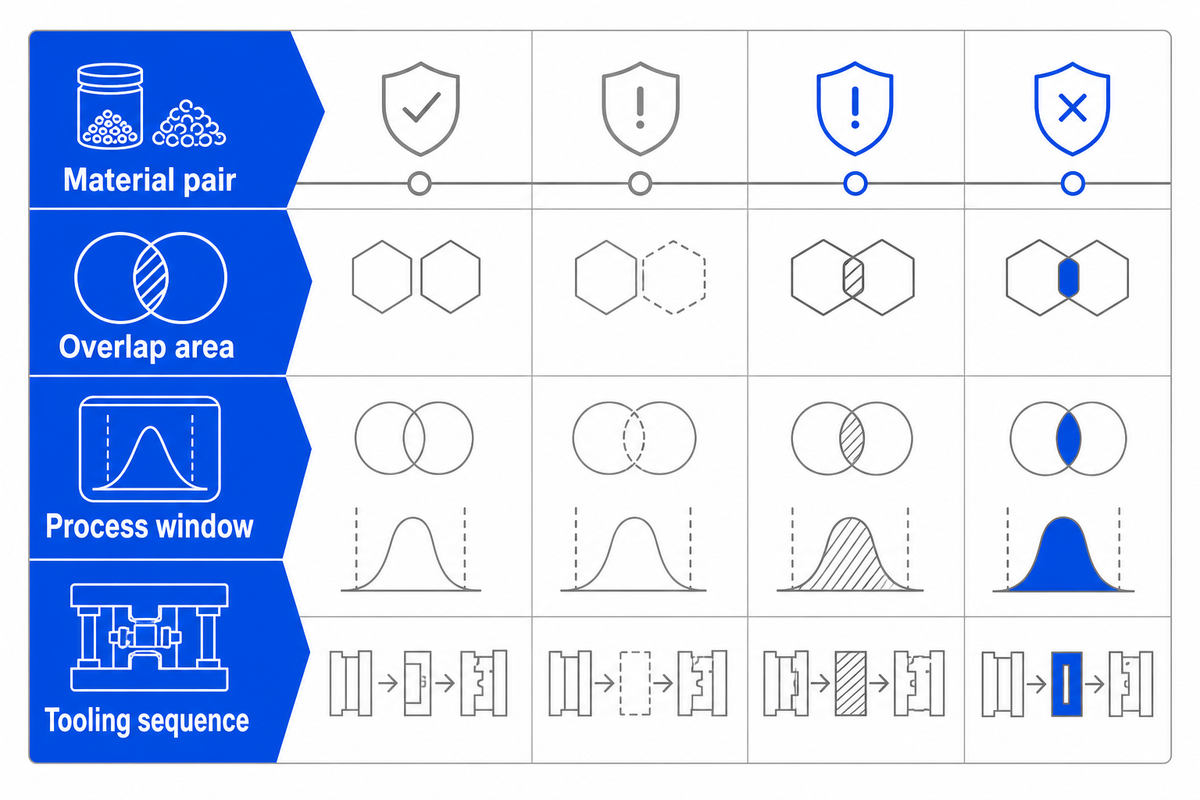
Material compatibility is relevant, but not the sole criterion. Typical first-shot selections are ABS, PC/ABS, PP, PA, PBT, and other rigid engineering plastics. Typical second-shot selections are TPE, TPV, TPU, LSR, EPDM, and nitrile materials. Supplier testing should cover the exact commercial grade, colorant, additive, surface texture, and processing window.
In recent injection molding research on multicomponent bonding, such as adhesive strength increasing with overlap area, a 2024 Journal of Manufacturing Science and Engineering paper on two-shot bi-injection, secondary molding, and bond strength considers mold temperature and melt temperature as bond-strength variables. Still, a material pair may appear in the acceptable zone of a chart, but fail due to weak interface geometry or process window.
| Risk Gate | What To Check | Why It Matters |
|---|---|---|
| Material pair | Grade, hardness, shrinkage, melt temperature, additive package, and colorant. | Resin-family names alone do not prove adhesion. |
| Overlap area | Contact length, mechanical locks, undercuts, texture, and interface width. | Small overlap can reduce bond margin even when the materials are compatible. |
| Process window | Injection flow rate, melt temperature, mold temperature, first-shot cooling, and second-shot pressure. | Bond strength can move with processing, not just resin chemistry. |
| Tooling sequence | Shut-off faces, gate direction, venting, rotary/indexing accuracy, and robot transfer controls. | Flash, distortion, or registration drift can turn a good concept into a poor production part. |
Common Applications: Where Two-Shot Molding Makes Sense
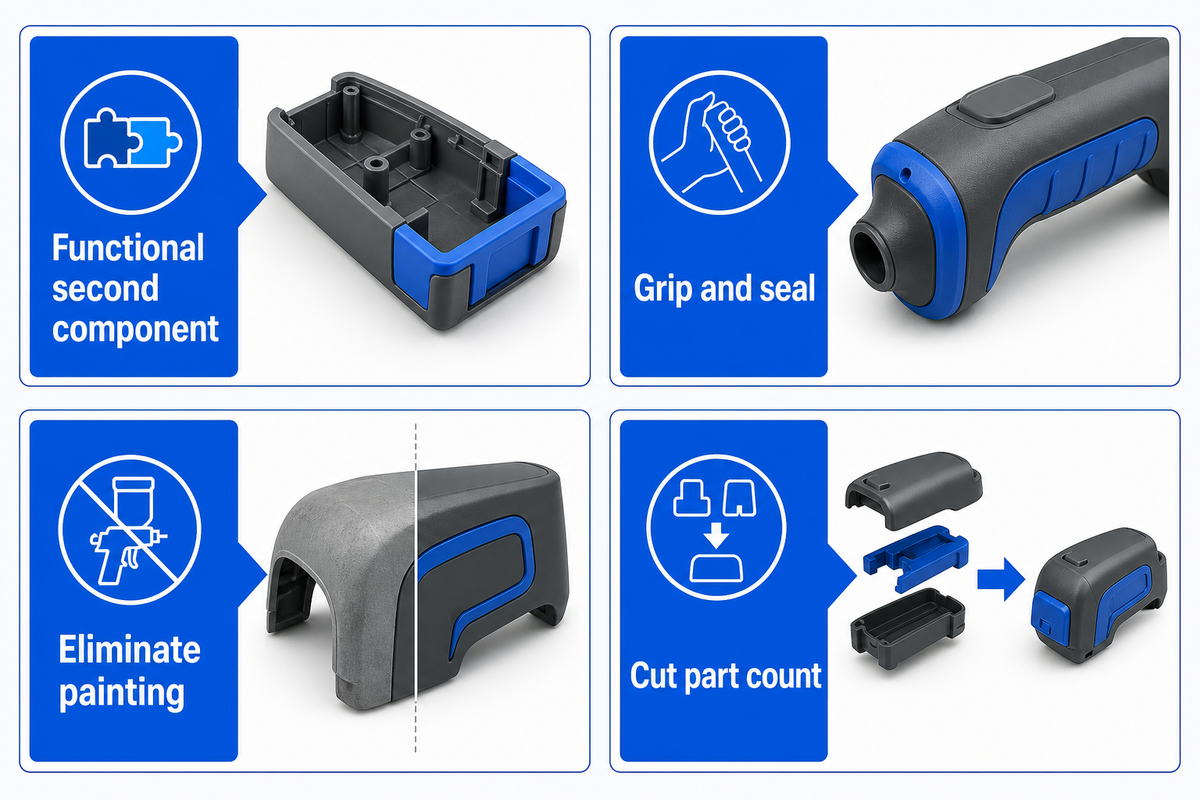
Two-shot molding is optimal when the second component provides a significant function or eliminates a secondary process, provided the interface is validated against the process parameters that affect adhesive strength. Typical application sets include automotive interior control buttons, appliance controls, consumer electronic components, soft-touch handles, multi-color caps, sealed connector interfaces, gasket applications, and assemblies where manual joining creates repeatability risk.
Value isn’t limited to “prestige appearance.” Hard/soft interfaces can benefit gripping and sealing. Two-color parts can eliminate painting. Second materials can form gaskets and edges, add surfaces, or cut part count. Design advantages grow when the production run repeats and interface conditions can be test molded before steel is allocated.
When To Use Two-Shot Molding
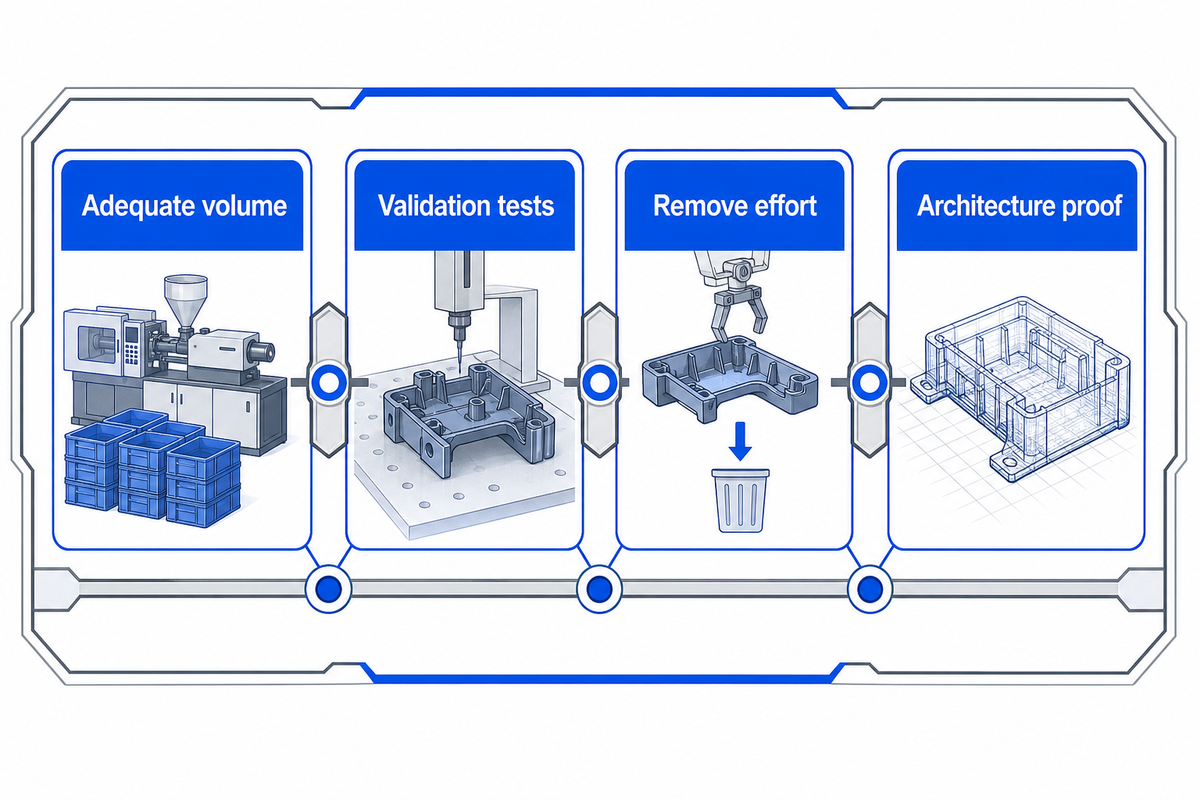
The bottom line is The Two-Shot Payback Gate: use two-shot molding only when production savings and finished-part benefits offset the investment in tooling, validation, and process controls. It works best after the design, material pair, interface geometry, and tolerance target are stable enough to test.
- Annual volume is adequate; if the part repeats in thousands, tooling makes more sense.
- Material combinations work only after validation. Perform bonding, peeling, tearing, sealing, or aging validation tests with the mold closed.
- Second-shot material removes effort. Common goals are bonding, painting, gasketing, manual joining, and color separation.
- Equipment suppliers should demonstrate shop-floor proven capability. Request multiple injection units, rotary, indexing, or transfer architecture, controls, and previous two-shot qualification, not just press capacity.
Engelhardt, a public source of injection molding information, supports a general context of broad injection molding capability including machine range, shot size, and tolerance recommendations. It shouldn’t be considered sole proof of the feasibility of all two-shot routes for all applications. A dedicated RFQ should request the exact cell architecture and validation plan.
When Not To Use Two-Shot Molding
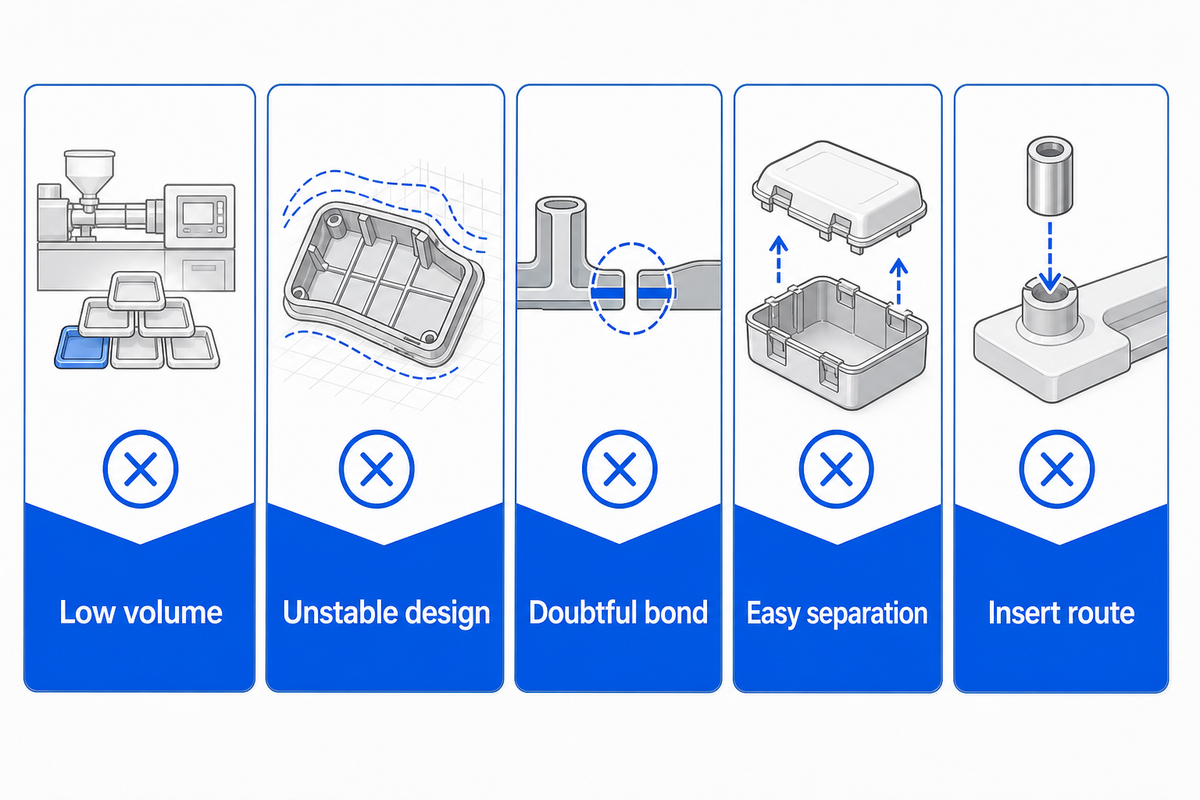
Two-shot molding isn’t always the right choice over standard injection molding plus later assembly or overmolding. It might be the wrong choice when design certainty, low volume, material risk, easy separation, or end-of-life considerations are more important than cycle time.
- Low volume: If needed only at low annual volumes standard injection molding with subsequent assembly might be more economical.
- Unstable design: Two-shot tooling locks interface geometry early. Maintain flexibility if the product is still evolving.
- Doubtful bond: if bond testing is not ready, do not hide that risk inside an expensive production tool.
- Easy separation is essential: permanently fused mixed-material components can be problematic where uniform, low-contamination waste streams are important for recycling.
- Metal or electronic inserts: the path for threads, pins, contacts and terminals will usually be insert molding.
NIST points out that mixed plastics, combined with contamination, can be an impediment for recycling, while effective recycling usually thrives on uniform, low-contamination waste streams. Two-shot parts are not off limits; product designers simply need to discuss separation early for a more sustainability-focused consumer product.
Product Design And Tool Design Checks Before Tooling
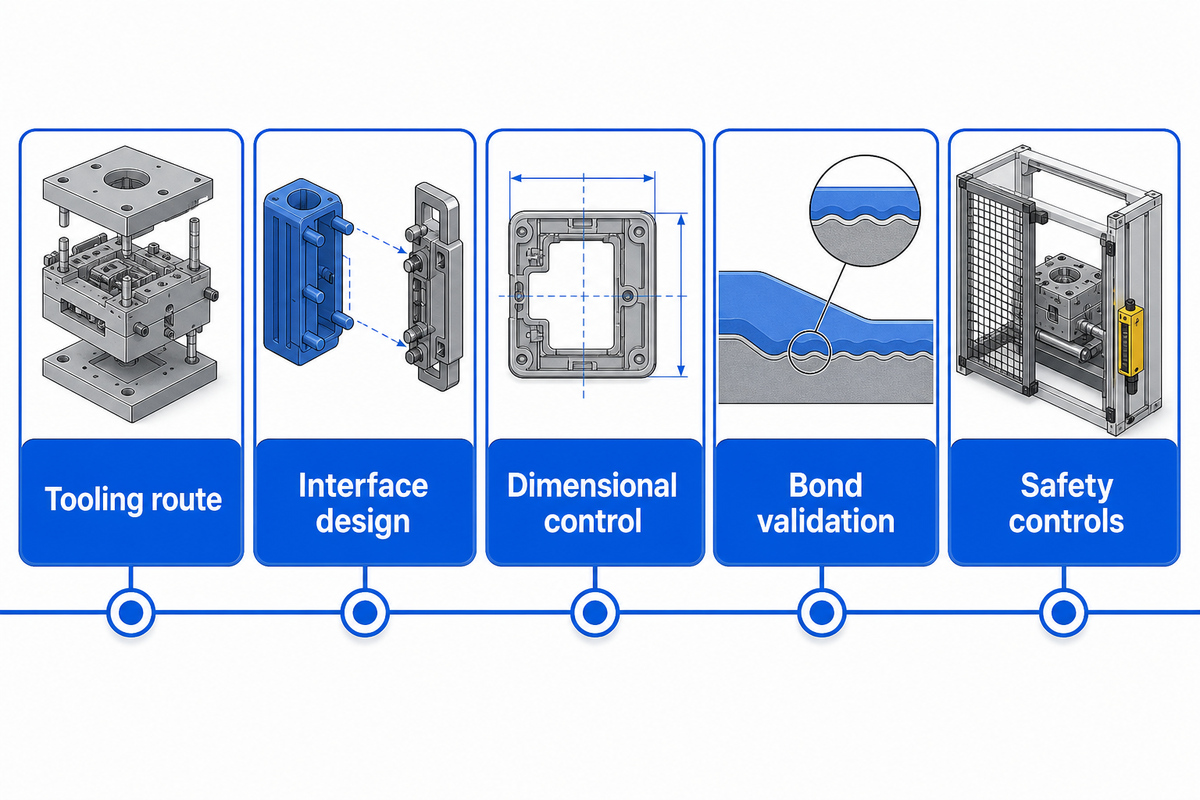
Before buying a 2-shot tool, consider the job from the viewpoint of a manufacturing process. General press capacity, clamping force, or tolerance range can help screen a supplier, but they cannot replace detailed process analysis of the potential second shot.
| Check | Evidence To Request |
|---|---|
| Tooling route | Machine layout, injection units, rotary/indexing or robot-transfer description, and control plan. |
| Interface design | Overlap area, shut-off faces, gate direction, venting, draft, and mechanical lock features. |
| Dimensional control | Datum scheme, shrinkage assumptions, tolerance stack, T1 report, T2 report, and inspection plan. |
| Bond validation | Peel, pull, shear, seal, thermal aging, chemical exposure, or drop-test method tied to real use. |
| Safety and production controls | Guarding, interlocks, hot-surface controls, ventilation, material safety data, pellet housekeeping, noise controls, adjacent robot guarding, and LOTO rules for servicing or guard bypass. |
OSHA’s lockout tagout standard applies to hazardous-energy control for servicing and maintenance only; those rules are not universal production instructions. OSHA’s machine guarding guidance for injection molding machines also identifies normal production hazards like barrel heat, melted plastic splatter, gases/vapors, ventilation, pellet housekeeping, noise and the adequacy of guards and interlocks. List these out as activity-specific observations, not sourcing articles, and not a substitute for professional advice.
RFQ Checklist For A Two-Shot Molding Project
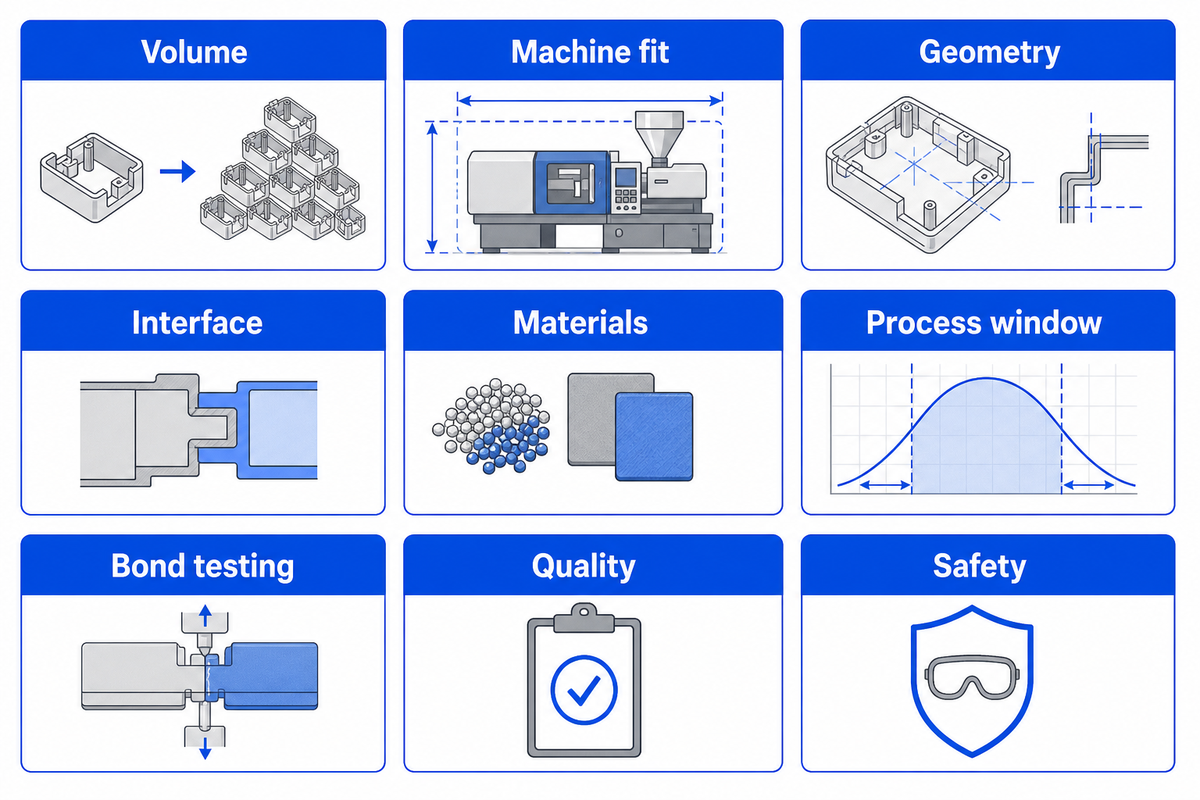
A useful RFQ should introduce greater certainty. No supplier can price and validate 2-shot molding from a CAD file alone without knowing the material combination, interface function, test method, and production pathway.
9-Point Two-Shot Qualification Matrix
| Category | RFQ Field | Unit Or Evidence To Request |
|---|---|---|
| Volume | Annual demand and production life | pcs/year, launch date, and expected years in production |
| Machine fit | Clamp force, shot size, and injection units | tons, g or cm3 shot size, and number of injection units |
| Geometry | Critical dimensions and tolerance stack | mm tolerance targets, datum scheme, and inspection points |
| Interface | Overlap area and shut-off design | mm2 contact area, texture callouts, and shut-off face drawings |
| Materials | First-shot and second-shot grades | resin grade, Shore hardness, melt temperature in deg C, and colorant package |
| Process window | Cycle time, flow rate, and cooling assumptions | seconds/cycle, cm3/s flow target, mold temperature in deg C |
| Bond testing | Peel, pull, shear, seal, or aging method | N, MPa, hours at temperature, chemical exposure, or drop height |
| Quality | T1/T2 reports, scrap criteria, and appearance limits | Cpk target, % scrap threshold, color delta, and sample size |
| Safety | Guarding, robot cell, ventilation, and maintenance plan | interlock check, exhaust method, dB noise review, and LOTO procedure for servicing |
Two-Shot RFQ Inputs
- 2D drawing, critical datum scheme, appearance zones, and 3D CAD.
- First-shot and second-shot resin grades, color, hardness, and regulatory requirements.
- Annual volume, target cycle time, expected production life, and production launch date.
- Bond, peel, pull, seal, drop, aging, or chemical-resistance requirements.
- Overlap-area assumptions, shut-off faces, gate direction, and surface-texture requirements.
- Required tooling route: rotary/indexing, movable core, robot transfer, or supplier-defined architecture.
- Injection units, mold-transfer controls, similar validation history, and T1/T2 inspection plan.
- Alternative routes to analyze: insert molding, standard molding, or a staged secondary molding route.
Two-Shot Mold Tool Design Terms For RFQ
Use this language checklist to make the supplier describe the actual mold, mold layout, process route, and acceptance evidence. It reduces the risk that a quote for two-shot mold work is really a looser secondary overmold operation with fewer process controls.
| RFQ Area | Terms To Confirm | Why It Matters |
|---|---|---|
| Machine and mold | Injection molding machine, standard injection molding machine, platen, mold components, cavity count, injection unit, independent injection unit, and tool design. | A supplier should prove how the mold opens, closes, indexes, rotates, or transfers the first molded part before steel is cut. |
| Process name | Shot injection, shot injection molding, two shot injection molding, two-shot plastic injection molding, two-shot molding process, two-shot injection molding process, multi-shot, multi-shot injection molding, 2-shot molding, and 2K molding. | The naming should match the real manufacturing process, not a generic plastic molding label copied into a quotation. |
| Material sequence | First injection, second material injection, first material is injected, second material is injected, two plastics, two plastic resins, two different materials, two or more materials, overmold surface, and overmolding material. | These phrases force the supplier to state whether two parts become one molded assembly, which material forms the substrate, which material bonds next, and whether the part is molded in the same tool. |
| Part outcome | Injection molded part, injection molded sample, two-shot injection molded sample, molded part, plastic parts, rubber molding interface, part to be molded, injected into a mold, cooled to form a solid, and form a solid part. | The review should connect the molding cycle to the final plastic part, not only to press capacity or tool size. |
| Production plan | Molding cycle, production runs, production efficiency, single process, two processes, one machine, sequential injection, second phase, product design, design phase, common applications, injection molding services, injection molding quote, molding capabilities, production of complex parts, bonding between the two materials, form a molecular bond, within a single tool, and wide range of industries. | These checks tie the mold, material pair, and production evidence back to repeatable output across the intended volume. |
Upload drawings for a molding review
FAQ
What is double shot molding?
Double shot molding is another name for two-shot molding.
This implies that two different materials and/or two colors were molded together to produce a single final part. In the RFQ, clarify whether the supplier’s quotation means rotary/indexed two-shot molding, multicomponent molding, robot transfer, or a separate secondary molding operation. Why does language matter here?
Several approaches can produce a similar underlying product, but each creates a different cost, validation scope, and operational risk for how the first-shot part is placed.
What are the key differences between two-shot molding and overmolding?
Two-shot molding is usually a coordinated multicomponent cell; overmolding usually molds over a preformed part in a later step, so buyers should verify whether both shots stay inside one controlled molding cell.
Boundaries are not always absolute because robot-transfer routes are used for multicomponent molding. A safer sourcing question is: what machine, mold, transfer method, and validation plan will be used? If the part is molded, removed, stored, and later transferred for other processing, buyers often call this a staged molding route. If the transfer is handled under control within a multicomponent molding cell, the supplier should prove that route with machine setup and sample validation.
What is two-component injection molding?
Two-component injection molding combines two molded materials or colors in one part through a machine, mold, and control plan designed for the full molding sequence.
They may use multiple injection units, rotary or indexing motion, movable cores or controlled transfer between cavities. For design for manufacturing, the exact set-up should be confirmed. For a buyer, the weight of the proof is not in the word, but in the supplier machine layout, mold-transfer plan, material test data and inspection proof that the two materials will bond repeatedly at the desired volume.
Is two-shot molding expensive?
Two-shot molding can be expensive up front because tooling and validation are higher, but it may reduce unit cost at high volume when secondary operations disappear.
Tool and validation costs need to be balanced against labor savings, fewer secondary processes, less scrap, more consistent sealing, or part count reduction. Low-volume or inconsistent designs often work better by a staged molding route or traditional molding.
Which materials can be used in two-shot molding?
Common pairs include rigid plastics with soft elastomers, but the exact grades, additives, colorants, surface texture, and process window must be tested before production tooling.
ABS, PC/ABS, PP, PA, and PBT may be used with TPE, TPV, TPU, LSR, EPDM or nitrile type materials depending on the design. Bonding test should confirm the precise grade, colorant, surface and process window.
Does two-shot molding replace insert molding?
No. Insert molding remains the better route when the part needs metal or electronic inserts such as terminals, contacts, bushings, pins, threaded features, or retained hardware.
Use insert molding for terminals, contacts, threads, bushings, pins or other placed parts. Use two-shot molding when both shots are molded materials and the second material provides function, color, grip or sealing.
References & Sources
- Plastic Injection Molding – Engelhardt
- Incorporating manufacturability considerations during design of injection molded multi-material objects – Research in Engineering Design
- Advanced Injection Molding Methods: Review – PubMed Central
- Effect of the Process Parameters on Adhesive Strength in Multicomponent Injection Molding – PubMed Central
- Multinject Multicomponent Injection Molding Technology – KraussMaffei
- Experimental Investigation of Processing Temperature Effect on Adhesive Bond Strength – Journal of Manufacturing Science and Engineering
- 29 CFR 1910.147 Lockout/Tagout – OSHA
- Horizontal Injection Molding Machines – OSHA
- U.S. Plastic Recycling Economy – NIST