Get in Touch with Engelhardt

Structural Foam Injection Molding: Process, Benefits & Applications

Injection Molding Guide
Structural foam injection molding is a foam-assisted thermoplastic molding process for large or thick plastic parts. For buyers, it is not just standard injection molding with bubbles added. It is a process family where resin, a blowing agent, mold cavity pressure, cooling, cell morphology, and part geometry decide whether a molded part gains useful stiffness, weight reduction, and production value.
For OEM buyers, the useful question is practical: when does this process help a large plastic part, and when does it add surface, validation, or compliance risk? This guide explains the process, its benefits, its limits, and the evidence a supplier should provide before you move a housing, enclosure, pallet, cover, or thick structural plastic part into production.
Fast answer
Choose structural foam when a large or thick thermoplastic part benefits from a cellular core, lower packing pressure, and stiffness per unit weight. Be more cautious when the part needs a polished cosmetic face, thin precision features, long service-life proof, chemical blowing-agent documentation, or end-use compliance evidence.
What Is Structural Foam Injection Molding?
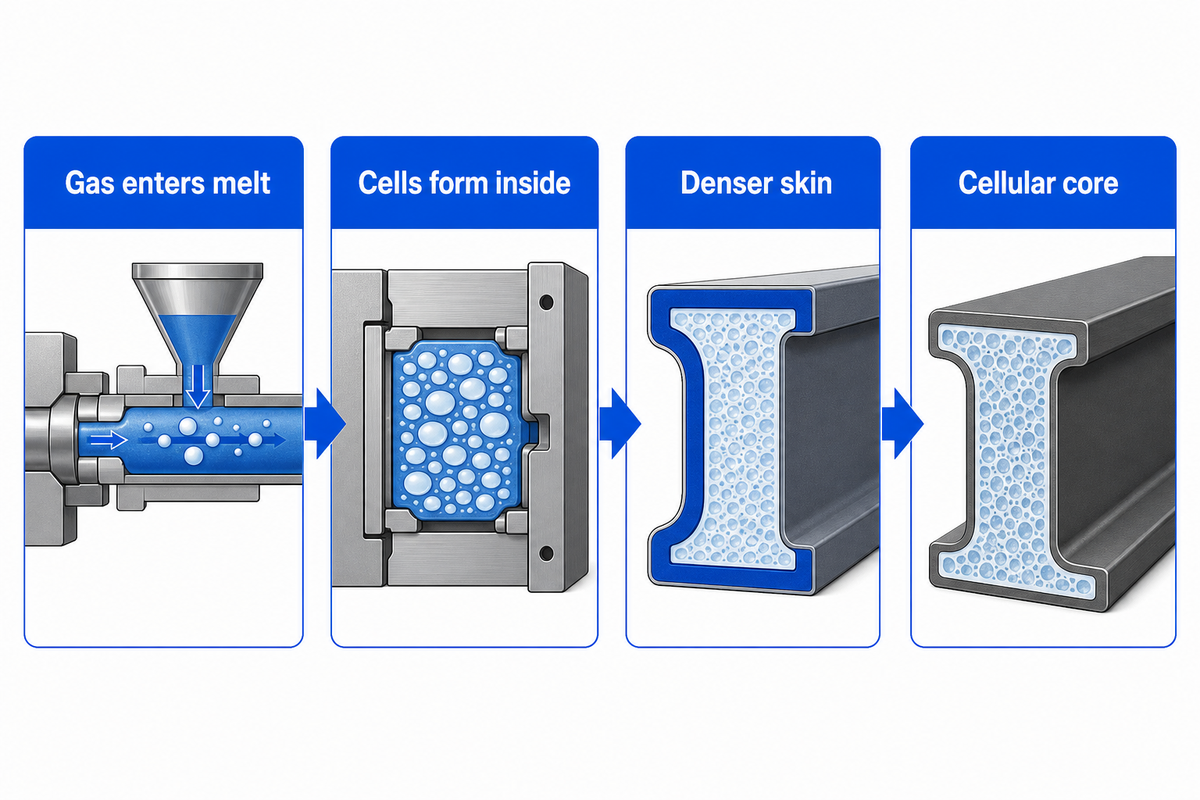
Structural foam injection molding is a plastic injection molding process family that introduces gas into a thermoplastic melt. The gas may come from a chemical blowing agent or a physical foaming route, depending on equipment and material. As the melt enters the mold cavity and pressure changes, cells form inside the part. A denser outer skin and a cellular core can give the part stiffness with less resin than a fully solid section.
That definition matters because the word “foam” is easy to misread. This is not rigid foam board, spray foam, or a soft cushioning foam. It is still injection molding of thermoplastic resin. The difference is that the injection molding process is designed around controlled foaming, cavity fill, cooling, surface expectations, and post-mold inspection.
Process-Family Boundaries: Structural Foam, Chemical Foaming, and Microcellular Molding

A buyer should not treat every foam molding paper, patent, or supplier page as evidence for the same production route. Conventional low-pressure structural foam, chemical foaming-agent molding, physical foaming, microcellular or MuCell-style molding, gas-counter-pressure molding, and mold-opening variants are useful RFQ categories because their equipment, pressure profile, cell size, cell distribution, surface remedies, and mechanical results may differ.
That does not make the subject too complex for a sourcing team. It means the RFQ should ask a precise question: “Which foam molding process are you quoting, and what evidence do you have for this material, wall section, surface requirement, and load case?” When buyers compare industrial molding processes, a supplier who answers only with generic low-pressure benefits still needs to connect the route to the actual part.
Engineering note: Treat the structural foam molding process and the structural foam molding machine as route-specific choices. The useful supplier answer is not “we can foam plastic”; it is a route, material, tool, venting, sample, and validation plan for the part in front of you.
3-Route Process Boundary Map
- Conventional structural foam: often discussed for large, thick, lower-pressure molded parts with a cellular core and denser skin.
- Chemical foaming-agent molding: depends on the agent, decomposition behavior, resin, processing temperature, and safety documentation.
- Microcellular or physical foaming: may use different equipment and can show different cell morphology and mechanical tradeoffs.
How the Structural Foam Injection Molding Process Works
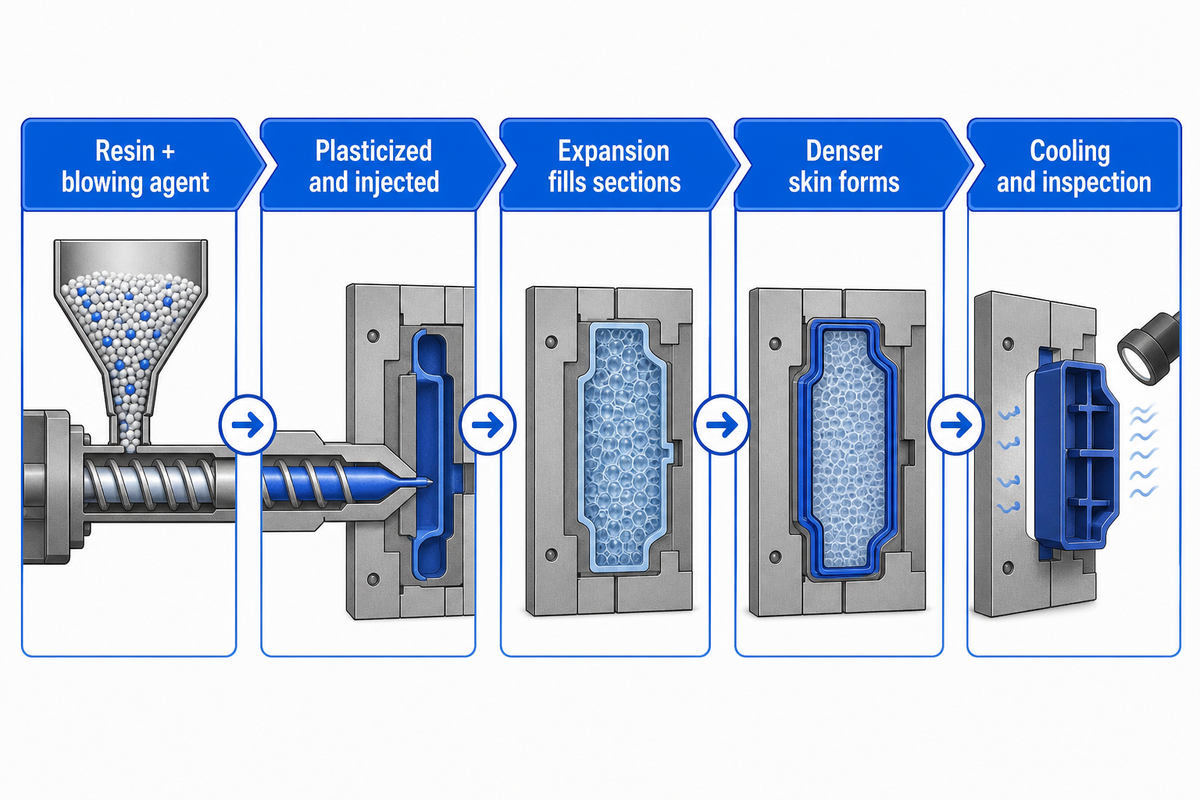
Building on that route-specific boundary, a buyer-level view of the process starts with thermoplastic resin and a blowing agent. The material is plasticized, injected into the mold cavity, and allowed to expand as pressure conditions change. The expanding material helps fill thicker sections, while the outer material against the colder mold wall forms a denser skin. After cooling and ejection, the part is inspected for dimensions, surface condition, weight, cell structure, and performance.
A more careful explanation adds an important limit: skin-core formation is not one universal clockwork sequence. Foam injection molding studies discuss factors such as pressure, re-dissolution, shear or fountain-flow effects, filling, cooling, polymer solidification, and bubble behavior near skin and core layers. For a buyer, this list is not a process recipe. It is a reason to ask how the supplier controls cell morphology, skin thickness, weight, dimensions, and part performance for the quoted route.
- Material definition: resin family, grade, filler or reinforcement, color, additives, and blowing-agent route.
- Mold and gating review: cavity volume, projected area, wall section, ribs, bosses, venting, knit-line risk, and surface texture.
- Injection and foaming: shot size, melt temperature, pressure, screw control, and expansion behavior.
- Cooling and ejection: dimensional stability, cooling balance, warpage risk, and surface variation.
- Validation: weight, visual standard, dimensional report, mechanical tests, and service-life checks when the part needs them.
A sample report format can list actual recorded values such as 230 °C melt temperature, 40 °C mold temperature, 15 sec cooling time, 35 bar back pressure, 80 rpm screw speed, 0.2 mm dimensional change, 250 hr aging exposure, 48 hr chemical soak, 3.0 kg part mass, and density-reduction target. Those are example reporting fields, not recommended settings.
Structural Foam vs Conventional Injection Molding
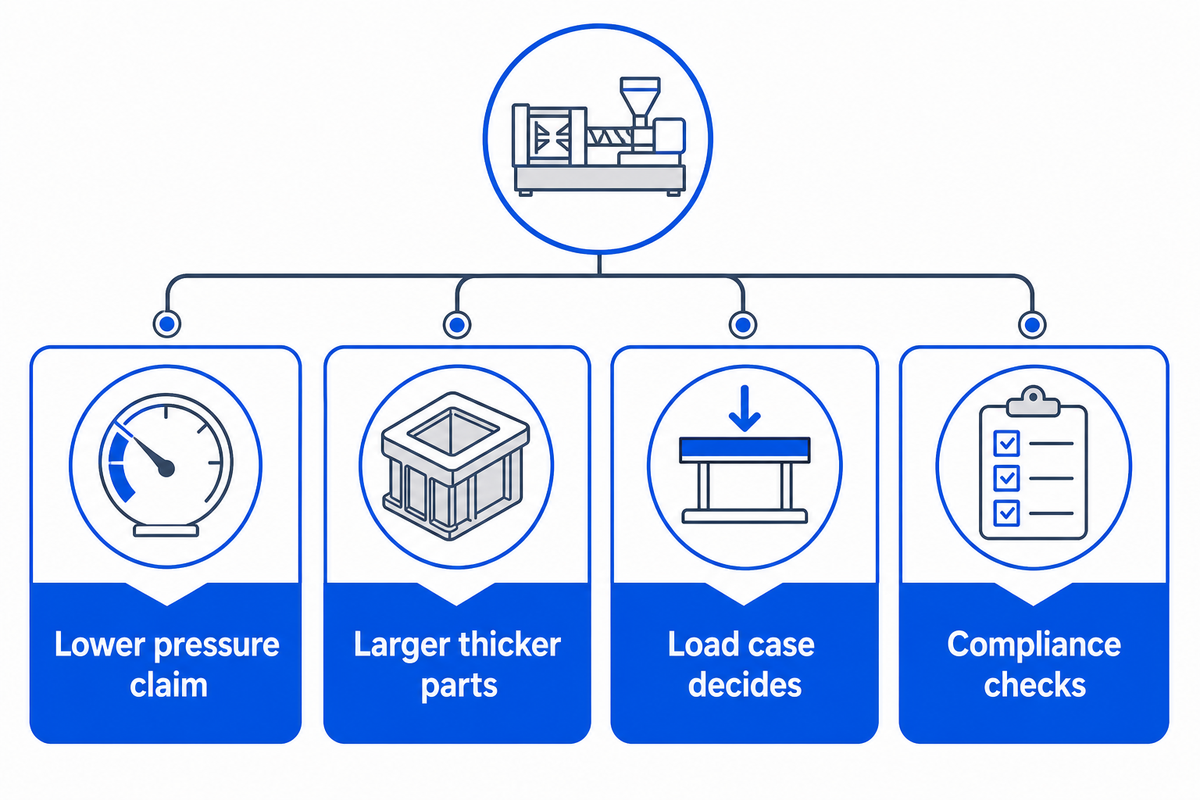
A common comparison says structural foam uses lower pressure and supports larger, thicker plastic parts. That is often useful, but it is not the full decision. For a real part, the process route, morphology, wall section, material, high pressure or low pressure route, and load case should decide whether a foam route is better than conventional injection molding.
The Clamp-Tonnage Relief Map is a buyer shorthand, not a promise. Searches such as structural foam injection molding cost, structural foam injection molding manufacturers, and structural foam injection molding machine all point back to the same question: do lower packing pressure and clamp-force relief actually help this drawing after surface, load, and compliance checks?
| Category | Conventional injection molding | Structural foam molding | Buyer check |
|---|---|---|---|
| Pressure | Higher packing pressure is common. | Lower packing pressure may be possible. | Confirm the quoted route and part size. |
| Clamp force | Projected area can drive tonnage. | Large parts may offer favorable economics at lower clamp force. | Ask for tonnage calculation. |
| Wall thickness | Thick walls can create sink and long cooling time. | Thicker sections may be more practical. | Review ribs, bosses, and transitions. |
| Weight | Solid section uses more resin. | Qualified vendor data often cites material or weight reduction. | Treat ranges as part-specific. |
| Surface | Better suited to fine cosmetic surfaces. | Swirl, streaks, or texture variation may appear, or a secondary finish may be needed. | Define the visible face standard. |
| Mechanical response | Solid material response is easier to model. | Cell structure, density, and skin thickness affect results. | Test the real geometry. |
| Service life | Still needs application testing. | Creep, fatigue, temperature, UV, and chemicals may be decisive when the end use exposes the part to them. | Name the exposure profile. |
| Compliance | Driven by resin and end use. | Adds blowing-agent and process documentation questions. | Request SDS and declarations. |
| Best fit | Smaller, thinner, cosmetic, precision parts. | Large covers, housings, pallets, bins, panels, and thick structures. | Match process to load and appearance. |
Benefits, Limits, and Tradeoffs
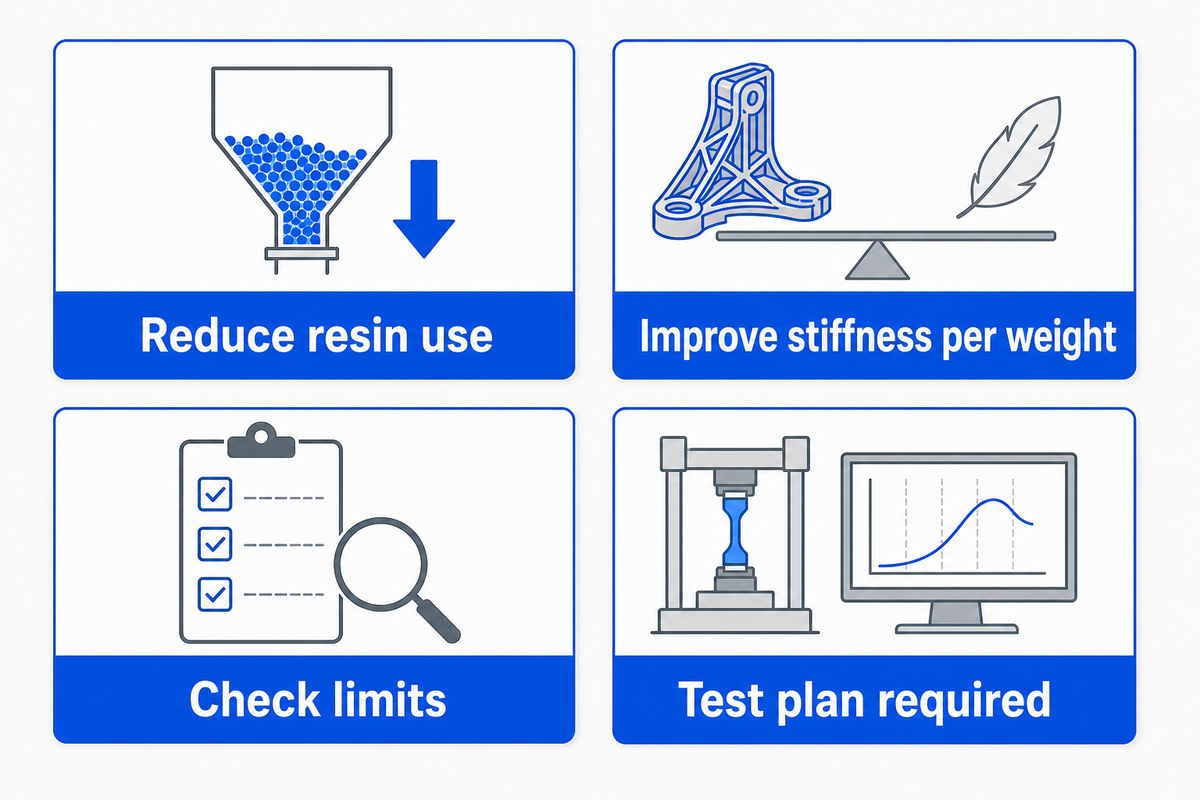
Structural foam molding can reduce resin use, lower molded-part weight, improve stiffness per unit weight, reduce sink in thick areas, and make very large plastic parts more feasible. Some vendor and cost-analysis sources discuss figures such as 8-15% weight reduction or material density around 60-80% of a comparable solid molded part, but those numbers should stay qualified. They depend on material, geometry, foam ratio, process route, and acceptance criteria.
5-Gate Skin-Core Fit Test
The Skin-Core Fit Test keeps the benefit claim tied to the actual part instead of treating every thick plastic component as a foam candidate.
- Geometry gate: Does the part have enough wall section for a cellular core to matter?
- Surface gate: Can the visible face accept texture, paint, grain, or a realistic cosmetic standard?
- Load gate: Are stiffness, impact, flexural, fatigue, creep, and fixture loads defined?
- Compliance gate: Are resin, blowing-agent, restricted-substance, and end-use documents defined?
- Validation gate: Will validation include testing under actual use conditions, not only short-term lab-coupon testing?
Important limits are not just swirl marks or tolerances. Academic foam injection molding literature also discusses mechanical-property deterioration, cell distribution, within-part variation, and the cost or complexity of methods used to improve appearance or performance. In practice, a good structural foam project starts with a drawing, expected loads, visual standard, resin target, production volume, and test plan.
Where Structural Foam Works Best
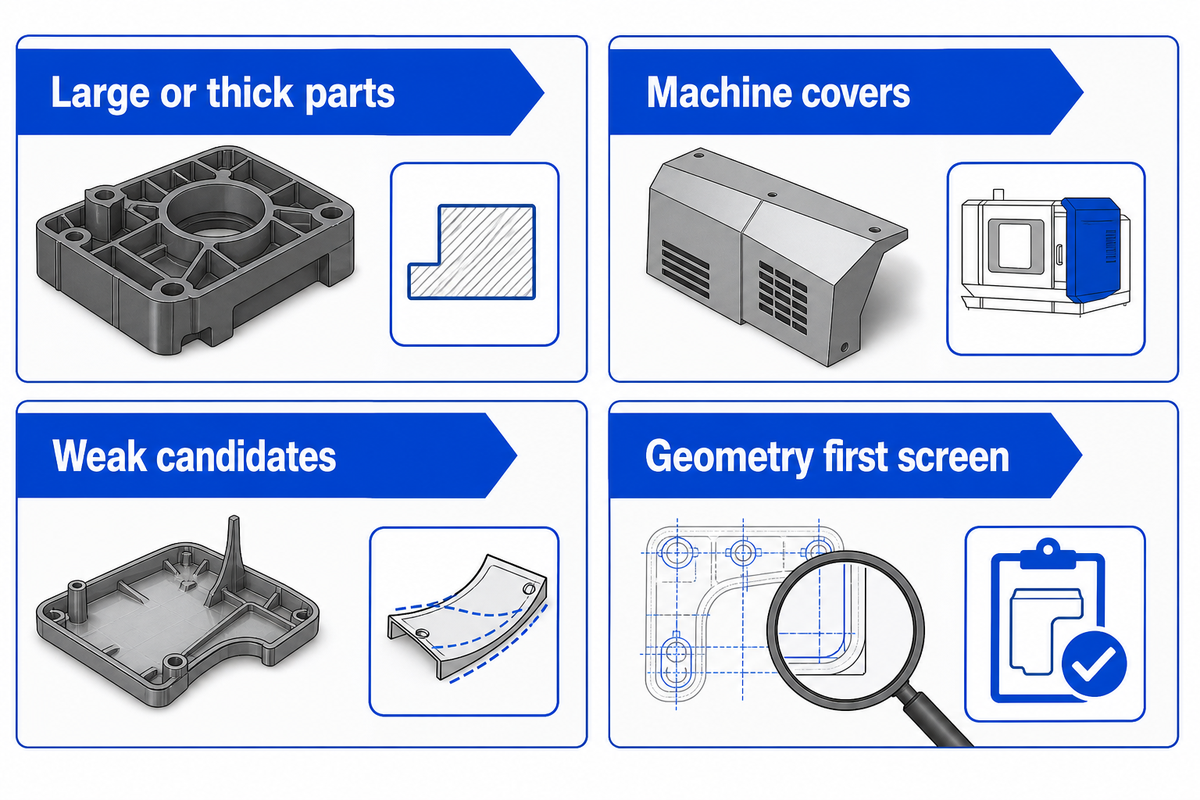
Structural foam works best when a part is large enough or thick enough for the skin-core structure to matter. Strong candidates include machine covers, equipment housings, industrial enclosures, bins, pallets, furniture shells, transport components, thick panels, and plastic parts where stiffness, part consolidation, lower weight, and practical mold fill matter more than a glossy face straight out of the tool.
Weak candidates are just as important. Tiny precision features, very thin decorative shells, polished Class A surfaces, food-contact components without material and additive clearance, and safety-relevant structures without service-life testing should not be pushed into structural foam only because the term sounds efficient. Geometry fit is only the first screen.
Cost Drivers and RFQ Data Buyers Should Prepare
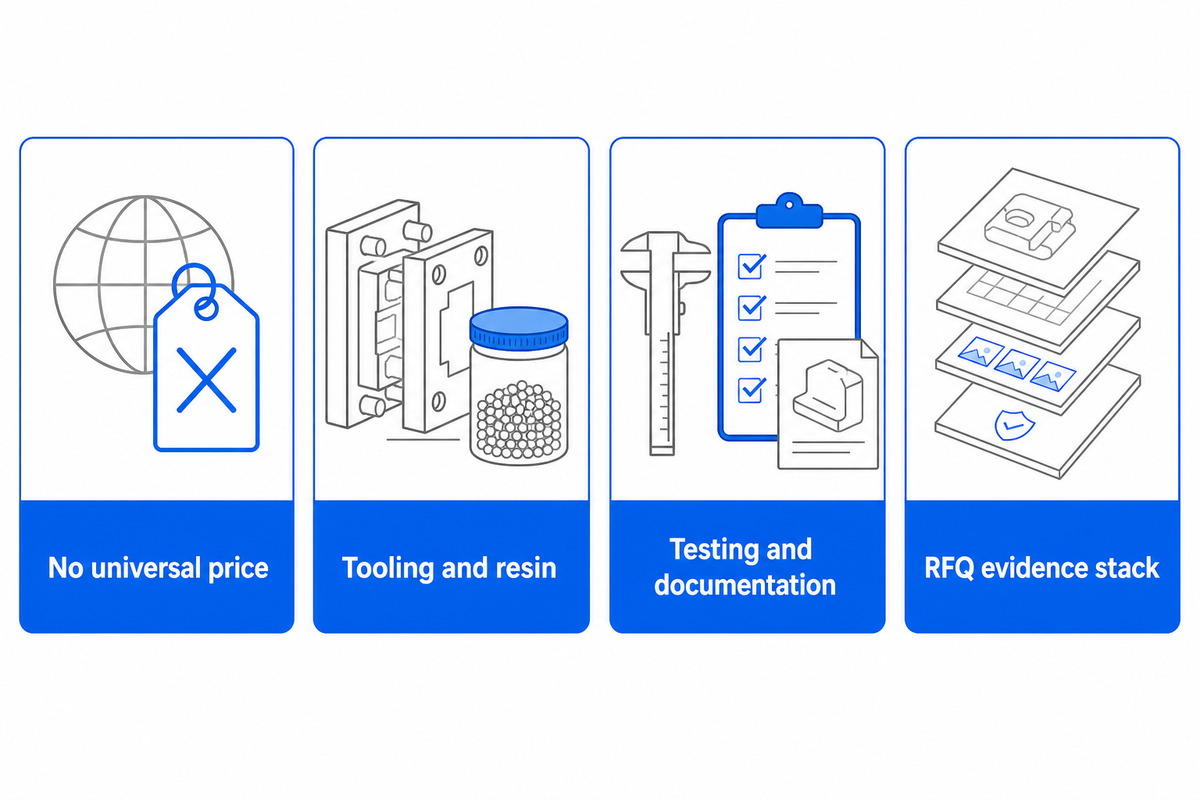
Structural foam injection molding cost cannot be reduced to a universal part price. Tooling, part size, resin, annual volume, wall thickness, surface finish, texture, painting, inserts, sampling, testing, cooling balance, morphology review, and documentation all affect the quote. If a surface-improvement method adds mold complexity or cooling asymmetry, it can change both cost and warpage risk.
Use project-defined units rather than generic targets. A useful RFQ may state, for example, 3 mm wall thickness, 1.2 kg target mass, 1.5 m² projected area, 85 °C heat exposure, 1,000 hours UV exposure, 24 hr chemical exposure, 2 MPa test stress, 0.3 mm allowed drift, and weight-reduction target. Those are example fields, not default promises; they tell the molder what must be proven.
| RFQ source | Benchmark or comparison value | Supplier proof to request |
|---|---|---|
| Traditional injection molding comparison | State whether the alternative is standard injection molding, high-pressure injection, or solid parts made at different injection pressures. | Ask why a high-pressure route is less suitable for this drawing. |
| Structural foam route statement | Name the structural foam process, low-pressure process, and expected internal pressure effect. | Request evidence that the route results in low stress and warpage in the parts. |
| Part family wording | Separate structural foam molded samples from generic foam parts, structural foam parts, finished parts, durable parts, precision parts, and lightweight parts. | Ask for photos and inspection records for structural foam molded parts similar to your geometry. |
| Skin and core evidence | Confirm foam core, foam structure, solid outer skin, outer skin condition, and cell position near the wall of the mold. | Request cut-section review after material is injected into a mold and expanded within the mold cavity. |
| Geometry and size benchmark | Mark whether the project involves thick parts, thicker walls, complex parts, large parts, or creating large plastic products. | Ask for wall-section review, fill simulation notes, and sample measurements. |
| Cost and material baseline | Break out raw material, material cost, secondary finishing, tooling value, and whether the part can be made cost effectively. | Compare resin saving against tooling, sampling, finishing, and validation cost. |
| Blowing-agent documentation | State when the blowing agent expands, whether resin is mixed with a chemical additive, and which chemical blowing agent or foaming agent is used. | Request SDS, restricted-substance declarations, and processing notes. |
| Supplier market check | Compare molding companies, injection molding companies, and structural foam injection molding manufacturers on evidence, not only equipment lists. | Ask for route-specific samples, reports, and customer-relevant inspection records. |
| Performance statement | Tie production of parts and the manufacturing process to structural integrity, stiffness-to-weight, and stiffness-to-weight ratios. | Treat the benefits of structural foam molding as testable claims, not default promises. |
| Application wording | Use the phrase “structural foam products” only when molding is ideal for the drawing, the surface target is realistic, and the consistent surface requirement is defined. | Request samples that show visible-face quality, weight, dimensions, and use-environment exposure. |
For a measurement-ready RFQ, attach example fields such as 4 mm nominal wall, 1.6 m² projected area, 65 bar trial pressure, 180 sec cycle target, 0.25 mm flatness limit, and 72 hr exposure notes, clearly marked as project data rather than supplier guarantees.
How to Choose a Structural Foam Injection Molding Supplier
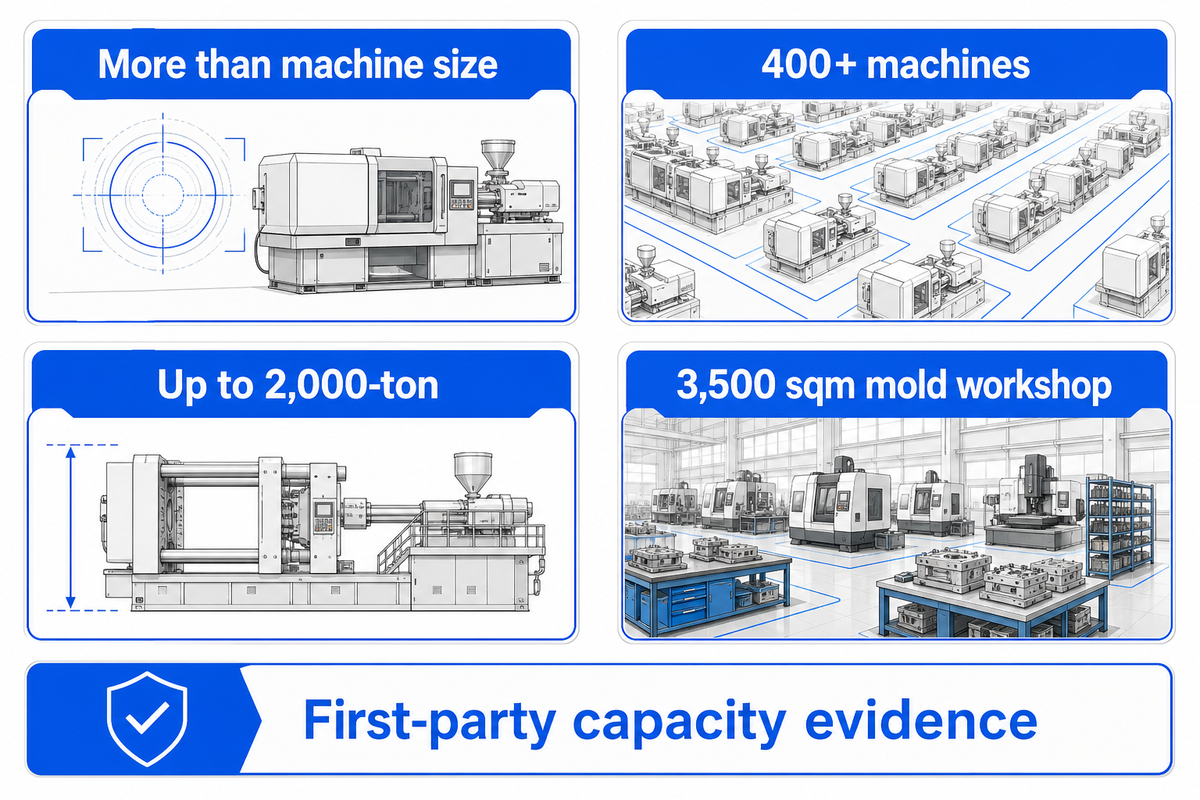
After the RFQ evidence stack is defined, a supplier should be evaluated on more than machine size. Engelhardt’s plastic injection molding service page describes 400+ plastic injection machines, up to 2,000-ton capacity, a 3,500 sqm mold workshop, and a structural foam subsection. Its company background also supports a manufacturing history dating to 2009 and quality-system positioning. That is useful first-party evidence for broad injection molding capacity.
It should still be scoped correctly. General machine count does not, by itself, prove structural-foam-specific production control. Ask for the route being quoted, venting strategy, material and blowing-agent controls, sample photos, weight data, dimensional reports, morphology inspection, surface standard, and test records for similar load cases.
If your project is still at the drawing-review stage, Engelhardt’s plastic injection molding services page is the right internal next step because it covers the broader injection molding capability around the structural foam decision.
Applications Across Industrial Plastic Parts
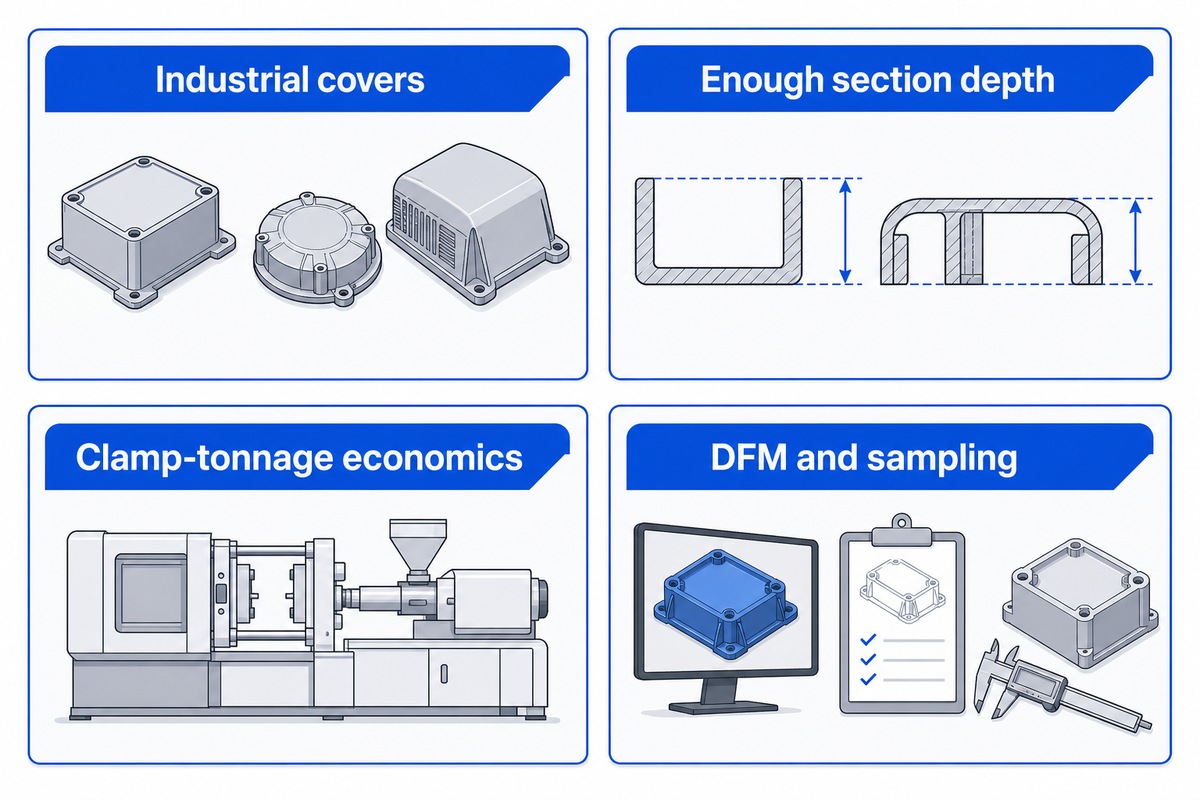
After supplier evidence is scoped, typical applications include industrial machine covers, utility housings, agricultural panels, pallets, bins, furniture shells, equipment enclosures, transport trays, and thick plastic covers. These parts often share three traits: enough section depth for a cellular core, enough projected area for clamp-tonnage economics to matter, and enough functional value to justify DFM and sampling.
End use can override the geometry signal. Electrical housings may require flammability evidence. Food-contact parts may need resin and additive clearance. Outdoor covers may need UV and weathering tests. Safety-relevant structures may need fatigue, impact, or traceability documentation. Chemical exposure may require property-retention data. Structural foam can still be the right route, but the application decides the proof package.
FAQ
How strong is structural foam?
Structural foam can be strong enough for large housings, pallets, equipment covers, and load-bearing panels when the geometry supports the load path. Strength should be judged by resin, cell morphology, skin thickness, density, rib layout, fasteners, creep, impact, flexural behavior, and environmental exposure. Do not approve the part based on the word “foam” alone; approve it based on samples and tests tied to the real drawing. For production approval, ask for fixture setup, repeat measurements, and environmental exposure results.
Can you injection mold foam?
Yes. In foam-assisted thermoplastic molding, the processor uses a chemical or physical foaming route to inject resin into a mold cavity. The material expands, forms cells, and can create a part with a cellular core and denser skin. It remains an injection molding process, but the mold design, pressure profile, surface expectation, blowing-agent documentation, and validation plan differ from standard solid molding. Clarify whether the supplier uses chemical foaming or physical foaming before tooling decisions.
What are the cons of structural foam injection molding?
The main cons are surface variation, tight-tolerance limits, process-route sensitivity, and validation burden. Some parts show swirl or texture variation. Some routes can lose tensile strength as foaming increases, even when stiffness per unit weight improves. Service-life factors such as creep, fatigue, temperature, UV, or chemicals may also matter. Buyers should request a part-specific test plan before approving production.
Is structural foam molding cheaper than conventional injection molding?
Sometimes, if resin savings and lower clamp-force economics outweigh tooling, sampling, finishing, validation, scrap risk, and annual-volume costs. Compare quotes with both part price and test evidence, because a cheaper molded shot can still lead to losses if surface or compliance work expands.
What parts are best suited for structural foam molding?
Best candidates are larger plastic parts where stiffness, wall thickness, part consolidation, and stable mold fill matter more than a polished cosmetic face. Examples include equipment housings, enclosures, bins, pallets, furniture shells, transport components, and thick ribbed panels with defined loads.
Conclusion
Structural foam injection molding can be a strong route for large and thick thermoplastic parts, but it is a fit decision rather than a slogan. Start with the drawing, route, material, surface standard, load case, service-life requirement, and compliance package. Then ask the supplier to prove the process on your part, not on generic foam molding claims.
To review whether your plastic part belongs in standard injection molding, structural foam, or another process, send the drawing to Engelhardt’s plastic injection molding services team or open the project form below.
References & Sources
- A Review on Microcellular Injection Moulding – process-family, surface, and mechanical-property context.
- A Combined In-Mold Decoration and Microcellular Injection Molding Process – appearance improvement and mechanical/warpage tradeoff context.
- Investigation of the Foaming Morphology of Polypropylene – current foam-morphology and skin/core layer context.
- Fraunhofer process comparison publication – route-specific mechanical-property comparison context.
- Fraunhofer ICT: Foam Injection Molding (FIM) – technical route and thermoplastic foam injection molding context.
- UK HSE: substances that can cause occupational asthma – azodicarbonamide and polymer-expansion handling context.
- ASTM plastics standards catalog – plastics testing and injection-molded specimen context.
- AIP Conference Proceedings: foam injection molding of thermoplastic elastomers – thermoplastic foaming process context.
- US4255368A patent record – foamed thermoplastic article skin-core background.
- DFMA foam molding cost resource – qualified material-density and cost-driver context.
- Engelhardt company background and plastic injection molding service page – first-party capability and internal-link context.