Póngase en contacto con Engelhardt


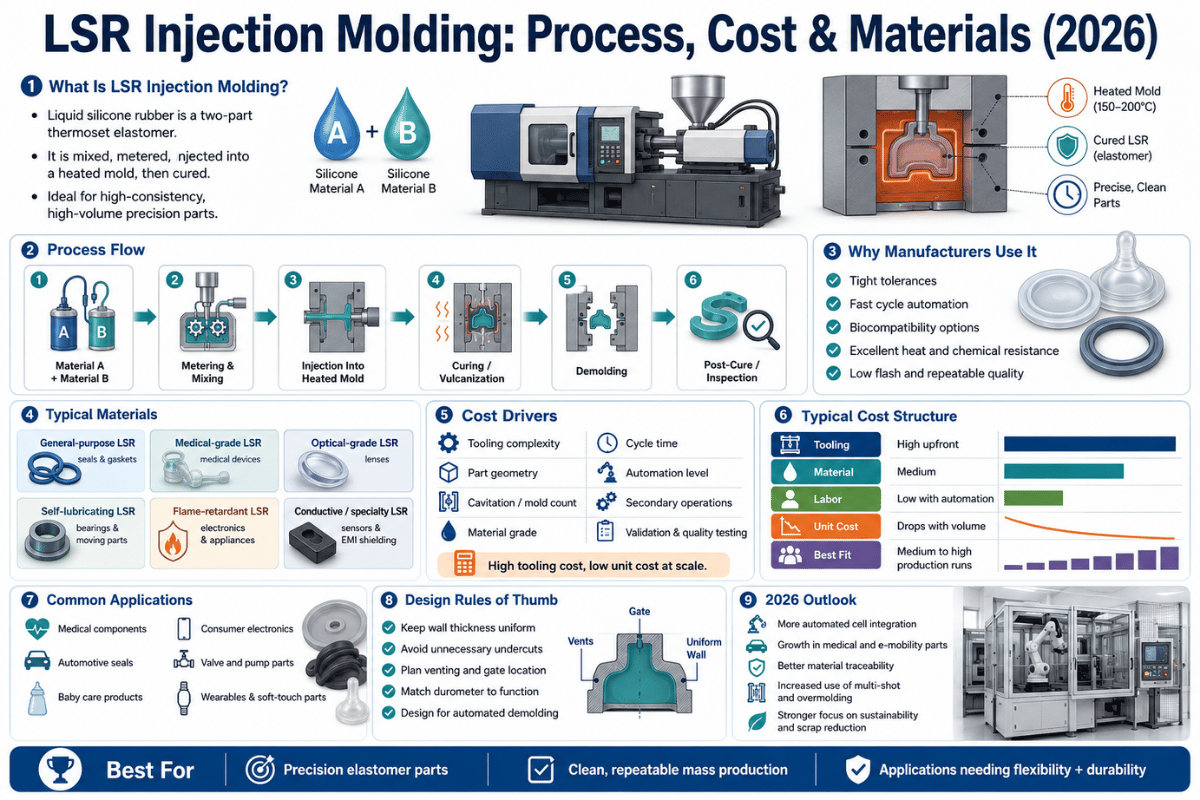
El moldeo por inyección LSR es un proceso de fabricación que inyecta caucho de silicona líquido curado con platino de dos partes en un molde calentado, donde se reticula en una pieza de elastómero termoestable terminada en segundos. Debido a que cura químicamente en lugar de congelarlo, la pieza permanece termoestable y no se puede fundir ni reformar, por lo que LSR es el material elegido para piezas de gran volumen en aplicaciones automotrices, médicas y electrónicas. Este artículo describe los conceptos básicos de este proceso etapa por etapa, incluidos los factores que debe considerar para seleccionar el mejor durómetro y grado de caucho de silicona, desglose de costos y cómo elegir un fabricante.
En un párrafo
El moldeo por inyección LSR mide con precisión y mezcla estáticamente dos materiales líquidos, típicamente una silicona de adición y curado compuesta por una base activada por catalizador de platino y un reticulante. Luego, el material mezclado se inyecta a través de un cortador en frío enfriado en una cavidad caliente (generalmente curado a 150-200 °C hasta su durómetro deseado en 25 segundos o menos). Debido a que la silicona no cura en el corredor frío, que normalmente permanece alrededor de 15-25 °C, es un método sin flash ni chatarra para la fabricación automatizada de gran volumen de piezas con índices de dureza de Shore A 5-80.
Especificaciones rápidas: moldeo por inyección LSR
| Forma material | Líquido de dos partes (A:B mezclado 1:1), curado por adición de platino |
| Gama de durómetros | Shore A 5-80 (los grados estándar suelen ser 30-70) |
| Curar/temperatura del molde | Cavidad calentada hasta ~200 °C; corredor frío ~15-25 °C |
| Temperatura de servicio | «50 °C a +250 °C (grados de especialidad más amplios) |
| Tolerancia típica | Lineal ±0,025 mm/mm; parte ±0,1-0,2 mm (según ISO 3302-1) |
| Contracción | ~2-3% (dependiente del grado) |
| Cavidades | 1 a 32+; cura medida en segundos por parte |
¿qué es el moldeo por inyección LSR?
El moldeo por inyección LSR se realiza cuando se inyecta un caucho de silicona líquido curado con platino de dos partes en una cavidad de molde que ya está caliente, curándose para convertirse en la parte final del elastómero en segundos. A diferencia de los termoplásticos que se solidifican al enfriarse y se derriten cuando se aplica calor nuevamente, el LSR experimenta una reticulación permanente (se establece como un termoestable) y no se puede fundir ni volver a plegar.
En el nivel fundamental, el material son dos líquidos separados. El componente A contiene un catalizador de platino y el componente B contiene el reticulante (es decir, metil hidrógeno siloxano) y un inhibidor, que evita que reaccione prematuramente mientras los dos componentes se almacenan en suspensión. El componente B también contiene un homopolímero inerte de polisiloxano de cadena larga reforzado con carga de sílice tratada. Cuando se mezcla 1:1 en una cavidad caliente, se produce la reacción de adición (o hidrosililación) catalizada por platino, uniendo químicamente las cadenas en un elastómero uniforme. Un ampliamente referenciado (publicado en el Revista de fabricación y procesamiento avanzados muestra cómo la temperatura de la cavidad y el tiempo de permanencia alcanzado dentro de ella son responsables de qué tan reticulado (o qué parte de él se forma) está el elastómero, la variable que dicta si el material se entrecruza completamente y está terminado o permanece pegajoso.
Dado que el material permanece líquido hasta que se ha curado, el LSR fluye y llena paredes delgadas y microcaracterísticas que los materiales más rígidos no pueden, con un destello bajo. Esa trinidad de química biológica, flujo compatible con la automatización y excelente estabilidad térmica en un rango de temperatura de -50 °C a +250 °C hace que el LSR sea el material elegido tanto para las piezas externas de contacto con la piel como para las piezas de automóviles debajo del capó. Obtenga más información sobre lo que se puede lograr en nuestro guía de mejores prácticas para moldeo de caucho de silicona líquida.
💡 Conclusión clave
LSR: valor termoestable termoestable: sin flash, de gran volumen y alta precisión; no apto para aplicaciones de bajo volumen y bajas herramientas
Cómo funciona el proceso de moldeo por inyección LSR: el ciclo de inyección de 7 etapas
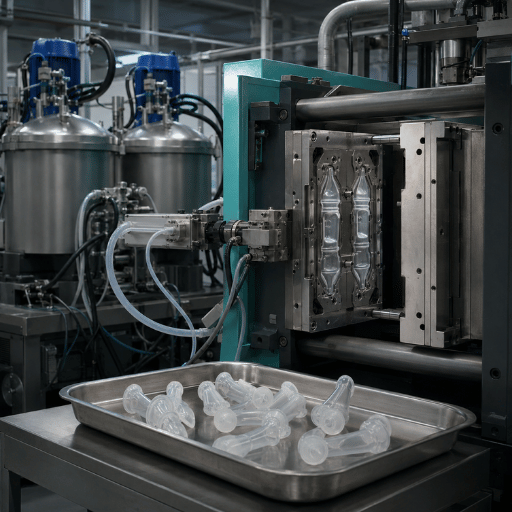
El proceso de moldeo por inyección de LSR se basa en el curado mediante una reacción de adición: la silicona mixta se mantiene en el canal frío alrededor de 15-25 °C, luego la cavidad calentada (normalmente alrededor de 200 °C) activa el catalizador de platino, reticulando la parte en segundos con cero destellos y cero. chatarra del corredor para curar. La forma más intuitiva de imaginarlo es un único bucle continuo. Debajo del ciclo de inyección LSR de 7 etapas resumido para una referencia conveniente, otras guías a menudo dispersan las fases en párrafos.
Una máquina LSR está diseñada para dosificar, no para plastificar. En lugar del típico cilindro alternativo y tornillo de prensa termoplástica para fundir bolitas de plástico, la prensa LSR se basa en una unidad dosificadora y bombas para dosificar los componentes A/B 1:1 en un mezclador estático, mientras que la fuerza de sujeción asienta la herramienta cerrada contra la presión de inyección. Dado que la vulcanización ocurre sólo en una cavidad calentada con entrega por canal frío, las prensas LSR son funcionalmente “sin corredor”, no hay nada que solidificar en la alimentación enfriada.
| Escenario | Qué pasa | Temperatura | Tiempo típico |
|---|---|---|---|
| 1. Medición/bombeo | Los émbolos empujan la base (A) y el catalizador (B) desde los tambores | Ambiente | Continuo |
| 2. Mezcla estática (1:1) | A y B se mezclan hasta obtener un disparo homogéneo en un mezclador estático | ~15-25 °C | Continuo |
| 3. Inyección de corredor en frío | El corredor enfriado entrega la mezcla a la puerta sin curarla | ~15-25 °C | <1-13 s |
| 4. Relleno de cavidades calentado | El disparo llena la cavidad caliente; El adelgazamiento por corte ayuda a las paredes delgadas | Hasta ~200 °C | 1-5 s |
| 5. Cura de platino | La reacción de adición entrecruza la pieza a un termoestable | Calor de cavidad | Segundos (dependientes de la pared) |
| 6. Demolición/automatización | Eliminación manual o robótica; no se necesitan pasadores eyectores | Caliente | 1-3 s |
| 7. Postcurado opcional | El horneado al horno elimina los volátiles de las piezas médicas y alimentarias | ~200 °C | Hasta 4 h (lote) |
Las temperaturas de etapa mostradas reflejan las máquinas típicas de LSR y los rangos de hojas de datos de materiales; Los valores exactos varían según el grado de LSR, el espesor de la pieza y el diseño de la cavidad.
La clave de todo esto es el corredor frío. Por un lado, los editores comerciales en Tecnología de plásticos La tecnología de plásticos de la revista (como se señaló anteriormente) nos dice que los LSR tienen tiempos de curado más largos que los tiempos de enfriamiento termoplástico típicos y, lo que es más importante, no se pueden volver a recubrir. El corredor frío aborda esto con precisión: solo se introduce y cura una parte del volumen, y no hay ningún corredor (y por lo tanto ningún bebedero, ningún recorte) que cure. Esto también es lo que hace que el núcleo del motor de la herramienta LSR sea patentable según los registros oficiales de patentes para los métodos para el dispositivo de moldeo por inyección LSR (EP1293323B1).
¿cómo se cura el LSR?
El LSR se cura mediante curado con platino activado por calor (adición), no mediante la presión o evaporación de la que dependen muchos plásticos. Cuando la mezcla 1:1 A/B llega a una cavidad caliente, el catalizador de platino impulsa una reacción de hidrosililación que entrecruza el líquido en un sólido en segundos. Las secciones delgadas se gelifican en menos de un segundo; las paredes más gruesas tardan más a medida que el calor se difunde hacia el núcleo. No se liberan subproductos, razón por la cual el LSR curado con platino es lo suficientemente limpio para piezas médicas y en contacto con alimentos.
📐 Nota de ingeniería « leyendo el tiempo de curación
El tiempo de curado está ligado a la dimensión más gruesa, no al área de superficie. Una regla general generalmente aceptada para una pared nominal de 2 mm a temperatura de molde completamente caliente es un tiempo de curado de varios segundos después del llenado, más el desmolde, y aproximadamente varios segundos cada uno adicional por ~2 mm adicional de material. Pero para un saliente de 4 mm en la misma parte que por lo demás tiene solo 1,5-2 mm de espesor, es el saliente el que gobernará el tiempo del ciclo, no las regiones más delgadas. Esté atento a las secciones gruesas y acorte el ciclo.
LSR frente a silicona HCR, TPE y RTV
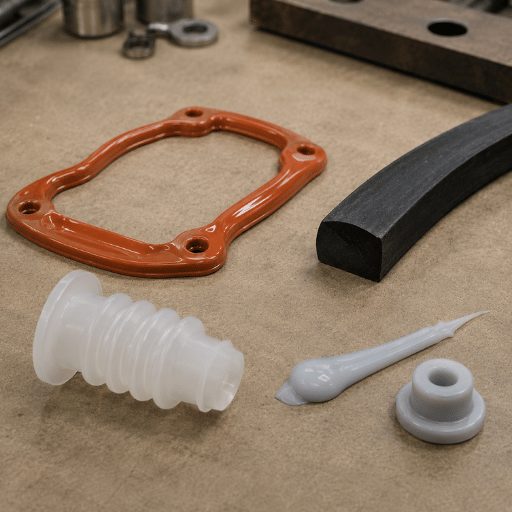
LSR es un líquido bombeable de dos partes que cura mediante la adición de platino; HCR (caucho de alta consistencia) es una goma rígida que debe molerse y curarse a presión; RTV cura a temperatura ambiente y es mejor para piezas de bajo volumen; y TPE es un plástico refundible. En la práctica, si buscas piezas altamente automatizadas, de gran volumen y de alta precisión, gana LSR; En trabajos de menor volumen y menor presupuesto de herramientas, su costo de herramientas para corredores en frío es difícil de justificar. Aquí está la matemática, no un gráfico comparativo vago de alto, medio y bajo.
| Propiedad | LSR | HCR | TPE | RTV |
|---|---|---|---|---|
| Forma | Líquido de 2 partes | Goma sólida | Pellets termoplásticos | Líquido de 2 partes |
| Curar | Adición de platino, calor | Peróxido/platino, calor+presión | Ninguno (derretir/enfriar) | Temperatura ambiente |
| Automatización | Alto | Medio-bajo | Alto | Bajo |
| Punto óptimo del volumen | Alto | Medio-bajo | Medio-alto | Bajo/prototipo |
| Temperatura de servicio | «50 a +250 °C | «50 a +250 °C | ~-30 a +120 °C | «50 a +200 °C |
| Costo de herramientas | Alto (corredor frío) | Medio-bajo | Medio | Bajo |
¿cuál es la diferencia entre HCR y LSR?
HCR viene como una goma sólida precompuesta que necesita molienda y curado a presión. LSR viene como un par de líquidos bombeables que necesitan medición e inyección. Los procesos de moldeo por transferencia de HCR exhiben menos control y más variación parte a parte. El proceso de inyección de canal frío LSR produce una alta repetibilidad con chatarra casi nula. Sin embargo, las herramientas requieren tiradores enfriados de precisión, por lo que se puede seleccionar HCR para volúmenes bajos. Ver el completo Comparación de LSR versus HCR artículo.
¿cuál es la diferencia entre RTV y LSR?
La silicona RTV (vulcanización a temperatura ambiente) cura lentamente sin calor, adaptando prototipos y volúmenes muy bajos; LSR cura en segundos en una herramienta calentada para producción automatizada. Elija RTV para algunas piezas, LSR para decenas de miles. Si las piezas de plástico podrían funcionar, consulte nuestro LSR frente a TPE artículo.
LSR Selección de Materiales y Durómetro
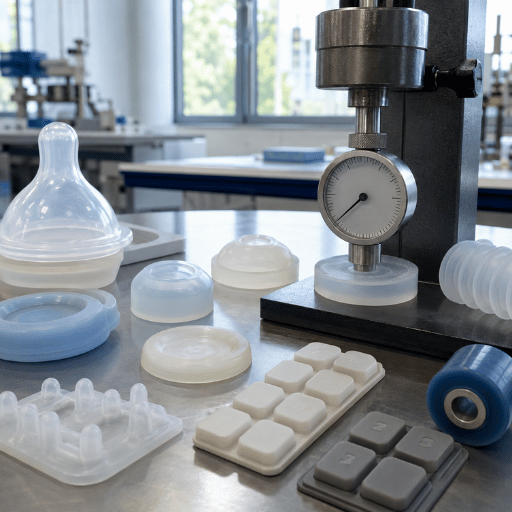
Dos factores lo guiarán al elegir LSR: banda durómetro y familia de grados. Los durómetros LSR varían desde un suave 5 A hasta un duro 80 A, pero la mayoría de los grados originales se encuentran entre 30 A y 70 A. La banda del durómetro debe estar relacionada con el modo de falla, por lo que una lente óptica necesita una banda diferente a un sello suave o un teclado táctil. Seleccionar la banda adecuada para la clase de pieza, que muchos competidores no abordan, es la forma más eficiente de proceder. Mire el mapa de durómetro a aplicación a continuación.
| Banda de costa A | Sentir | Clase de pieza | Ejemplos típicos |
|---|---|---|---|
| 5–20 | Muy suave, parecido a un gel | Sellos blandos, válvulas, membranas | Válvulas de alimentación infantil, válvulas de pico de pato, diafragmas |
| 30–50 | Suave al tacto, táctil | Teclados, juntas, puños | Teclados electrónicos, juntas tóricas, bandas portátiles |
| 60–80 | Firme, dimensionalmente estable | Estructural/óptico | Carcasas de conectores, lentes ópticas, sellos rígidos |
La selección de familia de grados es la siguiente. Los diferentes grados tendrán datos mecánicos variados (el mayor contenido de relleno da como resultado una mayor resistencia a la tracción y al desgarro), por lo que la hoja de datos de grado específico, no solo el durómetro, define si la pieza resistirá su aplicación. Los grados de durómetro bajo hasta Shore A 5 sirven sellos blandos, mientras que los grados autolubricantes cortan la fricción superficial. Existen grados típicos para aplicaciones industriales generales; y grados específicos para sellos blandos (hasta 5 A durómetro); grados autolubricantes (modificados con fenilo) para reducir la fricción superficial; grados autoadhesivos para adherirse directamente a otros plásticos; grados ópticos para mayor claridad y transparencia; y los grados médicos -una consideración muy importante porque deben coincidir ISO 10993 y/o el compuesto incluido en la lista USP Clase VI y no puede etiquetarse simplemente como “silicona médica”. Los principales fabricantes de LSR tienen estos grados disponibles con datos « Engelhardt clasifica aún más los grados según el modo de falla específico y valida los compuestos de biocompatibilidad especificados en lugar de tomar una etiqueta general. Puede seleccionar la banda durómetro adecuada utilizando nuestro Selector de durómetro LSR.
“El error de comprador más común que corregimos es especificar demasiado el durómetro o pedir ‘silicona médica’ sin nombrar el compuesto USP Clase VI enumerado. El grado tiene que coincidir con el modo de falla, una válvula de alimentación que necesita sellar en Shore A 10 no debe indicarse en un grado de uso general de 50 durómetros”
LSR Sobremoldeo y Moldeo de Dos Tiros
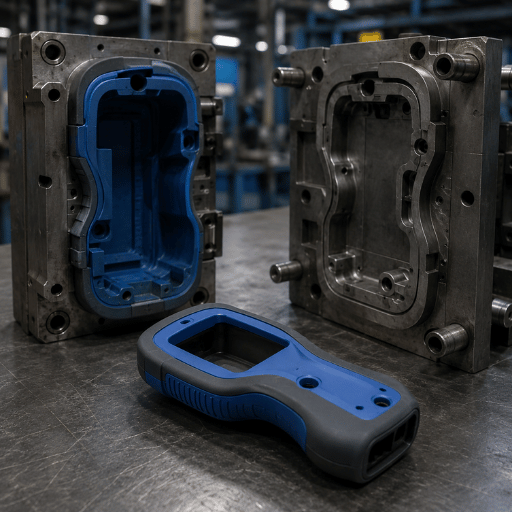
El sobremoldeo LSR utiliza silicona líquida directamente sobre sustratos rígidos «PA, PBT, PC, PPSU o insertos metálicos «para producir piezas blandas y duras en una o dos tomas. La unión se produce a través de un cebador o, cada vez más, grados LSR autoadhesivos que crean un entrecruzamiento químico con el sustrato durante el curado para eliminar el cebador. Ésa es una de las razones por las que la adopción del sobremoldeo está aumentando: un grado autoadhesivo hace que el proceso sea una operación única en lugar de dos.
El moldeo de dos disparos (2K) procesa ambos materiales (sustrato, luego LSR) en la misma herramienta, mientras que el moldeo por inserción agrega el sustrato antes del sobremoldeo. El riesgo clave del diseño radica en la preparación de la unión - La energía superficial y la limpieza determinan el éxito de la unión a través del ciclo térmico. Un estudio de LSR sobre moldeo termoplástico encontró que el calentamiento dinámico del molde y la preparación del sustrato antes del tratamiento pueden mejorar materialmente las uniones. Las pautas están en nuestro guía de sobremoldeo de silicona.
📐 Nota de ingeniería « preparación de bonos
Para los muchos LSR autoadhesivos, el tratamiento con plasma o el cebado pueden aumentar la energía superficial del material rígido, creando una mejor humectabilidad para la silicona. Después del ciclo térmico de la unión, no acepte los resultados de RT: la prueba más honesta es una prueba de pelado realizada a la peor temperatura de servicio esperada de la pieza.
Diseño y Herramientas para Moldeo por Inyección LSR
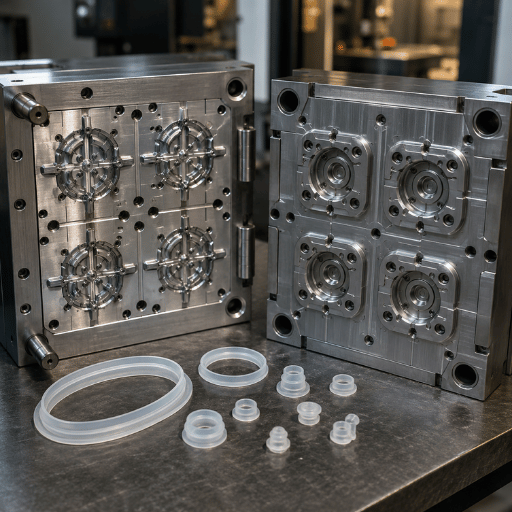
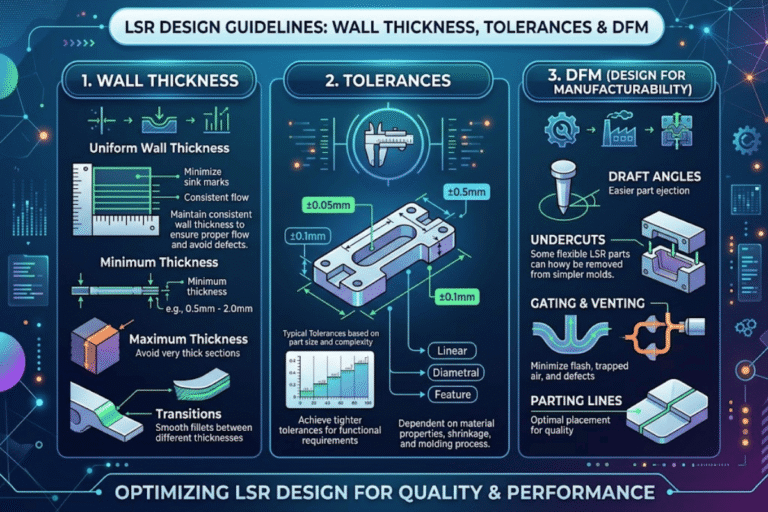
LSR se ocupa principalmente de controlar el flash, la contracción y la liberación de moho. Dado que es un líquido de baja viscosidad, fluye hacia cualquier abertura y, por lo tanto, las puertas, las líneas de ventilación y separación desempeñan un papel más importante que en las herramientas termoplásticas. Planifique la contracción 2-3%, mantenga las secciones de pared niveladas y ubique las puertas para ocultarlas. La simulación de flujo de moho predice patrones de llenado, ventilación al vacío y contracción antes de comprometer acero; Las herramientas que funcionan en volúmenes más altos utilizan acero para herramientas endurecido (el aluminio es fino para volúmenes bajos) y un agente desmoldante ligero o una cavidad pulida ayuda a la liberación del molde. Las tolerancias para las piezas originales suelen ser lineales a 0,001 pulgadas/pulgada [0,025 mm/mm], divididas en grados según ISO 3302-1, y las piezas médicas a menudo pasan al desflasheo criogénico. Hay tres errores principales que cometemos:
- Tratar el flash LSR como el material termoplástico. Quieres herramientas de moldeo sin flash y una ubicación de ventilación precisa; Su línea de piezas “suficientemente buena” aparece como un trabajo de recorte en cada pieza producida.
- Olvidar incluir la contracción al principio del proceso de diseño. Es mucho más alto que para un termoplástico, entre 2 y 3%, y diferirá según el grado: el proceso debe incluirlo en la herramienta, no como parte del informe de inspección.
- Poner la masa en las secciones del molde . Las características más gruesas hacen que todas las tomas se atasquen con un proceso de curado específico, lo que afecta la eficiencia general del proceso; Core estas partes para proteger el rendimiento.
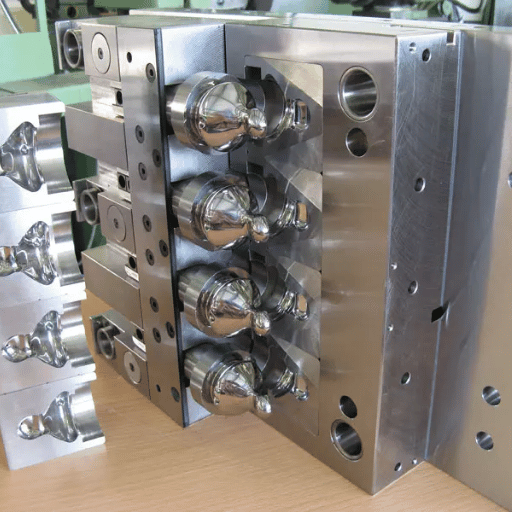
Un elemento central del molde es la tecnología de compuerta de válvula de corral en frío, que, en el momento de la redacción original, estaba protegida por patente (una buena descripción se encuentra en EP1293323B1). Echa un vistazo a nuestro completo Directrices de diseño LSR para obtener la lista de verificación completa.
Lo que impulsa el costo del moldeo por inyección LSR: la pila de costos de 4 palancas
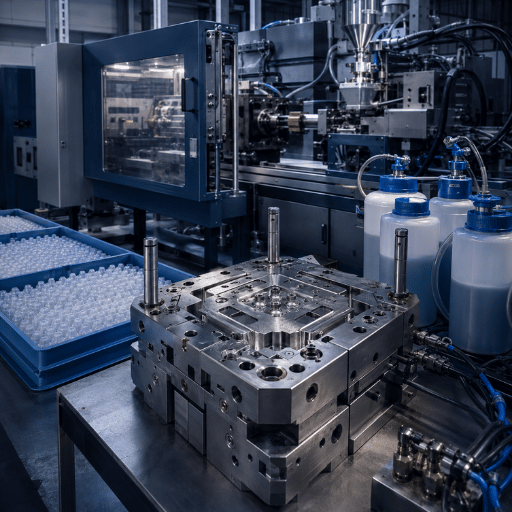
El costo de las piezas LSR se acumula a partir de cuatro palancas “herramientas de funcionamiento en frío, cavitación, nivel de automatización y calidad de material «, por lo que el alto costo de las herramientas se amortiza en un precio bajo por pieza sólo cuando el volumen y la cavitación son altos. La web abierta es escasa en precios reales de LSR y aquí no inventaremos cifras en dólares.
Lo confiable es la estructura del costo y cómo las palancas se intercambian entre sí. Los compradores en foros de ingeniería siguen preguntando “¿cuánto costará el molde y el costo unitario?” “Así que aquí está el marco honesto. Esta es la pila de costos LSR de 4 palancas.
La pila de costos LSR de 4 palancas
- las herramientas de canal en frío son el costo inicial más caro; corredor enfriado equilibrado con precisión con compuerta de válvula. es fijo; lo que significa que está adelgazado en una mayor cantidad de piezas
- -El molde de cavidad A16 proporciona 16 partes por ciclo, el costo por parte, a un costo de molde más costoso, se puede reducir a la mitad en caso de duplicar el número de cavidades.
- Grado de Automatización Robótica, las células y herramientas de “encendido” reducen la cantidad de mano de obra por unidad y controlan la consistencia de la calidad del producto; La recuperación aumenta directamente con el volumen.
- Los grados de calidad de material / durómetro Médico / Óptico / Autoadhesivo son más caros / Kg que los de uso general ; LSR no se puede volver a moler, por lo que el peso que importa es sólo una parte del peso.
📐 Nota de ingeniería « lectura del costo por pieza
Resuélvalo así: costo por pieza (volumen total de herramientas) + (cavidades de velocidad de la máquina de tiempo de ciclo) + (precio del material de peso de disparo). Lo que dice la fórmula: a un volumen alto, el término de herramientas desaparece y el tiempo del ciclo determina si LSR es barato o caro. Lo que no dice: La elección óptima en ejecuciones de piezas de gran volumen podría ser imposible en una ejecución de bajo volumen. Nuestro Estimador de costos de herramientas LSR debería permitirle modelar su propia situación.
✔ Donde gana LSR en costo
- Altos volúmenes que amortizan las herramientas
- Corredor en frío sin chatarra (sin pérdida por recorte)
- Células automatizadas, apagadas por luces y de bajo trabajo
- Piezas delgadas/complejas que evitan operaciones secundarias
⚠ Donde LSR pierde en costo
- Volúmenes bajos (las herramientas nunca se amortizan)
- Únicos y prototipos (use RTV)
- Grados médicos/ópticos sobreespecificados
- Partes de paredes gruesas que estiran el tiempo del ciclo
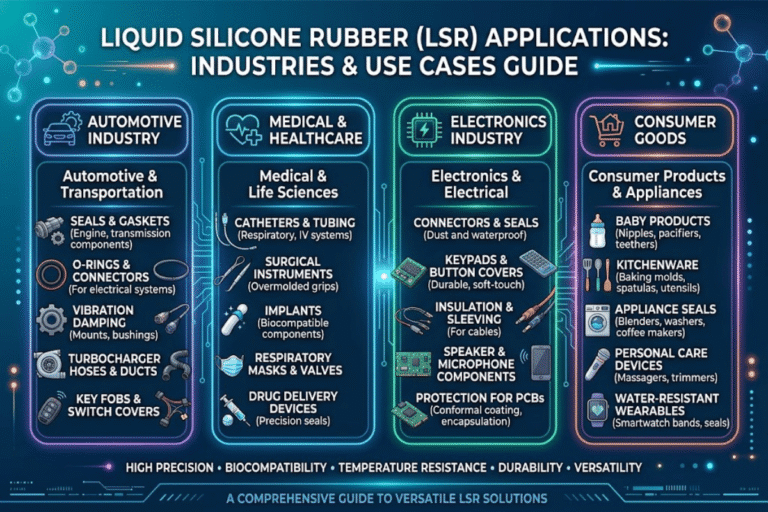
Aplicaciones LSR: médica, automotriz, electrónica y de consumo

Encontrará LSR en cualquier momento que sea necesario que una pieza sea flexible, biocompatible y mantenga propiedades a temperaturas extremas. Hay algunos segmentos que crean una gran demanda; Los tres grandes segmentos explotan las características únicas del LSR: a continuación proporcionamos una tabla que clasifica las aplicaciones comunes del LSR en las 3 industrias principales. También identifica propiedades clave para cada aplicación con un rango basado en durómetro. Piense en esto como un atajo desde “Qué estoy moldeando” hasta “Qué grado y dureza cito”
| Tipo de pieza | Industria | Costa típica A | Propiedad que impulsa la elección |
|---|---|---|---|
| Pico de pato/válvula de alimentación | Médico | 5–20 | Sello blando + grado USP Clase VI |
| Diafragma | Médico/fluídica | 10–30 | Vida del ciclo flexible |
| Junta tórica/sello estático | Automotor | 40–60 | Resistencia establecida por compresión |
| Sello conector | Automoción / EV | 40–70 | Rango de «50 a +250 °C |
| Sello de ojal/cable | Automotor | 30–50 | Vibración + protección de entrada |
| Teclado | Electrónica | 30–50 | Sensación táctil suave al tacto |
| Membrana impermeable | Electrónica | 20–40 | Sello de sobremolde autoadhesivo |
| Lente óptica | Iluminación/óptica | 60–80 | Estabilidad transparente + dimensional |
| Banda portátil | Consumidor | 30–50 | Seguro para la piel + flexibilidad |
| Junta de cerramiento | Industrial | 40–70 | Resistencia química + térmica |
| Pico/pezón para el cuidado del bebé | Consumidor/médico | 10–30 | Biocompatible, muy suave |
Médico. Imagen una válvula de alimentación infantil moldeada desde Shore A 10... necesita asentarse con poca fuerza, soportar cientos de ciclos de esterilización y moldearse a partir del compuesto exacto enumerado en USP Clase VI e ISO 10993. Otro compuesto de la misma dureza (Shore A 10 aquí) podría moldearse bien pero aún así no pasar la calificación « la calificación pasa la auditoría, no el durómetro.
Así es también como funcionarán nuestras piezas de respirador, autoinyector y válvula de diagnóstico.
Automoción AnEVconnectorseal funciona donde se encuentran el calor, la vibración y la protección de entrada. Un rango de temperatura de -50°C a +250°C más un buen ajuste de compresión brindan una resistencia al sellado de LSR en los extremos térmicos de todo un paquete de baterías que un TPE suavizaría y no sellaría. La creciente electrificación de vehículos está aumentando el uso de selladores y conectores, ambos impulsados por LSR.
Electrónica y consumidor. Teclado sobremoldeado en LSR personalizado sin juntas que sella cada botón contra una carcasa de PCB. Considere también este material para pulseras y prendas de vestir, cubiertas para accesorios de teléfono, productos para bebés y utensilios de cocina, consulte nuestro aplicaciones de caucho de silicona líquida descripción general. Moldeamos piezas de silicona personalizadas para aplicaciones de todo tipo.
Cómo elegir un fabricante de moldeo por inyección LSR
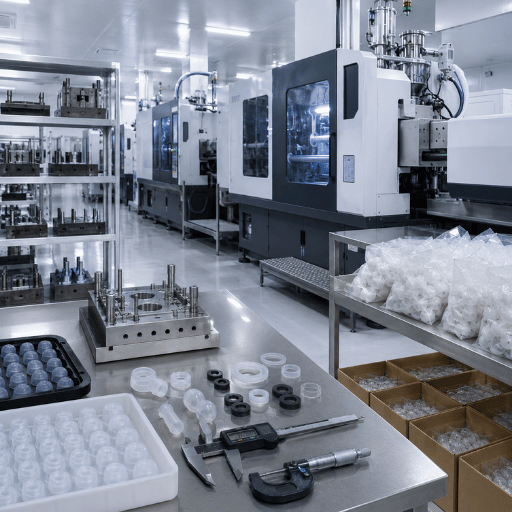
Pero debajo de todas estas preguntas se reduce a un único criterio. ¿Puede el moldeador LSR mantener un proceso de canal en frío válido y repetible a su volumen y con las certificaciones necesarias que requiere su mercado? Thermoplastic NO es experiencia que pueda transferir; Las herramientas, la activación y la curación LSR son disciplinas separadas. Utilice esto como su lista de verificación RFO para moldeadores LSR.
- Certificaciones en su propio mercado «ISO 9001 para calidad, IATF 16949 para automoción, FDA / LFGB / NSF y USP Clase VI / ISO 10993 para contacto médico y alimentario.
- Herramientas domésticas para el funcionamiento en frío. ¿Cortarán/ajustarán la herramienta crítica con válvula o se enviará la pieza más resistente?
- Automatización y capacidad de sala limpia -robotic desmold para mayor precisión; molde para médico en una sala blanca.
- Control de calidad in situ y trazabilidad de materiales: control de calidad in situ más todas las pruebas físicas y químicas necesarias, incluido el grado indicado al que se hace referencia en el certificado.
En perspectiva, Engelhardt tiene aprox. 700 máquinas (incluida una con prensa de 2.000 toneladas), más de 80 máquinas vulcanizadoras y 2-55 litros de sil./basura. líneas de mezcla que dan aprox. 3.000 toneladas/año. Los moldes se construyen en un taller interno de fabricación de moldes de 3.500 m², utilizando máquinas Makino, Roeders y Standy, más de 500 juegos de moldes por año, funcionando las 24 horas del día, los 365 días del año, y las piezas se prueban en el propio laboratorio químico/físico de control de calidad/control de calidad de la planta. La instalación mantiene Litegot ISO 9001, IATF 16949, FDA, LFGB y NSF, la razón por la que podemos hacer referencia a una formulación específica en lugar de afirmaciones genéricas y alcanzar un grado para el compuesto USP Clase VI enumerado. Comience su proyecto desde nuestro Moldeo por inyección LSR centro.
La perspectiva LSR: hacia dónde se dirige la demanda
La verdadera palanca del volumen de LSR en los próximos años no es el amplio aumento de la demanda (son tres fuerzas específicas). Y los tres interrumpen la planificación de los compradores. En primer lugar, es regulatorio: los criterios bioevaluados para la silicona médica están cambiando.
Mientras 21 CFR 177.2600 sigue siendo el estándar para aplicaciones en contacto con alimentos, la revisión de 2025 de ISO 10993-1 (publicada a finales de 2025) actualiza cómo su proveedor debe documentar las siliconas médicas. En lugar de simplemente marcar casillas, la evidencia de los proveedores basada en el impacto del ciclo de vida y el riesgo estructurado se alineará con ISO 14971. Lo que significa para usted: para su próxima compra de moldes de inyección para dispositivos médicos, prepárese para obtener tiempo adicional para verificar la calificación. La documentación de las siliconas médicas de su proveedor está a la altura de los nuevos estándares.
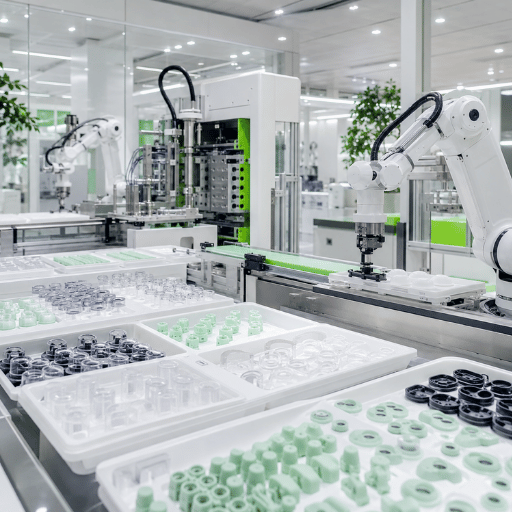
El segundo es la tecnología. Autoadhesivos sin imprimación LSR; grados de alto flujo micromoldeables; y la automatización servoaccionada con un corredor frío contribuyen a una gama más amplia de aplicaciones y costos de LSR; electrónica más pequeña; y un sobremoldeo más suave. En tercer lugar está la electrificación de los vehículos: cada sensor adicional, cada conector y cada sello de batería necesitan un material con esa estabilidad térmica.
Para proporcionar contexto, el tamaño del mercado LSR estimado por los investigadores de mercado en un crecimiento anual de tasa porcentual de un solo dígito medio a alto (solo direccional (los pronósticos individuales de las empresas pueden variar ampliamente) (esta información servirá para informar usted, pero la compra se basa en los otros tres criterios mencionados anteriormente. Si ya tiene un programa para 2026 o 2027, entonces el plan es muy directo; Bloquee los plazos de entrega de las herramientas ahora y asegure la disponibilidad de grados para el durómetro específico y la certificación requerida.
Preguntas frecuentes
P: ¿Cuál es la diferencia entre HCR y LSR?
Ver respuesta
HCR es una goma sólida premezclada que se muele y se cura a presión, lo que proporciona ciclos más lentos y más variación entre las piezas. LSR son dos líquidos bombeables, mezclados uno a uno e inyectados en una herramienta de funcionamiento en frío calentada, por lo que funciona más rápido y de forma más repetible.
P: ¿Cuáles son las desventajas del moldeo por inyección LSR?
Ver respuesta
El mayor inconveniente es el elevado coste inicial de las herramientas de funcionamiento en frío, que sólo se amortiza en volumen; Para unos pocos cientos o miles de piezas, RTV o HCR suelen ser más baratos. El LSR también es un líquido de baja viscosidad, por lo que parpadea fácilmente y exige una ventilación precisa y un control estricto del proceso. La silicona curada tampoco se puede volver a moler, por lo que cada pieza desechada es material perdido, y desmoldar piezas delicadas sin romperlas requiere herramientas cuidadosas y manipulación robótica.
P: ¿Cómo se cura el LSR?
Ver respuesta
El LSR se cura mediante una reacción de adición de platino activada por calor, no por presión o evaporación. Cuando la mezcla uno a uno ingresa a una cavidad a la temperatura de la cavidad, el catalizador de platino impulsa la hidrosililación entre los grupos vinilo e hidruro, reticulando el líquido en un sólido en segundos. No se forman subproductos, por lo que el LSR curado con platino permanece lo suficientemente limpio para uso médico.
P: ¿Cuál es la diferencia entre RTV y LSR?
Ver respuesta
RTV cura lentamente a temperatura ambiente, por lo que se adapta a prototipos, piezas fundidas y un puñado de piezas de bajo volumen. LSR cura en segundos dentro de una herramienta calentada para una producción totalmente automatizada. Elija RTV para algunas piezas; Elija LSR cuando necesite decenas de miles.
P: ¿Cuánto cuesta el moldeo por inyección LSR?
Ver respuesta
Respuesta honesta: depende de cuatro palancas: herramientas de funcionamiento en frío, número de cavidades, nivel de automatización y calidad del material. Las herramientas son el gran costo inicial y solo se amortizan en todo el volumen, por lo que el precio por pieza cae drásticamente a medida que aumenta la cantidad. Un trabajo que parece caro con cinco mil piezas puede ser la opción más barata con quinientas mil. En lugar de confiar en un número cotizado, modele su propio volumen según las herramientas, el tiempo del ciclo y el recuento de cavidades.
P: ¿El moldeo por inyección LSR es adecuado para dispositivos médicos?
Ver respuesta
Sí, ^ LSR es un material líder para dispositivos médicos porque es biocompatible, esterilizable y estable en un amplio rango de temperaturas. La condición es documentación: el grado debe ser el compuesto específico enumerado en USP Clase VI e ISO 10993, y según la revisión de 2025 de ISO 10993-1 esa evidencia debe seguir una evaluación basada en riesgos.
P: ¿Qué durómetro de LSR debo elegir?
Ver respuesta
Haga coincidir la banda del durómetro con el modo de falla de la pieza. Utilice Shore A 5-20 para sellos y válvulas blandos, 30-50 para teclados y juntas y 60-80 para piezas estructurales u ópticas. Cuando no esté seguro, cree dos bandas adyacentes y pruebe antes de comprometer las herramientas.
¿tiene una pieza LSR para enviar para cotización? Comuníquese con nuestro equipo para obtener recomendaciones de procesos y calificaciones para cumplir con sus especificaciones.
Acerca de este análisis
Esta guía refleja cómo moldeamos caucho de silicona líquido día a día, desde herramientas de cortador en frío cortadas en nuestro propio taller de moldes hasta verificación de grado con compuestos USP Clase VI e ISO 10993 enumerados. La sección de costos evita deliberadamente cifras fabricadas en dólares porque el precio de LSR es específico de geometría y volumen; la pila de costos de 4 palancas es como realmente cotizamos. Revisado por el equipo técnico de Engelhardt.
Referencias y fuentes
- Uso de la Norma Internacional ISO 10993-1 (Evaluación Biológica de Dispositivos Médicos)Administración de Alimentos y Medicamentos de EE. UU
- 21 CFR 177.2600, Artículos de caucho destinados a uso repetidoecfr de EE. UU
- Cálculo de temperatura y grado de reticulación para moldeo por inyección LSRRevista de Fabricación y Procesamiento Avanzado (AIChE/Wiley)
- Pruebas de biocompatibilidad para implantes (marco ISO 10993)PMC, Biblioteca Nacional de Medicina de EE. UU
- EP 1293323 B1, Método y dispositivo para moldeo por inyección de caucho de silicona líquidaPatente Europea (a través de Google Patents)
- Cómo llegar a LSR, en qué se diferencian las herramientas LSRTecnología de plásticos
![Sobremoldeo de silicona: Guía de diseño LSR multimaterial [2026]](https://meitu-engelhardt.com/wp-content/uploads/2026/04/0-8-768x512.png)