Entre em Contato com Engelhardt


Moldagem por injeção de plástico Transformará uma pelota da resina termoplástica em uma parte moldada da precisão em volumes de alguns milhares a centenas por ano Se este é o tempo que compra primeiramente componentes moldados (molded) ou a aplicação exige uma parte plástica capaz de sobreviver ao calor e ao mergulho UV em um ambiente automotivo do sob-capô, recebendo um ciclo da esterilização em um hospital, ou sendo aninhado em um conjunto do encaixe-instantâneo 50 vezes por minuto em uma linha de produção da modelação da injeção as decisões que você faz antes que a primeira parte bata a primeira máquina determinarão 801TP20 T de seu custo da peça e perto de 1001TP20 T de sua qualidade da peça Este artigo leva-o através do processo, dos materiais e das tolerâncias, dos motoristas do custo, dos defeitos típicos, e das sete perguntas a fazer todo o moldador da injeção antes de sua primeira ordem.
Especificações rápidas: resumo da moldagem por injeção de plástico
- Tempo do ciclo: 15 0 segundos por disparo (dependente da geometria)
- Tolerância padrão: ±0,127 mm (±0,005 pol.) De acordo com ISO 20457:2018
- Tolerância de precisão: ±0,025 mm (±0,001 pol.) Alcançável com ferramentas controladas
- Faixa de força de fixação: 50 a 2.000 + toneladas
- Variação de peso do tiro ao tiro: abaixo de 0.5% em prensas servo-hidráulicas
- Resinas típicas: ABS, PP, PC, PA (Nylon), POM, TPE, PBT, PC/ABS
- Ponto de equilíbrio económico versus CNC: aproximadamente 3.000 peças 5.000 para geometrias simples
- Mercado global: 298,7 mil milhões de dólares (2024), projectados 312,7 mil milhões de dólares (2025)
O que é moldagem por injeção de plástico e por que quase todas as indústrias o utilizam?
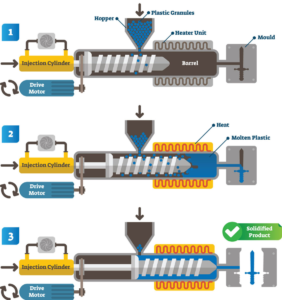
A moldagem por injeção de plástico envolve a injeção de uma resina termoplástica aquecida e fluida em uma cavidade de molde de aço ou alumínio usinada a alta pressão, permitindo que ela esfrie e, em seguida, ejete-a como uma formação do componente plástico acabado. Em contraste com a usinagem CNC (que usa subtração) ou impressão 3-D (aditivo, com material cultivado uma camada de cada vez), cada componente moldado por injeção é formado em um ciclo de repetição em uma única operação transformando pellets de polímero em um componente que pode ser removido e substituído, repetidamente na ordem de cada 15 a 90 segundos sem intervenção humana. É esta repetibilidade que tornou o molde de injeção o processo dominante para a fabricação de componentes plásticos hoje nas indústrias automotiva, de dispositivos médicos, eletrônica e de embalagens.
O mercado global de moldagem por injeção foi avaliado em 298,7 mil milhões de dólares em 2024 e deverá atingir 312,7 mil milhões de dólares em 2025, de acordo com a Pesquisa Grand View A escala não é acidental: uma vez que um molde é construído, o custo por peça moldada cai para centavos, enquanto CNC ou equivalentes impressos em 3 D ficam em dólares por unidade A matemática é por isso que a moldagem por injeção trava na decisão de desenvolvimento do produto em volumes surpreendentemente baixos.
Quando a moldagem por injeção bate a impressão CNC ou 3 D economicamente?
O ponto de equilíbrio é altamente dependente da complexidade da peça e dos requisitos de tolerância, mas uma regra prática razoável é que a moldagem por injeção se torna menos dispendiosa do que a usinagem CNC em algum lugar entre 3.000 e 5.000 unidades para geometrias simples, e entre 500 e 2.000 peças para recursos que são difíceis de usinar (corte inferior, dobradiças vivas, paredes abaixo de 2 mm).Contra a impressão SLA ou SLS 3 D, a moldagem por injeção geralmente ganha acima de algumas centenas de unidades porque o custo do molde se amortiza rapidamente quando o material e o tempo de impressão dominam Acima de cerca de 5.000 peças, a moldagem por injeção é quase sempre a resposta econômica correta para componentes termoplásticos.
É exatamente por isso que as molduras são o processo de fabricação dominante em produtos de consumo, dispositivos médicos e subconjuntos automotivos Para um lado a lado rápido de vários processos de moldagem, consulte nosso matriz de comparação de processos de moldagem.
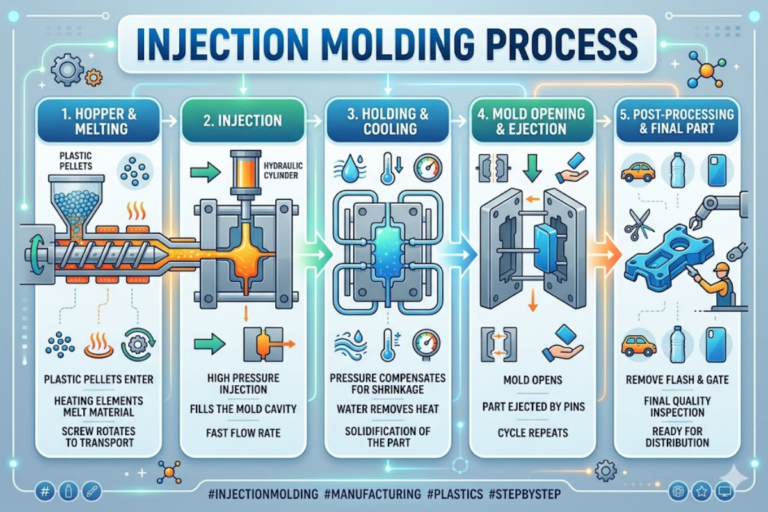
Como funciona o processo de moldagem por injeção: quatro estágios que definem o tempo do ciclo
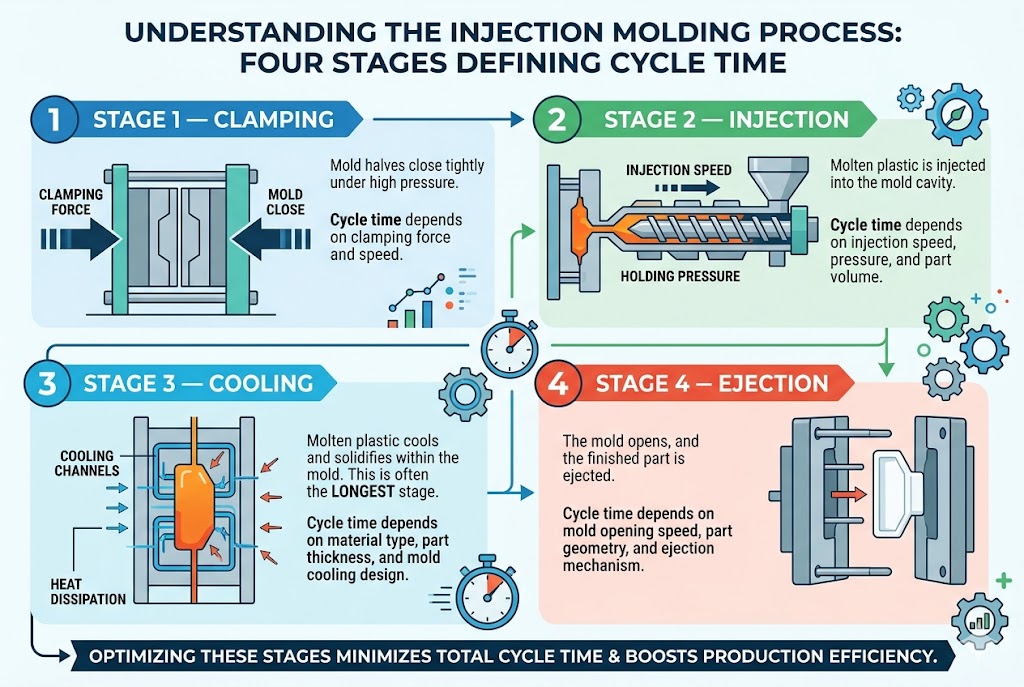
Toda operação de moldagem por injeção seja em um supino de bancada de 50 toneladas ou em uma ferramenta automotiva de 2,00 toneladas 00 progride através de quatro estágios fundamentais Você pode se familiarizar com esses estágios, a fim de testar rapidamente a resposta de um moldador quando você pergunta “quão rápido você pode fazer essa parte?” ou “por que a citação é tão alta?” porque o tempo de ciclo, a força de fixação e a dinâmica de resfriamento mapeiam cada um diretamente para um estágio.
Estágio 1. Clamping. Quando as duas metades do molde se encontram, fazem-no sob a força significativa hidráulica ou eletro-hidráulica do Clamping devem ser capazes de suportar a área projetada da parte vezes a pressão da injeção ou então o molde abrirá durante o tiro e o flash escapará ao longo da linha de separação As peças maiores exigem tonelagens maiores (300 by 200 mm automative trim panel) podem usar em qualquer lugar de 400 a 600 toneladas.
Estágio 2 Injeção. Os pellets de resina são injetados no cilindro aquecido onde um parafuso alternativo funde a resina e guia o plástico fundido através de um bocal e sistema de canal para dentro da cavidade do molde A pressão de injeção é comumente de 60-180 MPa (9.000-26,00 psi) dependente da resina e da espessura da peça O parafuso mede com precisão o material para cada granalha, garantindo que o peso do granalha seja consistente de ciclo para ciclo com prensas servo-hidráulicas modernas. Esse nível de precisão é frequentemente inferior a 0,5%.
Estágio 3 (Refrigeração). Esta é a fase dominante De acordo com dados de engenharia de processos publicados pela RJG Inc., 0, arrefecimento pode ser responsável por até 851TP20 T do tempo total do ciclo O líquido refrigerante que circula através dos canais dentro do molde puxa o calor para fora da peça solidificante a uma taxa determinada pela espessura da parede, condutividade térmica da resina e geometria do canal É por isso que a espessura da parede é a decisão de projeto mais influente para o tempo de ciclo: o tempo de resfriamento escala com o quadrado da espessura, de modo que uma parede de 3 mm esfria aproximadamente quatro vezes mais lentamente do que uma parede de 1,5 mm A BASF publica a artigo técnico sobre estimativa de tempos de resfriamento em moldagem por injeção isso documenta a relação matemática exata.
Estágio 4 E. openjection, Assim que o plástico solidificado atinge a temperatura de ejeção (uma propriedade do processo), as duas metades os pinos de ejeção ejetam as peças acabadas, que caem na coleta em caixas ou em transportadores O ciclo imediatamente começa novamente Máquinas modernas e moldes que são projetados adequadamente produzem peças de alta qualidade desacompanhadas por horas seguidas (a)), reduzindo o custo de tal forma que as plantas funcionam 24 horas por dia, 7 dias por semana.
Nota de Engenharia. Devido à dominância do coolling, a espessura da parede torna-se o driver de custo invisível “hidden” na moldagem por injeção A transferência de uma parede de 2 mm de espessura para 4 mm de espessura aumenta o tempo de ciclo de 18 segundos para 60+ segundos fazendo uma parte $0.12 em uma parte $0.40 na mesma máquina Se a espessura da parede não for trazida para a discussão DFM, então o DFM estava incompleto.
Para ver como esses quatro estágios funcionam em escala na prática, consulte nosso Capacidade de moldagem por injeção de plástico de 400 máquinas.
Materiais de moldagem por injeção: oito resinas comuns e como escolher uma
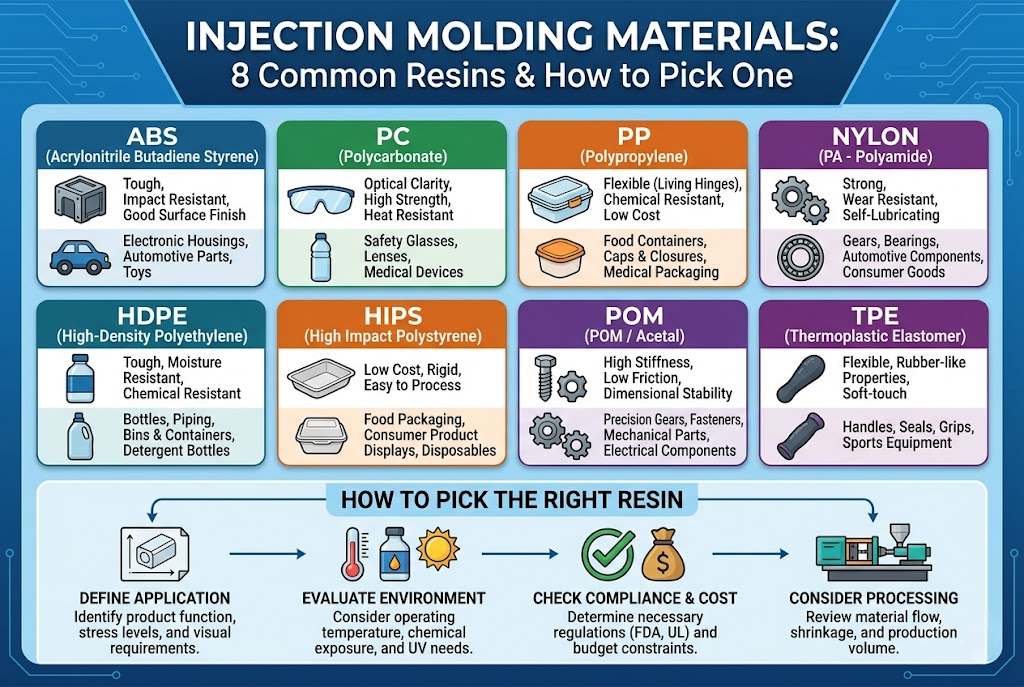
Das centenas de resinas termoplásticas disponíveis para injeção, apenas cerca de oito suportam a grande maioria da produção do mundo real A segunda decisão de design mais importante você tomará após a seleção de moldagem de parede da resina plástica porque determina os requisitos de armazenamento do aço, a quantidade de compensação de crescimento, a secagem ideal e até mesmo (em mercados médicos ou de contato com alimentos) sua via regulatória.
| Resina | Propriedades Chave | Encolhimento | Aplicações Típicas |
|---|---|---|---|
| ABS | Resistente a impactos, bom acabamento superficial, pintável | 0.4–0.7% | Caixas eletrônicas de consumo, acabamentos internos automotivos |
| PC | Claridade óptica, resistência de calor alta, resistente | 0.5–0.7% | Lentes LED, equipamentos de segurança, capas de dispositivos médicos |
| Nylon (PA6/66) | Resistente ao desgaste, forte, absorve a umidade | 0.8–1.5% | Engrenagens, rolamentos, suportes estruturais, abraçadeiras |
| PP (polipropileno) | Dobradiça resistente a produtos químicos, leve e viva capaz | 1.0–2.5% | Embalagem, recipientes domésticos, pára-choques automotivos |
| POM (acetal) | Baixa fricção, rigidez alta, dimensionalmente estável | 1.8–2.5% | Engrenagens, clipes, corpos de válvula, componentes transportadores |
| TPE/TPU | Flexibilidade semelhante à borracha, boa para sobremoldagem | 0.5–2.0% | Apertos, vedações, superfícies de toque suave, wearables |
| PC/ABS | Combina a tenacidade do PC com a processabilidade ABS | 0.5–0.7% | Caixas de laptop, carcaças de ferramentas elétricas, painéis de instrumentos |
| PBT | Isolamento elétrico, resistência química | 1.5–2.0% | Conectores, caixas de interruptores, invólucros de sensores |
Qual plástico é melhor para moldagem por injeção?
A resposta honesta é que a melhor resina plástica é aquela cujas propriedades mecânicas, resistência química, faixa térmica e perfil regulatório correspondem ao ambiente de serviço da sua peça (não o mais barato).Uma caixa médica que será esterilizada gama não deve ser feita de polipropileno (PP), embora o PP seja o segundo termoplástico mais comum em volume; cisões de cadeia de radiação gama PP e destrói sua resistência ao impacto Por outro lado, especificar policarbonato para um êmbolo de seringa descartável esterilizado adicionará custo desnecessário por causa da temperatura de processamento mais alta de P. A matriz de decisão deve começar com ambiente de serviço (temperatura, exposição química, UV, carga), adicionar restrições regulatórias (1TP10 T, 1TP11 T 61, USP Classe VI, 1TP19 T 94 V-0, 1TP3 T) e, em seguida, considerar o custo por kg. Só então um bom moldador pode citar uma construção apropriada.
Nota de engenharia: Graus reforçados com fibra de vidro (GF10, GF20, GF30) suportam e fortalecem a peça, mas desgastam significativamente as inserções mais macias da cavidade do molde. As resinas reforçadas com vidro requerem ferramenta endurecida aço-h13 ou S136 para qualquer superfície de cavidade que entre em contato com o fluxo de fusão. Os compradores podem notar isso tarde demais quando seu protótipo de molde P20 falha em 20.000 tiros, em vez dos 100.000 previstos.
Tipos de moldagem por injeção: padrão, inserção, sobremoldagem, assistida por gás e muito mais
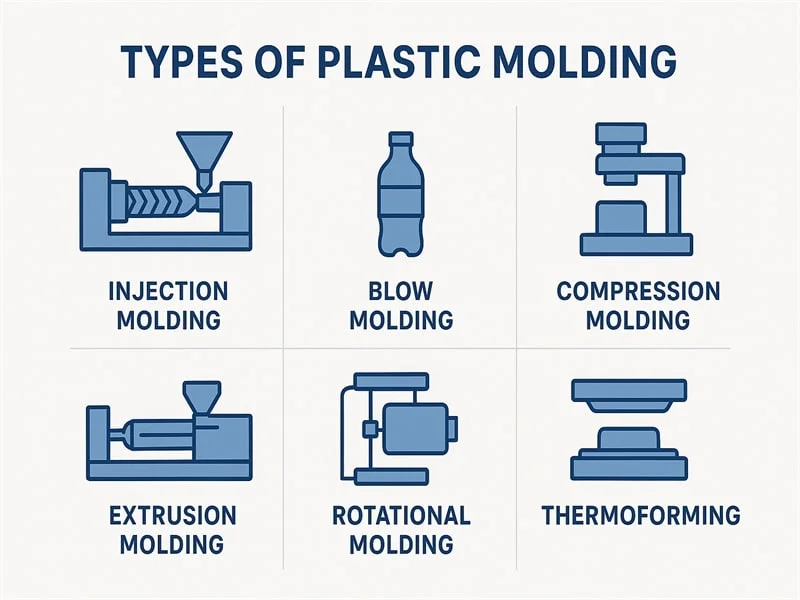
A maioria das peças é produzida a partir de moldagem por injeção de tiro único padrão Há, no entanto, um pequeno número de variações de processo para geometrias ou funções que a moldagem padrão não pode fornecer de forma eficaz, e saber qual variação resolve qual problema impedirá o pagamento pela complexidade que você não exige As técnicas modernas comuns de moldagem por injeção são:
- Inserir moldagem (inserção de metal pré-formado) inserção (bucha roscada, contato elétrico, fixador) é carregado no molde antes de encapsular o plástico em um ciclo Elimina a montagem secundária Comum em conectores elétricos e ligação de inserção metal-plástico aplicações.
- Overmolding (Molding) a máquina de injeção dura produz um segundo tiro (geralmente macio, TPE) no molde de injeção após o primeiro tiro (geralmente, ABS ou PC).Cria um único componente com duas características comuns para revestimentos macios, amortecimento e punhos macios.
- Moldagem de dois disparos (injeção)du a máquina de injeção produz dois materiais diferentes por injeção sequencial através de um molde móvel em um disparo Produz uma peça de bi-material sem ligação adesiva secundária Comum em interruptores automotivos e eletrônicos.
- Moldagem por injeção assistida por gás (nitrogênio) é injetado no processo após a injeção inicial para escavar seções grossas (aumenta a eficiência) e reduzir a guerra contra incêndio.
- Moldagem de espuma estrutural (um núcleo espumoso e de fixação (agente de expansão químico) é criado dentro de uma película sólida para reduzir as forças de peso da peça durante o processamento.
- Moldagem por injeção de mol - produz componentes de sub-grama com tolerâncias de micrômetros, usados em dispositivos med e eletrônicos.
Um erro comum é que dois moldagem de tiro e sobremoldagem são os mesmos Eles não são Dois moldagem de tiro requer um molde de órbita especial, e uma máquina de injeção de barril duplo Isso aumenta o custo de ferramentas 40-601TP20 T. Overmolding é dois ciclos na mesma máquina, com uma transferência entre Se você quiser uma aderência suave em um corpo rígido, volumes moderados sobremoldagem será mais barato no final Se você está executando milhões de peças idênticas, e tempo de ciclo é rei, dois tiro sobre o tempo cai em por parte de economia Outro tipo de processo a considerar em um projeto com elastômeros é moldagem por injeção borracha, que também é operação paralela, mas com química diferente.
“A moldagem por injeção assistida por gás ”Gas compensa acima de aproximadamente 3 mm de espessura de parede. Abaixo disso, você está comprando a complexidade do molde e da máquina sem uma redução significativa no tempo de afundamento ou ciclo”.
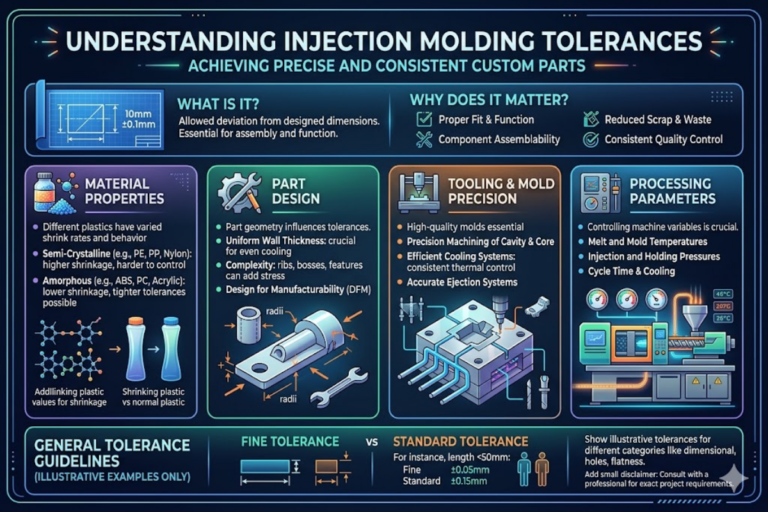
Tolerâncias e controle de qualidade: quão apertado é apertado o suficiente?
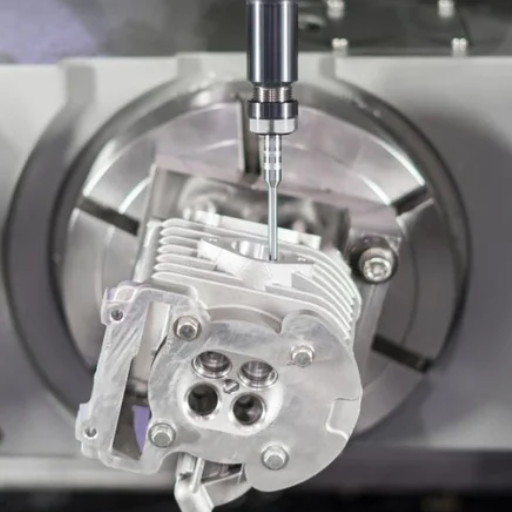
Moldagem por injeção tolerância plástica é a métrica menos compreendida em todo o processo e a razão para a maioria dos custos excessivos A maioria dos profissionais de aquisição sempre comprar “tolerâncias em todos os lugares”, confundindo especificações apertadas com qualidade Na realidade, apertar tolerâncias desnecessárias multiplica o custo do molde sem melhoria funcional.
O padrão internacional para tolerar peças plásticas moldadas por injeção é ISO 2057:2018 “Plásticos peças moldadas 4 Tolerâncias e condições de aceitação”, 0, que estabelece classes gerais de tolerância e critérios de aceitação para características dimensionais, geométricas e visuais de peças moldadas de plástico O padrão nacional alemão DIN 16742:2013 antecede e informa ISO 20457 e usa um sistema de grupo de tolerância (TG) (TG 1 a TG 7) da tolerância mais fina à mais grosseira A maior parte da produção de termoplásticos cai em TG 4 a TG 6, que mapeia de perto a tolerância geral de ±0,127 mm (±0,005 in) em tamanhos de características típicos.
Que tolerâncias a moldagem por injeção de plástico pode alcançar?
A produção padrão da moldagem por injeção mantém ±0.127 mm (±0.005 in) na maioria das dimensões sem esforço especial Com ferramentas da precisão-categoria, encolhimento firmemente controlado da resina, e parâmetros servo-conduzidos do processo, ±0.025 mm (±0.001 in) é alcançável em características críticas um nível de muitos compradores da primeira vez assumem exige usinagem do CNC A compensação é custo: tolerâncias mais apertadas conduzem o aço do molde de P20 a H13 ou S136, adicionam o lustro e o trabalho de encaixe, retardam a janela do processo, e estendem o tempo do ciclo Antes de especificar ±0.025 mm em toda a característica, perguntam-se: esta característica combina realmente com um outro componente, e se assim, o componente de acoplamento mantém uma tolerância equivalente? se a resposta é não, a tolerância mais apertada é dinheiro desperdiçado.
Encolhimento do material é a variável latente . Para os materiais disponíveis (0.41TP20 T para ABS, até 2.51TP20 T para POM e PP), ele cascatasectly em forma de cavidade uma cavidade deve ser usinada maior do que a parte final esperada por apenas a quantidade certa que depende tanto da temperatura do molde e pressão de retenção A garantia de qualidade para moldes de injeção de precisão crítica é então uma mistura de máquinas de medição de coordenadas (CMM) para verificação 3 D, projeção óptica para verificação de perfil 2 D e testes de reologia de material de entrada para pegar discrepâncias de lote de resina no início do caminho do processo Você pode quantificar tolerâncias de fabricação esperadas para o seu material de resina com o nosso calculadora de tolerância de moldagem por injeção.
Custo de moldagem por injeção de plástico: as regras 80/20 que os compradores precisam saber
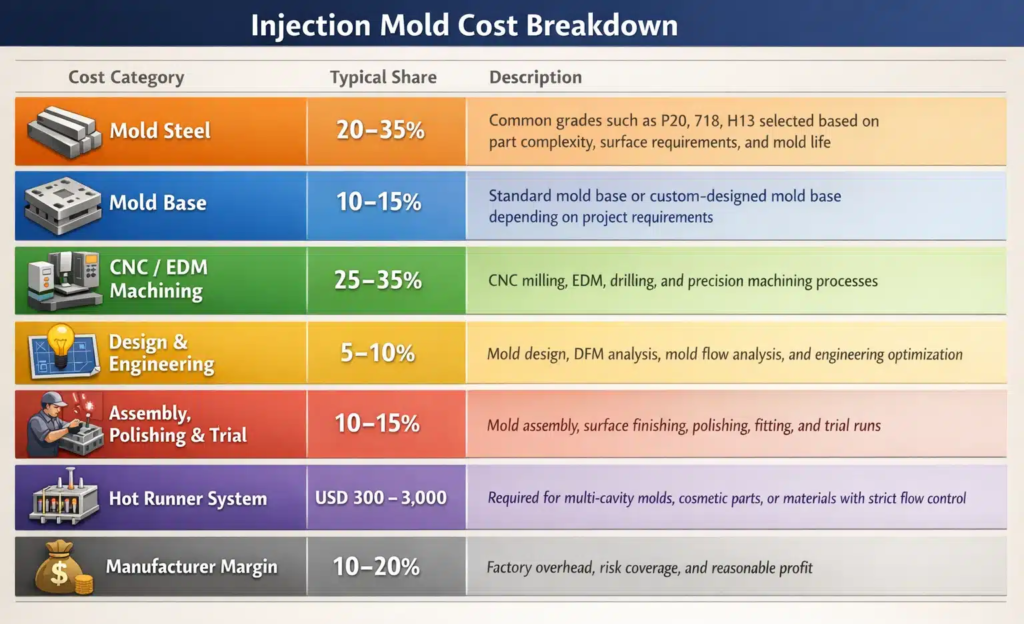
Aproximadamente 801TP20 T do seu custo de peça é determinado por decisões de projeto antes de 1 pellet ter entrado na seleção de resina de funil, parede e contagem de cavidades de molde de engenharia de projeto e foco de negociação do cliente, em seguida, gira em torno do restante 201TP20 T uma vez que a ferramenta está em produção, operação secundária e decisões de logística acabarão por determinar o preço A mesma peça do mesmo fornecedor pode citar em qualquer lugar de $0.40 a $0.12 dependendo apenas dessa semana e desse fornecedor.
O custo total se divide em três baldes:
1. custo de ferramentas. protótipo simples de alumínio single-cavities corre aos milhares; moldes de produção multi-cavidade, aço HRC com corredor quente, pode facilmente custar USD50 k ou mais, até mesmo USD 100 k para peças automotivas Drivers de custo: número de cavidade, complexidade da peça (corte inferior, elevadores, ações laterais), grau de aço de ferramenta (P20 para protótipo, S136 ou H13 para produção), brilho de superfície (SPI A-1 espelho polonês é caro), quente versus sistema de corredor frio.
Custo de fabricação 2. per-capita. Esta a soma do custo da matéria-prima (1TP21 T/kg de massa da peça, mais perdas de refusão do corredor e do sprue), taxa horária da máquina (MHR), dividida pelo número total da peça de saída por hora, e mão de obra direta Um recipiente de polipropileno de paredes finas com tempo de ciclo de 12 s pode custar apenas $0,05 por peça em matéria-prima e tempo de máquina; um invólucro de policarbonato de paredes espessas a 60 s de ciclo do mesmo tiro está mais próximo de $0,40.
Operação secundária 3. pad impressão, soldagem ultrassônica, montagem, inspeção, e embalagem cada adicionar ao custo por-parte As fábricas verticalmente integradas acham isso menos caro do que as cadeias de abastecimento internacionalizadas, desde uma vez/uma linha de ciclo taxas podem ser mantidas.
| O que impulsiona o custo ️ | O que custa baixo |
|---|---|
| Tolerâncias mais rígidas em recursos não críticos | Espessura uniforme da parede (refrigerar mais rápido) |
| Undercutes e ações paralelas | Resinas de commodities (PP, ABS) versus graus de engenharia |
| Acabamento de superfície espelhado ou texturizado | Maior volume amortizando o custo do molde |
| Resinas de engenharia (PEEK, PEI, LCP) | Moldes familiares (múltiplas peças por ferramenta) |
| Baixa quantidade de ordem anual | Simplificação de design e consolidação de recursos |
Quanto custa um molde de injeção de plástico?
Ferramentaria média de vários de milhares de dólares para um protótipo básico de alumínio único-cavitar molde, para USD 50 mais de dezenas de 100 K para multi-compartilhado olho captura ferramentas de produção com sistema de corredor quente, complexos ejetor formadores e outros babados Critérios de decisão de custo são parte geometria (número de cavidade, undercut, slides, elevadores), aço ferramenta (P20 para protótipos, H13/S136 para produção), corredor (qualquer de quente vs frio), e preferências de acabamento de superfície Os compradores subestimam o impacto de lead time mais do que custar duas vezes ou mais, uma ferramenta de “4 semanas” finalmente dispara para 8-12 semanas de produção de execução quando iterações DFM são repetidas Usando o nosso estimador de custos de moldagem por injeção você pode estimar o investimento em ferramentas e o custo unitário por peça.
Defeitos e lista de verificação DFM: onde as peças moldadas por injeção realmente falham

A infeliz realidade é que a grande maioria dos defeitos de moldagem por injeção se resume ao design do molde e não aos parâmetros da máquina. Quando A Fictiv publicou um estudo de produto sobre tamanhos e posicionamento de portões, eles identificaram decisões relacionadas ao portão como a causa raiz da maioria dos defeitos de tiro curto, linha de solda e cosméticos O takeaway para os compradores: nenhuma quantidade de ajuste de processo curará um molde mal projetado, e nenhuma quantidade de pressão de injeção fixará um portão colocado incorretamente no molde.
Os seis defeitos mais comuns nas peças moldadas e os culpados:
| Defeito | Causa Raiz Dominante | DFM ou correção de processo |
|---|---|---|
| Marcas de afundamento | Seções grossas da parede, resfriamento desigual | DFM sai costelas grossas até a parede uniforme |
| Warpage | Espessura de parede não uniforme, resfriamento desequilibrado | Parede DFM; resfriamento conforme |
| Tiros curtos | Portão muito pequeno, baixa pressão de injeção, ventilação deficiente | DFM (DFM) redimensionar portão; adicionar vent |
| Flash | Força de aperto insuficiente, linha de separação desgastada | Processo braçadeira; manutenção do molde |
| Linhas solda | Frentes de fusão que se encontram em baixa temperatura | DFM relocate gate; aumentar o tempo de fusão |
| Vazios/bolhas | Gás preso, resina úmida, baixa pressão do pacote | Processo de resina; adicionar tempo de embalagem |
Observe a tendência: quatro desses seis defeitos têm uma solução DFM em vigor em vez de uma correção de processo O erro DFM de elefante branco tantas vezes visto em fóruns de engenharia como r/MechanicalEngineering é solicitar tolerâncias mais apertadas em todas as dimensões em vez de apenas as medidas críticas Em uma conta no chão de fábrica, esse erro dobrou o custo do molde sem melhorias funcionais O segundo erro humano mais populoso é negligenciar uma simulação de fluxo de molde em geometrias complexas Uma simulação $2.000 que teria chamado o problema de empenamento torna-se um retrabalho de molde $15.000.
Em nosso recente projeto 1TP1 T, um fornecedor automotivo Tier-2 teve problemas para controlar o empenamento em um conjunto de duto HVAC PA66-GF30, já que dois moldadores anteriores colocaram portões no centróide Uma simulação de fluxo revelou que portões de válvula sequenciais em oito locais estratégicos, unidos com inserções de resfriamento conformadas nas zonas de encaixe rápido, mantiveram o empenamento a menos de 0,3 mm em um ciclo de 48 segundos A peça não produziu uma única rejeição de montagem OEM desde a transferência A moral: a localização do portão não é uma variável de processo; é um decreto de projeto de molde, e o investimento em simulação vale o atraso para cortar aço.
Como avaliar um fabricante de moldagem por injeção de plástico antes do primeiro PO
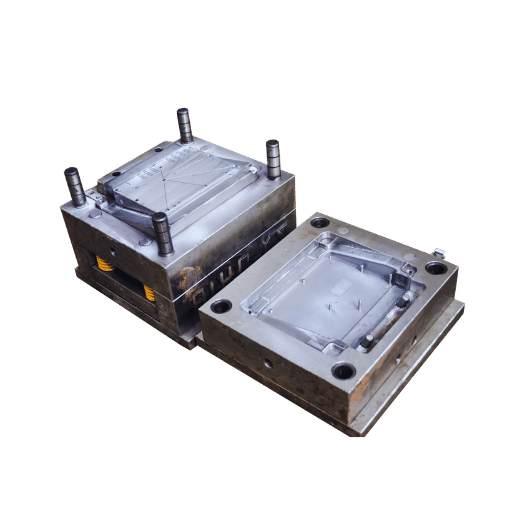
As sete perguntas abaixo fazem uma matriz de avaliação de fornecedores que diferenciará um bom moldador de injeção de plástico personalizado através de put-orientado de uma loja de empregos contratada Cada pergunta tem como alvo uma falha específica vista em revisões reais de compras do lado do comprador.
- Certs realizada: ISO 9001:2015 no mínimo, IATF 16949 para automotivo, ISO 13485 para médico Solicite o número do certificado e verifique com o registrador.
- Informações sobre aço para moldes: eles entrarão no tipo de aço (P20, H13, S136, NAK80) explicitamente por escrito na cotação de ferramentas? cotações menos caras geralmente são baseadas em aço de qualidade inferior que rachará após 20.000 tiros.
- rastreamento de dados MES /ERP: eles têm registros de produção digital do lote de matéria-prima até a caixa enviada? As lojas manuais de papel-trilho têm dificuldade em rastrear um incidente para encontrar a causa raiz.
- Ferramentas internas: eles cortam seus próprios moldes internamente ou subcontratam? Ferramentas internas significam DFM mais rápido e revisões mais rápidas.
- Operações secundárias: impressão de almofadas, soldagem ultrassônica, montagem e inspeção sob o mesmo teto reduzem os custos por peça e a necessidade de mover peças entre estações.
- Capacidade DFM: eles executarão Moldflow de sua parte antes que o aço seja cortado? um moldador que se recusa é um moldador enviando custos de retrabalho.
- Portfólio obtenha três exemplos de casos de uso de seu setor específico com resultados nomeados (ou anonimizados), mas específicos do setor). Tolerância dimensional, tempo de ciclo, taxa de rejeição.
Para uma análise detalhada de como esses parâmetros se traduzem em uma configuração de produção, consulte nossos serviços moldagem por injeção plástico.
Perguntas frequentes sobre moldagem por injeção de plástico
O que é moldagem por injeção de plástico e como funciona?
Ver Resposta
A moldagem por injeção de plástico envolve termoplásticos aquecidos através de um barril aquecido e em uma cavidade de molde usinada com precisão, onde a resina esfria e endurece na peça acabada e é então ejetada O processo envolve quatro estágios de ampolagem, injeção, ejeção que ocorre em ciclos de 1 a 90 segundos Devido à alta precisão do molde, a tolerância dimensional permanece muito baixa mesmo para bilhões de unidades que tornam a fabricação de dispositivos automotivos, médicos, de consumo muito rentável.
Quanto custa um molde de injeção de plástico?
Ver Resposta
O custo típico para um molde de cavidade única de alumínio protótipo básico está na baixa milhares de dólares, enquanto multi-cavidade, moldes de aço endurecido com canais quentes, ações laterais e geometrias de peças incomuns podem chegar às centenas de milhares Isso é afetado principalmente pela complexidade do molde, número de cavidades e texturas de superfície especificadas Os prazos de entrega para ferramentas de aço são geralmente de 2-3 semanas para ferramentas de protótipo e 6-12 semanas para ferramentas de produção.
Que tipos de plástico podem ser moldados por injeção?
Ver Resposta
A maioria dos termoplásticos moldam bem ABS, PC, PP, PA, POM, PBT, PC/ABS e TPE cobrem a maior parte da produção do mundo real graus de engenharia, como PEEK e PEI também são processáveis.
Qual é a quantidade mínima de pedido para moldagem por injeção personalizada?
Ver Resposta
MOQ começa em aproximadamente 100 peças para corridas de protótipo em ferramentas de alumínio ou aço macio As ordens de produção padrão normalmente começam em 1.000 unidades para espalhar o custo fixo do molde em peças suficientes para preços favoráveis por peça Abaixo desses limites, a amortização das ferramentas domina desproporcionalmente o custo por unidade, e a usinagem CNC ou a fundição de uretano geralmente permanecem mais econômicas até que você cruze o volume de equilíbrio.
Qual é a diferença entre moldagem por inserção e sobremoldagem?
Ver Resposta
A moldagem por inserção envolve o posicionamento de uma inserção pré-fabricada (geralmente um contato ou uma bucha) no molde antes da injeção do plástico, enquanto a sobremoldagem se refere à aplicação de uma segunda camada de plástico fundido (geralmente TPE macio sobre um ABS ou PC rígido). Ambos os processos economizam custos de mão de obra em relação à montagem secundária, mas normalmente atendem a diferentes requisitos funcionais.
Quanto tempo leva do design à primeira produção?
Ver Resposta
O prazo de execução típico para o processo de moldagem por injeção é: revisão do projeto e análise do rascunho 1-3 dias; fabricação e teste da ferramenta 3-8 semanas (dependendo do tamanho e complexidade do ferramental); amostras do primeiro artigo 1 semana a partir da conclusão do ferramental; aprovação de amostras, modificações de ferramental 1-2 semanas; início de produção 4-8 semanas (dependendo do tamanho do pedido e complexidade da peça Máximo de 1 semana de carga de produção antes do envio do primeiro lote O prazo total de entrega desde a aprovação até o primeiro envio é normalmente de 5 a 10 semanas).
Pronto para executar seu projeto de moldagem por injeção de plástico personalizado?
Envie-nos seu arquivo CAD e retornaremos feedback DFM, opções de ferramentas e um orçamento completo em 24 horas.
Os dados deste guia são compilados a partir de padrões de tolerância ISO e DIN, dados de mercado da Grand View Research, literatura técnica BASF, publicações de engenharia de processo RJG e experiência de piso de produção do Equipe de engenharia Meitu Engelhardt operando máquinas de moldagem por injeção 40+. taxas de encolhimento específicas, tempos de ciclo e tolerâncias variarão com seu lote de resina, condição e geometria parcial do molde, trate os números acima como faixas de engenharia e solicite dados do primeiro artigo para sua aplicação específica.
Referências e fontes
- ISO 2047:2018 5 Peças moldadas de plásticos (Tolerâncias e condições de aceitação) Ção Internacional para Normalização
- Relatório de tamanho e participação do mercado de moldagem por injeção, 2024 2033 Ên Grande Visualização Pesquisa
- Estimativa de tempos de resfriamento na moldagem por injeção (informações técnicas) 0,6
- Como determinar o tempo de resfriamento da moldagem por injeção •JG Inc.
- Estudo do Produto: Tamanhos de Portas e Colocação em Moldagem por Injeção – Engenharia
- DIN 1613:2013 4 Tolerâncias de peças moldadas de plástico 7 Deutsches Institut für Normung (padrão nacional alemão)
Artigos Relacionados
- Serviços personalizados de moldagem por injeção de plástico Visão geral completa da capacidade
- Estimador de custo de moldagem por injeção para ferramentas e precificação por peça
- Calculadora de tolerância de moldagem por injeção por tipo de resina e molde
- Serviços de moldagem de borracha personalizados e recursos de elastômero
- Silicone vs borracha: principais diferenças para engenheiros e equipes de compras