
Entre em Contato com Engelhardt


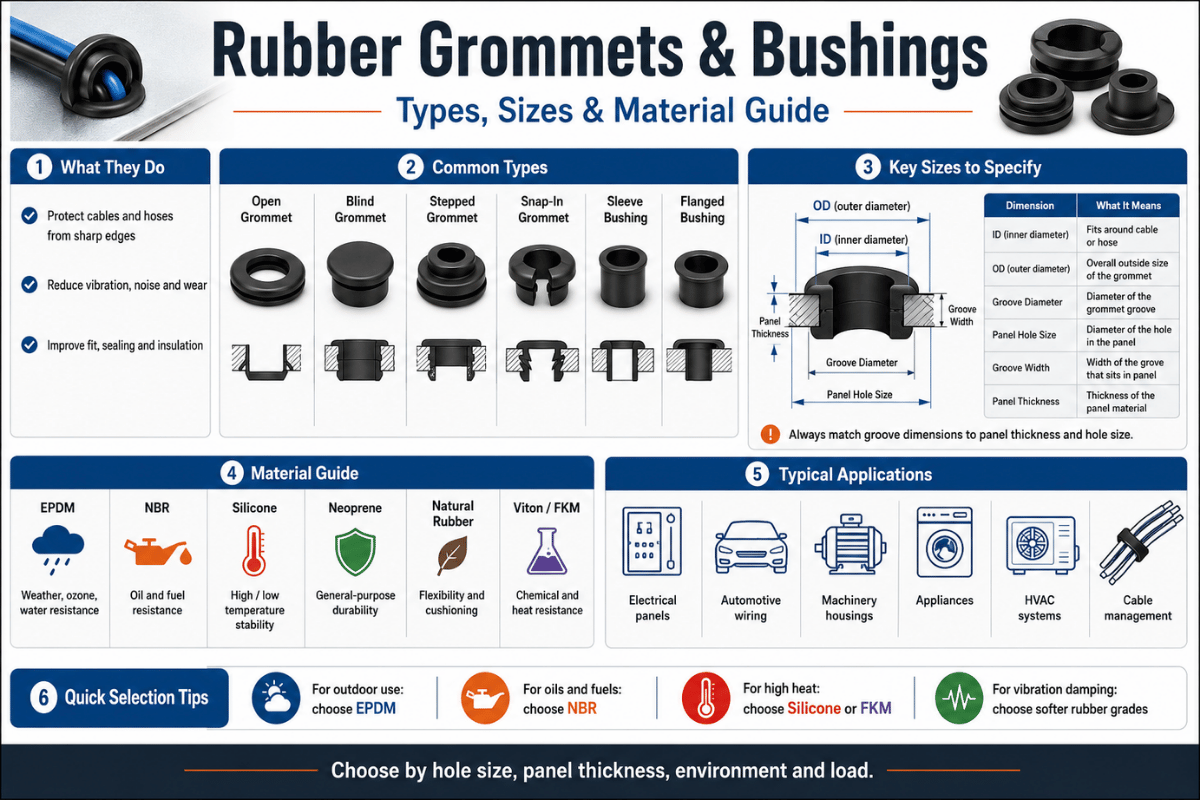
Os ilhós e buchas de borracha parecem peças baratas e descartáveis, mas erradas provocam uma parcela descomunal de falhas de campo: um fio passando por seu ilhó, uma montagem soltando seus parafusos, uma vedação que incha e fecha sua própria porta Este guia expõe a lógica que os engenheiros realmente usam para escolhê-los, qual tipo vai para onde, qual composto se adapta a qual ambiente, como dimensioná-los e quando uma peça pronta para uso deixa de ser boa o suficiente.
Especificações rápidas: ilhós e buchas de borracha
| Dureza típica | 40080 Shore A (50 Shore 60 comum para montagens de isolamento) |
| Compostos comuns | 1TP9 T, Nitrilo (1TP13 T/Buna-N), Silicone, Neoprene (CR), Borracha natural |
| Temperatura vão | -60 °C (silicone) até +230 °C (silicone); a maioria das classes -40 a +120 °C |
| Normas governamentais | ASTM D2000 (chamada de material); ISO 3302-1 (tolerância dimensional moldada) |
| A especificação do ilhó de 3 números | Furo/cabo Ø · Furo do painel Ø · Espessura do painel (profundidade da ranhura) |
| Manter método | Empurre-ajuste (sulco + pressão interna); nenhum adesivo ou porca de travamento |
Grometes de borracha vs. Buchas: o que cada um realmente faz

Em sua forma mais simples, um ilhó de borracha é uma inserção em forma de anel que preenche um orifício em um painel para que um cabo, fio ou mangueira possa passar sem esfregar em uma borda de metal afiada Ele fica em uma ranhura e mantém apenas por pressão de encaixe, sem cola ou porca de travamento A palavra bucha é onde a nomeação fica escorregadia, e errar pousa a parte errada no banco.
Portanto, existem dois significados separados para a palavra “bushing” em engenharia, e seu catálogo não avisará qual significado eles estão usando:
- ✔
Bucha isolante (elétrica): um quase sinônimo de um ilhó, um anel macio que protege e isola um condutor que passa por um painel Os fornecedores geralmente rotulam pequenos ilhós de até cerca de 51 mm como “bushings.” - ✔
Bucha de suporte de carga (mecânica): uma bucha de borracha moldada, uma manga que se assenta entre duas partes móveis ou vibratórias, um braço de suspensão, um pivô, um suporte de motor, Este carrega carga e controla o movimento; não é um furo-liner.
Aqui está uma segunda armadilha que vale a pena sinalizar na frente Os praticantes de fiação observam nos fóruns que um ilhó tecnicamente não é alívio de tensão: ele impede uma borda do painel de cortar o fio, mas não faz quase nada para resistir a uma tração dura no cabo Resistir ao pull-out é um trabalho separado, tratado por uma bucha de alívio de tensão ou uma braçadeira Confundir os dois é a maior fonte única de erros de especificação na fiação de baixa tensão.
Qual é a diferença entre um ilhó e um rebite?
Enquanto um ilhó e um rebite servem ambos para reforçar um furo, eles o percorrem de maneiras totalmente opostas Um rebite é um conector de metal permanente que mantém dois painéis de material firmemente juntos; uma vez formado, você não pode remover um rebite sem destruí-lo Um ilhó de borracha é um forro barato e reutilizável inserido em um orifício que protege um cabo, tubo, eixo, etc., movendo-se através do orifício, e também evita que os elementos externos penetrem nesse orifício Se você quiser unir duas superfícies com segurança, vá com um rebite Se você quiser passar algo com segurança através de uma superfície, use um ilhó Enquanto eles podem enviar juntos em uma única gaveta de loja de ferragens, um não pode substituir o outro.
Key Takeaway: Primeiro determine se sua peça veda um furo (bucha de ilhó/isolante) ou transmite carga de componente para componente (bucha mecânica) Esta decisão de um ramo determina a seleção de material, durômetro e classe de tolerância.
Tipos de ilhós e buchas de borracha
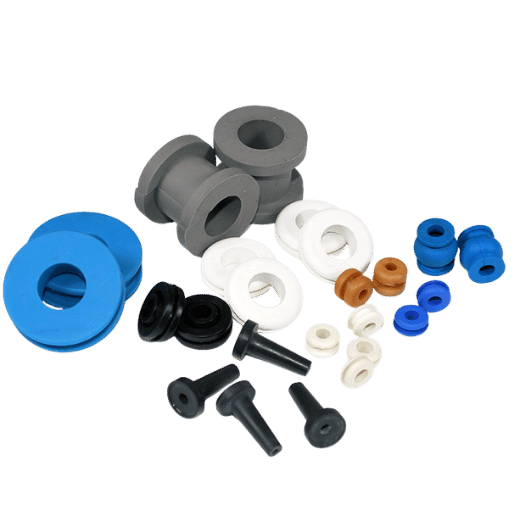
Depois de saber em que família você está, a configuração segue do aplicativo A confusão do catálogo é esclarecida quando você pensa no uso pretendido da peça, não no título em que está listada.
| Tipo | O que faz | Uso típico |
|---|---|---|
| Grumo aberto | O furo central reveste uma borda do painel | Encaminhamento de um único cabo ou tubo através de chapa metálica |
| Fechado/gromet cego | Nenhum furo central; sela uma porta | Apagando um nocaute não utilizado; mantendo a poeira fora |
| Grommet semi-cego | Membrana fina e perfurável | Convertível em campo: aberto ou selado conforme necessário |
| Tampão/rolha de apagamento | Mantém a pressão de cima ou de baixo | Tubulação de vedação e caixas pressurizadas |
| Cromos escalonados/cônicos | Cone de corte para tamanho para vários furos | Diâmetros mistos do cabo; painéis mais grossos |
| Manga/bucha flangeada | Interface de carga entre as peças | Pivôs, ligações, isolamento do fixador do painel |
| Montagem vibração moldada | Carrega a carga estática, isola a vibração | Motores, compressores, suportes de motor |
Os ilhós são vendidos por tiras redondas, ovais, em forma de D, quadradas e de borda - mas operam com base no princípio de encaixe para todos. O corte do painel de fósforos de forma, as opções de design são o material, o tamanho e - para aplicações de suporte de carga - durômetro.
Escolhendo o composto de borracha certo

Quando você está especificando essas peças, o desempenho depende muito do composto Material que é perfeitamente fino para os primeiros seis meses pode falhar completamente no mês sete, uma vez que o ambiente muda 1TP9 T, por exemplo, tem uma espinha dorsal de polímero totalmente saturada sem ligações duplas, razão pela qual ele encolhe o ozônio e UV ainda não tem resistência ao óleo em tudo A seleção de som segue a exposição dominante, em vez de hábito antigo.
| Composto | Faixa de temperatura típica | Resistência óleo | Ozônio/UV | Custo relativo |
|---|---|---|---|---|
| EPDM | -40 a +120°C | Nenhum | Excelente | 1× |
| Nitrila (NBR/Buna-N) | -40 a +120°C | Excelente | Pobre | 1.5× |
| Neoprene (CR) | -40 a +100°C | Moderado | Bom | 1.5× |
| Silicone (VMQ) | -60 a +230°C | Pobre | Bom | 3× |
| Viton (FKM) | -20 a +200°C | Excelente | Excelente | 8× |
Abaixo está uma tabela que mostra propriedades comuns para o material geral, mas pode variar com a formulação específica e deve sempre ser verificado a partir de seu fornecedor e a especificação 1TP8 T D2000 O índice de custo é normalizado para 1TP9 T como 1.
Quadro de decisão: Escolha um composto em quatro perguntas
- Se qualquer tipo de combustível, óleo ou fluido hidráulico é para entrar em contato com o componente, eliminar 1TP9 T como uma escolha Os parâmetros típicos para o óleo e combustível serão resumidos aqui: Sob 120 °C com óleo padrão, Nitrilo é aceitável Combustível aromático acima de 120 °C pode chamar para Viton.
- A temperatura é a próxima consideração ao escolher o melhor material abaixo de 120 °C você tem 3 seleções: 1TP9 T, 1TP13 T ou neoprene Mais de 120 a 230 °C se nenhum produto químico agressivo estivesse presente, você pode selecionar Silicone.
- Se o ambiente tem a chance de luz externa ou ozônio, um item feito de Nitrilo pode rachar por isso certifique-se de selecionar Neoprene ou 1TP9 T. Se um item será exposto a elementos externos e óleos, então Viton é melhor.
- Se o seu material deve tocar em quaisquer produtos alimentares ou produtos médicos que você precisará usar Silicone especificamente classificado como produto comestível sob FDA 21 CFR 177.2600 ou Food grade EPDM para uso seguro de água potável.
Os ilhós 1TP9 T ou nitrilo são melhores para a exposição ao óleo?
Nitrilo (1TP13 T) é de longe a escolha superior se qualquer tipo de exposição a combustível ou óleo estará presente como o composto foi formulado para lidar com tais ambientes Por exemplo, uma parte de acrilonitrilo 1TP13 T de 40 por cento mostra um inchaço inferior a cinco por cento sob os parâmetros dados em comparação com 1TP9 T. Uma parte de acrilonitrilo 1TP13 T de 40 por cento pode lidar com a exposição ao óleo, mantendo-se ainda altamente flexível, mas para baixas temperaturas em combinação com óleos escolher um com um 33-36 por cento ACN.
Um Exemplo Você verá em Ação A equipe de manutenção usou um material 1TP9 T em uma peça em seu painel de acesso à caixa de câmbio esperando que ele permanecesse à prova de óleo devido ao material ser uma borracha “soft.” Algumas semanas curtas depois, o óleo começou a vazar do painel; o ilhó 1TP9 T tinha se expandido em volume, fazendo com que não fosse mais capaz de preencher o sulco corretamente, e ele tinha suavizado e perdido sua rigidez Para resolver o problema, eles não selecionaram um ilhó maior, mas mudaram para 1TP13 T; isso foi eficaz, e o óleo não vazou desde então Muitos mecânicos afirmarão que o que parece ser uma pechincha baseada no catálogo barato - “ todas essas peças de borracha são as mesmas” - não funcionará uma vez que qualquer contato com óleos, ozônio ou temperaturas de 120 °C ou superiores ocorra.
Nossa maior fonte de retorno não é dimensional por material de longe A peça em si é dimensionada adequadamente, mas formulada em um composto que não pode suportar os fluidos ou temperaturas a que foi exposta em serviço Uma chamada de 2 minutos 1TP8 T D2000 no desenho cuida da grande maioria deles.
Como ler e medir tamanhos de ilhós e buchas

Erros de dimensionamento em uma peça geralmente significam que o recurso errado foi medido Para um ilhó redondo, tudo é definido por três dimensões, chamadas de Especificação do ilhó de 3 números, e se você obtiver todos os três, qualquer fabricante do ilhó deverá ser capaz de replicá-lo:
Nota de Engenharia O ilhó de 3 números Spec
- Furo /cabo máximo (o maior objeto a ser passado através do orifício central).
- Furo do painel & quina dimensão da abertura onde o ilhó será montado Este é o mesmo que o diâmetro do sulco do ilhó.
- Espessura do painel (supth) a espessura do material do painel corresponde à profundidade da ranhura do ilhó.
Sem o terceiro, o ilhó simplesmente não ficará no lugar Se a profundidade do sulco for menor que a espessura do painel, não há nada segurando o ilhó no painel e ele cairá com o menor empurrão Se for muito grande, o ilhó se ligará e não se sentará adequadamente dentro do painel A tabela abaixo é apenas uma pequena amostra ilustrando faixas representativas de tamanho de ilhó redondo.
| Cabo máximo Ø | Furo do painel Ø | Espessura máxima do painel |
|---|---|---|
| 3mm | 6mm | 2mm |
| 4mm | 6,4mm | 2,5mm |
| 6mm | 9mm | 4mm |
| 10mm | 12mm | 2mm |
| 25,5 mm (1 pol.) | 25,5mm | 2,4mm |
| 31mm | 40mm | 2,5mm |
| 48mm | 60mm | 2,5mm |
Gromets maiores tendem a ser rasos, o que significa que não há aumento proporcional do tamanho da ranhura com furo do painel ou tamanho do fio. Consulte as dimensões da mesa diretamente. Se você não conseguir encontrar uma dimensão que atenda às suas necessidades para todas as três especificações, ferramentas personalizadas podem ser uma consideração. Uma ferramenta rápida e fácil para identificar e selecionar o ilhó redondo de estoque correto com base em suas 3 dimensões é nossa localizador de tamanho de ilhó redondo.
Takeaway: Especifique o tamanho do cabo ID/max do fio, o ID do furo onde o ilhó é montado e a espessura do painel onde o ilhó se assenta em todos os ilhós redondos Essas três especificações e o composto são tudo o que um fabricante precisa saber para atender ao seu pedido.
Fio & cabo Pass-Through Grommets

Proteger o fio onde ele cruza um painel de metal é o trabalho de ilhó mais comum, e o mais propenso a especificações descuidadas Qualquer furo perfurado ou perfurado em chapa metálica terá uma rebarba ou faca-borda de um lado Como o fio é submetido à flexão normal do movimento e vibração de operar uma máquina ou dirigir um veículo, esta borda irá trabalhar lentamente através do isolamento do fio Todo o seu propósito é colocar um amortecedor resiliente entre essa borda e o condutor.
Os estilos básicos de ilhós são determinados pela forma como o orifício de montagem será usado Um ilhó estilo Open é um orifício redondo usado para rotear fios ou cabos através de uma abertura, e fornece uma passagem selada enquanto oferece proteção para os fios Um estilo fechado, ou cego, o ilhó sela uma abertura de nocaute para proteger contra sujeira, umidade e a intrusão de insetos e outros contaminantes do exterior Um ilhó estilo semi-cego tem uma teia fina em todo o centro que pode ser perfurada quando é hora de instalar um fio ou cabo, e também é o único estilo adequado quando você precisa manter a vedação estanque ao tempo do painel, como em um passe de parede de fogo, ou um conjunto de caixa ao ar livre.
Ao trabalhar em um painel sobre-recheado, os construtores alcançam buchas de encaixe em vez de ilhós A principal vantagem é o espaço Como uma bucha de encaixe consome menos imóveis na borda da parede do furo, permite que um furo menor se encaixe no mesmo feixe de fios Em um painel estrutural, onde cada abertura é um passivo, a abertura menor é importante Claro, também oferece menos de um selo ambiental - uma bucha de encaixe básica é principalmente uma proteção de borda - então a decisão se resume a se deve afastar a água E tenha em mente: Como observado acima, nenhum deles é alívio de tensão Se o fio pudesse ser puxado, adicione um componente extra, como uma braçadeira de cabo ou uma bucha de encaixe projetada para alívio de tensão Para fio de montagem em painel em seu gabinete ou sistema de montagem, nosso componentes elétricos e eletrônicos de borracha são moldados para vedação e proteção.
Isolamento de vibração: dimensionamento de montagens e buchas por durômetro

Para buchas de borracha que têm que transportar cargas e também isolar o durômetro de vibração - sua rigidez de acordo com a dureza Shore (Shore hardness) e montagem torna-se o fator decisivo Neste caso mais macio e mais flexível desviaria sob a carga e, portanto, reduziria a frequência natural da montagem, o que resulta em menos transmissão de vibração, enquanto mais duro e mais resistente carregaria mais, mas vibraria mais prontamente Em tais casos, o objetivo de projetar a peça seria trazer a frequência natural abaixo das frequências perturbadoras características da máquina.
Para atingir um nível a partir do qual um profissional irá refinar pela experiência, uma escolha padrão seria um isolador não diluído à base de elastômero aproximadamente 50-60 Shore A operando no ponto de carga estática ideal ou próximo a ele para o dispositivo, normalmente na região de 50 psi de carga/área do isolador. isto é apoiado pela literatura sobre o comportamento vibratório de montagens elastoméricas de autores como o Instituto Nacional de Padrões e Tecnologia dos EUA em seus publicações sobre montagens resilientes. Teoria semelhante para montagens elastoméricas vem de estudos puramente acadêmicos Estes também a geometria de estado mais durômetro determina a taxa de mola, e os dois são inextricavelmente acoplados, pois devem ser ajustados em uníssono contra as cargas dinâmicas e estáticas reais.
Que durômetro deve ser uma bucha de isolamento de vibração?
Não há resposta universal, mas os princípios se mantêm Equipamentos leves e condições operacionais que criam vibração de alta frequência respondem melhor a um elastômero de durômetro mais macio (40-50 Shore A); elastômero mais macio comprime e resulta em uma frequência natural mais baixa Para equipamentos com um alto peso estático onde o elastômero macio é suscetível a atingir o fundo quando perturbado ou se estabelecer ao longo do tempo, selecione uma borracha mais dura, 60-70 Shore A. A boa prática é estimar qual deve ser sua deflexão estática, então confirme que a frequência natural é cerca de um terço da frequência de operação da máquina, ou menor; nossa guia do durômetro da montagem vibração funciona através do cálculo completo.
💡 Dica profissional
Além disso, método de teste durômetro (55 ±5 Shore A).Se a tolerância de montagem for apenas “soft rubber”, então a dureza varia entre lotes entre 40 e 70 Shore A 70 mudando completamente a forma como a montagem é isolada.
Aplicações comuns em todos os setores

Não há surpresa que o mesmo conjunto de poucos componentes apareça de forma onipresente, embora as indústrias difiram quanto às demandas deles. Combinar a aplicação com a necessidade primária evita que as especificações fiquem infladas.
- Automotivo: firewall e carroceria pass-through grommets para fiação; ilhós selados para manter as classificações de entrada; uma bucha de borracha de suporte de carga em elos de suspensão e montagens de motor onde a tolerância ao óleo do neoprene e a vida útil do underhood do traje de amortecimento de vibração Explore moldado peças borracha automotivo para estes.
- Eletrônicos e data centers: ilhós de porta protegidos contra deformação, plugues de supressão selados e peças de silicone onde a rigidez dielétrica e a temperatura são importantes.
- Eletrodomésticos & HVAC: suportes antivibração sob compressores e motores; 1TP9 T weatherstrip e ilhós de painel.
- Equipamento médico & do alimento: ilhós do silicone formulados a FDA 21 CFR 177.2600 para a lavagem-para baixo e a esterilização.
- Construção & encanamento: 1TP9 T grommets e buchas de vedação para água potável e serviço ao ar livre, onde o ozônio e a resistência UV impulsionam a escolha do material.
Fora da prateleira vs. personalizado moldado: quando especificar personalizado

Um ilhó de catálogo é a chamada certa na maioria das vezes 's barato, em estoque e comprovado A moldagem personalizada ganha o custo de ferramentas quando uma peça padrão força um compromisso que você não pode aceitar A decisão raramente é sobre formas exóticas; trata-se de combinar todos os seus requisitos reais de uma só vez.
Regra de Decisão: Catálogo ou Personalizado?
Fique pronto para uso se um tamanho padrão corresponder à sua especificação de 3 números, um composto de estoque atender à exposição e as tolerâncias não forem críticas.
Mova-se para a moldagem personalizada se qualquer uma delas for verdadeira: nenhum tamanho de estoque se ajusta à combinação furo/painel-furo/espessura; você precisa de um composto ou durômetro específico não estocado nessa geometria; a peça deve atender a uma chamada precisa de 1TP8 T D2000 ou a uma tolerância ISO 3302-1 apertada; ou os volumes são altos o suficiente para que uma ferramenta dedicada reduza o preço da peça.
Os ilhós e buchas de borracha personalizados são produzidos por três processos principais A moldagem por compressão é econômica para peças maiores ou de menor volume; a moldagem por transferência adapta-se a peças com inserções ou detalhes mais finos; e a moldagem por injeção fornece a repetibilidade mais rigorosa em volumes mais altos Cada um equilibra o preço da peça de custo de ferramentas e a tolerância de maneira diferente moldagem por compressão borracha guia e uma visão geral de custo de moldagem de borracha personalizado mostre onde cada um faz sentido.
Tolerância é onde as peças personalizadas são ganhas ou perdidas.
As dimensões de borracha moldada regidas pela ISO 3302-1, que define quatro classes 1 são (Precisão), M2 (Alta Qualidade), M3 (Boa Qualidade, a classe comercial mais comum) e M4 (Não crítica).Quanto mais apertada a classe, mais custa: numa dimensão de 10-16 mm, uma tolerância fixa é de aproximadamente ±0,15 mm em M1 versus ±0,6 mm em M3. Especificar M1 onde M3 faria é uma forma silenciosa de pagar a mais; um tratamento mais completo vive em nossa nota tolerâncias de borracha moldada.
O material, por sua vez, é melhor bloqueado com uma chamada de linha 1TP8 T D2000, que codifica tipo (resistência ao calor) e classe (resistência ao óleo) para que qualquer moldador qualificado leia o mesmo requisito.
Bem-vindo ao ponto em parte complexidade onde a capacidade de fabricação faz a diferença Em 1TP2 T, OEG personalizado ilhós e buchas atravessar linhas de compressão, transferência e injeção sob 80+ prensas de vulcanização e uma oficina de molde em casa, com temos um laboratório de verificação de material e sistemas de qualidade em vigor sob 1TP4 T, 1TP3 T para apoiar uma classe de chamada e tolerâncias D2000 através de desenho para componente Tal integração vertical é o que permite uma classe de tolerância apertada e um D2000 call-out para sobreviver.
Para delinear uma peça, comece com o nosso ilhós e buchas de borracha personalizados.
Instalação, inspeção e erros a serem evitados

Um ilhó lixado para seleção ainda falha na instalação se for inserido no orifício errado para essa classe ou contornado no processo de inspeção Aprendemos que a velocidade de instalação pode ser mortal: rebarbar o orifício do painel para que a ranhura do ilhó se encaixe no metal limpo, lubrifique com uma solução compatível de sabão e água (sem graxa de petróleo em 1TP9 T) e assente a ranhura totalmente ao redor do aro Para obter um ajuste apertado, estique o ilhó sobre a borda em vez de forçar o painel.
️ Erros comuns
- Com vista para a espessura do painel. Um ilhó ranhurado de 2 mm sairá de um painel de 4 mm. Mesmo enquanto está sendo vibrado.
- Usando um orifício de painel de tamanho inferior O encaixe forçado rasga a ranhura e a porta vaza.
- Usando o fluido errado. 1TP9 T em óleo, nitrilo em UV (Uv 1TP9 T) ambos falham prematuramente.
- Assumindo alívio de tensão Os ilhós mantêm o fio fora da borda; eles não resistem a uma tração, então adicione uma braçadeira.
- Substituto de espuma ou fita Um envoltório de fita sobre uma borda afiada não pode ser um ilhó Ele corta e não sela.
O que posso usar em vez de ilhós de borracha?
Onde um ilhó de borracha não é ideal, outras soluções dependem da função da peça As buchas de encaixe de plástico precisam de um orifício menor e podem ser conectadas rapidamente; elas não selam Quando as passagens são seladas e também transportam tensão, uma rosca em uma braçadeira em uma glândula de cabo é a solução Quando você está portando em altas temperaturas ou para fluidos desafiadores, um ilhó Viton ou silicone chavetado (não o nosso de borracha de corrida do moinho) dará melhores resultados Não é os ilhós de borracha improvisar com fita adesiva, termorretrátil ou espuma: eles não duram contra a vibração em um painel de metal Se uma peça padrão estiver falhando, geralmente é um problema de material ou dimensionamento, não algo inerentemente errado com os ilhós como classe.
Na inspeção medir para fora as três dimensões no desenho, verificar o composto através de sua chamada 1TP8 T D2000 ou uma certificação do fornecedor, e verificar o durômetro com um medidor Shore A para verificar qualquer parte de suporte de carga Uma dureza entre lotes e algumas verificações dimensionais realizadas no início do lote evitar problemas de qualidade em componentes montados.
Perspectivas da indústria: o que está mudando no fornecimento de elastômeros

A procura de procura por ilhós e buchas aumentou, pelo que a mudança real em 2026 para a adaptação está no patamar da cadeia de abastecimento em conformidade e materiais, e não na procura. Previsão dos mercados de elastômeros prevê que os mercados mundiais de elastômeros aplicados aumentarão de cerca de US$111,5 bilhões em 2026 para US$160,1 bilhões até 2033, em 5,31TP20 T CAGR, com a demanda por elastômeros de silicone aumentando mais rapidamente para suportar requisitos de aplicativos de EV, eletrônicos e saúde Esse aumento está apertando os prazos de entrega para silicone especial e graus EPDM.
A regulamentação é a história maior de 2026 restrições PFAS montando a onda de ações amplas de PFAS da UE em todo o REACH mais uma onda de ações estaduais dos EUA (US state actions) aplica-se a fluoroelastômeros como Viton (1TP14 T) Para peças que realmente exigem o desempenho químico de 1TP14 T, procure uma oferta mais apertada e aumento de custo, e para peças que foram superespecificadas em 1TP14 T porque é isso que foi feito por hábito, este é o ano para re-qualificar um grau de nitrilo ou silicone onde a cobertura permite.
O que fazer em 2026: bloqueie suas especificações de material como uma chamada de linha ASTM D2000 em vez de um nome de marca, para que uma segunda fonte possa combiná-lo exatamente; e qualifique um moldador de backup antes que um composto de fonte única se torne um gargalo Uma chamada definida mais uma alternativa qualificada é um seguro barato contra a compressão da demanda e o aperto do PFAS.
Perguntas frequentes
P: Qual é a diferença entre um ilhó e uma bucha?
Ver Resposta
Uma bucha faz um furo para que algo possa passar por ela com segurança. “Bushing” tem dois significados: uma bucha isolante é simplesmente um ilhó usado em trabalhos elétricos, enquanto uma bucha mecânica é uma luva de suporte de carga entre peças móveis, como uma suspensão ou bucha de montagem Decida qual trabalho você precisa (furo) ou transporte de carga (carregando) antes de comprar uma peça.
Q: Que material de borracha é melhor para ilhós e buchas?
Ver Resposta
É inteiramente uma função da exposição dominante, e não há um único “best.” 1TP9 T é o padrão para exterior, água, vapor e ozônio, mas tem resistência zero ao óleo Nitrilo (1TP13 T) é o padrão para óleo e combustível, ainda racha na luz solar O silicone possui os extremos de temperatura e comida ou contato médico, embora sua resistência à tração seja baixa O neoprene é o meio equilibrado quando nenhuma propriedade domina, e Viton (1TP14 T) lida com produtos químicos agressivos a cerca de oito vezes o custo de 1TP9 T. Trabalhe a pior condição que a peça realmente verá, em seguida, combine o composto para que 1TP13 T substituindo na disponibilidade é como as falhas de campo começam.
Q: Como são fabricados os ilhós e buchas de borracha?
Ver Resposta
A maioria é moldada por um dos três processos: moldagem por compressão (custo-benefício para peças maiores ou de menor volume), moldagem por transferência (boa para inserções e detalhes) e moldagem por injeção (repetibilidade mais apertada em volume).O composto bruto é vulcanizado sob calor e pressão em uma ferramenta cortada na geometria da peça, depois aparado e inspecionado em relação à sua classe dimensional e chamada de material.
Q: Que escala da temperatura pode os ilhós de borracha suportar?
Ver Resposta
A maioria dos graus de uso geral 1TP9 T, nitrilo, neoprene (neoprene) são executados de cerca de -40 °C a +120 °C. O silicone se estende mais largo, aproximadamente -60 °C a +230 °C. Confirme sempre a classificação do grau específico.
P: Quando devo usar um ilhó moldado personalizado em vez de pronto para uso?
Ver Resposta
Vá personalizado quando nenhum tamanho de estoque corresponde ao seu furo, painel-furo e combinação de espessura; quando você precisa de um composto ou durômetro não estocado nessa geometria; quando uma chamada precisa 1TP8 T D2000 ou tolerância ISO 3302-1 apertada é necessária; ou quando o volume é alto o suficiente para que uma ferramenta dedicada reduza o preço da peça Caso contrário, uma peça de catálogo é mais rápida e barata.
Q: Como um ilhó de borracha permanece no lugar sem adesivo?
Ver Resposta
Por push-fit Sua ranhura é dimensionada para a espessura do painel, e a elasticidade da borracha agarra a borda de ambos os lados A ranhura, não a cola, segura-a.
Exigir ilhós ou buchas correspondentes às suas especificações, compostos e tolerância?
1TP2 T pode molde personalizado grommets de borracha e buchas para (ISO 9001/IATF 16949) - Moldagem por compressão, moldagem, Moldagem por injeção ISO 9001/IATF 16949) - Construção de molde em casa e material de transferência
Sobre Este Guia
Este manual foi compilado pelo departamento de engenharia 1TP2 T. Nossa orientação baseia-se em anos de experiência personalizada em moldagem de ilhós de borracha, bucha e montagem de vibração, nos mercados automotivo, elétrico e industrial. Para referência, referenciamos nossos bancos de dados internos para valores relacionados a materiais e dimensões (1TP8 T D2000/ISO 3302-1) e NIST e fontes acadêmicas para dados de vibração. Observamos quando valores específicos são influenciados pela forma e fatores ambientais de sua parte, e estes precisam ser confirmados por meio de uma peça de teste ou usando Análise de Elementos Finitos (FEA).
Referências e fontes
- Manual 122 Isolamento de Vibração8 Uso e Caracterização (NIST)
- ISO 3302-1:2014 Rubber: Tolerâncias para a Parte 1 (dimensional) Organização Internacional de Normalização
- Sistema de classificação padrão 1TP88T2000 ASTM para produtos de borracha (edição atual D2000-18) ASTM International
- Projeto e Modelagem de Isoladores de Vibração Elastomérica Utilizando Análise de Elementos Finitos Universidade Técnica do Oriente Médio
- Elastômeros de montagem isolados do motor Atlantis Press (aberto-acesso)
- Participação e previsão de mercado de elastômeros 2026-2033 Pesquisa de Mercado