Entre em Contato com Engelhardt


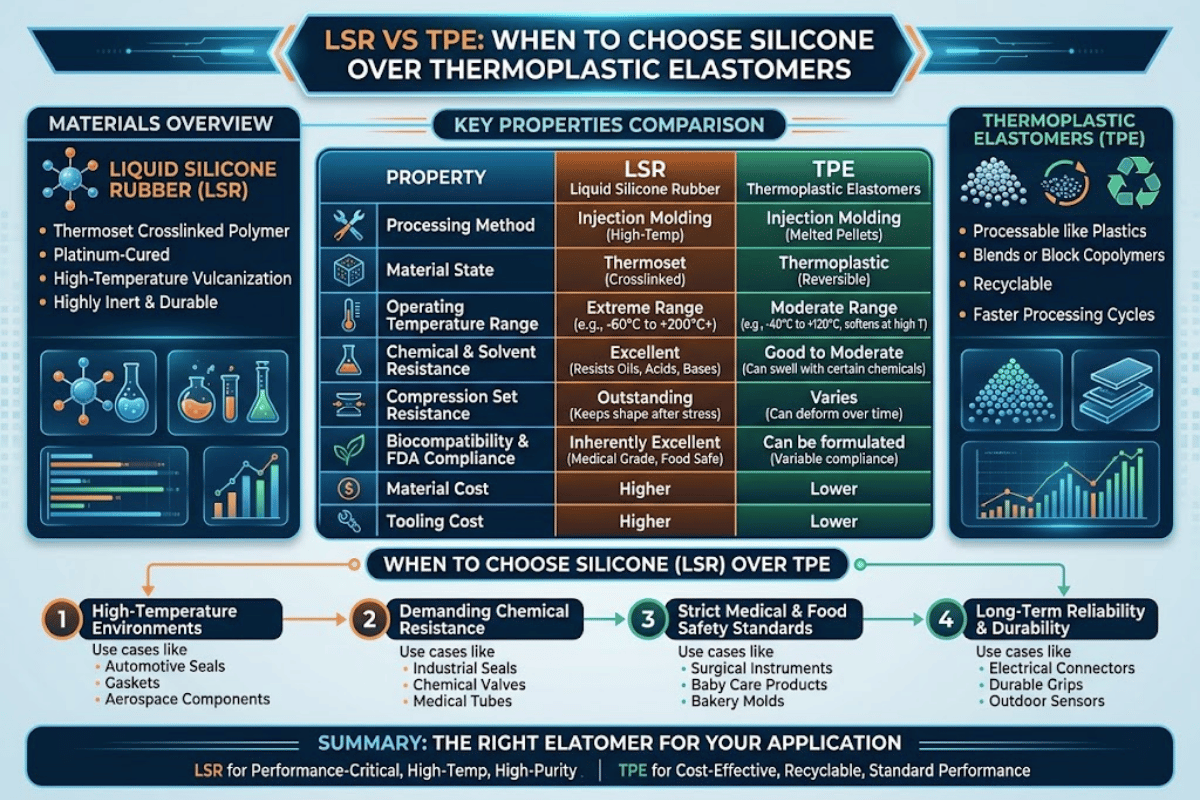
1TP15 T vs TPE é a questão de seleção de elastômero que condena a maioria das equipes de produtos antes que uma única peça seja trabalhada Tanto a borracha de silicone líquida (1TP15 T) quanto o elastômero termoplástico (TPE) deslocam a borracha natural nas aplicações de precisão mais exigentes, ainda assim ocupam extremos opostos da química do polímero um é um termofixo permanentemente vulcanizado, o outro um termoplástico reaquecível Escolha imprudentemente e você estará pagando 3× a conta de ferramentas ou observando uma peça de borracha de precisão fluir para fora das especificações no campo Este guia caminha através de química, temperatura, custo e fatores de processo que impulsionam a picareta, então entrega a você uma regra de decisão sem jargão fundamentada na economia de produção (não no marketing do fornecedor).
Especificações rápidas: LSR vs TPE em resumo
| Classe de polímero | LSR: termofixo · TPE: termoplástico |
| Temp de serviço contínuo | LSR: -60 a +200 °C · TPE: -40 a +100 °C (típico) |
| Faixa de dureza costeira | NSF: Shore A 580 · TPE: Shore OO 20 20 Shore A 9 |
| Tolerância moldagem | LSR±0.0.020.000. mm ··TPE: ±0.050.10 mm |
| Tempo ciclo | 1TP: 3015T s 0 s 15· T40 |
| Reciclável? | LSR: Não (reticulado) · TPE: Sim (remoção aceita) |
| Custo de ferramentas | LSR: $15K10TP21T8T8·TPE: ·TP21T1T1T1TTP2T50K |
| Ajuste de volume | LSR: mais de 10.000 peças/ano · TPE: mais de 5.000 peças/ano |
O que são 1TP e TPE? 15T termofixo versus termoplástico em um gráfico
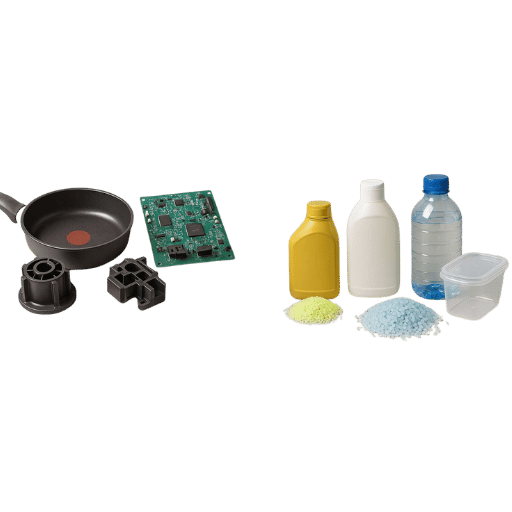
Decida a química primeiro A comparação elastômero termoplástico vs silicone repousa sobre como cada polímero responde ao calor 1TP15 T à base de silicone é um termofixo: aquecer um silicone líquido de duas partes através de um catalisador de platina impulsiona uma reação de reticulação irreversível (cross-linking reaction) um processo de vulcanização que bloqueia moléculas em uma rede elástica permanente Uma vez curada, a parte não amolecerá novamente (mesmo a 250 °C permanece emborrachada em vez de derreter.
TPE corre o. É um copolímero que derrete quando aquecido, enche o molde, endurece no resfriamento (no sentido oposto) a química muda. Reaqueça a peça e ela se torna líquida novamente, por isso a sucata de TPE pode ser retificada e reutilizada como qualquer termoplástico.
Qual é a diferença entre TPE e LSR?
Resposta curta: 100 T reticula permanentemente sob calor (termofixo), enquanto TPE suaviza e re-endurece repetidamente (termoplástico) Essa única diferença química cascades em cada decisão a jusante 1 teto, reciclabilidade ferramenta custo, tempo de ciclo, e que métodos de esterilização a parte pode sobreviver TPE abrange sete famílias comercialmente importantes: copolímeros em bloco estirênico (SBS e SEBS hidrogenado), vulcanizados termoplásticos (TPV), poliuretano termoplástico (TPU), poliolefina termoplástica (TPO), elastômeros de copoliéster (COPE), e elastômeros de copoliamida (COPA).De acordo com o Federação Britânica de Plásticos plastipedia, a família específica selecionada aciona aproximadamente 80 1TP20 T do comportamento mecânico final. 1TP15 T, por outro lado, é um material químico único variado principalmente por grau de durômetro e pacote de enchimento.
Para fabricantes que avaliam realisticamente ambos os materiais em um determinado programa, nosso Serviços de moldagem por injeção LSR a equipe realiza análises DFM lado a lado para sinalizar o ponto de cruzamento onde qualquer um dos materiais faz sentido racionalmente.
Propriedades do material comparadas: TPE vs Silicone Rubber Head-to-Head
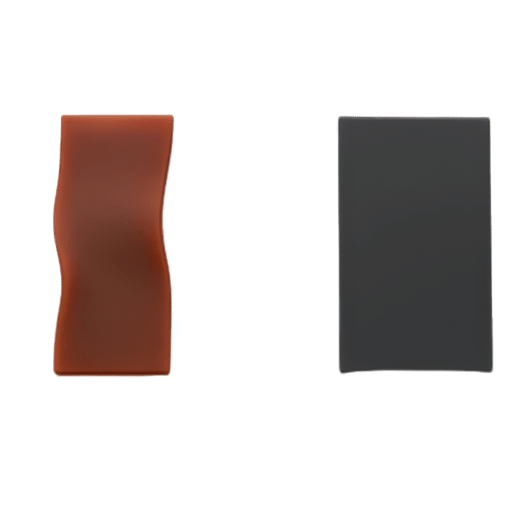
Uma vez que a decisão passa do conceito à especificação, cinco propriedades determinam o eventual resultado tpe vs borracha de silicone: limites de temperatura, faixa de dureza, resistência ao rasgo, compatibilidade química e recuperação do conjunto de compressão Uma tabela de comparação abaixo resume os valores cruzados da base de conhecimento de materiais da Avient, o BPF plastipedia, e padrões do durômetro ASTM D2240.
| Propriedade | LSR | TPE |
|---|---|---|
| Faixa de temperatura contínua | -60 a +200°C | -40 a +100 °C (dependente da nota) |
| Dureza costeira | A 5 A 80 | OO 20 A 95 |
| Gravidade específica | ~1.12 | ~0.89 |
| Alongamento na pausa | Até 950 % | Até 700 % (graus SEBS) |
| Força lacrimal | Relativamente baixas, pequenas lágrimas se propagam | Formulável ao estiramento de 3 mil no nível do filme |
| Conjunto de compressão (22 h @ 100 °C) | 10–25 % | 25–55 % |
| Resistência UV/ozônio | Inerente (sem aditivos) | Dependente de aditivos |
| Biocompatibilidade | Inerente (curado com platina) | Dependente de grau (TPE médico disponível) |
1TP15 T é um Elastômero?
Sim 1TP15 T é um elastômero, mas um thermoset um Um elastômero é qualquer polímero que se recupera elasticamente após a deformação, e a rede curada com platina de 1TP15 T atinge esse comportamento em toda a sua janela de temperatura de serviço Onde vacila é a propagação do rasgo: uma vez que uma rachadura inicia em 1TP15 T, ela tende a correr.
“Embora os enchimentos possam melhorar um pouco as propriedades, as resistências ao rasgo e à tração permanecem relativamente baixas [em 1TP15 T]. Mesmo uma pequena ruptura pode levar a uma falha catastrófica.”
A maioria das comparações de autores de fornecedores pula essa descoberta contra-intuitiva “Silicone é mais resistente do que o plástico” é amplamente verdadeiro para resistência à fluência e estabilidade térmica, mas errado para propagação de lágrimas (discreta) um detalhe importante se o seu design tiver paredes finas ou transições de raio nítidas Correspondentes Durômetro Shore A para o seu perfil de estresse real evita essa classe de falha de campo.
Processo de moldagem: líquido frio em molde quente versus pellet quente em molde frio
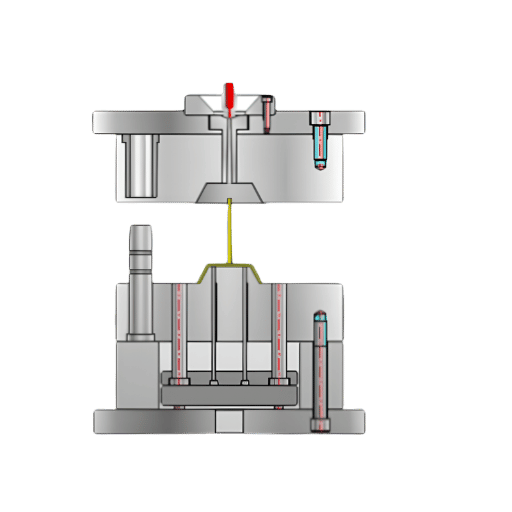
O processo de moldagem de borracha termoplástica vs silicone ocorre em direções térmicas opostas, e o equipamento o reflete. LSR chega como dois líquidos viscosos (Partes A e B) dosados na proporção de 1:1, resfriados através de um canal frio e injetados em um molde mantido a 150 °C onde o catalisador de platina reticula a peça em 300 segundos. O TPE chega como pellets secos, derrete em um barril quente a 180240 °C e injeta em um molde mantido a apenas 2149 °C onde solidifica ao resfriar.
| Parâmetro de processo | Injeção LSR | Injeção TPE |
|---|---|---|
| Alimentação material | Líquido bombeado (2 partes) | Pellets secos (hopper) |
| Temp barril | Refrigerado ~525 °C | 180240 °C |
| Temperatura do molde | 1500 °C (aquecido) | 21 °C (chilled) |
| Cura/mecanismo definido | Links cruzados platina | Resfriamento térmico |
| Requisitos de ferramentas | Corredor frio, aberturas de precisão, vácuo | Injeção padrão de parafuso único |
| Destino sucata | Não reciclável | Recobrir aceito |
Um tópico do fórum captura bem a diferença prática: o processamento de borracha ou silicone é fundamentalmente diferente da moldagem por injeção de plástico, e uma loja somente TPE não pode deixar cair um tambor 1TP15 T na mesma máquina Nossa célula dedicada 1TP15 T de 150 toneladas executa um sistema de medição de corredor frio ajustado para ±0,5 1TP20 T w/w precisão de relação, mais perto da dosagem de grau farmacêutico do que um piso de plástico típico Para o fluxo de trabalho completo, consulte o nosso guia moldagem por injeção borracha.
Nota de Engenharia sobre Moldagem de Dois Tiro
O TPE liga-se à maioria dos termoplásticos comuns (PP, ABS, PC) a temperaturas de molde na faixa de 40 coesivamente °C sem primers. 1TP15 T requer um substrato tratado com plasma ou um primer químico para atingir a mesma resistência de ligação, e o substrato deve tolerar uma superfície de molde de 150 °C +. A leitura errada desta janela de compatibilidade é a mais comum Sobremoldadura LSR modo de falha que vemos nas análises DFM.
Comparação de custos: material, ferramentas e armadilha de gravidade específica
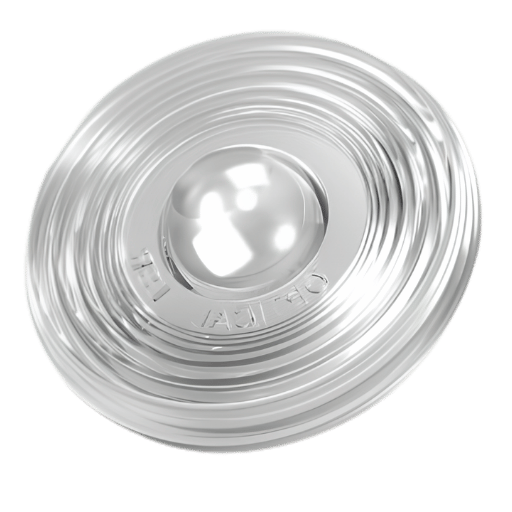
No papel, é mais barato. Os pellets TPE brutos rodam aproximadamente $4, enquanto o TPE21T1 por grau, LSR de grau médico, fica em $151T151T35 por kg. Mas essa não é a comparação que importa em uma nota de materiais. Partes por dólar, não dólares por quilograma é a medida certa.
O que é mais barato: TPE ou LSR?
O TPE é quase sempre mais barato tanto no material quanto na ferramenta de pequena cavidade Uma ferramenta de produção de pequena cavidade executa cerca de $10KT$50K para TPE versus $15KT$80 para uma ferramenta de corredor frio dedicada 1TP15 T. Adicione o tempo de segundo ciclo 1540 do TPE contra 3090 segundos do LSR e a diferença de custo por parte aumenta ainda mais em volumes baixos A inversão econômica uma vez que o volume anual excede cerca de 40.000 partes (em que os moldes de produção de 16 a 64 cavidades do ponto LSR amortizam mais rapidamente, e o ciclo automatizado sem flash recupera o delta de ferramentas.
Uma variável que as equipes de compras geralmente não percebem: gravidade específica Avient publica uma fórmula útil em sua base de conhecimento gravidade específica × preço por libra = custo de volume. Como o 1TP15 T é executado com gravidade específica 1,12 versus 0,89 do TPE, uma libra de 1TP15 T produz 20 1TP20 T a menos de partes do que uma libra de TPE A lacuna por libra se estreita quando você a traduz em partes acabadas.
Vedação da válvula de torneira com balanço de custo real
Uma marca de louças sanitárias Fortune 500 executou vedações de válvula moldadas por compressão para 3 milhões de peças por ano O tempo de ciclo foi de 8 minutos com 12 1TP20 T sucata de flash e short-fill A conversão da peça para uma ferramenta de 1TP15 T de 16 cavidades cold-runner colapsou o ciclo para 55 segundos e cortou sucata sob 1 1TP20 T. A alternativa TPE teria economizado mais em ferramentas iniciais, mas não poderia atingir a tolerância de vedação de ±0,03 mm o design necessário Economia anual líquida após a conversão: $200 K+. O ponto não é que 1TP15 T sempre ganhe é que a resposta de custo depende da tolerância e do volume, não do preço do material.
Para uma análise específica do programa, nosso Estimador de custos LSR executa ambos os cenários em relação ao seu volume anual e tolerância alvo.
Quando 1TP15 T ganha: quatro aplicações onde Silicone vs TPE não é um concurso
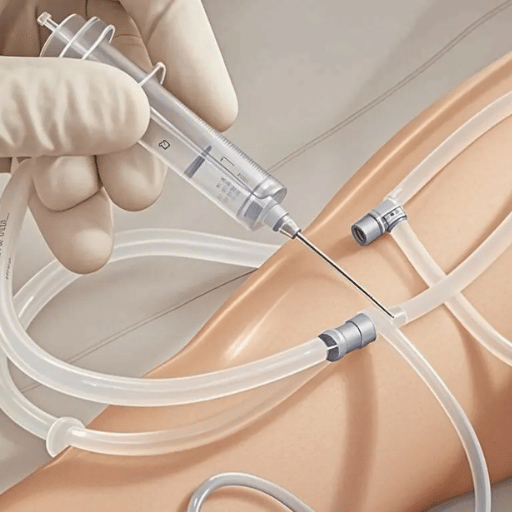
No debate silicone vs tpe, quatro cenários deixam 1TP15 T efetivamente não substituível Cada vínculo de volta a uma propriedade TPE não pode corresponder em sua forma típica.
1. dispositivos médicos implantáveis
Implantes Classe III e dispositivos de contato prolongado exigem Avaliação biológica FDA ISO 10993-1 e qualificação USP Classe VI. 1TP15 T curado com platina tem um histórico clínico documentado de 40 anos nesses padrões O TPE de grau médico existe, mas requer qualificação por formulação, e é por isso que cateteres, componentes de válvula cardíaca e selos implantáveis de administração de medicamentos são padrão para silicone.
2. vedações automotivas sob o capô
O serviço sob o capô vê -40 a +200 °C com óleo quente, vapor de combustível e ciclos de trabalho de 10 anos A resistência ao calor de 1TP15 T mantém a estabilidade dimensional em toda a janela; o TPE típico suaviza acima de 100 °C contínuo e perde resistência química à medida que a temperatura aumenta As vedações do conector, os amortecedores de vibração HVAC e as juntas do turbocompressor são território de silicone.
Esterilização repetida da vapor-autoclave
As alças de instrumentos cirúrgicos e as interfaces médicas reutilizáveis enfrentam vapor saturado de 134 °C, geralmente mais de 500 ciclos ao longo da vida útil de um dispositivo. O TPE de nível médico pode sobreviver a cerca de 100 ciclos; o LSR médico normalmente limpa mais de 2.000 sem desvio de durômetro ou mudança dimensional.
4. selos da precisão da Tight-tolerância
Quando o projeto exige ±0,025 mm em uma superfície de vedação crítica e geometria de parede fina abaixo de 0,5 mm, a baixa viscosidade do 1TP15 T preenche cavidades complexas que o TPE luta para alcançar As membranas sensíveis à pressão em aparelhos a gás e diafragmas de bomba oftálmica ficam neste balde.
️ Erro comum, presumindo que o TPE manuseia autoclavagem
Um OEM médico nós trabalhamos com o padrão especificado TPE para uma alça reutilizável do endoscópio, assumindo a esterilização coberta do “medical-grade” Pelo ciclo 30 o durômetro Shore A tinha desviado 8 pontos e a alça deformada sob pressão de aderência Esse dispositivo foi re-ferramentado em 1TP15 T. Se o protocolo de esterilização inclui vapor repetido a 134 °C, valide com dados de contagem de ciclos antes de especificar o TPE.
Para trabalhos de precisão com essas tolerâncias, nosso serviços personalizados de injeção LSR segure ±0.0. mm com 16625 ferramentas da cavidade, e cada programa é enviado com documentação PPAP. Uma comparação mais ampla de silicone contra outras borrachas fica em nosso silicone vs borracha repartição.
Quando o TPE vence: três casos em que material TPE versus silicone inverte a resposta
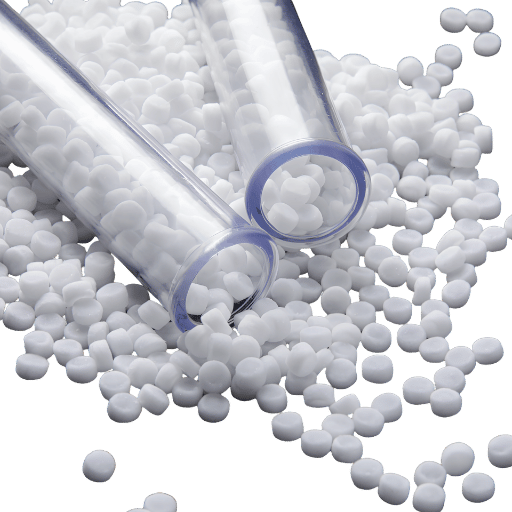
O TPE é frequentemente apresentado como a alternativa favorável ao orçamento Esse enquadramento o subestima No debate elastômero vs silicone, três cenários fazem do TPE a resposta tecnicamente correta, não o compromisso de corte de custos.
1. sobremoldagem de toque suave do consumidor
Alças de escova de dentes, alças de ferramentas elétricas e artigos esportivos exigem uma camada macia lapidada em um substrato duro O TPE liga-se facilmente a PP, ABS, PC e PA66 em moldes padrão de dois tiros sem primer. 1TP15 T requer um substrato resistente ao calor e um primer de plasma ou químico, o que dobra a despesa do processo.
2. dispositivos médicos de uso único
Tubulação IV descartável, vedações de saco de infusão e componentes respiratórios de uso único se encaixam no ponto ideal da TPE A tubulação TPE de grau médico da Saint-Gobain e DuPont Liveo é padrão no bioprocessamento de alto volume Essas peças não vêem esterilização repetida e não precisam do desempenho vitalício da LSR. Alcançar a LSR aqui desperdiça o investimento em ferramentas.
Filmes e vedações de alta resistência ao rasgo
Faixas de resistência ao exercício, filmes elásticos de fraldas, e vedações de barreira fina precisam de 500 alongamento 1TP20 T + sem propagação de rasgo Como mostra a citação Avient/McKeen acima, 1TP15 T é realmente mais fraco aqui SeBS ou TPV adequadamente formulados se estendem até a espessura do filme de 3 mil sem rasgar LSR se dividiria.
Quais são as desvantagens do TPE?
O cluster do TPE em torno da temperatura e do rastejamento O serviço contínuo acima de 100 °C suaviza a maioria dos graus A carga compressiva sustentada causa deformação por fluência Uma junta TPE mantida sob pré-carga do parafuso por 10 anos não recuperará totalmente sua forma original, enquanto 1TP15 T se recupera dentro de 1025 1TP20 do original O plastificante e os aditivos antioxidantes podem lixiviar ou extrair, o que importa para aplicações médicas e alimentares de contato direto Cada grau deve ser qualificado de forma independente E se a parte vir ozônio, UV sustentado ou solventes concentrados, o pacote de aditivos em vez do polímero base determina a sobrevivência.
️ Erro comum 1TP15 T sobre-especificar onde TPE funciona
Um engenheiro no r/InjectionMolding resumiu: “A menos que você lide especificamente com 1TP15 T, você estaria melhor com um TPV ou TPU. Vemos que os programas de padrão semanal descobrem padrão para 1TP15 T porque ”silicone soa mais seguro, então a conta de ferramentas é $40 K maior do que a alternativa TPE que teria atendido a todas as especificações Para peças não esterilizadas voltadas para o consumidor, de baixa temperatura, abaixo do volume anual de 40 K, o TPE quase sempre ganha no custo total de propriedade.
Nosso moldagem borracha personalizada equipe também corre serviços de moldagem por injeção de plástico no mesmo andar, uma recomendação TPE-first não é um truque comercial, então os dados dizem que o TPE se encaixa.
A Regra 60/40: Um Quadro de Decisão Simples para a Diferença entre Silicone e TPE
Tabelas de propriedades para a diferença entre silicone e tpe são úteis, mas não respondem à pergunta de compra: qual especifico para esta parte? Nossa Regra 60/40 divide essa decisão em dois números extraídos de dados de produção em 12 programas de fabricação (2022025).
A Regra 60/40
Escolha LSR se a parte verá serviço contínuo acima de 60 °C ou será esterilizado mais de 40 vezes ao longo de sua vida útil.
Escolha TPE se a peça opera abaixo de 60 °C contínuo e o volume anual de produção é menos de 40.000 unidades e soft-touch ou reciclabilidade é uma prioridade de design.
Esses limites são características derivadas de dados de produção de 1TP2 T. O programa de heuring pode exigir restrições de tolerância fina para restrições regulatórias ou específicas.
Um mapa cenário-material abaixo aplica a regra às categorias B2 B comuns:
| Aplicação | Material | Porquê |
|---|---|---|
| Cateter implantável | LSR | legado ISO 10993 + USP Classe VI |
| Junta turbo automotivo | LSR | Temperatura contínua >150 °C |
| Pulseira vestível de consumo | TPE (SEBS) | Ligação coesiva de baixa temperatura à carcaça do PC |
| Tampa armazenamento alimentos | TPE (TPV) | Existem classes compatíveis com FDA 21 CFR 177; reciclável |
| Junta exterior do cerco | LSR | UV + ozônio sem aditivos |
| Mamilo chupeta bebê | LSR | Biocompatibilidade + ciclos de esterilização a vapor |
Para uma recomendação específica de volume e tolerância, o Calculadora de seleção de material LSR aplica a mesma lógica contra a geometria da sua peça e a produção anual.
Incerto de que lado da linha 60/40 a sua parte cai?
Perguntas frequentes: LSR vs TPE
P: LSR é um TPE?
Ver Resposta
No. 1TP15 T é um termofixo (theroset) que reticula o polímero permanentemente através de um catalisador de platina, e a parte curada não pode ser fundida novamente O TPE é um termoplástico: ele amolece e re-endurece com calor sem qualquer alteração química Ambos os materiais ficam em categorias de polímeros opostas, apesar de serem elastômeros semelhantes a borracha.
Q: Pode TPE substituir o silicone em produtos do bebê?
Ver Resposta
Várias formulações de TPE de grau médico atendem a 1TP10 T 21 CFR 177 para contato com alimentos e são amplamente utilizadas em mamilos de garrafas, anéis de dentição e componentes de chupeta Restrições principais: esterilização repetida a vapor acima de 100 °C degradará a maioria dos graus de TPE, de modo que os produtos projetados para limpeza por fervura padrão para 1TP15 T. Sempre confirme que o grau específico está qualificado para a temperatura de uso esperada e o método de esterilização.
Q: É seguro o alimento de TPE?
Ver Resposta
As formulações de TPE de qualidade alimentar estão em conformidade com o FDA 21 CFR 177 e o Regulamento UE 10/2011 Nem todos os TPE cumprem estas normas por defeito (sebs sem plastificante) e as qualidades de TPV são as opções habituais de contacto com os alimentos Verifique a folha de dados e o perfil dos extraíveis para a aplicação específica.
Q: Pode TPE ser vapor-esterilizado como LSR?
Ver Resposta
Faixa limitada.TPE de grau médico tolera autoclavagem até cerca de 135 °C por 15 minutos, e conjuntos de cabos TPE/TPE sobrevivem cerca de 100 ciclos por teste ClearPath Medical Em comparação, 1TP15 T lida com vapor de 134 °C por 2.000 + ciclos sem drift de durômetro Para instrumentos cirúrgicos reutilizáveis e reprocessamento de alto ciclo, 1TP15 T continua a ser o padrão.
Q: 1TP15 T custa mais por parte do que TPE?
Ver Resposta
Em volumes baixos, sim 1TP15 T ferramentas e matéria-prima ambos correm mais alto Em volumes acima de ~ 40.00 partes por ano, automação multi-cavidade de 1TP15 T e flash-livre ciclo frio-corredor fecha a lacuna ou inverte-lo Sempre incluir o custo de volume ajustado-gravidade específica ao comparar: uma libra de 1TP15 T faz 20 1TP20 T menos partes do que uma libra de TPE.
Q: Pode 1TP15 T ser reciclado?
Ver Resposta
Não através da reciclagem de fusão A rede reticulada é termicamente irreversível, portanto, a re-moagem não pode entrar novamente em um ciclo de injeção da mesma forma que a sucata de TPE pode. Os fluxos de resíduos de 1TP15 T são normalmente downcycled para preenchimento mecânico ou recuperação de energia Se a circularidade é um requisito do programa, o TPE é estruturalmente o melhor ajuste.
Referências e fontes
- Uso da Norma Internacional ISO 10993-1 (Avaliação Biológica de Dispositivos Médicos) • Administração de Alimentos e Medicamentos
- Guia de última geração sobre os efeitos dos processos de esterilização em materiais TPU/TPE (NCBI)
- Elmoplástico ElPE, TPR Plastipedia Federação Britânica de Plásticos
- Qual é a Diferença? TPEs vs Silicones base de conhecimento da Corporação Aviente
- Escolha o material e processo de borracha certo (durômetro costeiro ASTM D2240) Soluções de vedação Trelleborg
- Silicone vs Tubo Termoplástico Seleção de Dispositivo Médico –Gobain Médica
- McKeen, LW, Manual de Aplicações de Polímeros em Medicina e Dispositivos Médicos, Elsevier, 2016 (ISBN 978-0-323-22169-6)
Sobre Esta Análise
Os números de custo e ciclo-tempo neste guia são extraídos dos registros de produção Engelhardt 2022025 Meitu e TPE de Engelhardt em 12 programas de fabricação que cobrem vedações de válvulas sanitárias, juntas de conectores automotivos e moldes vestíveis para o consumidor A Regra 60/40 é uma heurística destilada desses programas é um ponto de partida, não um substituto para a revisão DFM em sua parte específica As faixas de propriedades são cruzadas para ASTM D2240, o BPF plastipedia, a base de conhecimento de materiais publicada da Avient e a orientação de avaliação biológica ISO 10993-1 da FDA. Nossa equipe de engenharia possui certificação ISO 9001:2015 e IATF 16949 e revisou todas as reivindicações numéricas em relação aos documentos de origem.
Artigos Relacionados
- Silicone vs Borracha: principais diferenças para engenheiros e equipes de compras comparação de elastômeros mais ampla além do TPE
- Moldagem por injeção de borracha: processo, tipos e usos (Guia 2026) 1TP15 orgânicos e processos de borracha termoplástica
- Comparação de métodos de moldagem de borracha: compressão versus injeção versus transferência – para escolher cada processo
- Moldagem de borracha personalizada: guia de processo, materiais e tolerância (2026) guia de seleção de elastômeros de borracha
- Moldagem por compressão vs Moldagem por injeção: como escolher o processo certo – acompanhante de seleção
![Sobremoldadura de silicone: Guia de design multimaterial LSR [2026]](https://meitu-engelhardt.com/wp-content/uploads/2026/04/0-8-768x512.png)