Treten Sie mit Engelhardt in Kontakt


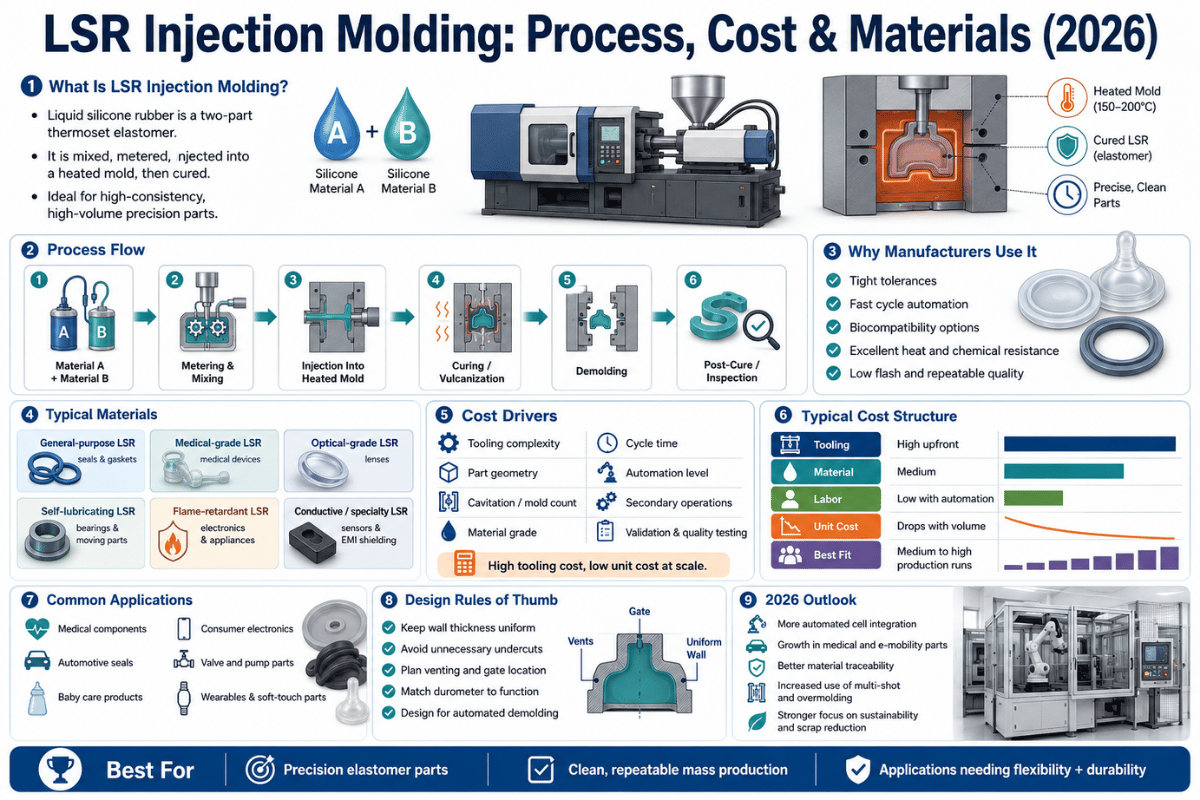
LSR-Spritzguss ist ein Herstellungsprozess, der einen zweiteiligen, platingehärteten flüssigen Silikonkautschuk in eine beheizte Form injiziert, wo er sich in Sekundenschnelle zu einem fertigen duroplastischen Elastomerteil vernetzt. Da er chemisch und nicht durch Einfrieren aushärtet, bleibt das Teil hitzestabil und kann nicht geschmolzen und reformiert werden. Aus diesem Grund ist LSR das Material der Wahl für Teile mit hohem Volumen in Automobil-, Medizin- und Elektronikanwendungen. Dieser Artikel beschreibt die Grundlagen dieser Prozessstufe nach Stufen - einschließlich der Faktoren Sie müssen den besten Durometer und die beste Silikonkautschukqualität auswählen, Kosten und wie Sie einen Hersteller auswählen.
In einem Absatz
1TP15 T-Spritzgießen genau messert und statisch mischt zwei flüssige Materialien, typischerweise ein Addition-Cure-Silikon, bestehend aus einer Platinkatalysator-aktivierten Basis und einem Vernetzer Das gemischte Material wird dann durch einen gekühlten Kaltkanal in einen heißen Hohlraum eingespritzt - normalerweise 150-200 C-Härtung auf das gewünschte Härtemeter in 25 Sekunden oder weniger. Da das Silikon im Kaltkanal, der typischerweise bei etwa 15-25 C bleibt, nicht aushärtet, handelt es sich um eine Flash-freie und schrottfreie Methode zur volumenstarken automatisierten Herstellung von Teilen mit Härtebewertungen von Shore A 5-80.
Schnelle Spezifikationen: LSR-Spritzguss
| Materialform | Zweiteilige Flüssigkeit (A:B gemischt 1:1), Platin-Additionshärtung |
| Durometerbereich | Shore A 580 (Standardnoten typischerweise 30 70) |
| Aushärten / Formtemp | Beheizter Hohlraum bis ~200 °C; Kaltläufer ~15 °C |
| Betriebstemperatur | -50 °C bis +250 °C (Spezialqualitäten breiter) |
| Typische Toleranz | Linear ±0,025 mm/mm; Teil ±0,1 – 0,2 mm (gemäß ISO 3302-1) |
| Schrumpfung | ~ 2 31 TP20 T (stufenabhängig) |
| Hohlräume | 1 bis 32+; Aushärtung gemessen in Sekunden pro Teil |
Was ist 1TP15 T Spritzguss?
Beim 1TP15 T-Spritzgießen wird ein zweiteiliger platingehärteter flüssiger Silikonkautschuk in einen bereits heißen Formhohlraum eingespritzt und in Sekundenschnelle ausgehärtet, um zum endgültigen Elastomerteil zu werden. Im Gegensatz zu Thermoplasten, die beim Abkühlen erstarren und bei erneuter Wärmeeinwirkung schmelzen, erfährt 1TP15 T eine dauerhafte Vernetzung (sie setzt sich als Duroplast fest) und kann nicht wieder geschmolzen und gefaltet werden.
Auf der fundamentalen Ebene besteht das Material aus zwei getrennten Flüssigkeiten, Komponente A enthält einen Platinkatalysator, und Komponente B enthält den Vernetzer (nämlich Methylhydrogensiloxan) und einen Inhibitor, der verhindert, dass es vorzeitig reagiert, während die beiden Komponenten in Suspension gelagert werden Die B-Komponente enthält außerdem ein inertes Homopolymer aus langkettigem Polysiloxan, das mit behandeltem Silica-Füllstoff verstärkt ist. Wenn es 1:1 in einem heißen Hohlraum gemischt wird, findet die platinkatalysierte Additionsreaktion (oder Hydrosilylierungsreaktion) statt, bei der die Ketten chemisch zu einem gleichmäßigen Elastomer verbunden werden. Ein weit referenziertes, veröffentlicht in der Zeitschrift für fortgeschrittene Fertigung und Verarbeitung Zeigt, wie die Temperatur des Hohlraums und die darin erreichte Verweilzeit dafür verantwortlich sind, wie vernetzt (oder wie viel davon geformt ist) das Elastomer ist, die Variable, die bestimmt, ob das Material vollständig vernetzt und fertig ist oder klebrig bleibt.
Da das Material flüssig bleibt, bis es ausgehärtet ist, fließt und füllt 1TP15 T dünne Wände und Mikromerkmale, die steifere Materialien nicht können, mit geringem Blitz Diese Dreifaltigkeit einer bio-freundlichen Chemie, automatisierungsfreundliche Strömung, und ausgezeichnete thermische Stabilität über einen Temperaturbereich von -50 C bis +250 C macht 1TP15 T zum Material der Wahl sowohl für äußere Hautkontaktteile als auch unter der Motorhaube Automobilteile Erfahren Sie mehr darüber, was in unserem erreicht werden kann Leitfaden für Best Practices für das Formen von flüssigem Silikonkautschuk.
💡 Schlüssel zum Mitnehmen
1TP15 T: wärmestabiler Duroplastwert: blinkenfrei, hochvolumig, hochpräzise; nicht für Anwendungen mit geringem Volumen und geringem Werkzeugaufwand
Funktionsweise des 1TP15 T-Spritzgussverfahrens: Der 7-stufige Injektionszyklus
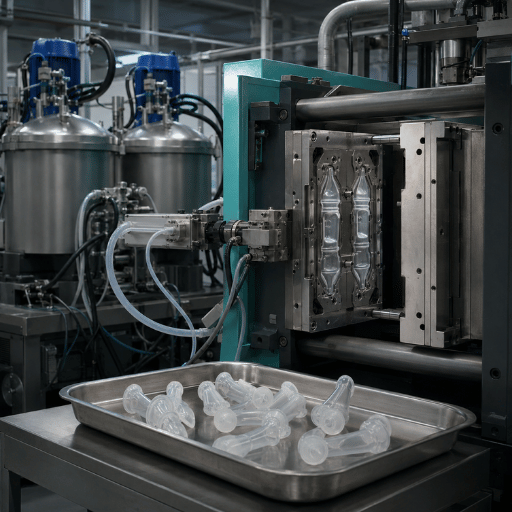
Das 1TP15 T-Spritzgussverfahren basiert auf der Aushärtung über eine Additionsreaktion: Mischsilikon wird im Kaltkanal um 15-25 C gehalten, dann wird durch erhitzten Hohlraum (typischerweise um 200 C) der Platinkatalysator aktiviert, das Vernetzungsteil in Sekundenschnelle mit Null-Blitz und Null-Läufer-Schrott zur Aushärtung Der intuitivste Weg, sich eine einzelne kontinuierliche Schleife vorzustellen Unterhalb des 7-stufigen 1TP15 T-Spritzzyklus zusammengefasst für bequeme Referenz andere Führungen, streuen Sie die Phasen oft über Absätze.
Eine 1TP15 T-Maschine ist auf Dosieren, nicht auf Plastifizieren ausgelegt Statt des typischen thermoplastischen Press-Hubkolbens und der Schraube zum Schmelzen von Kunststoffpellets, ist die 1TP15 T-Presse auf eine Dosiereinheit und Pumpen angewiesen, um die 1:1 A/B-Komponenten in einen statischen Mischer zu dosieren, während die Klemmkraft das Werkzeug gegen Injektionsdruck schließt Da die Vulkanisation nur in einem beheizten Hohlraum mit Kaltkanalabgabe erfolgt, sind 1TP15 T-Pressen funktionell “lauflos”, da es nichts gibt, was sich in der gekühlten Beschickung verfestigen könnte.
| Bühne | Was passiert | Temperatur | Typische Zeit |
|---|---|---|---|
| 1. Messung / Pumpen | Kolben drücken die Basis (A) und den Katalysator (B) aus Trommeln | Ambient | Kontinuierlich |
| 2. Statisches Mischen (1:1) | A und B vermischen sich zu einem homogenen Schuss in einem statischen Mischer | ~15 °C | Kontinuierlich |
| 3. Kaltlaufeinspritzung | Der gekühlte Läufer liefert die Mischung an das Tor, ohne es auszuhärten | ~15 °C | <1 – 3 s |
| 4. Beheizte Hohlraumfüllung | Der Schuss füllt den heißen Hohlraum; Die Scherverdünnung unterstützt dünne Wände | Bis zu ~200 °C | 1 – 5 s |
| 5. Platinheilung | Die Additionsreaktion vernetzt das Teil zu einem Duroplast | Hohlraumwärme | Sekunden (wandabhängig) |
| 6. Demold / Automatisierung | Roboter- oder manuelles Entfernen; Es sind keine Auswerferstifte erforderlich | Heiß | 1 – 3 s |
| 7. Optionale Nachkur | Durch den Ofenbacken werden flüchtige Stoffe für medizinische/Lebensmittelteile entfernt | ~200 °C | Bis zu 4 h (Charge) |
Die angezeigten Stufentemperaturen spiegeln typische 1TP15 T-Maschinen und Materialdatenblattbereiche wider; Die genauen Werte variieren je nach 1TP15 T-Güteklasse, Teildicke und Hohlraumanordnung.
Der Schlüssel zu allem ist der Kaltläufer Zum einen handeln Redakteure bei Kunststofftechnik Die Kunststofftechnologie des Magazins sagt uns (wie bereits erwähnt), dass LSRs längere Aushärtungszeiten haben als typische thermoplastische Abkühlzeiten und vor allem nicht nachgeschliffen werden können. Der Kaltläufer geht genau darauf ein: Es wird nur ein Teilvolumen eingeführt und ausgehärtet, und es gibt keinen Läufer (und daher keine Fichte, keine Posamenten), der aushärtet Auch das macht den Motorkern des LSR-Werkzeugs zum Patent geeignet, die offiziellen Patentunterlagen für Methoden für das LSR-Spritzgießgerät (EP1293323B1).
Wie wird 1TP15 T geheilt?
1TP15 T wird durch hitzeaktivierte Platin (Additions) Aushärtung ausgehärtet, nicht durch den Druck oder die Verdunstung, auf die viele Kunststoffe angewiesen sind Wenn die 1:1 A/B Mischung einen heißen Hohlraum erreicht, treibt der Platinkatalysator eine Hydrosilylierungsreaktion an, die die Flüssigkeit in Sekundenschnelle zu einem Feststoff vernetzt Dünne Abschnitte gelieren unter einer Sekunde; dickere Wände brauchen länger, wenn Wärme zum Kern diffundiert Es werden keine Nebenprodukte freigesetzt, weshalb platingehärtetes 1TP15 T sauber genug für medizinische und lebensmittelkontaktierte Teile ist.
Technische Anmerkung zur Aushärtezeit
Die Aushärtungszeit ist an die dickste Dimension gebunden, nicht an die Oberfläche. Eine allgemein anerkannte Faustregel für eine 2 mm Nennwand bei vollständig heißer Formtemperatur ist mehrere Sekunden Aushärtungszeit nach dem Befüllen, plus Entformen und etwa mehrere Sekunden pro ~2 mm zusätzlichem Material. Aber für einen 4 mm-Vorsprung im gleichen Teil, der sonst nur 1,5-2 mm dick ist, ist es der Vorbau, der die Zykluszeit regelt, nicht die dünneren Bereiche. Achten Sie auf dicke Abschnitte und verkürzen Sie den Zyklus.
LSR vs. HCR-, TPE- und RTV-Silikon
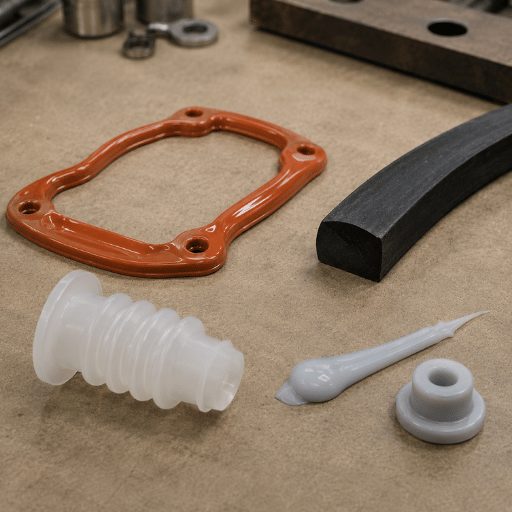
LSR ist eine zweiteilige pumpbare Flüssigkeit, die durch Zugabe von Platin aushärtet; HCR (Gummi mit hoher Konsistenz) ist ein steifer Gummi, der gefräst und pressgehärtet werden muss; RTV heilt bei Raumtemperatur und eignet sich am besten für Teile mit geringem Volumen; und TPE ist ein umschmelzbarer Kunststoff. Wenn Sie nach hochautomatisierten Teilen mit hohem Volumen und hoher Präzision suchen, gewinnt praktisch LSR; Bei Auf Jobs mit geringerem Volumen und geringerem Werkzeugbudget sind die Werkzeugkosten für Kaltläufer schwer zu rechtfertigen. Hier ist die Mathematik und nicht ein vages Vergleichstabell mit hohem bis mittlerem Tiefstand.
| Eigentum | LSR | HCR | TPE | RTV |
|---|---|---|---|---|
| Formular | 2-teilige Flüssigkeit | Fester Gummi | Thermoplastische Pellets | 2-teilige Flüssigkeit |
| Kur | Platinzugabe, Hitze | Peroxid/platin, Wärme+Druck | Keine (schmelzen/kühlen) | Raumtemperatur |
| Automatisierung | Hoch | Niederes Mittel | Hoch | Niedrig |
| Volumen-Süßfleck | Hoch | Niederes Mittel | Mittelhoch | Niedrig / Prototyp |
| Service-temp | -50 bis +250 °C | -50 bis +250 °C | ~-30 bis +120 °C | -50 bis +200 °C |
| Werkzeugkosten | High (kalter Läufer) | Niederes Mittel | Mittel | Niedrig |
Was ist der Unterschied zwischen HCR und 1TP15 T?
HCR kommt als vorkompoundierter fester Gummi, der gefräst und unter Druck gehärtet werden muss.1TP15 T kommt als ein Paar pumpbarer Flüssigkeiten, die dosiert und eingespritzt werden müssen HCR-Transferformverfahren zeigen weniger Kontrolle und mehr Teil-zu-Teil-Variation Das 1TP15 T Kaltläufereinspritzverfahren erzeugt eine hohe Wiederholbarkeit mit nahezu Null Schrott Die Werkzeuge erfordern jedoch Präzisionskühlläufe, so dass HCR für geringe Volumina ausgewählt werden kann Siehe die vollständige 1TP15 T versus HCR-Vergleich Artikel.
Was ist der Unterschied zwischen RTV und LSR?
RTV (Raum-Temperatur-Vulkanisierung) Silikon härtet langsam ohne Hitze, passend zu Prototypen und sehr geringen Volumina; 1TP15 T heilt in Sekunden in einem beheizten Werkzeug für die automatisierte Produktion Wählen Sie RTV für ein paar Teile, 1TP15 T für Zehntausende Wenn Kunststoffteile stattdessen funktionieren könnten, sehen Sie sich unsere LSR vs. TPE Artikel.
LSR-Materialien und Durometerauswahl
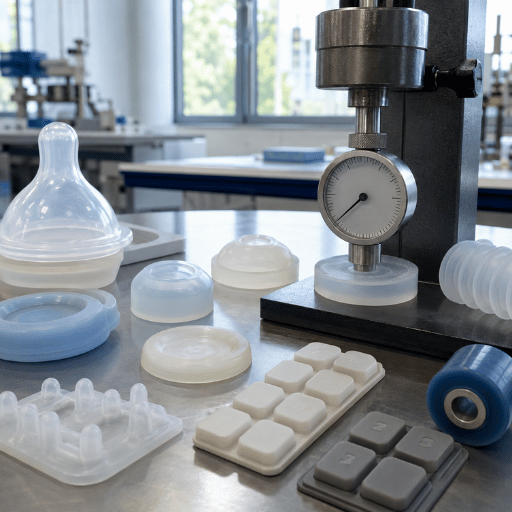
Zwei Faktoren werden Sie bei der Wahl von 1TP15 T leiten: Durometer Band und Grade Familie. 1TP15 T Durometer reichen von einem weichen 5 A bis zu einem harten 80 A, aber die meisten Stock Grades fallen zwischen 30 A und 70 A. Das Durometerband sollte mit dem Fehlermodus zusammenhängen, so dass eine optische Linse ein anderes Band als ein weiches Siegel oder ein taktiles Tastenfeld benötigt Die Auswahl des richtigen Bandes für die Teilklasse, das viele Konkurrenten nicht ansprechen, ist die effizienteste Vorgehensweise Schauen Sie sich die Durometer-to-Application Map unten an.
| Shore A-Band | Fühlen | Teilklasse | Typische Beispiele |
|---|---|---|---|
| 5–20 | Sehr weich, gelartig | Softdichtungen, Ventile, Membranen | Säuglingsnahrungsventile, Entenschnabelventile, Diaphragmen |
| 30–50 | Soft-Touch, taktil | Tastenbeläge, Dichtungen, Griffe | Elektronische Tastenfelder, O-Ringe, tragbare Bänder |
| 60–80 | Fest, formstabil | Strukturell / optisch | Steckverbindergehäuse, optische Linsen, starre Dichtungen |
Grade Familie Auswahl ist nächste Verschiedene Grade werden variierte mechanische Daten haben – erhöhter Füllstoffgehalt führt zu höherer Zugfestigkeit und Reißfestigkeit – so definiert das spezifische Grade Datenblatt, nicht nur das Durometer, ob das Teil seiner Anwendung standhält Niedrig-Durometer-Qualitäten bis hinunter zu Shore A 5 dienen weichen Dichtungen, während selbstschmierende Grade Schnittoberflächenreibung Es gibt typische Qualitäten für allgemeine Industrieanwendungen; und spezifische Qualitäten für weiche Dichtungen (bis zu 5 A Durometer); selbstschmierende (phenylmodifizierte) Qualitäten bis zu geringerer Oberflächenreibung; selbstbindende Qualitäten, um direkt an anderen Kunststoffen zu haften; optische Qualitäten für Klarheit und Transparenz; und medizinische Qualitäten müssen eine sehr wichtige Überlegung sein, da sie mit der ISO 10993 und/oder USP Klasse VI gelistete Verbindung und kann nicht einfach als “medizinisches Silikon” gekennzeichnet werden Die großen Hersteller von 1TP15 T haben diese Qualitäten leicht verfügbar mit Daten 1TP2 T sortiert die Qualitäten weiter nach dem spezifischen Fehlermodus und validiert die angegebenen Biokompatibilitätsverbindungen im Gegensatz zur allgemeinen Etikettierung Sie können das richtige Durometerband mit unserem auswählen 1TP15 T-Durometerwähler.
“Der häufigste Käuferfehler, den wir korrigieren, ist die Überspezifikation des Durometers oder die Forderung nach ‘medizinischem Silikon’ ohne Benennung der aufgeführten USP-Masse der Klasse VI. Die Sorte muss mit dem Fehlermodus übereinstimmen, ein Zuführventil, das an Shore A 10 abgedichtet werden muss, sollte nicht in einer 50-Durometer-Mehrzweck-Sorte angegeben werden”
1TP15 T Umspritzung und Zwei-Schuss-Formung
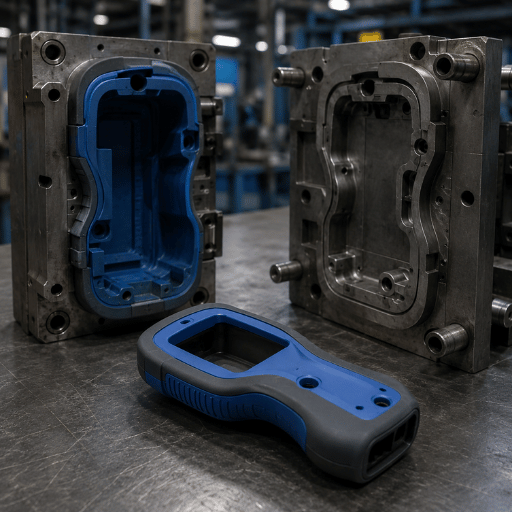
Beim 1TP15 T-Overmoding wird flüssiges Silikon direkt auf starren Substraten verwendet. PA-, PBT-, PC-, PPSU- oder Metalleinsätze 2. Um weichharte Teile in einem oder zwei Aufnahmen herzustellen. Das Bonden erfolgt durch eine Grundierung oder zunehmend auch durch selbstbindende 1TP15 T-Qualitäten, die beim Aushärten eine chemische Vernetzung mit dem Substrat erzeugen, um die Grundierung zu beseitigen. Das ist einer der Gründe, warum die Einführung des Overmouldings zunimmt: Eine selbstklebende Qualität macht den Prozess zu einer Ein-Operations-Angelegenheit statt zu zwei.
Beim Zwei-Schuss-Formen (2 K) werden beide Materialien (Substrat, dann 1TP15 T) im selben Werkzeug verarbeitet, während beim Einlegeformen das Substrat vor dem Umspritzen hinzugefügt wird Das Hauptentwurfsrisiko liegt in der Oberflächenenergie und Sauberkeit der Bondvorbereitung. Bestimmen Sie den Bindungserfolg durch Wärmezyklen. Eine Studie von 1TP15 T über thermoplastisches Formen ergab, dass dynamisches Formenheizen und Substratvorbehandlungssubstrat die Bindungen wesentlich verbessern können. Die Richtlinien sind in unserem Silikon-Umformführung.
Engineering Note, Vorbereitung auf Anleihen
Bei den vielen selbstklebenden LSRs kann entweder die Plasmabehandlung oder die Grundierung die Oberflächenenergie des starren Materials erhöhen und so eine bessere Benetzbarkeit des Silikons schaffen. Akzeptieren Sie nach dem thermischen Zyklus der Verbindung die RT-Ergebnisse nicht: Der ehrlichste Test ist ein Schältest, der bei der erwarteten schlechtesten Betriebstemperatur des Teils durchgeführt wird.
Design und Werkzeug für LSR-Spritzguss
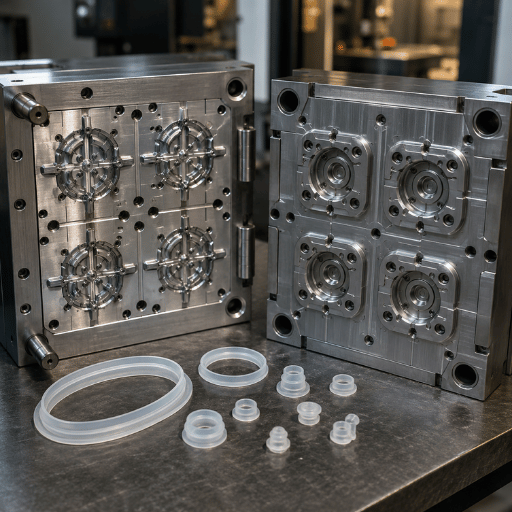
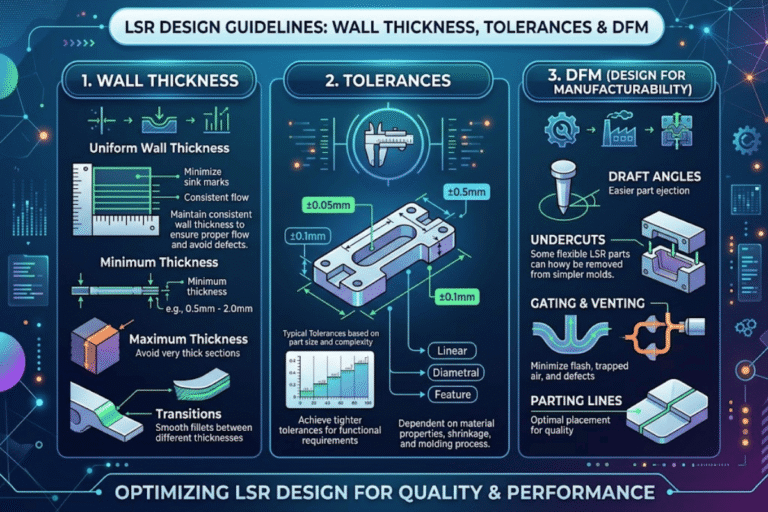
LSR befasst sich am meisten mit der Kontrolle von Blitz, Schrumpfung und Formfreisetzung Da es sich um eine Flüssigkeit mit geringer Viskosität handelt, fließt sie in jede Öffnung und so spielen Tore, Entlüftungs- und Trennlinien eine größere Rolle als bei thermoplastischen Werkzeugen. Planen Sie eine Schrumpfung von 2-3%, halten Sie Wandabschnitte gleichmäßig und lokalisieren Sie Tore, um sie zu verbergen. Die Formflusssimulation sagt Füllmuster, Vakuumentlüftung und Schrumpfung voraus, bevor Sie Stahl verwenden; Werkzeuge, die höhere Volumina verwenden, verwenden gehärteten Werkzeugstahl (Aluminium ist bei geringen Volumina fein), und ein leichter Trennmittel oder ein polierter Hohlraum unterstützt die Formfreisetzung.3.
- Behandeln von 1TP15 T-Blitz wie das thermoplastische Zeug Sie wollen blitzlose Formwerkzeuge und präzise Entlüftungsstelle; Ihre “gut genug” Teillinie erscheint als Trimmarbeit auf jedem produzierten Stück.
- Vergessen, Schrumpfung früh im Designprozess einzubeziehen. Es ist viel höher als bei einem Thermoplast, zwischen 2 und 31 TP20 T, und unterscheidet sich je nach Qualität - der Prozess sollte es in das Werkzeug aufnehmen, nicht als Teil des Inspektionsberichts.
- Einbringen der Masse in die Abschnitte der Form. Dickere Merkmale führen dazu, dass die gesamten Schüsse bei einem bestimmten Aushärtungsprozess stecken bleiben, was sich auf die Gesamteffizienz des Prozesses auswirkt; Kern dieser Teile zum Schutz des Durchsatzes.
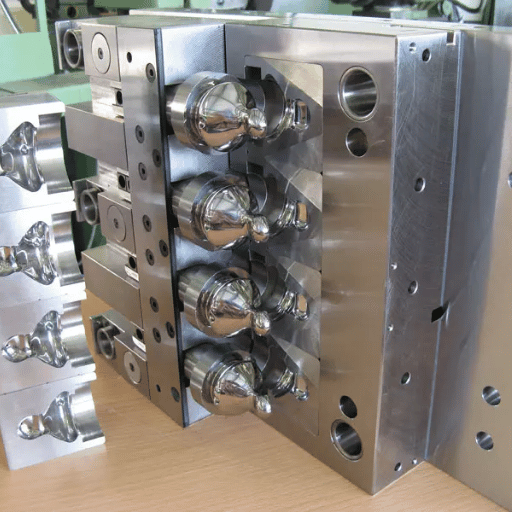
Im Mittelpunkt der Form steht die Kaltkanal-Ventil-Gate-Technologie, die zum Zeitpunkt des ursprünglichen Schreibens patentgeschützt war (eine gute Beschreibung finden Sie in EP1293323B1). Schauen Sie sich unser komplettes an LSR-Designrichtlinien für die komplette Checkliste.
Was 1TP15 T Spritzguss Kosten: Der 4-Lever-Cost-Stack
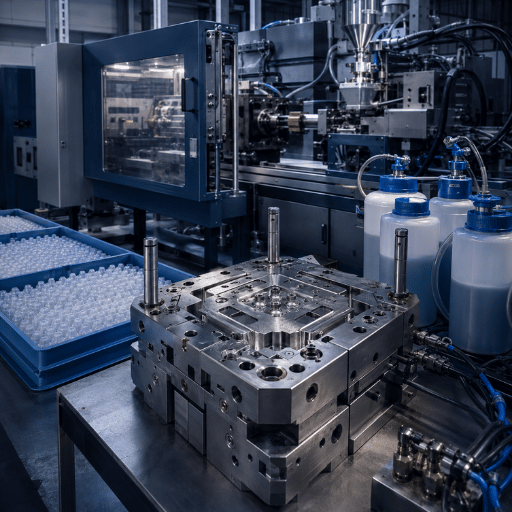
LSR-Teilkosten von vier Stacks für High-Teile, Werkzeug-Cold-Runner-Werkzeuge, und Automatisierungsniveau für Materialien, so dass die Teilkosten nur dann niedrig pro Teil sind, wenn Volumen und Kavitation hoch sind. Die offene Bahn ist bei realen LSR-Preisen dünn, und wir werden hier keine Dollarzahlen erfinden.
Was zuverlässig ist, ist die Kosten und wie die Hebel gegeneinander handeln Käufer im Engineering fragen immer wieder “Wie viel wird die Form kosten, und die Stückkosten?” die Struktur die hier ist also das ehrliche Framework Das ist der 4-Lever 1TP15 T Cost Stack.
Der 4-Lever 1TP15 T Cost Stack
- Kaltläuferwerkzeug mit den teuersten Vorlaufkosten; präzise ausbalancierter gekühlter Läufer mit Ventilschieber. es ist fest; Das bedeutet, dass es über eine größere Anzahl von Teilen ausgedünnt wird
- Die Form mit -A16 Hohlräumen bietet 16 Teile pro Zyklus. Die Kosten pro Teil können bei teureren Formkosten im Falle einer Verdoppelung der Hohlraumzahl halbiert werden.
- Grad der Automatisierung Roboter, “Leuchten” Zellen und Werkzeuge reduzieren den Arbeitsaufwand pro Einheit und kontrollieren die Konsistenz der Produktqualität; Die Amortisation steigt direkt mit dem Volumen.
- Materialqualität/Durometer Medizinische/optische/selbstklebende Qualitäten sind teurer/kg als Allzweckqualitäten; LSR kann nicht erneut gemahlen werden, sodass es nur auf das Gewicht ankommt.
- Engineering Note 'Pro-Teil-Kosten lesen
Arbeiten Sie es so aus: pro Teil Kosten (Werkzeuggesamtvolumen) + (Zykluszeit Maschinenrate Hohlräume) + (Schrotgewicht Materialpreis) Was die Formel sagt: bei hoher Lautstärke fällt der Werkzeugbegriff aus und die Zykluszeit bestimmt, ob 1TP15 T billig oder teuer ist Was es nicht sagt: Die optimale Wahl bei einem hohen Volumen Teil läuft könnte bei einem geringen Volumenlauf unmöglich sein Unser LSR-Werkzeugkostenschätzer Eigenen Situation modellieren zu lassen soll.
Wobei LSR bei den Kosten gewinnt
- Hohe Volumina, die Werkzeuge amortisieren
- Schrottfreier Kaltläufer (kein Nachschleifverlust)
- Automatisierte, ausleuchtende Zellen mit geringem Arbeitsaufwand
- Dünne/komplexe Teile, die sekundäre Ops vermeiden
Wo LSR an Kosten verliert
- Geringe Volumina (Tooling amortisiert nie)
- Einzelstücke und Prototypen (RTV verwenden)
- Überspezifizierte medizinische/optische Noten
- Dickwandige Teile, die die Zykluszeit verlängern
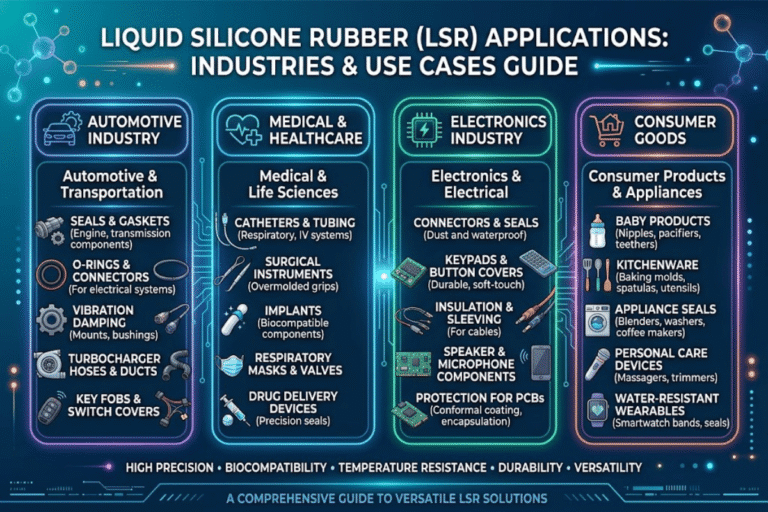
LSR-Anwendungen: Medizin, Automobil, Elektronik und Verbraucher

Sie finden 1TP15 T jederzeit, wenn ein Teil flexibel und biokompatibel sein und Eigenschaften bei extremen Temperaturen halten muss Es gibt ein paar Segmente, die eine hohe Nachfrage erzeugen; die großen drei Segmente nutzen einzigartige Eigenschaften von 1TP15 T aus: Wir haben unten eine Tabelle bereitgestellt, die gängige 1TP15 T-Anwendungen in den 3 großen Branchen sortiert Außerdem identifiziert es Schlüsseleigenschaften für jede Anwendung mit einem Bereich basierend auf dem Durometer Stellen Sie sich dies als eine Abkürzung von “What am I Moulding” zu “Welche Qualität und Härte zitiere ich” vor”
| Teiltyp | Industrie | Typisches Shore A | Eigenschaft, die die Wahl antreibt |
|---|---|---|---|
| Entenschnabel / Futterventil | Medizinische | 5–20 | Softdichtung + USP Klasse VI Grad |
| Membran | Medizinische / Fluidik | 10–30 | Flex-cycle-leben |
| O-Ring / statische Dichtung | Automobil | 40–60 | Druckfeststellwiderstand |
| Steckdose | Automobil / EV | 40–70 | -50 bis +250 °C Bereich |
| Tülle / Kabelabdichtung | Automobil | 30–50 | Vibration + Einbruchschutz |
| Tastatur | Elektronik | 30–50 | Taktiles Soft-Touch-Feeling |
| Wasserdichte Membran | Elektronik | 20–40 | Selbstbindende Umspritzdichtung |
| Optische Linse | Beleuchtung / Optik | 60–80 | Transparent + Dimensionsstabilität |
| Tragbares Band | Verbraucher | 30–50 | Hautsicher + Flexibilität |
| Umschließungsdichtung | Industriell | 40–70 | Chemisch + Hitzebeständigkeit |
| Babypflegeauslauf / Brustwarze | Verbraucher / Medizin | 10–30 | Biokompatibel, sehr weich |
Medizinisch. Bild eines Säuglingszuführventils, das aus einer Form von A 10 geformt ist... Es muss unter geringer Kraft sitzen, Hunderten von Sterilisationszyklen standhalten und aus der genauen Verbindung geformt werden, die in USP-Klasse VI und ISO 10993 aufgeführt ist. Eine weitere Verbindung mit derselben Härte (Shore A 10 hier) könnte sich verfestigen, aber die Qualifikation noch nicht bestanden haben. Die Stufe besteht das Audit, nicht das Durometer.
So funktionieren auch unsere Atemschutzmasken-, Autoinjektor- und Diagnoseventilteile.
Automotive AnEVconnectorseal arbeitet dort, wo Hitze, Vibration und Einbruchschutz aufeinandertreffen Ein Temperaturbereich von -50°C bis +250°C plus guter Kompressionssatz verleihen einer 1TP15 T-Dichtung Elastizität durch die thermischen Extreme eines gesamten Batteriepacks, dass ein TPE weich werden und nicht abdichten würde Steigende Fahrzeugelektrifizierung nimmt die Abdichtung und den Verbinderverbrauch zu, beide angetrieben durch 1TP15 T.
Elektronik und Verbraucher. Umspritzte Tastatur in kundenspezifischem dichtungsfreiem LSR, die jeden Knopf gegen ein Leiterplattengehäuse abdichtet. Betrachten Sie dieses Material auch für Armbänder und Bekleidung, Telefonzubehörbeläge, Babyprodukte und Küchengeräte, siehe unsere Flüssigsilikonkautschuk Anwendungen Übersicht Wir formen kundenspezifische Silikonteile für Anwendungen aller Art.
So wählen Sie einen 1TP15 T-Spritzgusshersteller aus
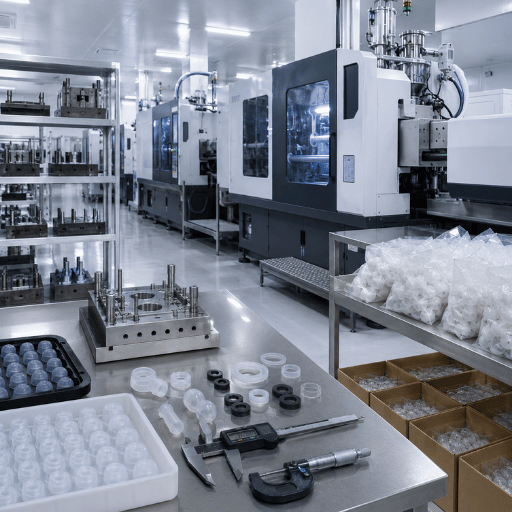
Aber unter all diesen Fragen läuft auf ein einziges Kriterium hinaus Kann der 1TP15 T-Former einen gültigen und wiederholbaren Kaltläuferprozess in Ihren Volumina aufrechterhalten und mit den notwendigen Zertifizierungen, die Ihr Markt benötigt? Thermoplast ist KEINE Erfahrung, die Sie übertragen können; 1TP15 T-Werkzeuge, Gating und Aushärten sind alles separate Disziplinen Verwenden Sie dies als Ihre 1TP15 T-Former-RFO-Checkliste.
- Zertifizierungen im eigenen Markt – 1 TP4 T für Qualität, 1TP3 T für Automobil, 1TP10 T / 1TP6 T / 1TP11 T und USP Klasse VI / ISO 10993 für medizinische und Lebensmittelkontakt.
- Selbstgebaute Kaltauslöser-Werkzeuge – werden sie das kritische, ventilgesteuerte Werkzeug schneiden/abstimmen, oder wird das härteste Teil ausgesendet?
- Automatisierungs- und Reinraumfähigkeit – Roboterentformung für Präzision; Form für medizinische Zwecke in einem Reinraum.
- Qualitätskontrolle und Materialrückverfolgbarkeit vor Ort: Qualitätskontrolle vor Ort sowie alle erforderlichen physikalischen und chemischen Tests, einschließlich der auf dem Zertifikat aufgeführten Qualität.
Aus der Perspektive verfügt 1TP2 T über ca. 700 Maschinen (davon eine mit einer 2.000 Tonnagepresse), über 80-m²-Vulkanisierungsmaschinen und 2-55 Liter Sil./Rub. Mischlinien, die ca. 3.000 Tonnen/Jahr ergeben Die Formen werden in einer internen 3.500 m² großen Formenbauwerkstatt gebaut, wobei Makino, Roeder und Standy-Maschinen, über 500 Formsätze pro Jahr, rund um die Uhr laufend, 365 Tage pro Jahr - und Teile in der werkseigenen chemischen/physikalischen QA/QCLabor 1 aufgeführt sind, steht unser Werkraum 1 TP 4TP 1. LSR Spritzguss Nabe.
Der LSR-Ausblick: Wohin die Nachfrage geht
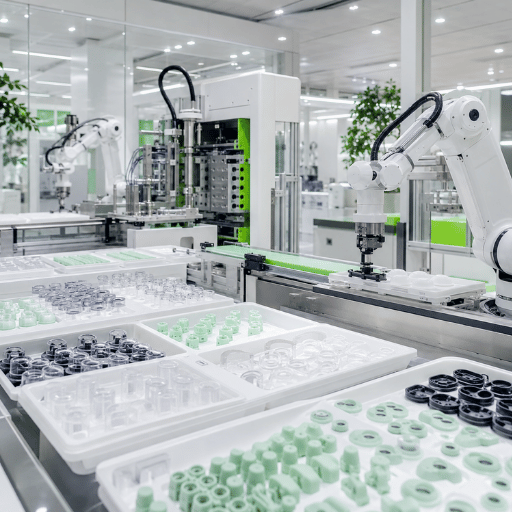
Der eigentliche Hebel auf 1TP15 T-Lautstärke in den nächsten Jahren ist nicht der breite Anstieg der Nachfrage – es sind drei spezifische Kräfte Und alle drei stören die Planung der Käufer Erstens ist regulatorisch (die Bio-Eval-Kriterien für medizinisches Silikon ändern sich.
Während 21 CFR 177.2600 Ist immer noch der Standard für Lebensmittelkontaktanwendungen, aktualisiert die Überarbeitung der ISO 10993-1 2025 (veröffentlicht Ende 2025), wie Ihr Lieferant medizinische Silikone dokumentieren muss. Anstatt einfach nur Kästchen anzukreuzen, stimmen die Beweise der Lieferanten basierend auf der Auswirkung auf den Lebenszyklus und dem strukturierten Risiko mit ISO 14971 überein. Was es für Sie bedeutet: Bereiten Sie sich für Ihren nächsten Spritzgusskauf für medizinische Geräte auf zusätzliche Zeit vor, um die Qualitätsdokumentation der medizinischen Silikone Ihres Lieferanten zu überprüfen, die den neuen Standards entsprechen.
Zweitens ist die Technik. Grundierungslose Selbstklebende LSR; mikroformbare High-Flow-Qualitäten; und servobetriebene Automatisierung mit Kaltkanal - alles trägt zu einem breiteren Spektrum an LSR-Anwendungen und -Kosten bei; kleinere Elektronik; und weichere Umspritzung. Drittens ist die Fahrzeugelektrifizierung: Jeder zusätzliche Sensor, jeder Stecker und jede Batteriedichtung benötigen ein Material mit dieser thermischen Stabilität.
Um den Kontext zu liefern, die von Marktforschern geschätzte 1TP15 T-Marktgröße im mittleren einstelligen bis hohen einstelligen Prozentsatz des jährlichen Wachstums (nur Richtung 2 6 Prognosen einzelner Unternehmen können stark variieren) – Diese Informationen dienen dazu, Sie zu informieren, aber der Kauf basiert auf den anderen drei oben genannten Kriterien. Wenn Sie bereits ein Programm für 2026 oder 2027 ausgelaugt haben, ist der Plan sehr direkt; Sperrwerkzeugvorlaufzeiten jetzt und sichere Notenverfügbarkeit für das spezifische Durometer und die erforderliche Zertifizierung.
Häufig gestellte Fragen
F: Was ist der Unterschied zwischen HCR und LSR?
Antwort anzeigen
HCR ist ein fester, vorgemischter Gummi, der gemahlen und unter Druck ausgehärtet wird, was zu langsameren Zyklen und mehr Variation zwischen den Teilen führt. LSR besteht aus zwei pumpbaren Flüssigkeiten, die einzeln gemischt und in ein beheiztes Kaltlaufwerkzeug eingespritzt werden, sodass es schneller und wiederholbarer läuft.
F: Was sind die Nachteile des 1TP15 T-Spritzgießens?
Antwort anzeigen
Der größte Nachteil sind die hohen Vorlauf-Cold-Runner-Werkzeugkosten, die sich nur bei Volumen amortisieren; für ein paar hundert oder ein paar tausend Teile ist RTV oder HCR normalerweise billiger. 1TP15 T ist auch eine Flüssigkeit mit geringer Viskosität, daher blinkt es leicht und erfordert eine präzise Entlüftung und eine enge Prozesskontrolle. Ausgehärtetes Silikon kann auch nicht nachgeschliffen werden, sodass jedes verschrottete Teil Material verliert und das Entformen empfindlicher Teile ohne Zerreißen erfordert sorgfältiges Werkzeug und Roboterhandling.
F: Wie wird 1TP15 T geheilt?
Antwort anzeigen
1TP15 T wird durch eine hitzeaktivierte Platinadditionsreaktion ausgehärtet, nicht durch Druck oder Verdampfung, Wenn die Eins-zu-eins-Mischung bei Hohlraumtemperatur in einen Hohlraum eintritt, treibt der Platinkatalysator die Hydrosilylierung zwischen Vinyl - und Hydridgruppen an, wobei die Flüssigkeit in Sekundenschnelle zu einem Feststoff vernetzt wird. Es bilden sich keine Nebenprodukte, so dass platingehärtetes 1TP15 T sauber genug für medizinische Zwecke bleibt.
F: Was ist der Unterschied zwischen RTV und LSR?
Antwort anzeigen
RTV härtet langsam bei Raumtemperatur aus, so dass es Prototypen, Guss und einer Handvoll Teile mit geringem Volumen passt. 1TP15 T heilt in Sekunden in einem beheizten Werkzeug für eine vollautomatische Produktion Wählen Sie RTV für ein paar Teile; wählen Sie 1TP15 T, wenn Sie Zehntausende benötigen.
F: Wie viel kostet 1TP15 T Spritzguss?
Antwort anzeigen
Ehrliche Antwort: Es hängt von vier Hebeln ab, von der Kaltlaufwerkzeug, der Anzahl der Hohlräume, dem Grad der Automatisierung und der Materialqualität. Werkzeug ist der große Vorlaufpreis und amortisiert sich nur über das gesamte Volumen, sodass der Preis pro Teil stark sinkt, wenn die Menge steigt. Ein Job, der mit fünftausend Teilen teuer aussieht, kann mit fünfhunderttausend die günstigste Option sein. Anstatt einer angegebenen Zahl zu vertrauen, modellieren Sie Ihr eigenes Volumen anhand von Werkzeug, Zykluszeit und Hohlraumanzahl.
F: Ist 1TP15 T Spritzguss für medizinische Geräte geeignet?
Antwort anzeigen
Ja 1TP15 T ist ein führendes Material für medizinische Geräte, weil es biokompatibel, sterilisierbar und stabil über einen weiten Temperaturbereich ist Der Zustand muss Dokumentation: die Note ist die spezifische Verbindung aufgeführt USP Klasse VI und ISO 10993, und unter der Revision von ISO 10993-1 2025, dass Beweise müssen folgen eine risikobasierte Bewertung.
F: Welches Härtemaß von 1TP15 T sollte ich wählen?
Antwort anzeigen
Passen Sie das Durometerband an den Fehlermodus des Teils an Verwenden Sie Shore A 5-20 für Softdichtungen und Ventile, 30-50 für Tastenbeläge und Dichtungen und 60-80 für strukturelle oder optische Teile. Wenn Sie sich nicht sicher sind, erstellen Sie Prototypen für zwei benachbarte Bänder und testen Sie, bevor Sie Werkzeuge einsetzen.
Haben Sie ein LSR-Teil, das Sie zur Angebotsabgabe einreichen können? Kontaktieren Sie unser Team für Prozess- und Notenempfehlungen, um Ihre Spezifikationen zu erfüllen.
Über diese Analyse
Dieser Leitfaden spiegelt wider, wie wir flüssigen Silikonkautschuk Tag für Tag formen, vom Kaltlaufwerkzeugschnitt in unserer eigenen Formwerkstatt bis zur Notenprüfung gegen gelistete Verbindungen der USP-Klasse VI und ISO 10993. Der Kostenabschnitt verzichtet bewusst auf gefertigte Dollarzahlen, da die 1TP15 T-Preisgestaltung geometrie - und volumenspezifisch ist; der 4-Lever Cost Stack ist so, wie wir ihn eigentlich zitieren. Vom 1TP2 T-Technikerteam überprüft.
Referenzen und Quellen
- Verwendung der internationalen Norm ISO 10993-1 (Biologische Bewertung medizinischer Geräte)US-amerikanische Lebensmittel- und Arzneimittelbehörde
- 21 CFR 177.2600, Gummiartikel zur wiederholten VerwendungUS eCFR
- Berechnung von Temperatur und Vernetzungsgrad für 1TP15 T-SpritzgussJournal of Advanced Manufacturing and Processing (AIChE/Wiley)
- Biokompatibilitätsprüfung für Implantate (ISO 10993-Framework)PMC, US National Library of Medicine
- EP 1293323 B1, Verfahren und Vorrichtung zum Spritzgießen von flüssigem SilikonkautschukEuropäisches Patent (über Google Patents)
- In LSR einsteigen, wie sich LSR-Tooling unterscheidetKunststofftechnik
![Silikon-Überspritzung: Multi-Material 1TP15 T Design Guide [2026]](https://meitu-engelhardt.com/wp-content/uploads/2026/04/0-8-768x512.png)