
Get in Touch with Engelhardt

Rubber Compression Molding
Rubber Compression Molding — Custom Molded Rubber Parts & Components
From prototype gaskets to high-volume automotive seals, Engelhardt provides precision-rubber parts supported by ISO 9001, IATF 16949, and over 13 years of compression molding expertise.
40+
Vulcanizing Machines
3,000 t
Annual Capacity
500+
Molds Per Year
300+
Team Members
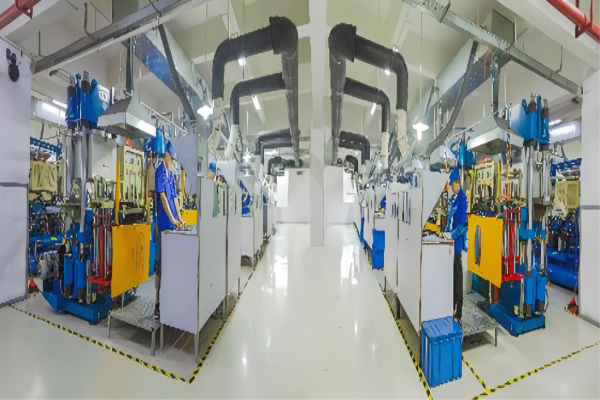
What Is Rubber Compression Molding?
rubber compression molding is a unique manufacturing technique that converts uncured, warm rubber compound into final parts with a heat pressure and a precision-machined mold. An exact charge of rubber is weighed and fed into an open mold cavity, and a turn of the pressur energizes the mold cavity to flow and fill even the most minute detail of the cavity.
The mold remains under controlled temperature and pressure until the desired cure cycle has been completed and the operator ejects the vulcanized part. This molding process has been around since the early 20 th century, yet it remains the go-to method for large parts, low-to-medium production runs, and high-durometer compounds. injection molding, which needs heated barrel systems and higher tooling, is far more complex and costly to set up — giving compression mold the edge when starting most custom rubber jobs.
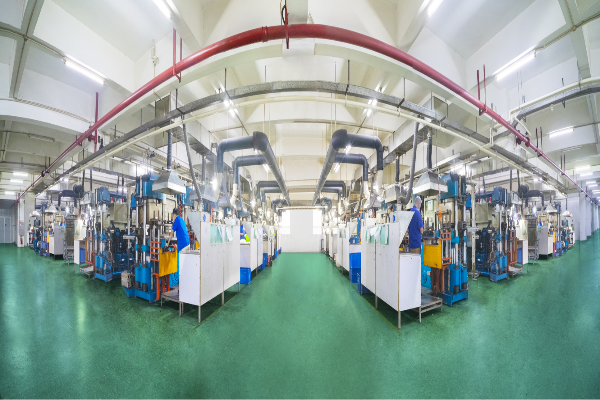
How the Process Works
The cycle takes four steps that every mold operator understands:
1
Preform preparation
Once the compound is mixed, it is weighed and formed into a slug or strip just slightly larger than the mold cavity chamber. Achieving the right charge weight matters: too little and you get a short shot; too much and you’ll have a lot of flash to trim.
2
Loading and closing
The charge is inserted into the bottom half of the heated mold. Temperatures in mold are kept at 150 C to 200 C for most elastomers. Hydraulic force then shoves the mold shut, wielding anywhere from 70 to 300 tons of clamping force.
3
Cure
Under pressure and heat, the rubber flows into every detail of the mold cavity, cross-links, and solidifies. Cure times can range from 3 minutes (for a thin silicone gasket) to 15 minutes or more (for a thick EPDM diaphragm). Most seasoned operators check the first part with a shore hardness gauge and confirm complete cure.
4
Demolding and trimming
The press opens, the finished part pops out, and excess flash material is trimmed away. Trimming can be done using hand trimming for low-volumes, frozen deflashing for complex geometries, or automatic die-cutting for mass production.
Key Advantages
Low tooling cost – A single-cavity compression mold can cost anywhere from 40-60% less than an equivalent injection mold, making your total investment time on target.
Compression can accommodate larger variety of part sizes and geometries than injection molding, from tiny o-rings up to gaskets down to 1 meter in diameter.
Almost all elastomers – natural rubber, EPDM, NBR, neoprene, silicone, FKM – can be processed in a compression mold.
For annual volumes of less than 10,000 parts, compression mold often offers the lowest per-piece cost, due to its limited setup time and tooling amortization.
By comparison, less moving parts and simpler pressures than injection molding mean most operators can easily repeat and depend on finished articles once the cure recipe is dialed in.
Rubber Materials & Compounds for Compression Molding
Your choice of rubber will decide whether a component lasts six months or six years. Below are the select elastomers we most frequently run through compression molding, each chosen for specific service conditions. We use our in-house mixing line to precisely control compound blend composition, offering us a full spectrum of materials from which to work.

Natural Rubber (NR)
Exceptional tear strength and resilience. NR continue to serve as our reference standard for dynamic seal mounts and bumpers where toughness is a priority over chemical resistance.
Shore A: 30–90 | Temp: -50°C to +80°C | Elongation: up to 700%

EPDM (Ethylene Propylene)
Superior ozone, UV, and steam resistance. Standard for moisture-resistant seals, roofing gaskets, and hot-water plumbing gaskets. EPDM compression molding comprises roughly 30% of our output.
Shore A: 40–90 | Temp: -50°C to +150°C | Ozone: excellent

Nitrile Rubber (NBR)
The natural selection for gasoline, oil, and grease contact. NBR gaskets and o-rings take predominance in automobile and hydraulic use where petroleum based liquids are encountered.
Shore A: 40–90 | Temp: -30°C to +120°C | Oil resistance: excellent

Neoprene (CR)
A well balanced general purpose grade with modest resistance to oil, ozone, and weathering. Frequently specified for building gaskets and industrial rubber product applications prone to mixed exposure.
Shore A: 40–80 | Temp: -35°C to +120°C | Flame: self-extinguishing
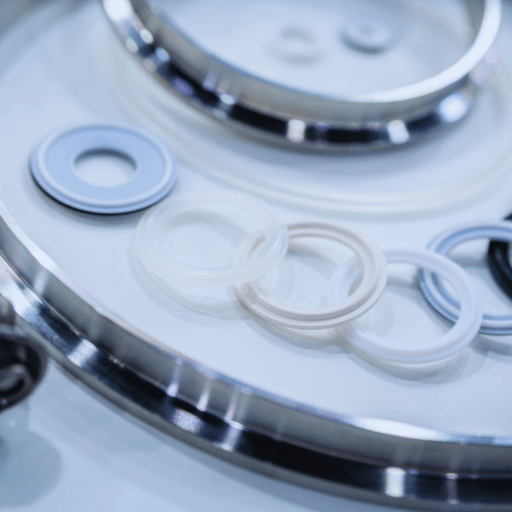
Silicone Rubber (VMQ / LSR)
Enables the greatest temperature range of any thermoset elastomer. silicone compression molding is most often seen in medicical seal applications, food grade gaskets (FDA, LFGB), and in kitchenappart components required to operate from freezer to oven.
Shore A: 20–80 | Temp: -60°C to +230°C | Biocompatibility: USP Class VI

FKM / Viton
Exceptional chemical resistance, especially toward concentrated acids, solvents and fuels. Used in high-performance fuel system seals and industrial valve seats subjected to the harshest chemicals.
Shore A: 60–90 | Temp: -20°C to +230°C | Chemical: exceptional
Rubber Material Selection Guide
Select your application requirements below. We score six common elastomers and recommend the best match for your compression molding project.
Ready to move forward? Get a quote for compression molded parts.
Get a Quote for Compression MoldingCompression vs. Transfer vs. Injection Molding
Understanding what each method does best and where it falls short is the first step in selecting the ideal engineering method for your rubber parts. Here is a quick comparison by the parameters most engineers care about:
| Parameter | Compression Molding | Transfer Molding | Injection Molding |
|---|---|---|---|
| Process | Rubber placed into open mold cavity, press closes | Rubber loaded into pot, forced through sprues into closed cavity | Rubber heated in barrel, injected under high pressure into closed mold |
| Tooling Cost | $1,500–$15,000 | $3,000–$20,000 | $8,000–$50,000+ |
| Cycle Time | 3–15 min | 2–10 min | 30 sec–5 min |
| Ideal Volume | 100–10,000 pcs/run | 500–25,000 pcs/run | 5,000–500,000+ pcs/run |
| Part Size Range | Widest — grams to 20+ kg | Small to medium | Small to medium |
| Tolerance (ISO 3302-1) | Class M2 (±0.25 mm) | Class M1–M2 | Class M1 (±0.15 mm) |
| Flash | Moderate — requires trimming | Less than compression | Minimal |
| Best For | Large parts, simple geometry, low runs, high-durometer compounds | Insert molding, moderate complexity, medium runs | Complex geometry, tight tolerances, high-volume production |
When to Choose Compression Molding
Go with compression molding if your part has an easy-to-moderate cross section, wall thickness above 3mm, or production run is less than 10K parts. It is a cost-effective choice for large-format parts (greater than 300mm footprint), as the tooling remains simple and press capacity is the only limit. When you require expensive compounds such as FKM or fluorosilicone, compression molding provides less material waste than injection, as there are no runners or sprues.
Cost and Lead Time Comparison
For a moderate complexity gasket in a batch of 1K pieces, a compression mold will run about $2,500 with a 2-week lead-time. An equivalent injection mold would cost $12,000-$18,000 and require 4-6 weeks for tooling. Most break-even points between injection molding and compression are in the range of 15K-30K annual units, depending on cycle times and waste.
Custom Rubber Compression Molding Capabilities
As a vertically integrated rubber manufacturer, Engelhardt owns and runs a 26K m², fully equipped blending, mold, compression molding, and quality control facility in Zhongshan, Guang-dong. The ability to produce and test in-house allows us to cut lead times significantly by not being dependent on third-party contractors.
Molding Equipment & Capacity
3,000 t / Year
Our rubber molding facility has over 40 vulcanizing machings, including 250-ton vacuum compression presses and 300-ton rubber injectionins. For large-format components, silicone facility maintains a 1200-ton vacuum vulcanizing press with up to 2200 L of 1200 mm mold area – one of the largest in the region.
Mold Design & In-House Tooling
10–20 Days
All compression mold products are designed and built in our 3500 m² mold workshop by the German Roeders high-speed CNC machining centers, Makino CNC machining centers, EDM, and laser welding. We produce over 500 mold sets/year, and maintain a 24/7 tooling maintenance rotation with no unplanned stops.
Rubber Mixing & Compound
±0.3% Accuracy
Our upstream mixing line is a fully-automated batching system with computer controlled weighing (+/0.3%) accuracy. We operate two 55-liter Banbury mixer production/cooling lines at 160-240 batches/day to produce consistent compound from batch to batch.
Rubber-to-Metal Bonding
ASTM D429 Tested
Parts that require a bonded-rubber-to-metal substrate for vibration isolators, suspension bushings, industrial mounts are handled with integrated surface preparing, primer coating, and bonded molding in a single flow. Bond strength tests per ASTM D429 standards verify each lot.
Trimming & Finishing
<0.05 mm Flash
Three designated trimming methods allow us to match the trim process for material shape and size – frozen-deflashing for intricately shaped parts or micro-flash, die-cutting for high volume, simple parts, and close hand-trimming for prototypes and construction. Selection depends on part geometry, flash location, and production volume.
Digital Manufacturing
Industry 4.0
OurMES (Manufacturing Execution System) is factory-wide and associates all presss with a single operating dashboard that monitors cure progressing in real-time, enable batch traceability, and typical statistical process control. Along with our ERP, SRM, and barcode track/tracing, we can trace forward and reverse any part, back to raw material lot or manufacturing batch.
Molded Rubber Products Applications & Industries Served
Every industry that requires reliable sealing, vibration isolation, or corrosion resistant plastic parts is served by compression mold. The table shows popular industries where our custom molded parts are most commonly used.

Automotive & Transportation
Engine mounting gaskets, transmission seals, suspension bushings, dust covers, exhaust hangers. IATF 16949 approved production.

Building Materials & Plumbing
Pipe fitting seals, floor drain gaskets, valve seats, foam rubber insulation, window seal profiles.

Medical & Food-Grade
FDA approved silicone diaphragms, medical device grips, operating room seals, LFGB-rated kitchenware components.

Industrial Machinery
Vibration mounts, wear pads, pneumatic diaphragms, hydraulic seals, large industrial gaskets for chemical processing.
Rubber Compression Molding Quality Certifications & Testing Standards
SodetayTGIT certifications are not just “window dressing,” they define how we manufacture each part. Our quality management systems cover the entire process from incoming raw material inspection through final delivery, and each phase of manufacture is documented through our MES-driven traceability system.

ISO 9001 & IATF 16949 Quality Systems
Our ISO 9001:2015 is ISO 9002 certified to manufacture all rubber, silicone, plastic and hardware operations. For our automotive customers the IATF 16949 accreditation means our PPAP documents, FMEA analysis, control plans and SPC monitoring is in accordance with Tier 1 specifications. Both accreditations are subject to annual surveillance audits by independent third party registrars.
- ISO 9001:2015
- IATF 16949
- IAPMO
- ASTM
- UL
- WRAS
- KTW
- NSF 61
- LFGB
- FDA 21 CFR 177
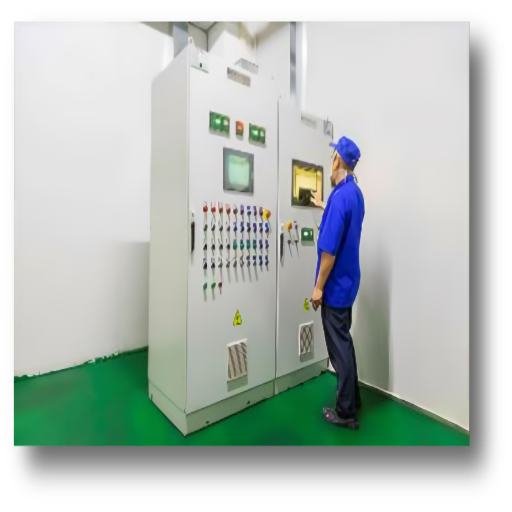
Material Testing & Traceability
Our chemical and physical lab operates Mooney viscometers, moving die rheometers, carbon black analyzers, salt spray tests for corrosion, aging ovens, tensile test machines and hardness gauges. Every batch of raw rubber compound is checked to a specification sheet before being permitted onto the factory floor. Our barcode based traceability system links each finished part back to the raw compound lot, mixing batch, press number, operator, and cure parameters – providing complete forward and reverse traceability within minutes.
Rubber Compression Molding Case Studies
These project examples show how we specialize in different custom rubber molding – from material choice to production ramp up.
01.
Automotive EPDM Seal Assembly
Industry: Automotive | Material: EPDM 70 Shore A | Vol: 80,000 pcs/yr
Challenge: An automotive Tier 1 required a door seal gasket with an intricate U-channel profile able to sustain repeated controlled damping at 100 C without exceeding preset compression set limits to 25% after 72 hours. Previous suppliers failed to consistently keep the inner lip dimensional variation below specification, resulting in a 12% incoming rejection rate.
Solution: We designed out a closed two-cavity compression mold with tighter parting line registration and implemented vacuum-assist venting to draw trapped air from the U-channel angle. The EPDM compound received a dose of faster curing peroxide which improved cycle time from 8 minutes to 5.5 minutes, as well as improved compression set durability. Our mold design team arranged 3D flow simulation to locate overflow grooves exactly where flash would not require difficult trimming.
Result: Rejection rate dropped from 12% to under 1.5%. Cycle time reduced 31%. The program has been running for three consecutive years with zero quality holds.
02.
Building Material Pipe Gaskets
Industry: Plumbing/Building | Material: NBR 60 Shore A | Vol: 200,000+ pcs/yr
A European-based building materials distributor needed a series of WDAS-approved pipe connection gaskets in sizes DN50 to DN200. These geometrically simple pipe gaskets were not technically difficult, but required high volume, certification and very competitive pricing to beat off two well established European moldajers.
We produced five multi-cavity compression molds (4 to 8 cavities depending on part diameter) in under 15 working days. Our NBR series compounds passed demanding WDAS tests on the first go. Automated batch weigh ensured charge weights within 1 gram across all five molds, and frozen deflashing provided volume handling which manual trimming could not keep up with.
Result: Per-piece cost came in 35% below the European quotes. WRAS approval issued in 6 weeks. All five sizes in steady production within 2 months of initial inquiry.
03.
Silicone Diaphragm for Valve
Industry: Process Control | Material: Silicone 50 Shore A | Bonded to SS
Technical challenge: The diaphragm had to withstand 500,000 cycles of flexing at the bond line of silicone to a 304SS support ring without cracking, in an environment intermittently contacting dilute acids (pH 3-5) at 150 C.
silicone adhesion to metal surfaces is mediocre without specialist treatments. We ran a number of ASTM D429 proof load bond pull tests with three different primer systems, finally settling on a two-coat primer, which provided bond strength in excess of 8 N/mm — far exceeding the customer specification minimum of 4 N/mm. Our 1,200 ton vacuum press drew microvoids from the thin diaphragm web, which would otherwise have been the start of fatigue cracks.
Result: Passed 500,000 flex cycles with zero bond failures in accelerated testing. The part entered series production and has been reordered quarterly for the past 18 months.
Rubber Compression Molding Cost Guide & Pricing Factors
The pricing of the rubber compression molding is driven by three major cost buckets of the product. These buckets are- tooling (ONE time), Material (per piece) & Labor/press time (per piece). The following section discusses three cost buckets and their major drivers.
Tooling (One-Time)
$1,500 – $15,000
Varies on: amount of cavities, mold steel grade (P20 vs S136), part complexity, surface finish. Engelhardt manufactures all molds in-house — no third-party markup on tooling.
Material (Per Piece)
$0.05 – $8.00+
Function of: Compound type (EPDM, ~3/kg, silicone, ~8/kg, FKM, ~40/kg), Part weight and Flash %. compression molding uses 5-15% more material than injection due to flash, but does get rid of runner scrap.
Per-Part Processing
$0.10 – $5.00+
Determined by factory cycle time, number of cavities (more cavities= less cost per piece), trimming machine, and inspection needs. IATF 16949 parts also include extra costs for SPC paperwork.
Volume Discounts & Lead Times
Order quantity, through the multiple-cavity tooling(Koudenkosing) and less hanghang-jeunyeok to be a price per piece; Order quantity depends. Typically:
- For prototypes (1-50 pcs), the single-cavity mold will be per-piece, not, at. Lead time: 2-3 weeks including tooling.
- At low volume (50-5,000 pcs), a 2-4 cavity mold per piece cost reduction of 20-40% versus prototype cost is attainable. Lead time: 3-4 weeks.
- At production volumes (5,000-50,000+ pcs) 4-8+ cavity molds is what allows cost per unit to be minimized. Leadtime for reorders: 2-3 weeks (after have tooling).
We have a inventory of classic compound grades in our storage (EPDM, NBR, silicone), thus is the time elapsed in other smaller shops in passing you the raw material procurement lead time (can be 2-3 weeks). We need 1-2 more weeks for custom compounds to do formulation and validation.
Rubber Compression Molding Interactive Tools
Compression Molding Cost Estimator
Estimate tooling investment and per-piece costs for your rubber parts
Access Tool
Elastomer Property Comparison
Select 2 or 3 rubber materials below to compare mechanical properties, chemical resistance, and application fit side by side.
Compare Materials
Rubber Molding Method Selector
Answer 5 quick questions about your part and production needs. This tool compares Compression, Transfer, and Injection molding to recommend the best fit for your project.
Select Method
Rubber Compression Molding FAQs
Compression molding loads rubber directly into the mold cavity — best for large parts and low-to-medium runs. Transfer molding forces rubber through sprues into closed cavities for tighter tolerances. Injection molding heats and injects rubber under high pressure for the fastest cycles and highest precision at high volumes.
Common elastomers include Natural Rubber (NR) for high resilience, EPDM for weather and ozone resistance, Nitrile (NBR) for oil and fuel resistance, Neoprene (CR) for balanced chemical and temperature performance, Silicone for extreme temperature ranges from -60 °C to +230 °C, and FKM/Viton for aggressive chemical environments. Material selection depends on operating temperature, chemical exposure, hardness requirements (typically Shore A 30–90), and regulatory standards such as FDA or WRAS.
Tooling costs for rubber compression molds typically range from $1,500 to $15,000 depending on part complexity, number of cavities, mold material (P20 steel vs. S136 hardened steel), and surface finish requirements. A single-cavity prototype mold for a simple gasket may cost $1,500–$3,000, while a multi-cavity production mold for an automotive seal with tight tolerances can run $8,000–$15,000. Engelhardt designs and manufactures all molds in-house, which reduces lead times and eliminates third-party markup.
Key markets include automotive (seals, bushings), plumbing (pipe gaskets, valve seats), medical devices (FDA-grade diaphragms), industrial machinery (vibration mounts), electrical (cable grommets), and consumer products.
Standard tolerances follow ISO 3302-1 Class M2 at roughly ±0.25 mm. Precision tooling can reach Class M1 (±0.15 mm). Flash is usually held below 0.05 mm with proper mold maintenance.
Typical defects include short shots (unfilled cavities from insufficient rubber charge), trapped air (causing voids or surface blisters), excessive flash (from worn tooling or excess material), backrinding (torn edges from premature mold opening), and undercure (from insufficient temperature or time). Most defects trace back to three root causes: incorrect preform weight, improper cure parameters, or worn mold surfaces. At Engelhardt, our process engineers use cavity pressure sensors and infrared temperature monitoring to catch deviations before they become scrap. We also run first-article inspection on every production lot and keep cure parameter logs going back five years for traceability.
Yes — compression molding handles the widest range of part sizes among rubber molding methods. Parts can range from small o-rings weighing a few grams to large industrial diaphragms and gaskets exceeding 1 meter in diameter. Engelhardt operates presses up to 1,200 tons with a maximum mold size of 2,200 mm × 1,200 mm, making it possible to mold large-format parts that would be impractical or prohibitively expensive with injection molding.
Choose compression molding when your parts are large, relatively simple in geometry, required in low-to-medium volumes (under 10,000 pieces per run), or when tooling budget is limited. Choose injection molding when you need tight tolerances on complex geometries, fast cycle times for high-volume production (over 50,000 pieces), or when material waste must be minimized. If you are unsure, send us your part drawing and annual volume estimate — our engineering team at Engelhardt will run a cost-per-piece comparison for both processes and recommend the method that delivers the best value for your project.